
Reactions of Alcohols — Acidity and Esterification
Alcohols react both as nucleophiles (through the lone pairs on oxygen) and as compounds where the O-H or C-O bond can break.
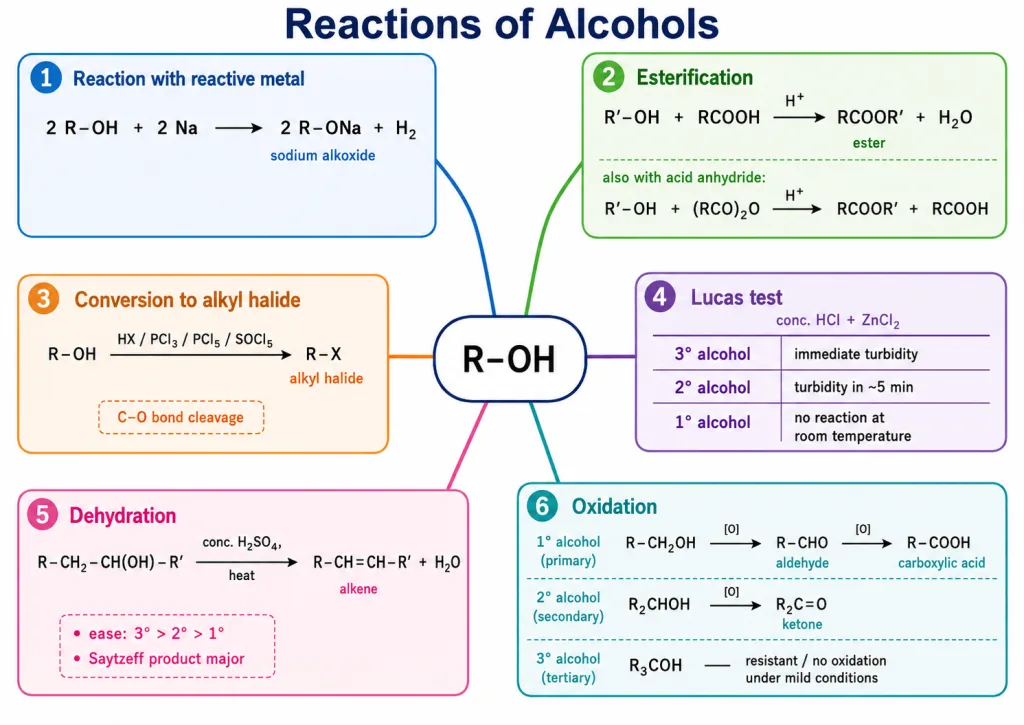
Reaction with reactive metals (acidic O-H): alcohols react with sodium (and K, Al) to liberate hydrogen and form alkoxides: This shows the weakly acidic nature of the O-H bond.
Esterification: alcohols react with carboxylic acids (in the presence of a little conc. HSO) to form esters and water: This is a reversible reaction; the acid catalyst and removal of water drive it forward. With acid anhydrides or acid chlorides, esterification is faster and irreversible.
Reactions Involving C-O Cleavage and Dehydration
Reaction with hydrogen halides (the Lucas test): the -OH is replaced by -X: The Lucas test (conc. HCl + anhydrous ZnCl) distinguishes 1°, 2° and 3° alcohols by how fast the cloudy alkyl chloride appears: 3° alcohols react immediately, 2° in about 5 minutes, and 1° only on heating (because the reaction is much faster for alcohols that can form more stable carbocations; 3° > 2° > 1°). (PCl, PCl and SOCl also convert alcohols to alkyl chlorides.)
Dehydration to alkenes: heating an alcohol with conc. HSO (or AlO) removes water to give an alkene: The ease of dehydration is 3° > 2° > 1°, and where more than one alkene is possible, the more substituted (Saytzeff) alkene is the major product.
Oxidation of Alcohols
The product of oxidation depends on the class of alcohol — this is one of the most useful diagnostic reactions in organic chemistry.
- Primary alcohols → aldehydes → carboxylic acids: (With a mild oxidant like PCC the reaction stops at the aldehyde; with strong oxidants - KMnO, KCrO - it goes on to the carboxylic acid.)
- Secondary alcohols → ketones (oxidation stops there, since there is no H to remove from the carbonyl carbon):
- Tertiary alcohols resist oxidation (the C-OH carbon has no hydrogen). Under drastic conditions the carbon skeleton breaks to give smaller molecules.
Key Point: Oxidation distinguishes the classes — 1° → aldehyde/acid, 2° → ketone, 3° → resists oxidation. The Victor Meyer test (involving nitrous acid) gives different colours for 1°, 2° and 3° alcohols and is used to identify the class.
[NEET Important] Two tests identify the class of an alcohol: the Lucas test (rate of turbidity: 3° fast, 2° moderate, 1° slow) and the Victor Meyer test (red for 1°, blue for 2°, colourless for 3°). The Lucas test depends on carbocation stability, while the Victor Meyer test depends on characteristic colour formation after conversion of the alcohol into nitrolic acid or pseudonitrol derivatives.
Solved Examples
Example 1: Reaction with sodium
What is formed when ethanol reacts with sodium metal?
Solution: Sodium ethoxide and hydrogen gas: 2 CHCHOH + 2 Na → 2 CHCHONa + H↑. This shows the weakly acidic O-H of the alcohol.
Example 2: Esterification
Write the product when ethanol reacts with ethanoic acid in the presence of conc. HSO.
Solution: An ester (ethyl ethanoate / ethyl acetate) and water: CHCOOH + CHOH → CHCOOCH + HO.
Example 3: Lucas test
How does the Lucas test distinguish a tertiary from a primary alcohol?
Solution: With Lucas reagent (conc. HCl + ZnCl), a tertiary alcohol gives immediate turbidity (cloudiness) as the insoluble alkyl chloride forms quickly, while a primary alcohol gives turbidity only on heating, because it reacts much more slowly.
Example 4: Dehydration product
What is the major product of the acid-catalysed dehydration of butan-2-ol?
Solution: By Saytzeff's rule, the more substituted alkene predominates: but-2-ene (CH-CH=CH-CH) is the major product (minor: but-1-ene).
Example 5: Oxidation of a primary alcohol
What products form when ethanol is oxidised, first mildly and then strongly?
Solution: Mild oxidation gives ethanal (acetaldehyde), CHCHO; further (strong) oxidation gives ethanoic acid (acetic acid), CHCOOH.
Example 6: Oxidation of a secondary alcohol
What is the product of oxidising propan-2-ol?
Solution: A ketone — propan-2-one (acetone), (CH)C=O. Secondary alcohols are oxidised to ketones and oxidation stops there.
Example 7: Tertiary alcohol oxidation
Why does 2-methylpropan-2-ol resist oxidation?
Solution: Its C-OH carbon (a tertiary carbon) has no hydrogen atom attached, so there is no C-H bond to remove in the oxidation step. Hence tertiary alcohols resist ordinary oxidation (only drastic conditions break the carbon chain).
Example 8: Order of dehydration
Arrange ethanol, propan-2-ol and 2-methylpropan-2-ol in increasing ease of acid-catalysed dehydration.
Solution: Ease of dehydration follows carbocation stability (3° > 2° > 1°): ethanol (1°) < propan-2-ol (2°) < 2-methylpropan-2-ol (3°).
Example 9: Identify the alcohol class from oxidation
An unknown alcohol is oxidised to a ketone. What class is it?
Solution: A secondary (2°) alcohol — only secondary alcohols are oxidised to ketones. (Primary alcohols give aldehydes/acids; tertiary alcohols resist oxidation.)
Example 10: SOCl reaction
What is the product when ethanol reacts with thionyl chloride (SOCl)?
Solution: Chloroethane (plus SO and HCl gases): CHOH + SOCl → CHCl + SO↑ + HCl↑. The gaseous by-products escape, leaving a pure alkyl chloride.