
Chemical Reactions of Ethers — Overview
The C-O bonds in ethers are fairly strong and unreactive, so ethers are generally inert toward bases, reducing agents and dilute acids — which is why they make good solvents. Their two important reactions are:
- Cleavage of the C-O bond by hydrogen halides (HX), and
- Electrophilic aromatic substitution when the ether is aromatic (e.g. anisole), because -OR activates the ring.
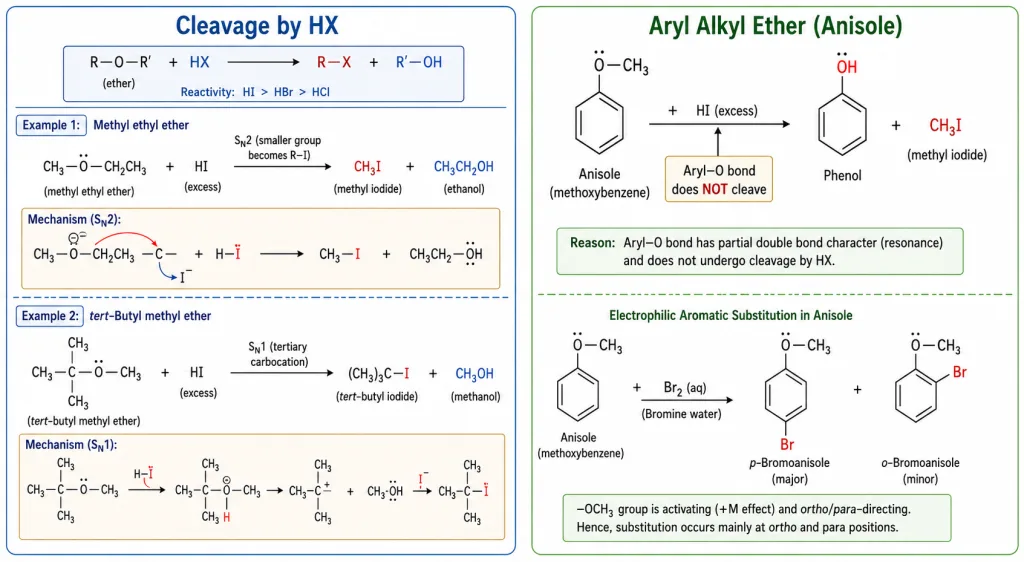
Key Point: ethers resist most reagents; the exam reactions are C-O cleavage by HX and aromatic substitution of anisole.
Cleavage of the C-O Bond by HX
When heated with hydrogen halides, ethers are cleaved at the C-O bond to give an alkyl halide and an alcohol (and, with excess HX, two alkyl halides):
R-O-R' + HX → R-X + R'-OH (and R'-X + HO with excess HX)
Reactivity order of the acids: HI > HBr > HCl (HI is the strongest and most commonly used).
Which fragment becomes the halide? With excess HX, the alkyl group that gives the more stable carbocation (or, for a simple case, the less hindered group via SN2) is the one that ends up as the halide.
- With primary/methyl ethers the reaction is SN2: the halide attacks the less hindered (smaller) carbon, so e.g. CH-O-CH + HI → CHI + CHOH (the smaller methyl becomes the iodide).
- With ethers bearing a tertiary/branched group the reaction is SN1: cleavage gives the more stable (3°) carbocation, so e.g. (CH)C-O-CH + HI → (CH)C-I + CHOH.
Key Point: HX cleaves ethers (HI > HBr > HCl). For methyl/1° ethers the smaller group becomes the halide (SN2); when a 3° group is present it forms the carbocation and becomes the halide (SN1).
Cleavage of Aryl Alkyl Ethers (e.g. Anisole)
In an aryl alkyl ether such as anisole (CH-O-CH), the C(aryl)-O bond does NOT break because of the partial double-bond character (the oxygen lone pair is delocalised into the ring) and because aryl cations/aryl-SN2 are not feasible. So cleavage always breaks the alkyl-oxygen bond and gives a phenol + an alkyl halide:
CH-O-CH + HI → CH-OH (phenol) + CHI
The phenol is not further converted to an aryl halide.
Key Point: with aryl alkyl ethers the alkyl-O bond breaks → you always get phenol + alkyl halide. The aryl-O bond is too strong to cleave.
Electrophilic Substitution in Anisole
The -OCH (alkoxy) group is activating and ortho/para-directing, just like -OH, because the oxygen lone pair feeds electron density into the ring. So anisole undergoes electrophilic aromatic substitution faster than benzene, mainly at the ortho and para positions.
Halogenation: anisole + Br in ethanoic acid → mainly p-bromoanisole (para is favoured because ortho is hindered by the -OCH group).
Nitration: anisole + conc. HNO/HSO → ortho- and para-nitroanisole.
Friedel-Crafts reaction: anisole + CHCl (or CHCOCl) with anhydrous AlCl → mainly the para methyl/acetyl product (ortho + para; para predominates).
Key Point: -OR activates the ring (o/p-directing). Anisole gives mainly para products in halogenation, nitration and Friedel-Crafts because the ortho position is sterically hindered.
Solved Examples
Example 1: Cleavage products of a methyl ether
What are the products when CH-O-CH reacts with excess HI?
Solution: The reaction is SN2 and the iodide attacks the less hindered methyl group: first CHI + CHOH. With excess HI the ethanol is also converted, giving CHI + CHI.
Example 2: Reactivity of HX
Arrange HCl, HBr and HI in order of reactivity toward ether cleavage.
Solution: HI > HBr > HCl. HI is the strongest acid and best nucleophile (iodide), so it cleaves ethers most readily.
Example 3: Directing effect in anisole
Why does bromination of anisole give mainly the para product?
Solution: The -OCH group is o/p-directing and activating. Both ortho and para are favoured electronically, but the ortho position is sterically hindered by the methoxy group, so the para product (p-bromoanisole) predominates.
Example 4: Identify the ether
An ether CHO on cleavage with HI gives methanol and a tertiary iodide. Identify it.
Solution: The tertiary iodide must be (CH)CI, so the ether is methyl tert-butyl ether, (CH)C-O-CH (2-methoxy-2-methylpropane). The 3° group forms the carbocation/iodide, leaving methanol.
Example 5: Nitration of anisole
What products form when anisole is nitrated?
Solution: -OCH is o/p-directing, so nitration gives o-nitroanisole and p-nitroanisole (para usually predominates).
Example 6: Why ethers are good solvents
Why are ethers chemically suitable as reaction solvents?
Solution: The C-O bonds are strong and ethers are inert to bases, dilute acids, oxidising and reducing agents under mild conditions, so they dissolve organic reactants without reacting themselves (caution: flammable and form explosive peroxides on storage).
Example 7: Product with limited HX
CH-O-CH reacts with one mole of HI. Write the product.
Solution: Symmetrical dimethyl ether gives CHI + CHOH (with one mole of HI). With excess HI both halves become CHI.
Example 8: Friedel-Crafts on anisole
What is the main product of anisole with CHCOCl/anhydrous AlCl?
Solution: Friedel-Crafts acylation on the activated, o/p-directing ring gives mainly p-methoxyacetophenone (4-methoxyacetophenone), the para acetyl product.