
Preparing Alcohols from Alkenes
Two important methods add water across a C=C double bond, but they give opposite products.
(1) Acid-catalysed hydration (Markovnikov): Water adds by Markovnikov's rule (the -OH goes to the more substituted carbon, via the more stable carbocation). Propene gives propan-2-ol (a secondary alcohol).
(2) Hydroboration-oxidation (anti-Markovnikov): Diborane (BH) adds to the alkene (boron to the less hindered carbon), then oxidation with alkaline HO replaces boron by -OH with retention. The net result is anti-Markovnikov, syn addition of water — propene gives propan-1-ol (a primary alcohol).
Key Point: Acid hydration → Markovnikov (more substituted alcohol); hydroboration-oxidation → anti-Markovnikov (less substituted alcohol). The same alkene gives different alcohols by the two routes.
Preparing Alcohols from Carbonyl Compounds
Alcohols can be made by reducing carbonyl compounds (adding hydrogen across C=O):
- Aldehydes → primary alcohols:
- Ketones → secondary alcohols:
- Carboxylic acids and esters → primary alcohols (using the strong reducing agent LiAlH):
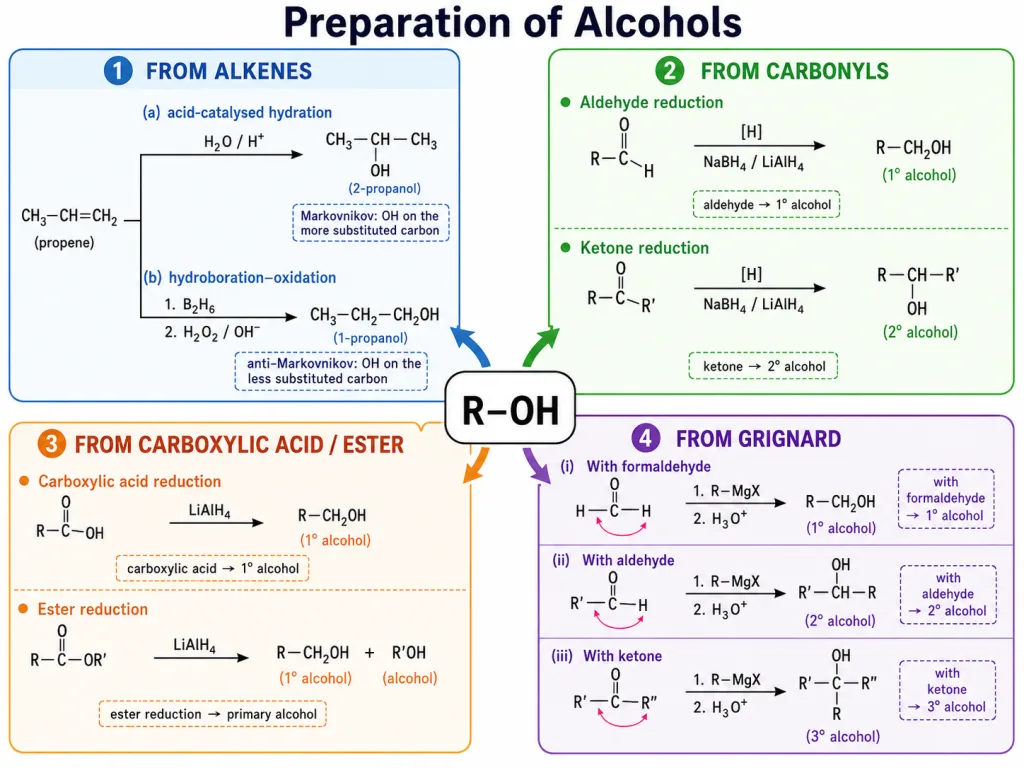
(NaBH reduces aldehydes and ketones but not acids/esters; LiAlH reduces all of them.)
Preparing Alcohols from Grignard Reagents
Grignard reagents (RMgX) add to the carbonyl group, and after hydrolysis give alcohols. The class of alcohol depends on the carbonyl compound:
- RMgX + methanal (HCHO) → a primary alcohol.
- RMgX + any other aldehyde (R'CHO) → a secondary alcohol.
- RMgX + a ketone (R'COR'') → a tertiary alcohol.
For example: CHMgBr + CHCHO → (after HO) → CH-CH(OH)-CH (propan-2-ol, a secondary alcohol).
The Grignard reagent's R group adds to the carbonyl carbon and the oxygen becomes -OH on hydrolysis.
Key Point: With Grignard reagents, HCHO gives 1° alcohols, other aldehydes give 2° alcohols, and ketones give 3° alcohols. This lets you design a synthesis to reach any class of alcohol. (Grignard reactions need dry conditions — water destroys the reagent.)
[JEE Tip] To decide which alcohol a Grignard route gives: count the carbons that end up on the C-OH carbon. Methanal contributes one H, so the product carbon has one R (from RMgX) and ends up primary; a ketone contributes two R groups, so the product carbon has three carbon attachments — tertiary.
Solved Examples
Example 1: Markovnikov hydration
What is the product of the acid-catalysed hydration of but-1-ene (CHCHCH=CH)?
Solution: By Markovnikov's rule, -OH adds to the more substituted carbon: CHCH-CH(OH)-CH → butan-2-ol (a secondary alcohol).
Example 2: Hydroboration-oxidation
What is the product of hydroboration-oxidation of but-1-ene?
Solution: Anti-Markovnikov addition gives the -OH on the terminal (less substituted) carbon: CHCHCH-CH-OH → butan-1-ol (a primary alcohol).
Example 3: Reduction of a ketone
What alcohol is obtained by reducing propan-2-one (acetone) with NaBH?
Solution: Reduction of a ketone gives a secondary alcohol: (CH)C=O → (CH)CH-OH (propan-2-ol).
Example 4: Grignard to a tertiary alcohol
What type of alcohol is obtained when a Grignard reagent reacts with a ketone?
Solution: A tertiary alcohol — the R group of the Grignard adds to the ketone's carbonyl carbon (which already has two R groups), giving a carbon with three carbon attachments and an -OH.
Example 5: Distinguish the two alkene routes
How can propan-1-ol and propan-2-ol both be made from propene?
Solution: Propan-2-ol is made by acid-catalysed hydration (Markovnikov); propan-1-ol is made by hydroboration-oxidation (anti-Markovnikov). The same alkene gives different alcohols by the two methods.
Example 6: Reduction of a carboxylic acid
Which reagent reduces ethanoic acid (CHCOOH) to ethanol, and what is the product type?
Solution: LiAlH reduces the carboxylic acid to a primary alcohol: CHCOOH → CHCHOH (ethanol). (NaBH is too weak to reduce acids.)
Example 7: Grignard with methanal
What alcohol is formed when CHCHMgBr reacts with methanal (HCHO) followed by hydrolysis?
Solution: Grignard + HCHO gives a primary alcohol: CHCH-CH-OH → propan-1-ol.
Example 8: Anti-Markovnikov reasoning
Why does hydroboration-oxidation give the anti-Markovnikov product?
Solution: In hydroboration, the boron atom (electrophilic) adds to the less hindered (terminal) carbon, and hydrogen adds to the other carbon. On oxidation, -OH replaces boron with retention of position, so the -OH ends up on the less substituted carbon — the anti-Markovnikov product.
Example 9: Which Grignard route gives a secondary alcohol?
What carbonyl compound should react with CHMgBr to give a secondary alcohol?
Solution: Any aldehyde other than methanal. For example, CHMgBr + CHCHO → (CH)CHOH (propan-2-ol, a secondary alcohol).
Example 10: Reduction selectivity
A compound has both an aldehyde and an ester group. Which reagent reduces only the aldehyde?
Solution: NaBH — it reduces aldehydes (and ketones) but not esters or carboxylic acids. LiAlH would reduce both.