
The Oxygen Family: Alcohols, Phenols and Ethers
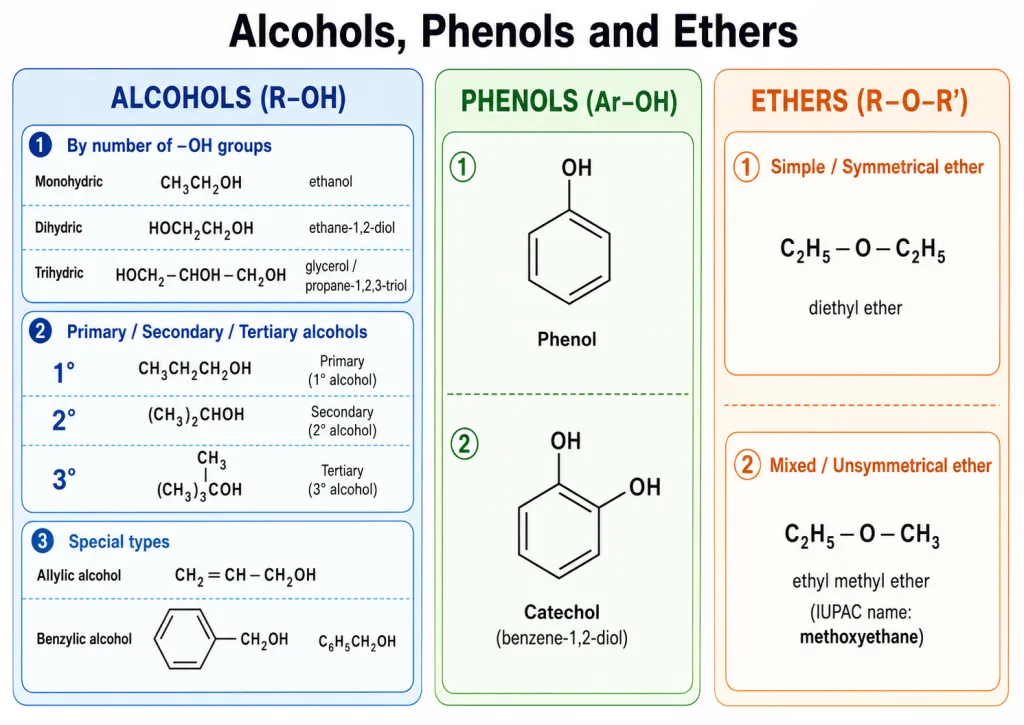
When a hydrogen atom of a hydrocarbon is replaced by an -OH (hydroxyl) group, or two carbon groups are joined through an oxygen atom, we get the three families of this chapter:
- Alcohols (R-OH): the -OH group is attached to an sp carbon of an alkyl chain (e.g. ethanol, CHCHOH).
- Phenols (Ar-OH): the -OH group is attached directly to an sp carbon of a benzene ring (e.g. phenol, CHOH).
- Ethers (R-O-R'): two alkyl or aryl groups are joined by an oxygen atom (e.g. diethyl ether, CHCH-O-CHCH).
The difference between an alcohol's sp C-OH and a phenol's sp (aromatic) C-OH controls nearly all their differences in acidity and reactivity.
Classifying Alcohols and Phenols
Alcohols are classified two ways:
(a) By the number of -OH groups:
- Monohydric (one -OH, e.g. ethanol), dihydric (two, e.g. ethane-1,2-diol/glycol), trihydric (three, e.g. propane-1,2,3-triol/glycerol).
(b) By the carbon bearing the -OH (for monohydric alcohols):
- Primary (1°): -OH carbon attached to one other carbon (e.g. CHCHOH, ethanol).
- Secondary (2°): attached to two carbons (e.g. (CH)CHOH, propan-2-ol).
- Tertiary (3°): attached to three carbons (e.g. (CH)COH, 2-methylpropan-2-ol).
Special types by the adjacent carbon: allylic (-OH on an sp C next to C=C), benzylic (-OH on an sp C attached to a ring), and vinylic (-OH on an sp C=C carbon).
Phenols are similarly classed as monohydric, dihydric (e.g. catechol, resorcinol, quinol) or trihydric by the number of -OH groups on the ring.
Classifying Ethers and IUPAC Nomenclature
Ethers are classified by whether the two groups are the same:
- Simple (symmetrical): both groups identical, e.g. diethyl ether (CH-O-CH).
- Mixed (unsymmetrical): different groups, e.g. ethyl methyl ether (CH-O-CH).
IUPAC nomenclature:
- Alcohols are named as alkanols: the -e of the alkane is replaced by -ol, and the position of -OH gets the lowest locant. CHOH = methanol; CHCHCHOH = propan-1-ol; (CH)CHOH = propan-2-ol.
- Phenols are named as substituted phenols (phenol is the parent); the ring carbons are numbered to give -OH position 1. e.g. 2-methylphenol, 4-nitrophenol.
- Ethers are named as alkoxyalkanes: the smaller group + oxygen is the alkoxy substituent on the larger (parent) chain. CH-O-CHCH = methoxyethane; CH-O-CH = methoxybenzene (anisole).
Key Point: Alcohol = alkanol; ether = alkoxyalkane (smaller group as the alkoxy prefix). For phenols, "phenol" is the parent and substituents are numbered to give -OH the lowest locant.
Solved Examples
Example 1: Classify the alcohol
Classify (CH)COH and (CH)CHOH as 1°, 2° or 3°.
Solution: In (CH)COH the C-OH carbon is attached to three carbons → tertiary (3°). In (CH)CHOH the C-OH carbon is attached to two carbons → secondary (2°).
Example 2: IUPAC name of an alcohol
Give the IUPAC name of CHCHCHCHOH.
Solution: A four-carbon chain with -OH on C1 → butan-1-ol.
Example 3: Name an ether
Give the IUPAC name of CH-O-CHCH.
Solution: The smaller group (methyl + O = methoxy) is the substituent on the larger chain (ethane): methoxyethane (common name: ethyl methyl ether).
Example 4: Dihydric alcohol
What is the common name and IUPAC name of CH(OH)-CH(OH)?
Solution: It is a dihydric alcohol: common name ethylene glycol; IUPAC name ethane-1,2-diol.
Example 5: Phenol vs alcohol
Is CH-CH-OH a phenol? Explain.
Solution: No. In CH-CH-OH (benzyl alcohol) the -OH is on an sp carbon attached to the ring, not directly on the ring. It is a benzylic alcohol. A phenol has -OH directly on an sp ring carbon (e.g. CH-OH).
Example 6: Classify the ether
Classify CHCH-O-CHCH and CH-O-CH.
Solution: CHCH-O-CHCH (diethyl ether) has two identical groups → simple/symmetrical ether. CH-O-CH (anisole) has different groups → mixed/unsymmetrical ether.
Example 7: Allylic alcohol
Why is CH=CH-CH-OH called an allylic alcohol?
Solution: Because the -OH is on an sp carbon that is directly attached to a carbon-carbon double bond (the allylic position).
Example 8: IUPAC name of a substituted phenol
Give the IUPAC name of the phenol with a methyl group at the ortho position.
Solution: Numbering -OH as C1 and methyl as C2: 2-methylphenol (common name: o-cresol).
Example 9: Trihydric alcohol
Name the trihydric alcohol present in fats and oils.
Solution: Glycerol (propane-1,2,3-triol), CH(OH)-CH(OH)-CH(OH).
Example 10: Name an alkoxybenzene
Give the IUPAC and common names of CH-O-CH.
Solution: IUPAC: methoxybenzene; common name: anisole.