
Preparing Phenol — Laboratory Methods
Phenol (carbolic acid) can be made from several aromatic starting materials.
(1) From haloarenes (Dow process): chlorobenzene is heated with aqueous NaOH at high temperature (~623 K) and pressure (~300 atm) to give sodium phenoxide, then acidified:
(2) From benzenesulphonic acid: benzene is sulphonated, and the sodium benzenesulphonate is fused with NaOH, then acidified:
(3) From diazonium salts: a benzenediazonium salt is warmed with water (or dilute acid):
Preparing Phenol — The Cumene Process (Industrial)
The most important industrial method is the cumene process.
Step 1: Cumene (isopropylbenzene) is oxidised by air to cumene hydroperoxide.
Step 2: The cumene hydroperoxide is treated with dilute acid, which cleaves it into phenol and acetone (propanone):
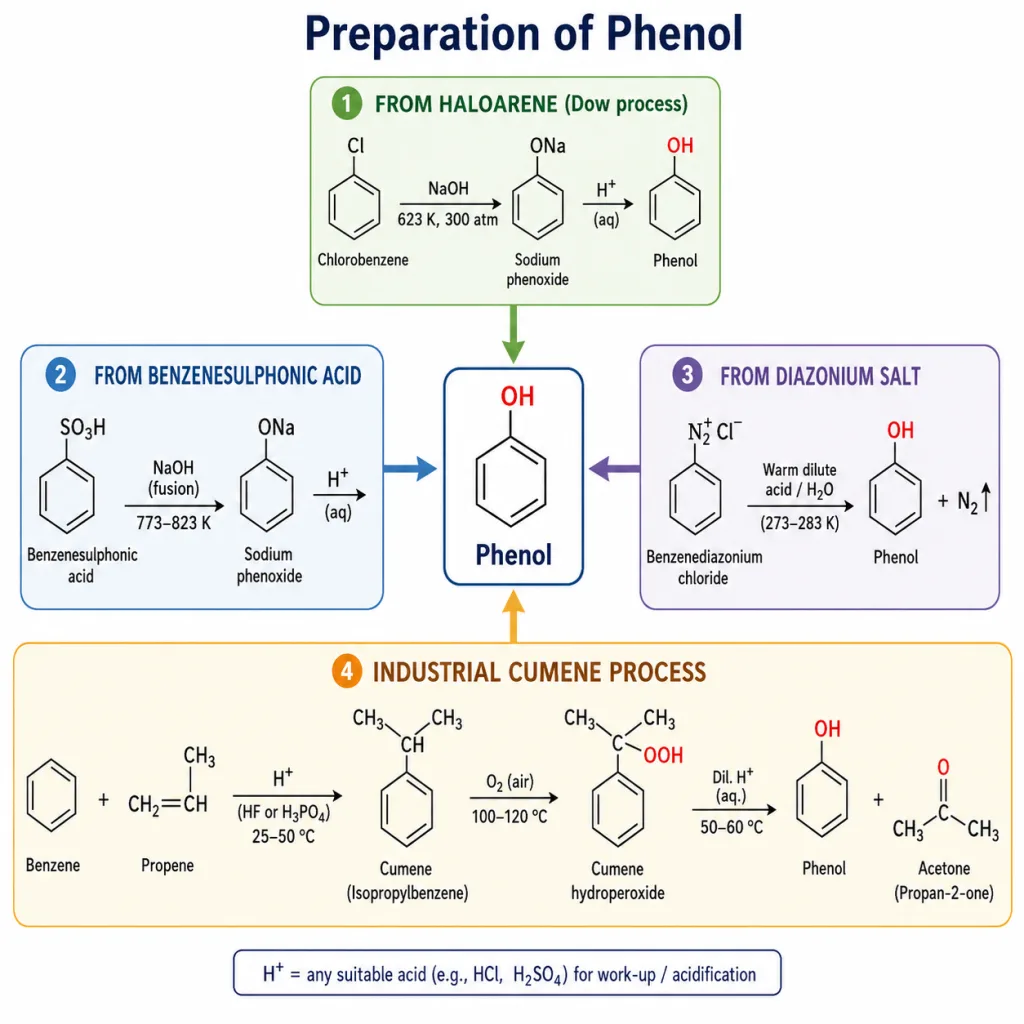
This is economical because it produces two useful products (phenol and acetone) in one process.
Key Point: Four routes to phenol — chlorobenzene (Dow, harsh conditions), benzenesulphonic acid (NaOH fusion), diazonium salt (warm water), and the industrial cumene process (gives phenol + acetone). The cumene process is the one to remember for "industrial preparation."
[NEET Important] "Phenol from cumene" gives phenol AND acetone — this co-production is a favourite exam point. Cumene is isopropylbenzene; it is air-oxidised to cumene hydroperoxide, then acid-cleaved.
Why These Methods Work
Each method replaces a leaving group on the ring with -OH:
- In the Dow process, the strong nucleophile OH displaces chloride — but only under drastic conditions, because aryl halides are unreactive (Chapter 6).
- In the benzenesulphonic acid route, the -SONa group is replaced by -OH on fusion with alkali.
- In the diazonium route, the very good leaving group N departs as the diazonium salt reacts with water.
- In the cumene process, a rearrangement of the hydroperoxide under acid gives phenol and acetone.
Worked comparison: the laboratory routes (diazonium, benzenesulphonic acid) are convenient on a small scale, while the cumene process dominates industry because it is cheap and co-produces acetone.
[JEE Tip] When asked "how is phenol prepared from benzene using only conc. HSO and NaOH," the answer is the benzenesulphonic acid route: benzene → benzenesulphonic acid (conc. HSO) → sodium salt → fuse with NaOH → sodium phenoxide → acidify → phenol.
Solved Examples
Example 1: Phenol from chlorobenzene
Write the conditions for preparing phenol from chlorobenzene.
Solution: Heat chlorobenzene with aqueous NaOH at ~623 K and ~300 atm (the Dow process) to give sodium phenoxide, then acidify to obtain phenol.
Example 2: Cumene process products
What two products are obtained when cumene hydroperoxide is treated with dilute acid?
Solution: Phenol and acetone (propanone). This is the basis of the industrial cumene process.
Example 3: Phenol from a diazonium salt
What happens when benzenediazonium chloride is warmed with water?
Solution: It is hydrolysed to phenol, releasing nitrogen gas:
Example 4: Phenol from benzene (acid + alkali only)
How is phenol prepared from benzene using conc. HSO and NaOH?
Solution: Benzene + conc. HSO → benzenesulphonic acid → neutralise to sodium benzenesulphonate → fuse with NaOH → sodium phenoxide → acidify → phenol.
Example 5: Industrial preference
Why is the cumene process the preferred industrial method for making phenol?
Solution: It is economical because it co-produces a second valuable product, acetone, alongside phenol from cheap cumene and air. The acetone offsets the cost, making phenol cheaper to manufacture this way.
Example 6: Identify the starting material
Cumene is the starting material in the industrial preparation of phenol. What is cumene's other name?
Solution: Cumene is isopropylbenzene (CH-CH(CH)).
Example 7: Role of NaOH fusion
In the benzenesulphonic acid route, why is sodium benzenesulphonate fused with NaOH?
Solution: The molten (fused) NaOH provides the strong nucleophile OH at high temperature to displace the -SONa group, converting it to -O (sodium phenoxide), which is then acidified to phenol.
Example 8: Drastic conditions for the Dow process
Why does the conversion of chlorobenzene to phenol require such drastic conditions?
Solution: Chlorobenzene is an aryl halide; its C-Cl bond has partial double-bond character (resonance) and is hard to break, so nucleophilic substitution by OH needs very high temperature and pressure.
Example 9: Product of cumene oxidation (step 1)
What is formed when cumene is oxidised by air?
Solution: Cumene hydroperoxide — the air oxidises the benzylic C-H of the isopropyl group to a -OOH (hydroperoxide). It is then cleaved by acid to phenol and acetone.
Example 10: Choosing a method
Which method would you use to prepare a pure sample of phenol in the laboratory from aniline?
Solution: Diazotise aniline (NaNO/HCl, 0-5 °C) to the diazonium salt, then warm with water to hydrolyse it to phenol (releasing N).