
Physical Properties — The Role of Hydrogen Bonding
Alcohols and phenols both have an -O-H group, which can form hydrogen bonds. This single feature explains their two most important physical properties.
High boiling points: alcohols and phenols boil at much higher temperatures than hydrocarbons or ethers of similar molecular mass, because their molecules are held together by intermolecular hydrogen bonds. For example, ethanol (b.p. 78 °C) boils far higher than propane (b.p. −42 °C) despite similar masses. The boiling point also rises with molecular size (more van der Waals forces) and falls with branching.
Solubility in water: lower alcohols are miscible with water because they form hydrogen bonds with water molecules. Solubility decreases as the alkyl group grows (the hydrophobic carbon chain becomes dominant), so higher alcohols are less soluble.
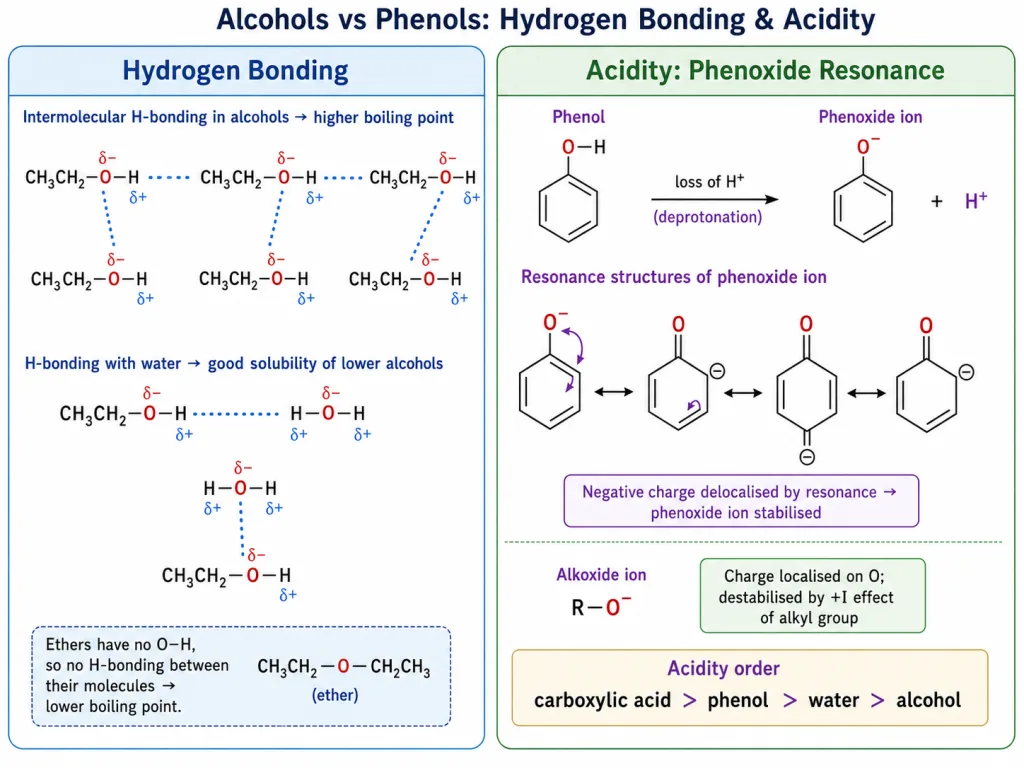
Key Point: Hydrogen bonding makes alcohols and phenols boil higher and dissolve better in water than comparable hydrocarbons and ethers. Ethers cannot hydrogen-bond to each other (no O-H), so they boil much lower.
Acidity of Alcohols and Phenols
Both alcohols and phenols can lose the -O-H proton, but to very different extents.
Acidity order: carboxylic acid > phenol > water > alcohol. Phenol (pKa ≈ 10) is about a million times more acidic than ethanol (pKa ≈ 16), but still much weaker than a carboxylic acid.
Why is phenol so much more acidic than an alcohol? When phenol loses its proton, it forms the phenoxide ion, whose negative charge is delocalised into the benzene ring by resonance (onto the ortho and para carbons). This resonance stabilisation makes the phenoxide ion much more stable than an alkoxide ion, so phenol releases its proton far more readily.
In an alkoxide ion (RO), by contrast, the negative charge is localised on oxygen and is actually destabilised by the electron-donating alkyl group, so alcohols are even weaker acids than water.
Worked logic: phenol reacts with NaOH to give sodium phenoxide (so it is acidic enough to react with a strong base), but it does not react with the weaker base NaHCO — unlike a carboxylic acid, which does. This is a common test to distinguish a phenol from a carboxylic acid.
Effect of Substituents on Phenol's Acidity
Groups on the ring change phenol's acidity by changing how stable the phenoxide ion is:
- Electron-withdrawing groups (EWG) like -NO increase acidity — they pull electron density away and stabilise the phenoxide's negative charge. The effect is strongest at the ortho and para positions (where resonance can act). So nitrophenols are more acidic than phenol, and the order is: phenol < o-/p-nitrophenol < 2,4-dinitrophenol < 2,4,6-trinitrophenol (picric acid, a strong acid).
- Electron-donating groups (EDG) like -CH and -OCH decrease acidity — they push electron density onto the ring and destabilise the phenoxide. So cresols (methylphenols) and methoxyphenols are less acidic than phenol.
Key Point: EWG (e.g. -NO) at ortho/para → more acidic; EDG (e.g. -CH, -OCH) → less acidic. The more the substituent can stabilise the negative charge of the phenoxide ion, the stronger the acid.
[JEE Tip] To rank substituted phenols by acidity: count and place the electron-withdrawing groups (ortho/para nitro groups are the most acid-strengthening). More EWG at o/p = stronger acid. An ortho-NO phenol is more acidic than an ortho-OCH phenol because -NO withdraws electrons while -OCH donates them.
Solved Examples
Example 1: Boiling point comparison
Why does ethanol have a much higher boiling point than dimethyl ether, though they have the same molecular formula (CHO)?
Solution: Ethanol (CHCHOH) has an O-H group and forms intermolecular hydrogen bonds, which require extra energy to break. Dimethyl ether (CH-O-CH) has no O-H, so it cannot hydrogen-bond between its molecules; hence it boils much lower.
Example 2: Why phenol is more acidic than ethanol
Explain why phenol is more acidic than ethanol.
Solution: The phenoxide ion formed when phenol loses its proton is stabilised by resonance (the negative charge is delocalised into the ring). The ethoxide ion has its charge localised on oxygen and is destabilised by the electron-donating ethyl group. The greater stability of the phenoxide makes phenol the stronger acid.
Example 3: Effect of -NO on acidity
Why is o-nitrophenol more acidic than phenol?
Solution: The -NO group is electron-withdrawing, so it pulls electron density away and stabilises the negative charge of the nitrophenoxide ion (especially from the ortho/para position by resonance). The more stable conjugate base means o-nitrophenol releases its proton more readily — it is more acidic than phenol.
Example 4: Acidity ranking
Arrange in increasing acidity: ethanol, phenol, p-nitrophenol.
Solution: Ethanol (weakest) < phenol < p-nitrophenol (strongest). The phenoxide is resonance-stabilised (so phenol > ethanol), and -NO further stabilises it (so p-nitrophenol > phenol).
Example 5: Phenol vs carboxylic acid test
How can you distinguish phenol from benzoic acid using a simple test?
Solution: Benzoic acid reacts with sodium bicarbonate (NaHCO) to give effervescence (CO), but phenol does not (it is too weak an acid to react with NaHCO, though it does react with the stronger base NaOH). The effervescence test distinguishes the two.
Example 6: Solubility trend
Why does the water solubility of alcohols decrease as the carbon chain lengthens?
Solution: The -OH group hydrogen-bonds with water (favouring solubility), but the hydrocarbon (alkyl) part is hydrophobic. As the chain grows, the hydrophobic part dominates, so solubility in water decreases.
Example 7: Effect of -OCH on acidity
Is o-methoxyphenol more or less acidic than phenol? Why?
Solution: Less acidic. The -OCH group is electron-donating, so it pushes electron density toward the ring and destabilises the phenoxide's negative charge, making the proton harder to release.
Example 8: Why ethers boil lower than alcohols
Why do ethers have lower boiling points than isomeric alcohols?
Solution: Ethers lack an O-H bond, so ether molecules cannot hydrogen-bond with one another. Without intermolecular hydrogen bonding, less energy is needed to separate them, so they boil at a lower temperature than the isomeric alcohols (which do hydrogen-bond).
Example 9: Picric acid
Why is 2,4,6-trinitrophenol (picric acid) a strong acid?
Solution: It has three electron-withdrawing nitro groups at the 2, 4 and 6 positions (two ortho and one para). They strongly stabilise the negative charge of the phenoxide ion by both inductive and resonance effects, so the compound readily loses its proton — it is a strong acid.
Example 10: Hydrogen bonding and boiling point order
Among CHCHOH, CHOCH and CH, which has the highest boiling point and why?
Solution: CHCHOH (ethanol) — it forms intermolecular hydrogen bonds (O-H), unlike the ether (no O-H) and the alkane (non-polar). Hydrogen bonding raises its boiling point well above the other two.