
Ethers — Structure and Nomenclature
An ether has two alkyl or aryl groups joined to an oxygen: R-O-R'. If the two groups are the same, the ether is simple (symmetrical), e.g. diethyl ether (); if they differ, it is mixed (unsymmetrical), e.g. ethyl methyl ether ().
Common names: name the two groups attached to oxygen alphabetically and add the word ether — e.g. ethyl methyl ether, diethyl ether, anisole (methyl phenyl ether).
IUPAC names (alkoxyalkane): the smaller alkyl or aryl alkyl group + oxygen is treated as an alkoxy substituent on the larger parent alkane chain. So is methoxyethane; is 2-methoxypropane; is methoxybenzene (anisole).
Key Point: simple ether = same groups; mixed ether = different groups. IUPAC = (smaller group)oxy + parent chain. The larger group is the parent in the name.
Preparation of Ethers — 1. By Dehydration of Alcohols
Heating a primary alcohol with protonic acid (conc. ) at about 413 K (140 °C) removes a molecule of water between two alcohol molecules to give a symmetrical ether (intermolecular dehydration):
The reaction occurs through protonation of the alcohol followed by nucleophilic attack by a second alcohol molecule.
Important limitation: this method works well only for primary alcohols to make symmetrical ethers. With secondary and tertiary alcohols the major product is an alkene (elimination wins over substitution), and it cannot be used to make mixed ethers. Note the temperature control: ethanol gives ether at 413 K but ethene at 443 K.
Key Point: intermolecular dehydration of a 1° alcohol (conc. , 413 K) gives a symmetrical ether. Higher temperature or 2°/3° alcohols give alkenes instead.
Preparation of Ethers — 2. Williamson Synthesis
The Williamson synthesis is the best and most general method, and the only good route to unsymmetrical (mixed) ethers. An alkyl halide is heated with a sodium alkoxide (or sodium aryloxide):
This is an SN2 reaction: the alkoxide oxygen is the nucleophile and displaces the halide.
Choosing the right partners is crucial. Because it is SN2, the alkyl halide must be primary (or methyl) for a good yield. If a secondary or tertiary halide is used, the alkoxide acts as a base instead of a nucleophile and gives an alkene by elimination. So to make tert-butyl methyl ether, use sodium tert-butoxide + methyl iodide (methyl halide), not sodium methoxide + tert-butyl bromide (3° halide → elimination).
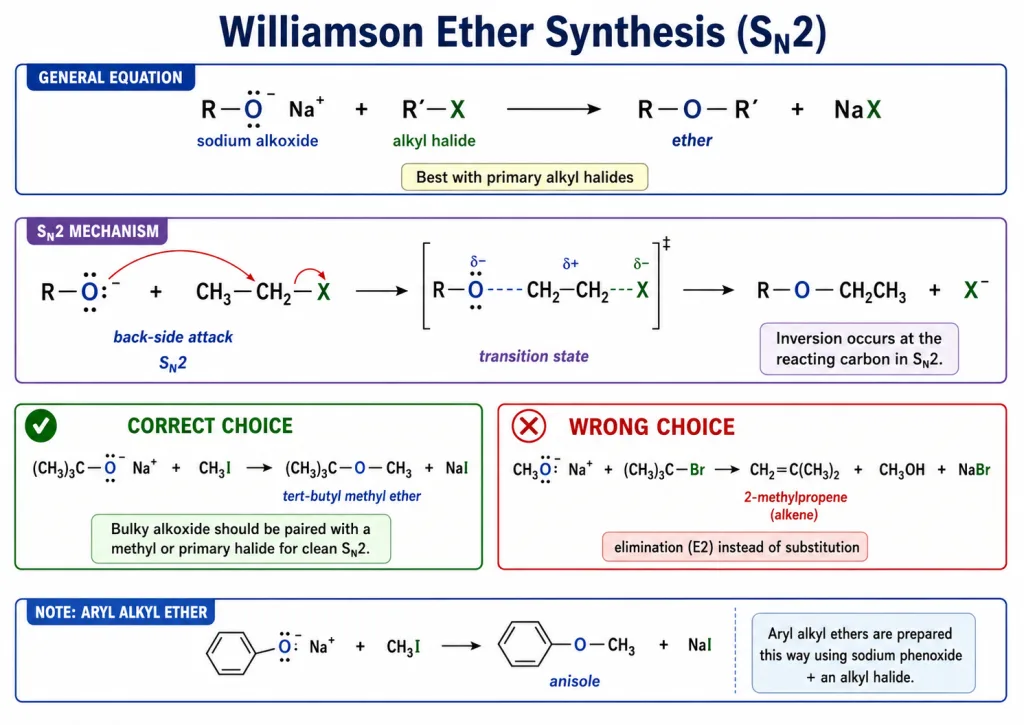
Key Point: Williamson = alkoxide + alkyl halide (SN2). Always pick the primary or methyl halide; pair it with the more hindered alkoxide to avoid elimination. It also makes aryl alkyl ethers (e.g. sodium phenoxide + gives anisole).
Physical Properties of Ethers
Boiling points: ethers have low boiling points, close to those of alkanes of comparable molecular mass and much lower than isomeric alcohols. The reason is that ether molecules cannot hydrogen-bond to each other — there is no O-H bond — so only weak dipole-dipole and van der Waals forces operate. For example, diethyl ether (b.p. 35 °C) boils far below its isomer butan-1-ol (b.p. 118 °C).
Solubility: despite having no O-H, ethers are fairly soluble in water when they are low-molecular-mass compounds, because the ether oxygen can form hydrogen bonds with water molecules (water provides the H). Solubility falls as the alkyl chains grow.
Key Point: ethers boil low (no H-bonding between ether molecules) but dissolve appreciably in water (the O accepts H-bonds from water). Their low reactivity and good solvent power make them excellent, if flammable, organic solvents.
Solved Examples
Example 1: IUPAC naming
Give the IUPAC name of .
Solution: The larger group is propyl (parent = propane); the smaller group + O = methoxy. The name is 1-methoxypropane.
Example 2: Symmetrical vs unsymmetrical
Classify (a) diethyl ether and (b) ethyl methyl ether.
Solution: (a) Diethyl ether () has two identical groups → simple/symmetrical. (b) Ethyl methyl ether () has two different groups → mixed/unsymmetrical.
Example 3: Dehydration limitation
Why can't dehydration of an alcohol be used to make ethyl methyl ether?
Solution: Acid dehydration gives symmetrical ethers from a single alcohol. A mixture of ethanol and methanol would give a mixture of three ethers (diethyl, dimethyl and ethyl methyl). Hence only the Williamson synthesis gives a pure mixed ether.
Example 4: Temperature control
What is obtained when ethanol is heated with conc. at (a) 413 K and (b) 443 K?
Solution: (a) At 413 K the product is diethyl ether (intermolecular dehydration). (b) At 443 K the product is ethene (intramolecular dehydration/elimination). Temperature decides ether vs alkene.
Example 5: Boiling point reasoning
Diethyl ether and butan-1-ol are isomers (), yet butan-1-ol boils much higher. Why?
Solution: Butan-1-ol has an O-H group and forms intermolecular hydrogen bonds, raising its boiling point. Diethyl ether has no O-H, so its molecules are held only by weak forces and it boils much lower.
Example 6: Solubility of ethers
Diethyl ether dissolves appreciably in water though it has no O-H. Explain.
Solution: The ether oxygen has lone pairs and can act as a hydrogen-bond acceptor toward water's O-H. These ether-water hydrogen bonds make low-molecular-mass ethers fairly soluble in water.
Example 7: Anisole naming
Write the common and IUPAC names of .
Solution: Common name = anisole (methyl phenyl ether). IUPAC name = methoxybenzene.
Example 8: Designing a synthesis
How would you prepare 2-ethoxy-2-methylpropane (tert-butyl ethyl ether) by Williamson synthesis?
Solution: Use sodium tert-butoxide [ ] + ethyl bromide (). The 1° halide (ethyl) undergoes SN2 while the bulky tert-butoxide supplies the oxygen, avoiding elimination.
Example 9: Why primary halide
In Williamson synthesis why must the alkyl halide preferably be primary?
Solution: The reaction is SN2. Primary halides react cleanly by substitution. Secondary and especially tertiary halides favour E2 elimination (the alkoxide is a strong base), giving alkenes instead of the ether.