
Reactions of Phenols — Acidity
Phenol's chemistry is dominated by two features: its acidic -OH and the strongly activated ring.
Acidity (reaction as an acid):
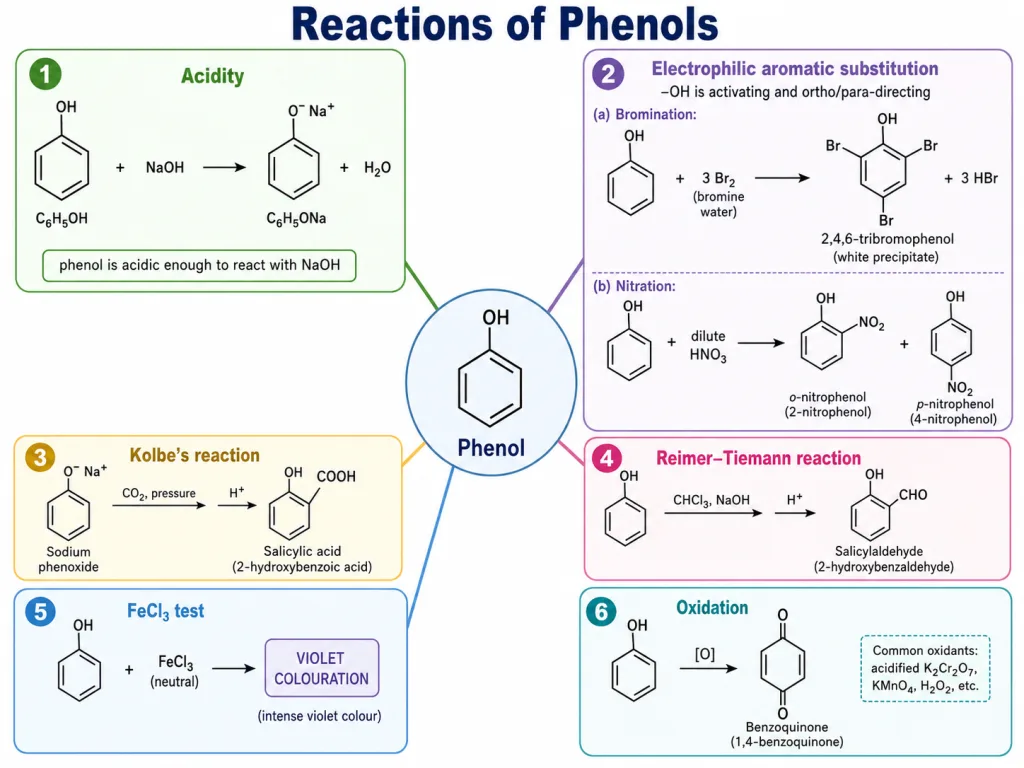
- With sodium hydroxide, phenol forms sodium phenoxide:
- With sodium metal, it gives sodium phenoxide and hydrogen:
Phenol is acidic enough to react with the strong base NaOH (unlike alcohols, which do not), but not with the weaker base NaHCO (unlike carboxylic acids). This places phenol's acidity between alcohols and carboxylic acids.
The -OH group strongly activates the benzene ring toward electrophilic substitution and directs incoming groups to the ortho and para positions (it is a powerful activating, o/p-directing group).
Electrophilic Substitution and the Named Reactions
Because the ring is activated, phenol undergoes electrophilic substitution easily — often more vigorously than benzene.
Halogenation: phenol with bromine water gives a white precipitate of 2,4,6-tribromophenol (all three available o/p positions are substituted) — a sensitive test:
Nitration: dilute HNO gives a mixture of o- and p-nitrophenol; conc. HNO gives picric acid (2,4,6-trinitrophenol).
Kolbe's reaction: sodium phenoxide is heated with CO under pressure, then acidified, to give salicylic acid (2-hydroxybenzoic acid) - the precursor of aspirin:
Reimer-Tiemann reaction: phenol is treated with chloroform and NaOH, then acidified, to introduce a -CHO group at the ortho position, giving salicylaldehyde (2-hydroxybenzaldehyde):
More Phenol Reactions and the FeCl Test
Reaction with FeCl (test for phenol): phenols give a characteristic violet (purple) colouration with neutral ferric chloride, a standard test that distinguishes phenols from alcohols (which give no colour).
Oxidation: phenol is readily oxidised (e.g. by chromic acid) to benzoquinone (a conjugated diketone), reflecting how electron-rich the ring is.
Esterification/acylation: phenol reacts with acid chlorides or anhydrides to give esters (e.g. with acetic anhydride it gives phenyl acetate).
Key Point — phenol's signature reactions:
- Acidity: reacts with NaOH (not NaHCO).
- Bromine water → 2,4,6-tribromophenol (white precipitate, a test).
- Kolbe → salicylic acid (with CO/NaOH).
- Reimer-Tiemann → salicylaldehyde (with CHCl/NaOH).
- FeCl → violet colour (test for phenol).
[NEET Important] Match the reagent to the product: CO/NaOH (Kolbe) → salicylic acid; CHCl/NaOH (Reimer-Tiemann) → salicylaldehyde; Br water → 2,4,6-tribromophenol; neutral FeCl → violet colour.
Solved Examples
Example 1: Phenol with bromine water
What product forms when phenol reacts with bromine water?
Solution: A white precipitate of 2,4,6-tribromophenol (all three ortho/para positions are brominated): CHOH + 3 Br → CHBrOH + 3 HBr.
Example 2: Kolbe's reaction
What is the product of Kolbe's reaction on phenol?
Solution: Salicylic acid (2-hydroxybenzoic acid) — sodium phenoxide is heated with CO under pressure, then acidified.
Example 3: Reimer-Tiemann reaction
What is formed when phenol is treated with chloroform and NaOH, then acidified?
Solution: Salicylaldehyde (2-hydroxybenzaldehyde) — the Reimer-Tiemann reaction introduces a -CHO group at the ortho position of phenol.
Example 4: Test for phenol
How can you confirm the presence of phenol using ferric chloride?
Solution: Add neutral FeCl solution; phenols give a characteristic violet (purple) colour. Alcohols give no such colour, so this distinguishes phenols from alcohols.
Example 5: Acidic nature of phenol (two reactions)
Give two reactions that show the acidic nature of phenol.
Solution: (i) With NaOH: CHOH + NaOH → CHONa + HO (forms sodium phenoxide). (ii) With sodium metal: 2 CHOH + 2 Na → 2 CHONa + H↑ (liberates hydrogen). Both show that phenol can donate its O-H proton.
Example 6: Why phenol reacts faster than benzene in substitution
Why does phenol undergo electrophilic substitution more readily than benzene?
Solution: The -OH group strongly activates the ring by donating electron density (its oxygen lone pair delocalises into the ring), increasing the electron density at the ortho and para positions and making the ring more reactive toward electrophiles than benzene.
Example 7: Nitration of phenol
What products form on nitration of phenol with dilute nitric acid?
Solution: A mixture of o-nitrophenol and p-nitrophenol (the -OH is ortho/para-directing). With concentrated HNO, further nitration gives 2,4,6-trinitrophenol (picric acid).
Example 8: Salicylic acid use
What everyday medicine is made from the salicylic acid produced in Kolbe's reaction?
Solution: Aspirin (acetylsalicylic acid) — salicylic acid is acetylated (with acetic anhydride) to give aspirin, a common analgesic and antipyretic.
Example 9: Distinguish phenol from ethanol
Give one chemical test to distinguish phenol from ethanol.
Solution: Add neutral FeCl: phenol gives a violet colour, while ethanol gives no colour. (Alternatively, phenol gives a white precipitate with bromine water; ethanol does not.)