
Amino Acids — Structure & Classification
Amino acids are the building blocks of proteins. Each contains two functional groups — an amino group (-NH) and a carboxyl group (-COOH) — together with a side chain R that differs from one amino acid to the next.
In the amino acids found in proteins, both groups are on the same carbon (the alpha-carbon), so they are called alpha-amino acids. About 20 of them build all proteins.
Classification:
- By the side chain / nature: acidic (extra -COOH, e.g. glutamic acid), basic (extra -NH, e.g. lysine) or neutral (e.g. glycine).
- Essential vs non-essential: essential amino acids cannot be made by the body and must come from the diet (e.g. valine, leucine, lysine); non-essential ones can be synthesised by the body (e.g. glycine, alanine).
Key Point: alpha-amino acid = -NH and -COOH on the same (alpha) carbon, plus a side chain R. They are acidic/basic/neutral and essential (from diet) or non-essential (body-made).
The Zwitterion & Amphoteric Nature
Because an amino acid has both an acidic (-COOH) and a basic (-NH) group, the -COOH can transfer its proton to the -NH within the same molecule. This gives a dipolar ion called a zwitterion, with a positive -NH and a negative -COO⁻ at the same time (overall neutral):
HN-CHR-COOH ⇌ ⁺HN-CHR-COO⁻ (zwitterion)
Amphoteric behaviour: in the zwitterion form an amino acid can react both with acids (the -COO⁻ accepts a proton) and with bases (the -NH donates a proton) — so amino acids are amphoteric.
Isoelectric point: the specific pH at which the amino acid exists mainly as the neutral zwitterion (with no net migration in an electric field) is its isoelectric point.
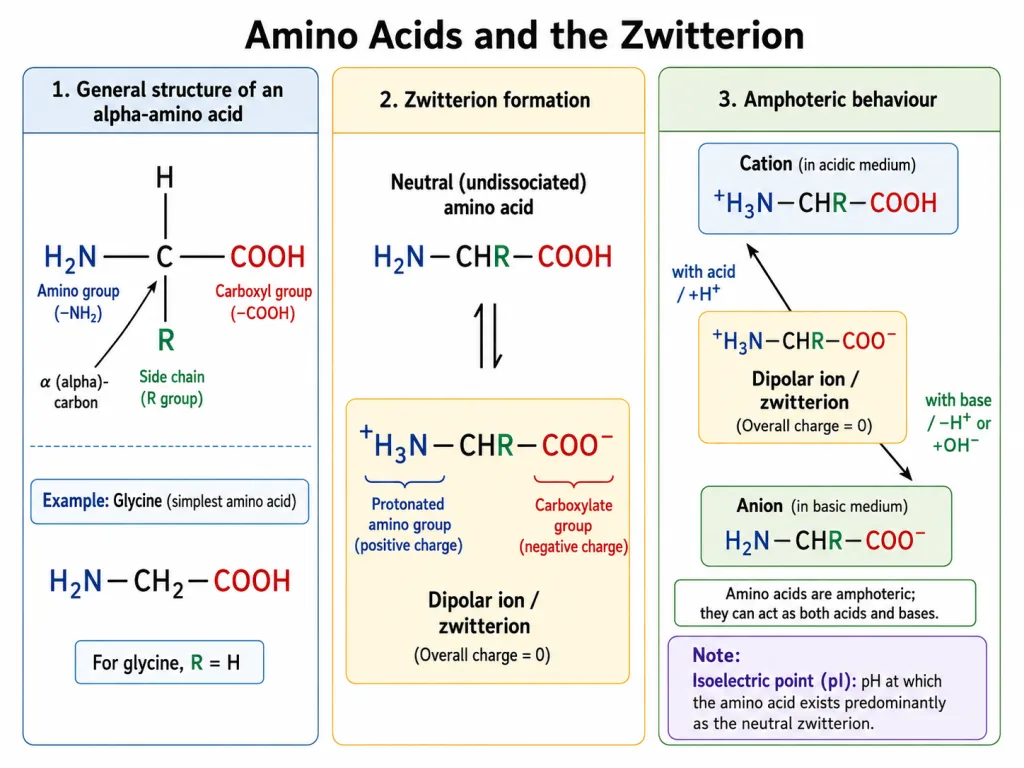
Key Point: amino acids exist as zwitterions (⁺HN-CHR-COO⁻); they are amphoteric (react with both acids and bases); the isoelectric point is the pH of the neutral zwitterion.
Physical Properties from the Zwitterion
The zwitterionic (ionic) nature explains the unusual physical properties of amino acids:
- They are crystalline solids with high melting points (they behave like ionic salts, held together by strong electrostatic forces).
- They are generally soluble in water (the charged zwitterion interacts strongly with polar water) and insoluble in non-polar organic solvents.
- In water they can act as buffers because of their dual acid-base character.
These properties are quite unlike simple amines or carboxylic acids of comparable size, and they are a clear sign of the internal salt (zwitterion) structure.
Key Point: the zwitterion makes amino acids high-melting crystalline solids, water-soluble and able to buffer — behaving like ionic salts rather than ordinary amines or acids.
Solved Examples
Example 1: What is an alpha-amino acid?
Define an alpha-amino acid and give the simplest example.
Solution: An organic compound with an amino (-NH) and a carboxyl (-COOH) group on the same (alpha) carbon, plus a side chain R. The simplest is glycine (HN-CH-COOH) (R = H).
Example 2: Essential vs non-essential
What is the difference between essential and non-essential amino acids?
Solution: Essential amino acids cannot be synthesised by the body and must be obtained from the diet; non-essential amino acids can be made by the body.
Example 3: The zwitterion
Draw/describe the zwitterion form of glycine.
Solution: Glycine exists as the dipolar ion ⁺HN-CH-COO⁻ — the -COOH has donated its proton to the -NH, giving a positive -NH and a negative -COO⁻ in the same (overall neutral) molecule.
Example 4: Amphoteric behaviour
Why are amino acids amphoteric?
Solution: They contain both an acidic -COOH and a basic -NH group, so they can react with both acids and bases — they are amphoteric.
Example 5: Isoelectric point
Define the isoelectric point.
Solution: The pH at which an amino acid exists predominantly as the neutral zwitterion and shows no net movement toward either electrode in an electric field.
Example 6: High melting points
Why do amino acids have unusually high melting points?
Solution: Because they exist as zwitterions (internal salts); the strong electrostatic forces between the + and − ends (like an ionic solid) require a lot of energy to break, giving high melting points.
Example 7: Solubility
Why are amino acids soluble in water but not in organic solvents?
Solution: The charged zwitterion interacts strongly with polar water (ion-dipole and H-bonding) but not with non-polar organic solvents, so amino acids dissolve in water and are insoluble in organic solvents.
Example 8: Classify by side chain
Classify glutamic acid and lysine as acidic, basic or neutral.
Solution: Glutamic acid has an extra -COOH → acidic; lysine has an extra -NH → basic.
Example 9: Behaviour in acid and base
What form does an amino acid take in (a) strongly acidic and (b) strongly basic solution?
Solution: (a) In strong acid the -COO⁻ is protonated → the cation ⁺HN-CHR-COOH. (b) In strong base the -NH loses its proton → the anion HN-CHR-COO⁻.
Example 10: Why glycine is not optically active
Why is glycine the only common amino acid that is not optically active?
Solution: In glycine the alpha-carbon bears two hydrogens (R = H), so it has no four different groups — it is not chiral, hence not optically active. All other alpha-amino acids have a chiral alpha-carbon.