
The Peptide Bond & Proteins
Proteins are polymers of alpha-amino acids joined by peptide bonds. A peptide bond is the amide (-CO-NH-) linkage formed when the -COOH of one amino acid reacts with the -NH of the next, with loss of a water molecule.
Two amino acids give a dipeptide, three a tripeptide, and many a polypeptide. A protein is a polypeptide (or several polypeptides) with a defined sequence and shape that performs a biological function.
Proteins are broadly classified as:
- Fibrous proteins — thread-like, water-insoluble, structural (e.g. keratin in hair/nails, myosin in muscle).
- Globular proteins — roughly spherical, water-soluble, functional (e.g. insulin, albumin, enzymes).
Key Point: proteins are polymers of alpha-amino acids linked by peptide bonds (-CO-NH-, formed with loss of water). Fibrous proteins are structural and generally insoluble, while globular proteins are functional and generally soluble.
The Four Levels of Protein Structure
Primary structure: the exact sequence (order) of amino acids in the polypeptide chain. Even one change in this sequence can alter the protein completely.
Secondary structure: the regular local folding of the chain, stabilised by hydrogen bonds between the backbone -C=O and -N-H groups. The two main forms are the alpha-helix (a coiled spring) and the beta-pleated sheet (extended chains side by side).
Tertiary structure: the overall three-dimensional folding of a single polypeptide chain into its final shape, stabilised by several interactions — hydrogen bonds, disulphide (-S-S-) bridges, ionic and hydrophobic interactions.
Quaternary structure: the arrangement of two or more polypeptide subunits into one functional protein (e.g. haemoglobin has four subunits).
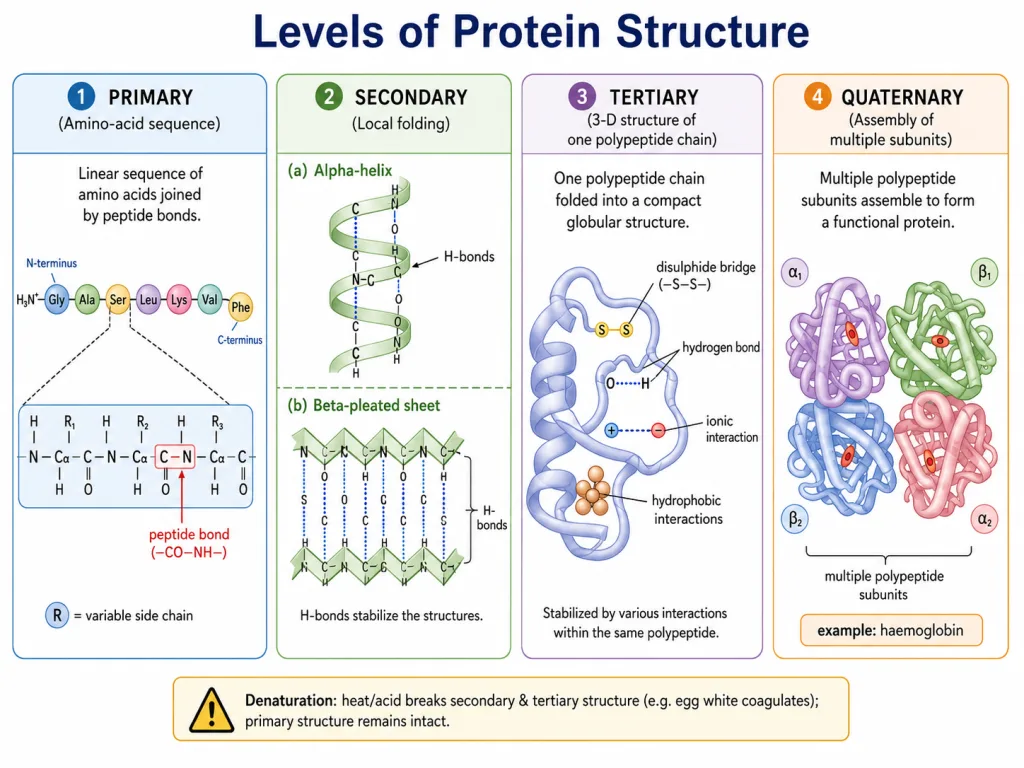
Key Point: primary = sequence; secondary = alpha-helix / beta-pleated sheet (H-bonds); tertiary = overall 3-D fold (H-bonds, S-S, ionic, hydrophobic); quaternary = arrangement of subunits.
Denaturation of Proteins
A protein in its natural, biologically active shape is called a native protein. When it is exposed to heat, acids, bases, heavy-metal ions, alcohol or other agents, the weak interactions (hydrogen bonds, etc.) that hold its 3-D shape are broken — the protein unfolds and loses its biological activity. This is called denaturation.
Crucially: in denaturation the secondary and tertiary structures are destroyed, but the primary structure (the peptide-bonded sequence) stays intact — the peptide bonds are not broken.
Everyday examples: the coagulation of egg white on boiling, and the curdling of milk, are familiar examples of protein denaturation.
Key Point: denaturation = loss of secondary/tertiary structure and biological activity (e.g. boiled egg white), while the primary structure is preserved.
Solved Examples
Example 1: What is a peptide bond?
Define a peptide bond.
Solution: The amide linkage (-CO-NH-) formed between the -COOH of one amino acid and the -NH of another, with the loss of a water molecule.
Example 2: Primary structure
What is meant by the primary structure of a protein?
Solution: The specific sequence (order) in which the amino acids are joined in the polypeptide chain.
Example 3: Secondary structure forms
Name the two types of secondary structure and the force that stabilises them.
Solution: The alpha-helix and the beta-pleated sheet, both stabilised by hydrogen bonds between backbone C=O and N-H groups.
Example 4: Tertiary structure forces
What interactions stabilise the tertiary structure of a protein?
Solution: Hydrogen bonds, disulphide (-S-S-) bridges, ionic (electrostatic) interactions and hydrophobic interactions between the side chains.
Example 5: Denaturation
What is denaturation of a protein, and what happens to the structure?
Solution: Denaturation is the loss of a protein's natural 3-D shape and biological activity on treatment with heat/acid/etc. The secondary and tertiary structures break down, but the primary structure (sequence) remains intact.
Example 6: Everyday denaturation
Give two everyday examples of denaturation.
Solution: Coagulation of egg white on boiling and curdling of milk — both involve denaturation of proteins.
Example 7: Fibrous vs globular
Distinguish fibrous and globular proteins with an example of each.
Solution: Fibrous proteins are thread-like, water-insoluble and structural (e.g. keratin); globular proteins are roughly spherical, water-soluble and functional (e.g. insulin).
Example 8: Quaternary structure
What is the quaternary structure of a protein? Give an example.
Solution: The arrangement of two or more polypeptide chains (subunits) into one functional protein, e.g. haemoglobin (four subunits).
Example 9: Number of amino acids in a tripeptide
How many amino acids and peptide bonds are in a tripeptide?
Solution: Three amino acids joined by two peptide bonds.
Example 10: What is preserved on denaturation?
When milk curdles, which level of protein structure is NOT destroyed?
Solution: The primary structure (the amino-acid sequence / peptide bonds) is not destroyed — only the secondary and tertiary structures are lost.