
The Glycosidic Linkage & Disaccharides
When two monosaccharides join, the -OH of the anomeric carbon of one reacts with the -OH of the other, losing a water molecule and forming a C-O-C bridge called a glycosidic linkage. This is how disaccharides (and polysaccharides) are built.
The three important disaccharides (all CHO):
- Sucrose = glucose + fructose (cane/table sugar). Both anomeric carbons are involved in the linkage, so sucrose is non-reducing.
- Maltose = glucose + glucose. One anomeric carbon is free → reducing.
- Lactose = glucose + galactose (milk sugar). Has a free anomeric carbon → reducing.
Key Point: glycosidic linkage = C-O-C bridge (loss of water) joining sugars. Sucrose (glucose+fructose) is non-reducing; maltose (glucose+glucose) and lactose (glucose+galactose) are reducing.
Invert Sugar & Hydrolysis of Sucrose
Sucrose is dextrorotatory (it rotates plane-polarised light to the right, +66.5°). On hydrolysis (by acid or the enzyme invertase) it gives an equimolar mixture of glucose (+52.5°) and fructose (−92.4°).
Because fructose's strong laevorotation outweighs glucose's dextrorotation, the mixture becomes laevorotatory overall. So the sign of rotation changes from (+) to (−) during hydrolysis — and the product is called invert sugar, and the process inversion.
[JEE Tip] This sign change (dextro → laevo) is a favourite exam point: sucrose itself is non-reducing and dextrorotatory, but its hydrolysis product (invert sugar) is reducing and laevorotatory.
Key Point: sucrose (dextro, +66.5°) hydrolyses to glucose + fructose; fructose's −92.4° dominates, so the mixture is laevorotatory — "invert sugar".
Polysaccharides — Starch, Glycogen & Cellulose
Polysaccharides are long chains of monosaccharide units joined by glycosidic linkages. They are the storage and structural carbohydrates.
- Starch (the storage carbohydrate of plants) is a mixture of two components: amylose (about 15-20%, a water-soluble, linear chain of alpha-glucose units) and amylopectin (about 80-85%, water-insoluble, a branched chain of alpha-glucose units).
- Glycogen (the storage carbohydrate of animals, "animal starch") is a highly branched polymer of alpha-glucose, stored in the liver and muscles.
- Cellulose (the structural material of plant cell walls) is a straight-chain polymer of beta-glucose units. Humans cannot digest it (we lack the enzyme to break the beta-linkage), so it is dietary fibre.
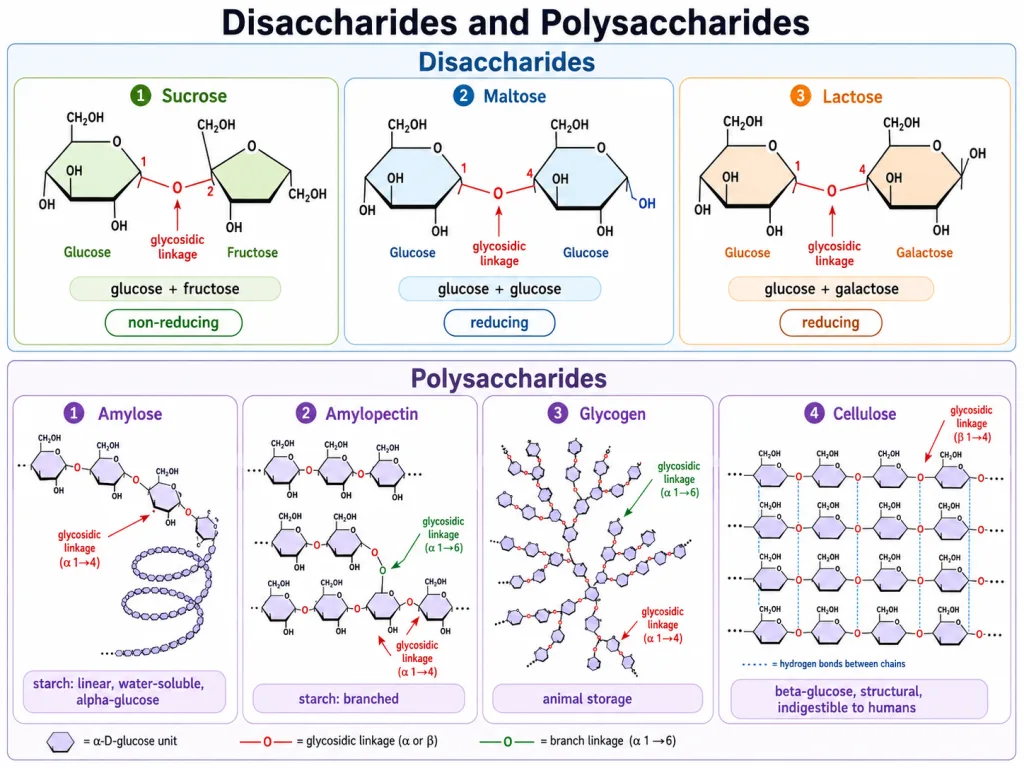
Key Point: starch = amylose (linear, soluble) + amylopectin (branched) of alpha-glucose (plant store); glycogen = branched alpha-glucose (animal store); cellulose = linear beta-glucose (plant structure, indigestible to humans).
Solved Examples
Example 1: What is a glycosidic linkage?
Define the glycosidic linkage.
Solution: The C-O-C bridge formed (with loss of a water molecule) between two monosaccharide units when the anomeric -OH of one reacts with an -OH of the other.
Example 2: Components of sucrose
What monosaccharides make up sucrose, maltose and lactose?
Solution: Sucrose = glucose + fructose; maltose = glucose + glucose; lactose = glucose + galactose.
Example 3: Invert sugar
Why is the product of sucrose hydrolysis called invert sugar?
Solution: Sucrose is dextrorotatory (+), but on hydrolysis the strongly laevorotatory fructose (−92.4°) outweighs the dextrorotatory glucose (+52.5°), so the mixture becomes laevorotatory (−). The inversion of the sign of rotation gives the name invert sugar.
Example 4: Amylose vs amylopectin
State two differences between amylose and amylopectin.
Solution: Amylose is a linear (unbranched) chain of alpha-glucose and is water-soluble (about 15-20% of starch). Amylopectin is a branched chain of alpha-glucose and is water-insoluble (about 80-85% of starch).
Example 5: Starch vs cellulose
Give the key structural difference between starch and cellulose.
Solution: Starch is made of alpha-glucose units (and is digestible by humans); cellulose is made of beta-glucose units (and is not digestible by humans, who lack the enzyme to hydrolyse the beta-linkage).
Example 6: Storage carbohydrates
Name the storage carbohydrate of plants and of animals.
Solution: Starch is the storage carbohydrate of plants; glycogen ("animal starch") is the storage carbohydrate of animals (liver and muscles).
Example 7: Reducing or not?
Is sucrose a reducing sugar? Why?
Solution: No. In sucrose both anomeric carbons (of glucose and fructose) are involved in the glycosidic linkage, so there is no free reducing group; sucrose is non-reducing.
Example 8: Why can't humans digest cellulose?
Explain why humans cannot digest cellulose.
Solution: Cellulose has beta-glycosidic linkages between beta-glucose units; humans lack the enzyme (cellulase) needed to hydrolyse these linkages, so cellulose passes through as dietary fibre.
Example 9: Identify the disaccharide
A reducing disaccharide on hydrolysis gives only glucose. Name it.
Solution: Maltose — it is a reducing disaccharide made of two glucose units.
Example 10: Enzyme for sucrose
Name the enzyme that hydrolyses sucrose and the products formed.
Solution: Invertase hydrolyses sucrose into glucose + fructose (invert sugar).