
What Are Carbohydrates?
Carbohydrates are polyhydroxy aldehydes or polyhydroxy ketones, or compounds that give these on hydrolysis. The name comes from "hydrates of carbon" (many have the formula Cx(HO)y, e.g. glucose CHO), though this is not a strict rule.
They are among the most abundant organic molecules in nature — examples include glucose, fructose, sucrose (cane sugar), starch and cellulose. Chemically, most are also called saccharides (sugars), and many of the simpler ones taste sweet.
Key Point: carbohydrates = polyhydroxy aldehydes/ketones (or substances that yield them on hydrolysis). Glucose, sucrose, starch and cellulose are all carbohydrates.
Classification by Hydrolysis
Carbohydrates are classified by how many sugar units they give on hydrolysis:
- Monosaccharides: cannot be hydrolysed into simpler sugars — the simplest units. Examples: glucose, fructose, ribose, galactose (about 20 occur in nature).
- Oligosaccharides: give 2 to 10 monosaccharide units on hydrolysis. The most important are the disaccharides (give 2 units), e.g. sucrose, maltose, lactose.
- Polysaccharides: give a large number of monosaccharide units on hydrolysis. Examples: starch, cellulose, glycogen. These are usually not sweet and are called non-sugars.
Key Point: monosaccharide (1 unit, can't be hydrolysed) → disaccharide (2 units) → polysaccharide (many units). Starch and cellulose are polysaccharides ("non-sugars").
Classifying Monosaccharides; Reducing vs Non-Reducing
Monosaccharides are further classified by:
- The carbonyl group: an aldose has an aldehyde group; a ketose has a keto group.
- The number of carbons: triose (3C), tetrose (4C), pentose (5C), hexose (6C). So glucose is an aldohexose (6C, aldehyde) and fructose is a ketohexose (6C, keto).
Reducing vs non-reducing sugars (a very important exam distinction):
- Reducing sugars reduce Fehling's solution and Tollens' reagent. In their open-chain form, they have a free aldehyde group; many ketoses also behave as reducing sugars because they can tautomerise to aldoses in alkaline medium. All monosaccharides and disaccharides like maltose and lactose are reducing.
- Non-reducing sugars do not reduce these reagents (no free anomeric group). Sucrose is the classic non-reducing sugar.
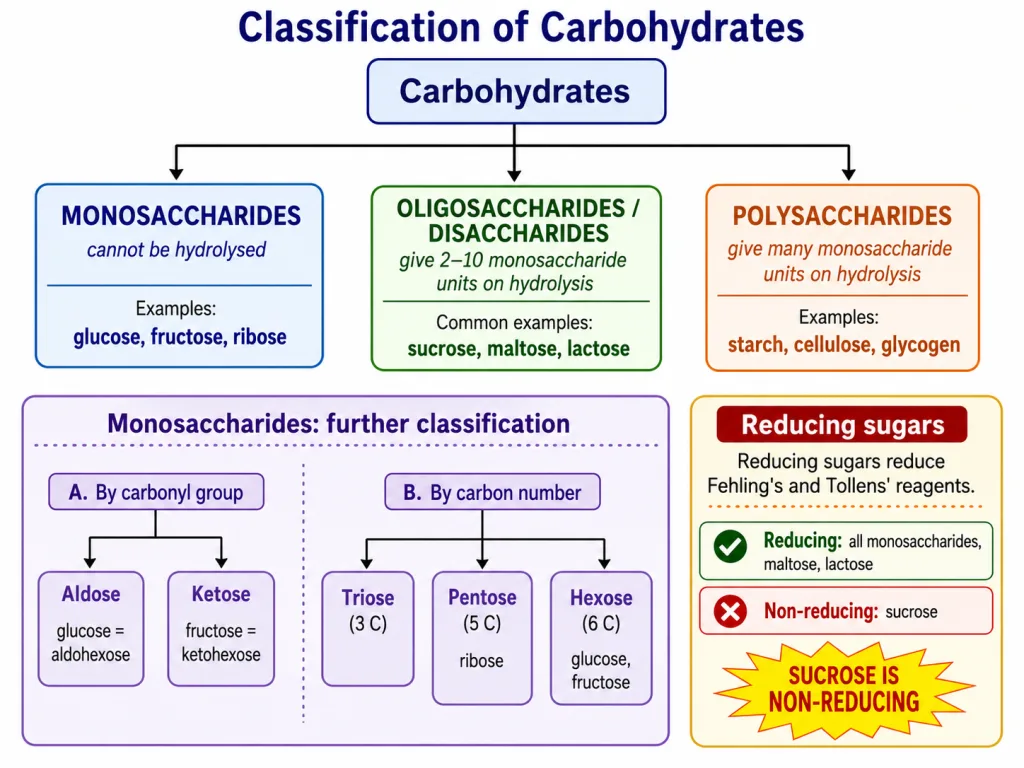
Key Point: glucose = aldohexose, fructose = ketohexose. Reducing sugars (all monosaccharides, maltose, lactose) reduce Fehling/Tollens; sucrose is non-reducing.
Solved Examples
Example 1: Define a carbohydrate
What is the chemical definition of a carbohydrate?
Solution: A polyhydroxy aldehyde or polyhydroxy ketone, or a compound that yields these on hydrolysis (e.g. glucose is a polyhydroxy aldehyde).
Example 2: Classify by hydrolysis
Classify glucose, sucrose and starch by the number of units they give on hydrolysis.
Solution: Glucose = monosaccharide (cannot be hydrolysed); sucrose = disaccharide (gives 2 units); starch = polysaccharide (gives many units).
Example 3: Aldose or ketose
Classify glucose and fructose as aldose/ketose and by carbon number.
Solution: Glucose = aldohexose (an aldehyde, 6 carbons). Fructose = ketohexose (a keto sugar, 6 carbons).
Example 4: Reducing sugar test
Which reagents does a reducing sugar reduce?
Solution: A reducing sugar reduces Fehling's solution (to red CuO) and Tollens' reagent (to a silver mirror), because it has a free aldehyde group or can form one in solution.
Example 5: Why sucrose is non-reducing
Why does sucrose not reduce Fehling's solution?
Solution: In sucrose the anomeric carbons of glucose and fructose are joined by the glycosidic linkage, so there is no free anomeric group available to act as a reducing agent — making it non-reducing.
Example 6: Maltose vs sucrose
Which of maltose and sucrose is a reducing sugar?
Solution: Maltose is reducing (it has a free anomeric -OH); sucrose is non-reducing (both anomeric carbons are tied up in the linkage).
Example 7: Identify a pentose
What type of sugar is ribose?
Solution: Ribose is an aldopentose — a monosaccharide with an aldehyde group and 5 carbons (found in RNA).
Example 8: Sugars vs non-sugars
Why are polysaccharides called "non-sugars"?
Solution: Polysaccharides like starch and cellulose are not sweet and are usually insoluble or colloidal, unlike the sweet, crystalline mono- and disaccharides ("sugars") — so they are called non-sugars.
Example 9: Number of units on hydrolysis
How many monosaccharide units does a disaccharide give on hydrolysis?
Solution: Two monosaccharide units (e.g. sucrose → glucose + fructose).
Example 10: General formula caution
Glucose has the formula CHO, fitting Cx(HO)y. Does this formula define all carbohydrates?
Solution: No. Although many carbohydrates fit Cx(HO)y, the definition is based on being a polyhydroxy aldehyde/ketone (or yielding one on hydrolysis), not on the formula — some carbohydrates do not fit the formula and some non-carbohydrates do.