
What Are Vitamins?
Vitamins are organic compounds required in small amounts in the diet for normal growth, health and metabolism. The body cannot synthesise most of them (or makes too little), so they must be supplied through food. They are denoted by letters — A, B (a group), C, D, E, K — and many act as co-factors that help enzymes work.
A deficiency of a vitamin causes a specific deficiency disease, while an excess of some (especially fat-soluble ones) can be harmful.
Key Point: vitamins are organic compounds needed in small amounts from the diet for health; a deficiency of each causes a specific disease.
Classification: Fat-Soluble vs Water-Soluble
Vitamins are classified by their solubility:
- Fat-soluble vitamins: A, D, E and K. They dissolve in fats/oils and are stored in the liver and fatty tissues. Because they are stored, they need not be supplied daily, but an excess can accumulate and become toxic.
- Water-soluble vitamins: the B group (B, B, B, B, etc.) and C. They dissolve in water and are not stored (excess is excreted in urine), so they must be supplied regularly in the diet.
[NEET Important] A common one-mark question: "Which vitamins are fat-soluble?" — remember A, D, E, K. The rest (B-complex and C) are water-soluble.
Key Point: fat-soluble = A, D, E, K (stored, can be toxic in excess); water-soluble = B-complex and C (not stored, needed regularly).
Sources & Deficiency Diseases
Learn these classic vitamin-deficiency disease pairs (very high-yield):
- Vitamin A (sources: carrots, fish-liver oil, milk) — deficiency causes night blindness and xerophthalmia.
- Vitamin B (thiamine) — deficiency causes beriberi.
- Vitamin B (riboflavin) — deficiency causes cheilosis (cracking of lips/tongue).
- Vitamin B (pyridoxine) — deficiency causes convulsions.
- Vitamin B — deficiency causes pernicious anaemia.
- Vitamin C (ascorbic acid) (sources: citrus fruits, amla) — deficiency causes scurvy (bleeding gums).
- Vitamin D (sunlight, fish-liver oil) — deficiency causes rickets (children) and osteomalacia (adults).
- Vitamin E (vegetable oils) — deficiency causes muscular weakness/increased fragility of red blood cells.
- Vitamin K (green leafy vegetables) — deficiency causes poor blood clotting (haemorrhage).
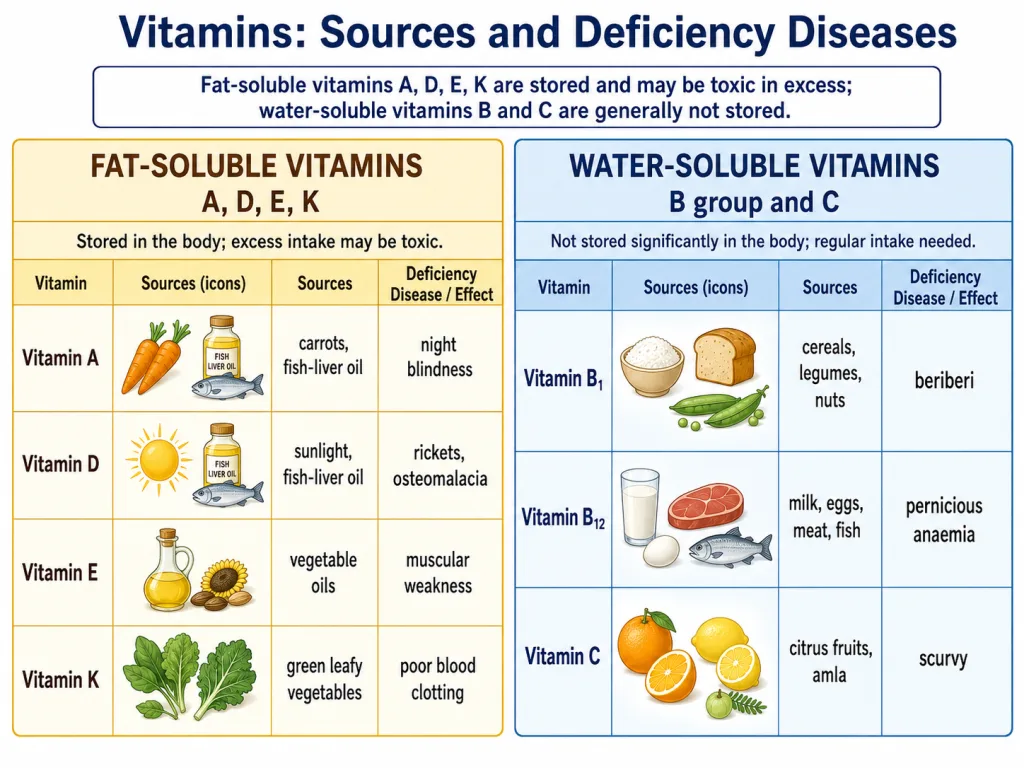
Key Point: A → night blindness; B → beriberi; B → pernicious anaemia; C → scurvy; D → rickets/osteomalacia; K → poor blood clotting.
Solved Examples
Example 1: Define a vitamin
What is a vitamin?
Solution: An organic compound required in small amounts in the diet for normal growth and health, which the body cannot synthesise in adequate amounts.
Example 2: Fat-soluble vitamins
Name the fat-soluble vitamins.
Solution: A, D, E and K are fat-soluble.
Example 3: Scurvy
Which vitamin's deficiency causes scurvy, and name a source.
Solution: Vitamin C (ascorbic acid) — its deficiency causes scurvy; sources include citrus fruits and amla.
Example 4: Night blindness
A person suffers from night blindness. Which vitamin is deficient?
Solution: Vitamin A — its deficiency causes night blindness (and xerophthalmia).
Example 5: Why must vitamin C be taken regularly?
Why should water-soluble vitamins like C be supplied regularly?
Solution: Because they are water-soluble and not stored in the body (the excess is excreted in urine), so they must be provided regularly through the diet.
Example 6: Rickets
Which vitamin deficiency causes rickets, and how can it be prevented?
Solution: Vitamin D deficiency causes rickets (in children); it can be prevented by sunlight exposure (the skin makes vitamin D) and foods like fish-liver oil.
Example 7: Stored vitamins
Which vitamins can accumulate to toxic levels, and why?
Solution: The fat-soluble vitamins (A, D, E, K) — because they are stored in the liver and fatty tissue, an excess can build up and become toxic (unlike water-soluble vitamins, which are excreted).
Example 8: Beriberi & pernicious anaemia
Which vitamins are linked to beriberi and to pernicious anaemia?
Solution: Vitamin B (thiamine) deficiency causes beriberi; vitamin B deficiency causes pernicious anaemia.
Example 9: Blood clotting
A patient bleeds excessively because blood does not clot properly. Which vitamin is likely deficient?
Solution: Vitamin K — it is needed for normal blood clotting, and its deficiency leads to excessive bleeding (haemorrhage).
Example 10: Classify a vitamin
Is vitamin B fat-soluble or water-soluble? What follows from this?
Solution: Water-soluble (a B-group vitamin). So it is not stored and any excess is excreted — it should be supplied regularly in the diet.