
Enzymes — Nature's Catalysts
Enzymes are biological catalysts that speed up the thousands of chemical reactions in living cells. Almost all enzymes are globular proteins; a few RNA molecules also have catalytic activity.
Like all catalysts, an enzyme lowers the activation energy of a reaction, providing an easier pathway, so the reaction goes much faster — often a million-fold or more — without the enzyme itself being used up.
Enzymes are named (mostly) by adding -ase to the name of the substrate or the reaction: maltase hydrolyses maltose, urease acts on urea, oxidases carry out oxidations.
Key Point: enzymes are biological catalysts (mostly globular proteins) that lower the activation energy and hugely speed up cellular reactions; they are typically named with the suffix -ase.
Specificity & the Active Site
The most striking property of enzymes is their high specificity — a given enzyme usually catalyses one particular reaction of one particular substrate. For example, urease catalyses only the hydrolysis of urea, not of other amides.
This specificity is explained by the active site of the enzyme — a region with a specific shape into which only the correct substrate fits, like a key fitting a lock (the "lock-and-key" model). The substrate binds at the active site, the reaction is catalysed, and the product is released.
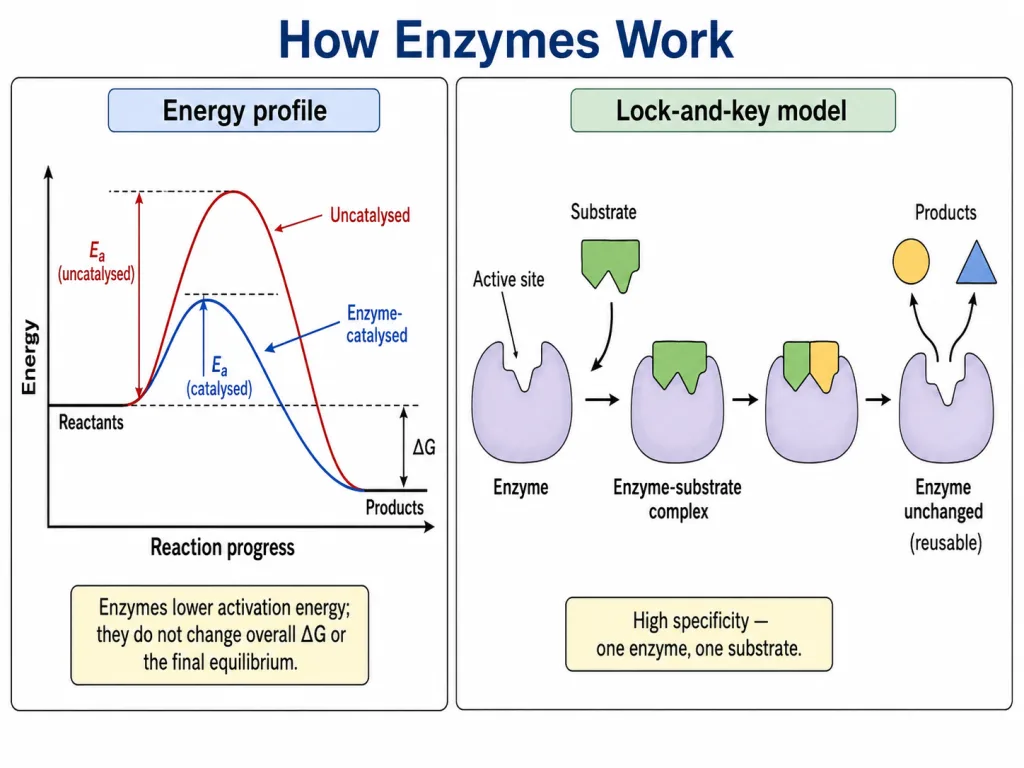
Key Point: enzymes are highly specific — the substrate fits the enzyme's active site like a key in a lock; this is why one enzyme catalyses one specific reaction.
Efficiency and Conditions
Enzymes are extraordinarily efficient — a tiny amount of enzyme can transform a large amount of substrate, and they work under the mild conditions of the body (around 37 °C, near-neutral pH, atmospheric pressure), unlike many industrial catalysts that need high temperature and pressure.
Because enzymes are proteins, their activity depends strongly on conditions:
- Temperature: activity rises with temperature up to an optimum, then falls sharply as the enzyme is denatured by heat.
- pH: each enzyme has an optimum pH; strongly acidic or basic conditions denature it.
This sensitivity is why fevers are dangerous and why digestive enzymes work best at specific pH values (e.g. pepsin in the acidic stomach).
Key Point: enzymes are highly efficient and work under mild body conditions; being proteins, they have an optimum temperature and pH and are denatured (deactivated) outside these ranges.
Solved Examples
Example 1: What are enzymes chemically?
What class of biomolecule are almost all enzymes?
Solution: Almost all enzymes are globular proteins (a few RNA molecules also act as catalysts).
Example 2: How enzymes work
How does an enzyme speed up a reaction?
Solution: It acts as a biological catalyst, lowering the activation energy of the reaction (providing an easier pathway), so the reaction proceeds much faster — without the enzyme being consumed.
Example 3: Specificity
What is meant by the specificity of an enzyme?
Solution: An enzyme usually catalyses only one particular reaction of one particular substrate (e.g. urease acts only on urea) — it does not catalyse other reactions.
Example 4: Lock-and-key
Explain the lock-and-key model of enzyme action.
Solution: The enzyme's active site has a specific shape into which only the matching substrate fits (like a key in a lock); binding there allows the reaction to be catalysed and the product released.
Example 5: Naming enzymes
How is the enzyme that hydrolyses maltose named?
Solution: By adding -ase to the substrate name: maltase (it hydrolyses maltose). Similarly, urease acts on urea.
Example 6: Effect of temperature
What happens to enzyme activity as temperature rises above the optimum?
Solution: Activity falls sharply because the enzyme (a protein) is denatured by the heat, losing its active-site shape.
Example 7: Mild conditions
Why are enzymes considered remarkable catalysts compared with industrial ones?
Solution: They are extremely efficient and work under mild conditions (about 37 °C, near-neutral pH, normal pressure), whereas many industrial catalysts need high temperature and pressure.
Example 8: Effect of pH
Why does each enzyme have an optimum pH?
Solution: Enzymes are proteins; their active-site shape depends on pH. Away from the optimum pH, the enzyme is denatured/deactivated, so activity drops.
Example 9: One enzyme, one reaction
Urease catalyses the hydrolysis of urea but not of other amides. What property does this show?
Solution: It shows the enzyme's high specificity — it acts only on its specific substrate.
Example 10: Activation energy
Does an enzyme change the position of equilibrium of a reaction?
Solution: No. Like any catalyst, an enzyme only loweres the activation energy and speeds up the attainment of equilibrium; it does not change the equilibrium position.