
Open-Chain Structure of Glucose
Glucose (D-(+)-glucose, dextrose) is the most important monosaccharide. Its open-chain structure is a straight six-carbon chain with:
- an aldehyde group (-CHO) at C-1 (so it is an aldohexose),
- five -OH groups (on C-2, C-3, C-4, C-5 and a -CHOH at C-6).
Evidence for this structure (NCERT): glucose forms a pentaacetate (five -OH groups), gives an oxime and HCN addition (a carbonyl group), and on mild oxidation gives a carboxylic acid (gluconic acid) with the same six carbons (an aldehyde). Its configuration is the D-(+) form (the -OH on the highest-numbered chiral carbon, C-5, is on the right in the Fischer projection).
Key Point: glucose = an aldohexose: a 6-carbon straight chain with -CHO at C-1, four secondary -OH groups and a terminal -CHOH; it is D-(+)-glucose.
Cyclic Structure, Anomers & Mutarotation
The open-chain structure does not explain everything (e.g. glucose does not give the Schiff's test or react with NaHSO like a normal aldehyde). The reason: in solution glucose exists mainly as a cyclic hemiacetal — the C-5 -OH adds across the C-1 aldehyde to form a six-membered ring (pyranose form).
The anomeric carbon and anomers: ring closure makes C-1 a new chiral centre (the anomeric carbon). The new -OH at C-1 can point down (alpha) or up (beta), giving two anomers — alpha-D-glucose and beta-D-glucose (drawn as Haworth projections).
Mutarotation: when either pure anomer is dissolved in water, its optical rotation gradually changes until it reaches a constant value, because the alpha and beta forms interconvert through the small amount of open-chain aldehyde present. This change in rotation is called mutarotation.
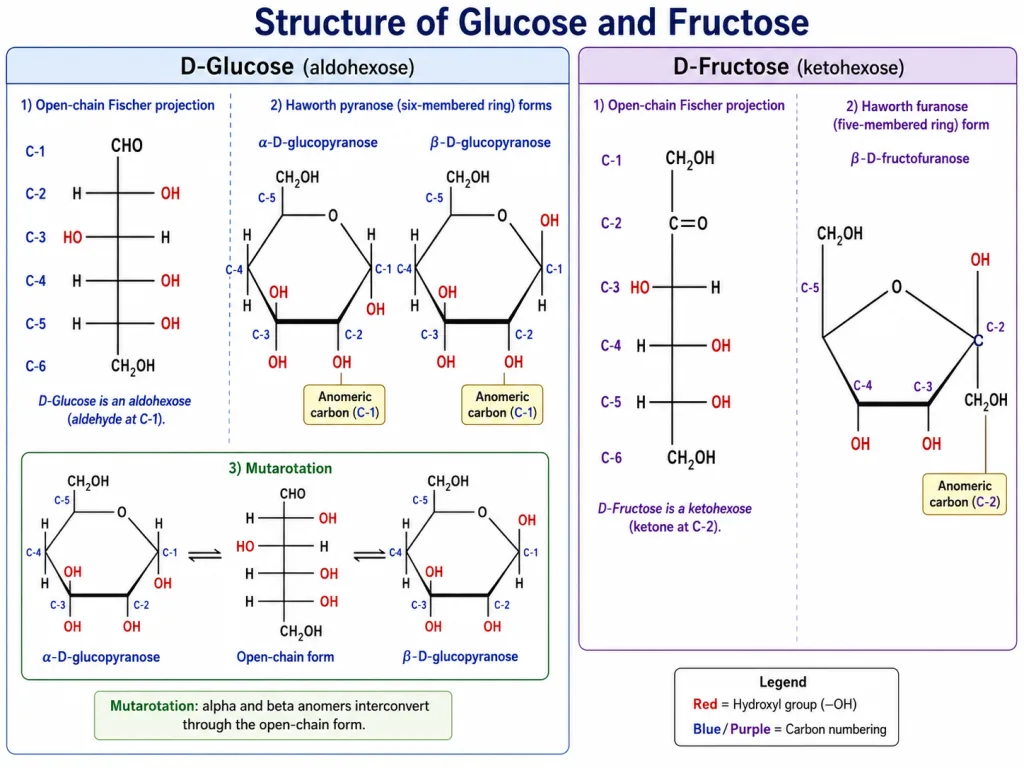
Key Point: glucose cyclises to a pyranose hemiacetal; C-1 becomes the anomeric carbon giving alpha/beta anomers; their interconversion in water is mutarotation.
Structure of Fructose
Fructose (D-(−)-fructose) is a ketohexose — a six-carbon sugar with a keto group at C-2 (not an aldehyde). It has the same molecular formula as glucose (CHO) but a different functional group.
In its cyclic form, fructose forms a five-membered ring (furanose form) — the C-5 -OH adds to the C-2 keto group, making C-2 the anomeric carbon.
[NEET Important] Even though fructose is a ketose, it is a reducing sugar (it reduces Fehling's and Tollens'). This is because under the basic conditions of these tests, the ketose isomerises (via an enediol) to an aldose, which then reduces the reagent. So "ketones don't reduce Tollens" does not apply to fructose here.
Key Point: fructose = ketohexose (keto at C-2), cyclises to a furanose (5-membered) ring; it is still a reducing sugar (it isomerises to an aldose in base).
Solved Examples
Example 1: Functional groups of glucose
State the carbonyl and number of hydroxyl groups in open-chain glucose.
Solution: An aldehyde (-CHO) at C-1 and five hydroxyl (-OH) groups (four secondary -OH groups and one primary -OH group in the terminal -CHOH). Hence glucose is an aldohexose.
Example 2: Evidence of -OH groups
What reaction shows that glucose has five -OH groups?
Solution: Glucose forms a pentaacetate with acetic anhydride — the formation of five acetate (ester) groups shows there are five -OH groups.
Example 3: Anomers
What are anomers? Name the two anomers of glucose.
Solution: Anomers are cyclic sugars that differ only in the configuration of the -OH at the anomeric carbon (C-1). The two anomers of glucose are alpha-D-glucose and beta-D-glucose.
Example 4: Mutarotation
Define mutarotation.
Solution: Mutarotation is the gradual change in optical rotation of a freshly prepared solution of a pure anomer (alpha or beta) until it reaches a constant equilibrium value, due to the interconversion of the alpha and beta forms through the open-chain form.
Example 5: Glucose vs fructose
How do glucose and fructose differ in functional group and ring size?
Solution: Glucose is an aldohexose (-CHO at C-1) and cyclises to a six-membered pyranose ring. Fructose is a ketohexose (keto at C-2) and cyclises to a five-membered furanose ring.
Example 6: Why fructose reduces Tollens
Fructose is a ketose, yet it reduces Tollens' reagent. Explain.
Solution: In the basic medium of the test, fructose isomerises through an enediol to an aldose (glucose/mannose), which has a free aldehyde group that reduces the reagent — so fructose acts as a reducing sugar.
Example 7: Anomeric carbon
Which carbon is the anomeric carbon in cyclic glucose and in cyclic fructose?
Solution: In glucose the anomeric carbon is C-1 (the former aldehyde carbon); in fructose it is C-2 (the former keto carbon).
Example 8: Why glucose fails some aldehyde tests
Why does glucose not give the Schiff's test or react with sodium bisulphite?
Solution: Because in solution glucose exists almost entirely in the cyclic hemiacetal form, with only a trace of the free aldehyde present — so it does not give these typical aldehyde reactions.
Example 9: D-configuration
What does the "D" in D-glucose refer to?
Solution: It refers to the configuration of the -OH on the highest-numbered chiral carbon (C-5) — in the D-form this -OH is on the right in the Fischer projection (the same configuration as D-glyceraldehyde).
Example 10: Oxidation evidence
On mild oxidation glucose gives gluconic acid (a six-carbon monocarboxylic acid). What does this prove?
Solution: It proves glucose has a terminal aldehyde group (-CHO) (only the aldehyde is oxidised to -COOH), and that the carbon chain is six carbons and unbranched.