
Nucleic Acids & Their Building Blocks
Nucleic acids are the molecules that store and transmit genetic information. There are two kinds: DNA (deoxyribonucleic acid) and RNA (ribonucleic acid). They are long-chain polymers of units called nucleotides (so they are also called polynucleotides).
Each nucleotide is built from three components:
- a pentose sugar — deoxyribose in DNA, ribose in RNA;
- a nitrogenous base — a purine (adenine A, guanine G) or a pyrimidine (cytosine C, thymine T in DNA, uracil U in RNA);
- a phosphate group (phosphoric acid).
Key Point: nucleic acids (DNA, RNA) are polymers of nucleotides; each nucleotide = pentose sugar + nitrogenous base + phosphate.
Nucleoside vs Nucleotide; DNA vs RNA
A very common exam distinction:
- Nucleoside = sugar + base (no phosphate).
- Nucleotide = sugar + base + phosphate (a nucleoside with a phosphate; the repeating unit of nucleic acids).
The sugar and phosphate form the backbone, with the bases sticking out.
Differences between DNA and RNA:
| Feature | DNA | RNA |
|---|---|---|
| Sugar | deoxyribose | ribose |
| Bases | A, G, C, T | A, G, C, U |
| Strands | usually double-stranded | usually single-stranded |
| Role | stores genetic information | protein synthesis |
Key Point: nucleoside = sugar + base; nucleotide = sugar + base + phosphate. DNA has deoxyribose + thymine and is double-stranded; RNA has ribose + uracil and is single-stranded.
The Double Helix, Base Pairing & Functions
DNA's structure (Watson and Crick): DNA is a double helix — two polynucleotide strands coiled around each other. The strands are held together by hydrogen bonds between the bases, which pair in a strict complementary way:
- Adenine (A) pairs with Thymine (T) — two hydrogen bonds.
- Guanine (G) pairs with Cytosine (C) — three hydrogen bonds.
(In RNA, A pairs with U instead of T.)
Biological functions:
- Replication: the complementary base pairing lets DNA make exact copies of itself, so genetic information is passed on during cell division.
- Protein synthesis: DNA directs the making of proteins. The information is transcribed into messenger RNA (mRNA) and then translated (with the help of tRNA and ribosomes) into the sequence of amino acids in a protein.
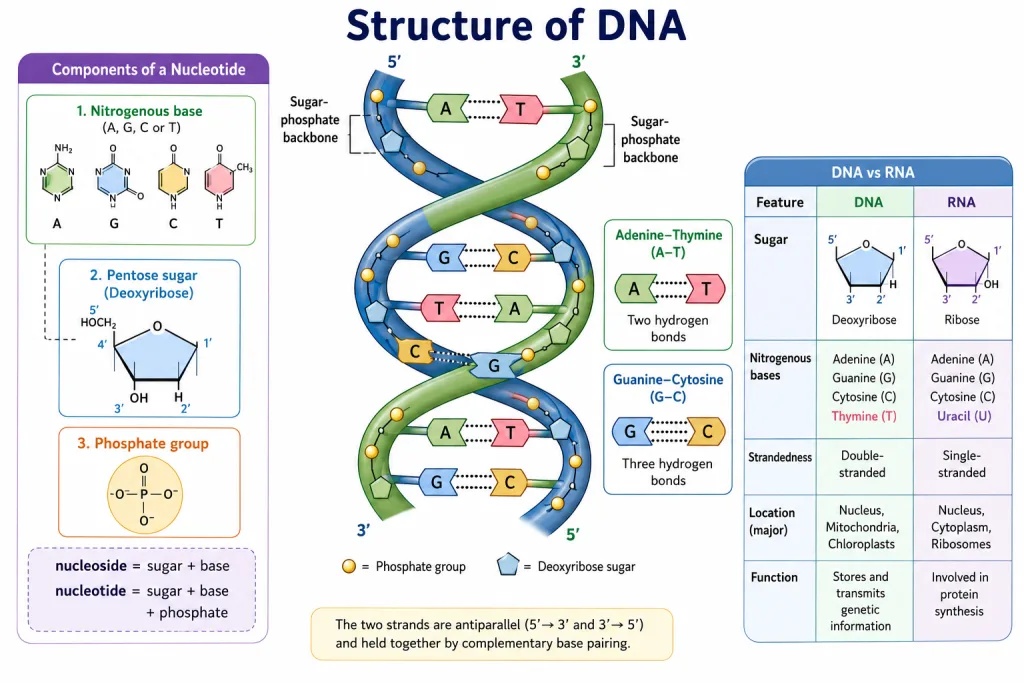
Key Point: DNA is a double helix with complementary base pairing A-T and G-C (held by H-bonds). Its functions are replication (copying genes) and directing protein synthesis (transcription then translation).
Solved Examples
Example 1: Components of a nucleotide
What are the three components of a nucleotide?
Solution: A pentose sugar, a nitrogenous base and a phosphate group.
Example 2: Nucleoside vs nucleotide
What is the difference between a nucleoside and a nucleotide?
Solution: A nucleoside is sugar + base; a nucleotide is sugar + base + phosphate (a nucleoside plus a phosphate group).
Example 3: DNA vs RNA sugar and bases
Give two differences between DNA and RNA.
Solution: DNA contains the sugar deoxyribose and the base thymine and is usually double-stranded; RNA contains ribose and the base uracil and is usually single-stranded.
Example 4: Base pairing
State the complementary base-pairing rules in DNA.
Solution: Adenine pairs with Thymine (A-T) and Guanine pairs with Cytosine (G-C), held by hydrogen bonds.
Example 5: Purines and pyrimidines
Classify the DNA bases as purines or pyrimidines.
Solution: Purines: adenine (A) and guanine (G) (double-ring bases). Pyrimidines: cytosine (C) and thymine (T) (single-ring bases).
Example 6: Complementary strand
If one DNA strand reads A-T-G-C, what is the sequence of the complementary strand?
Solution: Pair A with T, T with A, G with C, C with G → the complementary strand reads T-A-C-G.
Example 7: Functions of DNA
State the two main biological functions of DNA.
Solution: Replication (making exact copies of itself so genetic information is passed to daughter cells) and directing protein synthesis (via transcription to mRNA and translation).
Example 8: The base unique to RNA
Which base is present in RNA but not in DNA, and vice versa?
Solution: Uracil (U) is in RNA (not DNA); thymine (T) is in DNA (not RNA). The other three bases (A, G, C) are common to both.
Example 9: Backbone of nucleic acids
What forms the backbone of a nucleic acid chain?
Solution: Alternating sugar and phosphate groups form the backbone, with the nitrogenous bases projecting from it.
Example 10: Transcription and translation
In protein synthesis, what are transcription and translation?
Solution: Transcription is the copying of the DNA's information into messenger RNA (mRNA); translation is the reading of the mRNA (with tRNA and ribosomes) to assemble the sequence of amino acids of the protein.