
The Geiger-Marsden Experiment: The Set-up
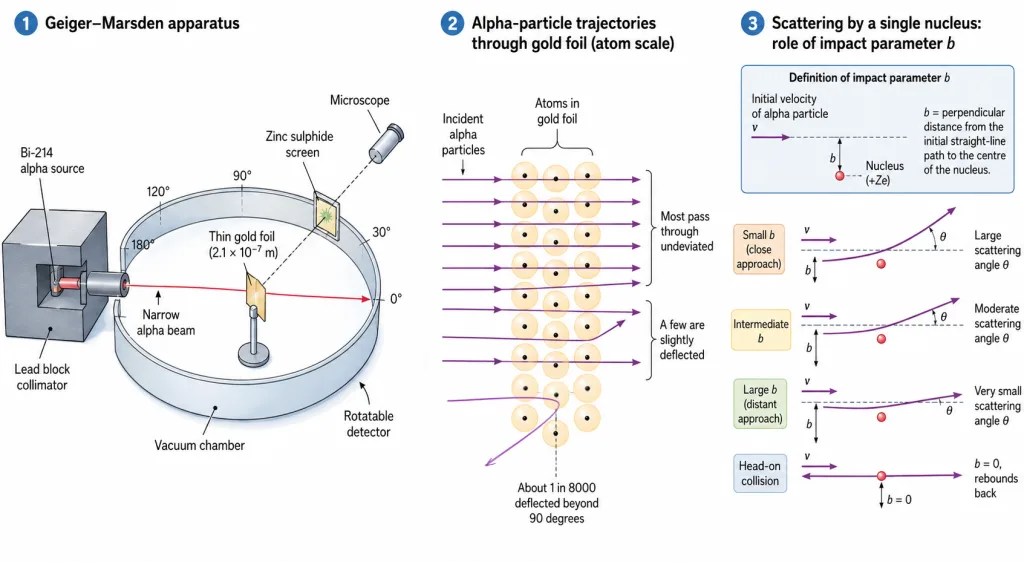
In 1911, at Rutherford's suggestion, Geiger and Marsden fired subatomic bullets at atoms and watched where they ricocheted. The components (NCERT Figs. 12.1-12.2):
- Source: alpha particles of 5.5 MeV from a Bi radioactive source. (Recall: an alpha particle is a helium nucleus — charge +2e, mass ≈ helium atom.)
- Collimation: the alphas pass through lead bricks, emerging as a narrow beam.
- Target: a thin gold foil of thickness m — thin enough that each alpha scatters at most once.
- Detector: a rotatable detector — zinc sulphide screen + microscope. Each alpha striking the screen produces a brief scintillation (light flash), counted by eye through the microscope, angle by angle.
- The entire apparatus sits in a vacuum chamber.
The results that shocked physics
- Most alpha particles passed straight through — no collision at all.
- Only about 0.14% scattered by more than 1 degree.
- About 1 in 8000 deflected by more than 90 degrees — some nearly bounced straight back.
Rutherford's famous reaction (paraphrased): it was as if a cannon shell bounced off tissue paper. In Thomson's diffuse pudding, the positive charge is spread so thin that nothing can turn a 5.5 MeV alpha around. Something in the atom must be tiny, massive and intensely charged.
Rutherford's Inference: The Nuclear Atom
To deflect an alpha particle backwards, it must experience a large repulsive force. That is possible only if the greater part of the atom's mass and its entire positive charge are concentrated tightly at the centre. Then an incoming alpha can approach very close to this concentrated charge without penetrating it, and such a close encounter produces a large deflection.
This is Rutherford's nuclear model (planetary model):
- The entire positive charge and most of the mass sit in a tiny central nucleus.
- Electrons revolve around the nucleus like planets around the sun, at distances far larger than the nuclear size.
The numbers to memorise
| Quantity | Size |
|---|---|
| Nucleus (from scattering) | to m |
| Atom (from kinetic theory) | ~ m |
| Ratio atom : nucleus | 10,000 to 100,000 |
Key Point: Most of the atom is empty space. That's why most alphas sail through untouched; only the rare alpha that comes near a nucleus meets the intense electric field that swings it through a large angle. The atomic electrons, being so light, do not appreciably affect the alphas.
The force at work
With the gold nucleus (charge , Z = 79) about 50 times heavier than the alpha (charge ), the nucleus stays essentially stationary, and the alpha's trajectory follows from Newton's second law under the Coulomb repulsion:
directed along the line joining alpha and nucleus, changing continuously in magnitude and direction as the alpha approaches and recedes.
[NEET Important] Single-scattering assumption: the foil is so thin that each alpha scatters at most once — this is why analysing one alpha vs one nucleus suffices. Directly quizzed as an assertion-reason item.
Impact Parameter and the Distance of Closest Approach
Impact parameter b
The impact parameter is the perpendicular distance of the alpha particle's initial velocity vector from the centre of the nucleus. It decides the fate of each alpha (all particles in the beam have nearly the same kinetic energy but a spread of b):
- Small b (close aim): large scattering angle.
- b ≈ 0 (head-on): minimum impact parameter — the alpha rebounds back ().
- Large b (wide miss): nearly undeviated ().
That only a small fraction rebound confirms that head-on collisions are rare — i.e. the mass and positive charge occupy a small volume.
Distance of closest approach (head-on collision)
For a head-on alpha that momentarily stops at centre-to-centre distance d, energy conservation converts all kinetic energy into electrostatic potential energy:
NCERT's worked case (Example 12.2): the most energetic natural alphas have K = 7.7 MeV = J. Then m, and for gold (Z = 79): d = m = 30 fm (1 fermi = m).
Since the actual gold nuclear radius is ~6 fm, the alpha turns back without ever touching the nucleus — d is an upper limit on nuclear size. Rutherford scattering is thus a powerful way to bound the nucleus from above.
[JEE Tip] Scaling instincts: — double the alpha energy, halve the closest approach; heavier target (larger Z), larger d. And the classic solar-system analogy (NCERT Example 12.1): if the Earth-Sun system shared the atom's proportions (orbit = × central-body radius), Earth would orbit at m — over 100 times its actual distance. An atom is emptier than the solar system.
Solved Examples
Example 1: Closest approach for a 7.7 MeV alpha (NCERT Example 12.2)
Find the distance of closest approach of a 7.7 MeV alpha particle to a gold nucleus (Z = 79).
Solution:
- Energy conservation: .
- Substitute: .
- Calculate: m = 30 fm.
- Interpretation: the actual gold nucleus radius is ~6 fm, so the alpha stops well outside the nucleus — d is an upper bound on nuclear size.
Example 2: The emptiness of the atom (NCERT Example 12.1)
If the solar system had the atom's proportions (electron orbit m, nucleus m; Sun's radius m), how far would Earth orbit?
Solution:
- Atomic ratio: .
- Scaled orbit: m.
- Compare: actual Earth orbit = m — the scaled orbit is over 100 times larger.
- Conclusion: the atom contains a far greater fraction of empty space than the solar system.
Example 3: Scaling the closest approach [JEE Numerical]
A 5.5 MeV alpha approaches gold. Using d = 30 fm at 7.7 MeV, find its closest approach.
Solution:
- Scaling: (same Z).
- Compute: fm.
- Answer: m.
- Takeaway: lower energy stops farther out — invert the energy ratio, don't multiply it.
Example 4: Silver foil swap [JEE Numerical]
If the gold foil (Z = 79) is replaced by silver (Z = 47), same 7.7 MeV alphas, what is the new closest approach?
Solution:
- Scaling: at fixed K.
- Compute: fm.
- Answer: ≈ m.
- Takeaway: smaller nuclear charge repels less strongly — the alpha gets closer before turning.
Example 5: Reading the scattering statistics [Board Conceptual]
What do these three facts separately imply: (a) most alphas pass undeflected; (b) ~0.14% deflect beyond 1 degree; (c) ~1 in 8000 deflect beyond 90 degrees?
Solution:
- (a) Most of the atom is empty space — the alphas meet nothing substantial.
- (b) Regions of strong field are rare and small — deflecting encounters are uncommon.
- (c) Yet occasionally a huge repulsion occurs → all positive charge and mass are concentrated in a tiny volume (the nucleus); only near head-on approaches to it produce backscattering.
- Takeaway: each statistic maps to one structural claim — exams ask the mapping.
Example 6: Why electrons don't matter here
Why can the atomic electrons be ignored in analysing alpha scattering?
Solution:
- An electron's mass is ~1/7350 of the alpha's mass.
- A collision with so light a particle barely perturbs the alpha — like a bowling ball meeting dust.
- NCERT: 'the atomic electrons, being so light, do not appreciably affect the alpha-particles.' Deflection comes only from the massive, highly charged nucleus.
Example 7: Impact parameter extremes [NEET Conceptual]
Relate the impact parameter to the scattering angle for: (a) b ≈ 0, (b) small b, (c) large b.
Solution:
- (a) b ≈ 0 (head-on): the alpha stops and rebounds — (180 degrees). Minimum b, maximum deflection.
- (b) small b: close passage through an intense field — large scattering angle.
- (c) large b: distant passage, weak force — nearly undeviated, .
- Takeaway: b and move oppositely; the b- inverse pairing is a fixed exam favourite.
Example 8: Hydrogen foil thought experiment (NCERT Exercise 12.2)
If the gold foil were replaced by solid hydrogen (T < 14 K), what would the alpha scattering look like?
Solution:
- A hydrogen nucleus (proton) has mass ~1/4 of the alpha's — the target is now lighter than the projectile.
- In a collision with a lighter target, the alpha cannot bounce back; it barrels through, pushing protons aside (a heavy ball cannot rebound off a light one).
- Expected result: no large-angle scattering at all — the dramatic backscattering requires a target much heavier than the alpha.
- Takeaway: the gold nucleus being ~50× heavier than the alpha is what justifies the 'stationary nucleus' analysis.
Example 9: Closest approach for a proton [JEE Twist]
A proton with the same kinetic energy K approaches the same gold nucleus head-on. How does its closest approach compare to the alpha's?
Solution:
- General formula: where q is the projectile charge.
- Proton has q = e; alpha has q = 2e. At the same K: .
- Answer: the proton gets twice as close (15 fm vs 30 fm for the 7.7 MeV case).
- Takeaway: closest approach scales with projectile charge — mass never enters (energy is specified, not speed).
Example 10: Foil thickness and single scattering
Why must the foil be extremely thin ( m) for the analysis to work?
Solution:
- Analysis computes the trajectory of an alpha scattered by a single nucleus.
- A thin foil ensures each alpha suffers not more than one scattering during passage.
- In a thick foil, multiple scatterings would compound unpredictably, and angle statistics could no longer be compared with the one-nucleus Coulomb calculation.
- Takeaway: thin foil = clean single-scattering data = trustworthy nuclear-size inference.