
Why nh/2π? De Broglie's Standing-Wave Answer
Of Bohr's three postulates, the second is the most puzzling. Why should angular momentum come only in integral multiples of ? Bohr offered no reason — it simply worked. The French physicist Louis de Broglie explained the puzzle in 1923, ten years after the model appeared.
His idea: the orbiting electron (whose wave nature Davisson and Germer would confirm in 1927) must be seen as a particle wave — and particle waves, like waves on a plucked string, form standing waves only under resonant conditions.
The string analogy
When a string is plucked, countless wavelengths are excited — but only those that fit (nodes at the ends, whole numbers of half-wavelengths) survive as standing waves; all others interfere destructively with themselves and die out.
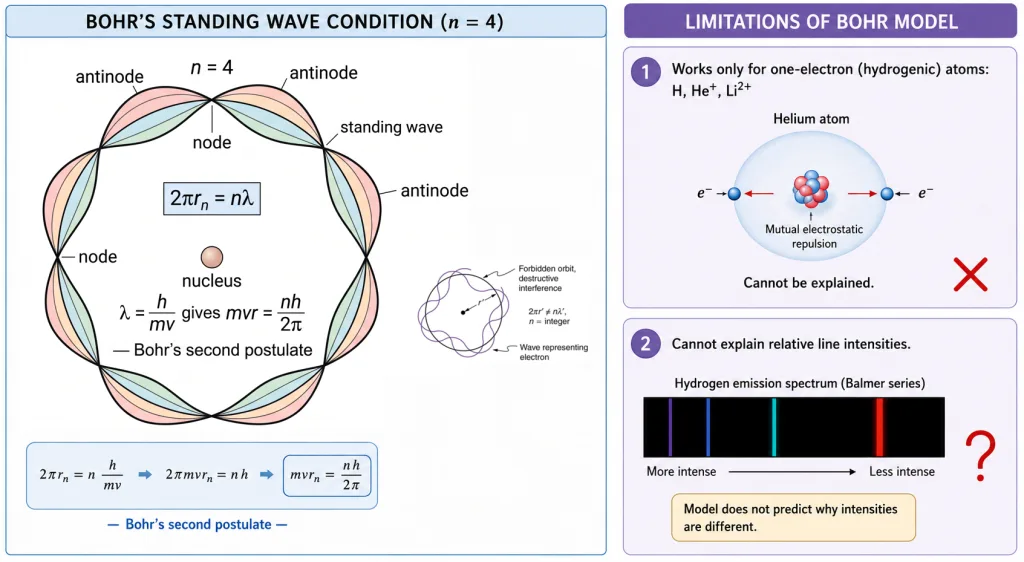
For an electron in a circular orbit of radius , the 'string' closes on itself: the wave must fit the circumference exactly:
(NCERT Fig. 12.8 shows n = 4: four de Broglie wavelengths wrapped around the orbit.)
Two lines of algebra
Substituting :
This is exactly Bohr's second postulate. The quantised orbits exist because only resonant standing electron waves persist — quantisation is the wave nature of the electron in disguise.
The Honest Audit: Limitations of Bohr's Model
Bohr's model correctly predicts the gross features of hydrogenic atoms — especially the frequencies of emitted and absorbed radiation. But NCERT lists its limits plainly:
Limitation 1: Hydrogenic atoms only
The model works for hydrogenic (one-electron) atoms: H, He, Li, … It cannot be extended even to helium (two electrons). The reason: Bohr's formulation includes only the nucleus-electron electrical force; in multi-electron atoms, each electron also interacts with all other electrons, and these electron-electron forces are comparable in magnitude to the nuclear pull (same order of charges and distances). Unlike the solar system — where planet-planet gravity is negligible next to the Sun's — the atom offers no such small parameter.
Limitation 2: No intensities
The model predicts the frequencies of hydrogen's lines but is silent on their relative intensities — why some transitions are strong and others weak. Experiment shows some transitions are 'more favoured' than others; Bohr's model cannot say why.
For complex atoms — and even for a full account of hydrogen — physics needed the radical new framework of quantum mechanics.
[NEET Important] The two limitations, verbatim, are a standard 2-marker: (i) fails for multi-electron atoms (electron-electron interactions omitted), (ii) cannot explain relative intensities of spectral lines.
Points to Ponder: The Deep Cuts — [JEE/NEET Extra Insight]
NCERT's closing reflections furnish the assertion-reason questions of tomorrow:
- Why angular momentum? Planck's constant h has the dimensions of angular momentum ([M L T]), and for circular orbits angular momentum is the natural variable — 'the second postulate is then so natural!'
- Orbits are not literal. Bohr's trajectory picture is inconsistent with the uncertainty principle; modern quantum mechanics replaces orbits with regions of high probability of finding the electron.
- Revolution frequency ≠ spectral frequency. Contrary to classical expectation, the frequency of the emitted line is , not the orbital frequency — except for transitions between very large adjacent n, where the two coincide. (This is the correspondence principle: quantum results merge into classical ones at large quantum numbers.)
- One number isn't enough. Bohr's model carries only n; full quantum mechanics characterises states by four quantum numbers (n, l, m, s) — though for the pure Coulomb potential the energy still depends only on n.
- Why keep a 'wrong' model? Three postulates account for almost all gross features of hydrogen's spectrum; the model leans on familiar classical concepts; and it shows how a physicist may deliberately set aside difficulties to extract predictions — rationalising them later if experiment agrees.
[JEE Tip] The standing-wave condition doubles as a formula: the de Broglie wavelength in the nth orbit is — proportional to n. For n = 1: m, exactly one circumference.
Solved Examples
Example 1: Deriving Bohr from de Broglie [Board Derivation]
Show that the standing-wave condition on a circular orbit yields Bohr's quantisation of angular momentum.
Solution:
- Resonance condition: the electron wave must close smoothly on itself: .
- de Broglie: (speed well below c, so p = mv).
- Substitute: .
- Rearrange: — Bohr's second postulate, derived rather than decreed. ∎
Example 2: Wavelength in the nth orbit [JEE Numerical]
Find the de Broglie wavelength of hydrogen's electron in the n = 1 and n = 4 orbits.
Solution:
- From the fit condition: .
- n = 1: m.
- n = 4: m.
- Takeaway: — one wavelength fills the first orbit, four fill the fourth (NCERT Fig. 12.8's picture).
Example 3: Why helium defeats Bohr [Board Conceptual]
Explain precisely why Bohr's model cannot handle the helium atom.
Solution:
- Helium has two electrons; each interacts with the nucleus AND with the other electron.
- Bohr's formulation includes only the nucleus-electron force; it has no machinery for electron-electron forces.
- These cannot be neglected: the charges and distances involved are of the same order, so the e-e force is comparable to the nuclear pull (NCERT Points to Ponder 4).
- Contrast: the solar system survives a similar 'many-body' worry because planet-planet gravity is genuinely tiny next to the Sun's — no analogous smallness exists in the atom.
Example 4: Standing vs travelling waves [Conceptual]
Why do non-resonant electron wavelengths not correspond to allowed orbits?
Solution:
- A wave that fails the fit condition returns to each point out of phase with itself after each circuit.
- Successive circuits interfere destructively; the amplitude 'quickly drops to zero' (NCERT's string language).
- Only wavelengths satisfying reinforce themselves — resonant standing waves persist, and these are precisely Bohr's orbits.
Example 5: Counting nodes on the n = 4 orbit [NEET Pattern]
How many de Broglie wavelengths fit around hydrogen's n = 4 orbit, and how many nodes does the standing wave have?
Solution:
- Fit condition: — four wavelengths wrap the orbit (NCERT Fig. 12.8 exactly).
- Nodes: a circular standing wave with n wavelengths has 2n nodes (each wavelength contributes two) — here 8 nodes.
- Takeaway: 'number of wavelengths = n' is the picture exams draw; count nodes as 2n if asked.
Example 6: Ratio of de Broglie wavelengths [JEE Ratio]
Find the ratio of the electron's de Broglie wavelengths in the n = 2 and n = 3 orbits of hydrogen.
Solution:
- Formula: .
- Ratio: .
- Cross-check via speeds: and → . ✔
- Takeaway: two independent routes, one answer — the mark of a consistent model.
Example 7: The correspondence check [JEE Advanced Flavour]
NCERT states that for transitions n → n-1 with very large n, the emitted frequency approaches the orbital revolution frequency. Verify the scaling.
Solution:
- Emitted frequency: for large n.
- Orbital frequency: — with matching constants, the two coincide as n → ∞.
- Takeaway: quantum → classical at large quantum numbers: Bohr's correspondence principle, NCERT Points to Ponder 6.
Example 8: What the modern picture keeps and discards [Conceptual]
According to NCERT's Points to Ponder, what happens to Bohr's orbits in modern quantum mechanics?
Solution:
- The orbital picture is inconsistent with the uncertainty principle (exact r and v simultaneously is forbidden).
- Orbits are replaced by regions where the electron may be found with large probability — probability clouds, not tracks.
- What survives: the energy levels and the transition rule — the experimentally tested content.
- Takeaway: Bohr's numbers were right; his trajectories were scaffolding.
Example 9: Momentum from the fit condition [JEE Numerical]
Using only and m, find the electron's momentum in hydrogen's ground state.
Solution:
- Wavelength: m.
- de Broglie: .
- Answer: kg m/s.
- Check: kg m/s. ✔ Geometry and dynamics agree.
Example 10: Why gravity can't rescue Bohr for helium [Conceptual]
The solar system is a many-body system, yet Newtonian 'Bohr-style' analysis of each planet works well. Why does the analogous trick fail for helium's two electrons?
Solution:
- Solar system: planet-planet gravitational forces are negligible compared with the Sun's pull — the Sun's mass dwarfs the planets'.
- Helium: the electron-electron Coulomb force is comparable to the nucleus-electron force — the charges (e vs 2e) and distances are of the same order.
- No small parameter exists to justify ignoring the e-e interaction → the one-electron machinery cannot be patched; a genuine many-body theory (quantum mechanics) is required.
- Takeaway: NCERT Points to Ponder 4, dressed as a comparison — a favourite assertion-reason setup.