
The Puzzle: What's Inside an Atom?
By the nineteenth century, the atomic hypothesis of matter was well supported. Then in 1897, J. J. Thomson's discharge-tube experiments revealed something profound: atoms of different elements all contain identical negatively charged constituents — electrons.
But atoms as a whole are electrically neutral. So every atom must also contain positive charge to balance its electrons. The million-dollar question: how are the positive charge and the electrons arranged inside the atom?
Thomson's plum pudding model (1898)
The first answer came from Thomson himself. In his model:
- The positive charge is uniformly distributed throughout the volume of the atom.
- The electrons are embedded in it — NCERT's image: like seeds in a watermelon (the model is picturesquely called the plum pudding model).
It was a reasonable first guess — and, as this chapter shows, completely wrong about how the charge is actually distributed. Science advances by testing such guesses to destruction.
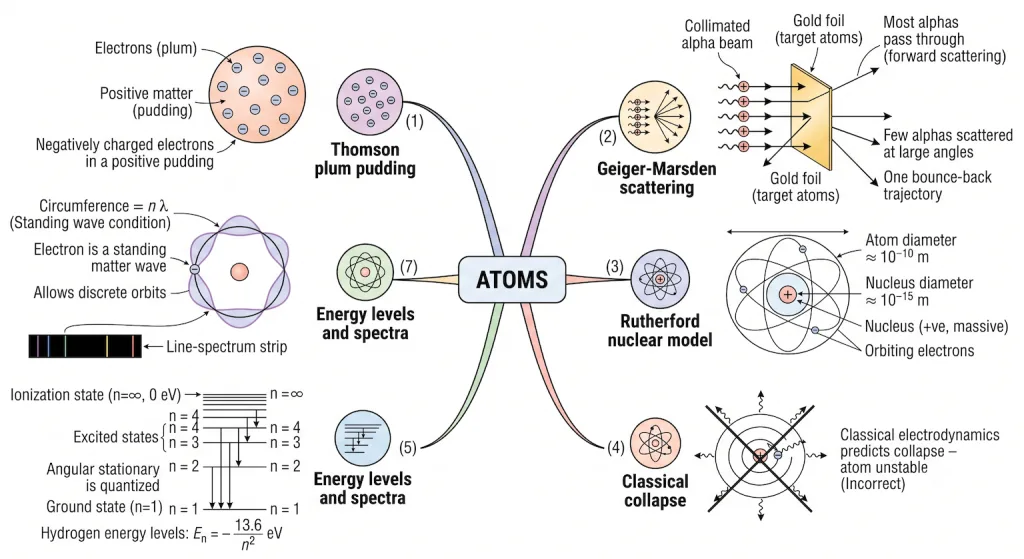
Spectra: The Atom's Fingerprint
The crucial experimental clue about atomic structure came from light.
Continuous vs line spectra
- Condensed matter (solids, liquids) and dense gases at all temperatures emit radiation with a continuous distribution of wavelengths. This radiation comes from atoms oscillating under strong interaction with their neighbours.
- Rarefied gases — heated in a flame or excited electrically in a glow tube (neon signs, mercury vapour lamps) — emit only certain discrete wavelengths: a series of bright lines. With atoms far apart, the radiation comes from individual atoms, unmodified by neighbours.
Key Point: Line spectra are the voice of the single atom. Whatever structure the atom has, it must explain why the atom sings only these exact notes.
Every element has its own spectrum
By the early nineteenth century it was established that each element has a characteristic spectrum — hydrogen always gives the same set of lines with fixed relative positions. The spectrum is a fingerprint identifying the element, and it hints at an intimate link between internal atomic structure and emitted radiation.
In 1885, Johann Jakob Balmer found a simple empirical formula for the wavelengths of a group of hydrogen lines — a formula that worked perfectly but that nobody could explain for nearly thirty years. Since hydrogen is the simplest element, its spectrum is this chapter's central case study.
[NEET Important] Match facts to names: Thomson — electrons + plum pudding (1897-98); Balmer — empirical hydrogen formula (1885); Rutherford — proposed alpha-scattering probe (1906); Geiger & Marsden — performed it (~1911). Marsden was a 20-year-old undergraduate — a favourite trivia hook.
Rutherford Enters: Probing the Atom with Alpha Particles
Ernst Rutherford (1871-1937), a former research student of J. J. Thomson, was working on alpha particles emitted by radioactive elements. In 1906 he proposed a classic experiment: scatter alpha particles off atoms to investigate atomic structure.
The experiment was performed around 1911 by Hans Geiger and Ernst Marsden (the details fill the next section). Its explanation gave birth to Rutherford's planetary model — also called the nuclear model: the entire positive charge and most of the mass concentrated in a tiny nucleus, with electrons revolving around it like planets around the sun.
But the story doesn't end there
Rutherford's model was a major step — yet it could not explain why atoms emit light of only discrete wavelengths. How could hydrogen — one electron, one proton — emit a complex spectrum of specific wavelengths? And worse, the classical picture of an orbiting electron carries the seeds of its own destruction (Section 4).
This chapter is the story of three models, each fixing its predecessor's fatal flaw:
| Model | Idea | Fatal flaw |
|---|---|---|
| Thomson (1898) | positive pudding + embedded electrons | cannot explain alpha scattering |
| Rutherford (1911) | tiny nucleus + orbiting electrons | unstable; no line spectra |
| Bohr (1913) | quantised orbits + photon jumps | works only for one-electron atoms |
[JEE Tip] Exams often quote NCERT Exercise 12.1 verbatim: Thomson and Rutherford atoms have the same size (~ m); in Thomson's ground state the electrons are in stable equilibrium, in Rutherford's they always experience a net force; a classical atom based on Rutherford's model is doomed to collapse; mass distribution is nearly continuous in Thomson's, highly non-uniform in Rutherford's; the positive part carries most mass in both models.
Solved Examples
Example 1: The watermelon test
In Thomson's model, where is the positive charge and where are the electrons?
Solution:
- The positive charge is spread uniformly over the entire atomic volume.
- Electrons are embedded within this positive sphere like seeds in a watermelon.
- The atom is neutral because the embedded electrons exactly balance the distributed positive charge.
- Takeaway: 'uniformly distributed positive charge' is the phrase that identifies Thomson in any matching question.
Example 2: Why line spectra point to single atoms [Board Conceptual]
Why do rarefied gases give line spectra while dense matter gives continuous spectra?
Solution:
- In condensed matter and dense gases, each atom interacts strongly with neighbours; the collective oscillations smear the radiation into a continuous band.
- In rarefied gases the average spacing between atoms is large — emission comes from individual, undisturbed atoms.
- Individual atoms emit only their characteristic discrete wavelengths → bright-line spectrum.
Example 3: NCERT Exercise 12.1 rapid-fire
Fill the blanks: (a) The size of the atom in Thomson's model is ….. the atomic size in Rutherford's model. (b) In the ground state of ….. electrons are in stable equilibrium, while in ….. electrons always experience a net force.
Solution:
- (a) no different from — both models give atoms of size ~ m.
- (b) Thomson's model has electrons sitting in equilibrium inside the positive pudding: Thomson's model for stable equilibrium; in Rutherford's model the orbiting electron always feels the net Coulomb pull toward the nucleus (that pull IS the centripetal force).
- Takeaway: these exact clozes appear in Boards repeatedly — learn all five parts of Exercise 12.1.
Example 4: More of Exercise 12.1
(c) A classical atom based on ….. is doomed to collapse. (d) An atom has a nearly continuous mass distribution in ….. but a highly non-uniform mass distribution in ….. (e) The positively charged part possesses most of the mass in …..
Solution:
- (c) Rutherford's model — the accelerating orbital electron must radiate and spiral in (Thomson's static electrons don't radiate).
- (d) continuous in Thomson's model; highly non-uniform in Rutherford's model (mass packed into the tiny nucleus).
- (e) both the models — in Thomson's the (massive) positive pudding fills the atom; in Rutherford's the positive nucleus carries most mass. The surprise 'both' answer is the exam's favourite trap.
Example 5: The fingerprint idea [NEET Conceptual]
A gas sample's emission spectrum matches hydrogen's line positions exactly. What can you conclude, and why?
Solution:
- Each element's line spectrum is characteristic — fixed lines with fixed relative positions.
- A perfect match with hydrogen's pattern identifies the gas as hydrogen.
- This is precisely how astronomers identify elements in stars — spectroscopy as chemical fingerprinting.
Example 6: Balmer's contribution
What exactly did Balmer achieve in 1885, and what was missing from it?
Solution:
- Balmer found a simple empirical formula giving the wavelengths of a group of lines emitted by atomic hydrogen.
- 'Empirical' means fitted to data — it predicted the lines beautifully but came with no physical explanation of why atoms obey it.
- The explanation had to wait 28 years for Bohr (1913), whose model derives Balmer's formula from first postulates.
Example 7: Who's who timeline [NEET Pattern]
Arrange chronologically: Bohr's postulates, Balmer's formula, Thomson's plum pudding, Geiger-Marsden experiment, Rutherford's scattering proposal.
Solution:
- Balmer's formula (1885) → Thomson's plum pudding (1898) → Rutherford's proposal (1906) → Geiger-Marsden experiment (~1911) → Bohr's postulates (1913).
- Memory hook: formula → pudding → proposal → proof → postulates — alliteration in discovery order.
Example 8: Emission vs absorption preview
White light passes through cool hydrogen gas. What does the transmitted spectrum look like?
Solution:
- The gas absorbs exactly those wavelengths it would itself emit.
- The transmitted light therefore shows dark lines on the continuous background — the absorption spectrum.
- The dark lines sit at precisely the positions of hydrogen's bright emission lines — same fingerprint, negative image.
Example 9: Why neutrality demands positive charge
From Thomson's 1897 findings alone, argue why the atom must contain positive charge.
Solution:
- Discharge experiments showed every atom contains negatively charged electrons, identical across elements.
- Yet bulk matter and individual atoms are electrically neutral.
- Neutrality therefore forces the atom to contain positive charge exactly balancing the electrons' total negative charge.
- Takeaway: the structure question of this chapter — how is that positive charge arranged? — follows inescapably from just two facts: electrons exist, atoms are neutral.
Example 10: Sodium lamp vs sunlight [NEET Conceptual]
A sodium vapour street lamp and the hot filament of an incandescent bulb are viewed through a spectrometer. Contrast the spectra and explain.
Solution:
- Sodium lamp: rarefied excited vapour → atoms radiate individually → discrete bright lines (dominated by the yellow doublet region).
- Filament: a hot solid → atoms strongly interacting with neighbours → continuous spectrum across all colours.
- Takeaway: phase and density of the source, not its temperature alone, decide line vs continuous character.