
From Postulate to Spectrum
Bohr's third postulate is a spectrum-generating machine. When the atom drops from a higher state to a lower state (), the energy difference leaves as one photon (Eq. 12.11):
Since both and are integers, light is radiated only at discrete frequencies — line spectra explained at a stroke.
- Emission lines: electron jumps down; photon emitted.
- Absorption lines: the atom absorbs a photon of exactly the energy needed to jump up — pass white light through the gas and dark lines appear at those frequencies.
Substituting eV gives the working formula:
or, in wavelength form — the Rydberg formula:
Bohr's model derives R from fundamental constants () — turning Balmer's mystery formula into physics. The explanation of the hydrogen spectrum was a brilliant achievement; Bohr received the 1922 Nobel Prize.
[JEE Tip] Fast photon energies without R: eV, then nm. Example: 3 → 2 gives eV → 656 nm, the famous red H-alpha line.
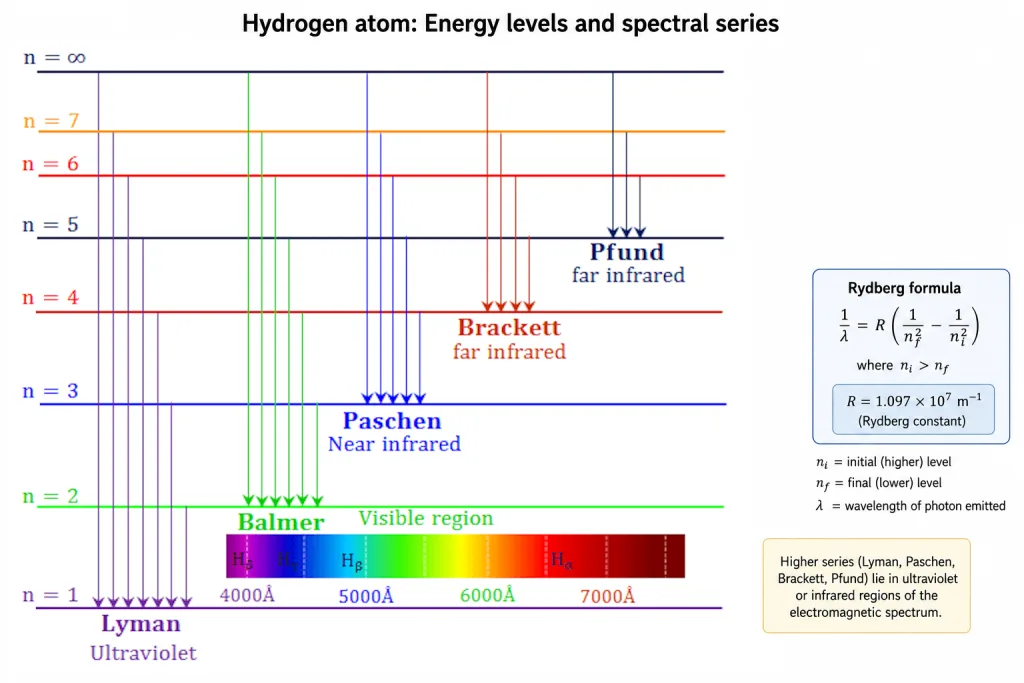
The Named Series — [JEE/NEET Important]
The rationalised NCERT trims the detailed series discussion, but Board questions still assume the names (Exercise 12.8 asks 'what series of wavelengths will be emitted') and JEE/NEET test them every year. Master this table:
| Series | Region | First line () | Series limit | ||
|---|---|---|---|---|---|
| Lyman | 1 | 2, 3, 4… | Ultraviolet | 121.6 nm (2→1) | 91.2 nm |
| Balmer | 2 | 3, 4, 5… | Visible | 656.3 nm (3→2, H) | 364.6 nm |
| Paschen | 3 | 4, 5, 6… | Infrared | 1875 nm (4→3) | 820.4 nm |
| Brackett | 4 | 5, 6, 7… | Infrared | 4051 nm (5→4) | 1459 nm |
| Pfund | 5 | 6, 7, 8… | Infrared | 7460 nm (6→5) | 2279 nm |
Anatomy of a series
- The first line ( line) is the smallest jump (): longest wavelength, lowest energy.
- The series limit is : shortest wavelength, energy = ionisation energy from level . For Lyman: → 91.2 nm ↔ 13.6 eV.
- Successive lines crowd toward the limit, mirroring the crowding of energy levels.
Why absorption shows only Lyman at room temperature
At room temperature virtually all hydrogen atoms sit in the ground state (n = 1). Absorption transitions must start where the atoms are — so only 1 → n (Lyman) absorption lines appear. Emission, fed by cascading de-excitations, shows all series.
[NEET Important] Memory hooks: Lyman-Balmer-Paschen-Brackett-Pfund = 'Lazy Bears Prefer Big Pillows'; = 1, 2, 3, 4, 5 in order. Only Balmer is visible — the series you can actually see.
Counting Lines and the 12.5 eV Problem
How many lines from level n?
An atom excited to level n can de-excite by every possible downward jump among levels 1 to n. The maximum number of distinct spectral lines:
n = 3 → 3 lines; n = 4 → 6 lines; n = 5 → 10 lines. (For a single atom descending one path the count is smaller, but a gas sample realises all combinations.)
NCERT Exercise 12.8 solved
A 12.5 eV electron beam bombards ground-state hydrogen. Section 5 showed excitation reaches n = 3. The emitted lines:
- 3 → 2 (Balmer H): eV → nm (visible, red).
- 3 → 1 (Lyman ): eV → nm (UV).
- 2 → 1 (Lyman ): eV → nm (UV).
Answer: Lyman series (two lines) and one Balmer line — lines in all.
[JEE Tip] Wavelength ratios need no constants: for the same series, for Lyman . For Balmer's first two lines: . Set up the bracket ratio and cancel R every time.
Solved Examples
Example 1: Frequency from a level difference (NCERT Exercise 12.3)
Two energy levels in an atom are separated by 2.3 eV. What is the frequency of radiation emitted in the transition between them?
Solution:
- Postulate 3: eV J.
- Solve: .
- Answer: Hz (green-yellow region).
- Takeaway: level difference ÷ h = frequency; in eV-land, nm cross-checks it.
Example 2: Photon for the n = 1 → 4 jump (NCERT Exercise 12.5)
A ground-state hydrogen atom absorbs a photon and lands in n = 4. Find the photon's wavelength and frequency.
Solution:
- Energy needed: eV.
- Wavelength: nm (ultraviolet — a Lyman absorption).
- Frequency: Hz.
- Takeaway: absorption needs the EXACT level difference — 12.75 eV, no more, no less.
Example 3: H-alpha, the red line of Balmer [NEET Numerical]
Calculate the wavelength of the first Balmer line (3 → 2).
Solution:
- Energy: eV.
- Wavelength: nm.
- Answer: ≈ 656 nm — the crimson H line that colours emission nebulae.
- Takeaway: the fraction 5/36 for 3→2 is worth memorising; with 1240, it hands you 656 nm in five seconds.
Example 4: Lyman limit = ionisation energy [Board Conceptual]
Show that the Lyman series limit corresponds to 13.6 eV, and find its wavelength.
Solution:
- Limit: , : eV.
- This is exactly the ionisation energy — the limit photon just barely frees the electron.
- Wavelength: nm.
- Takeaway: every series limit equals the ionisation energy from that series' lower level: 13.6 eV (Lyman), 3.4 eV (Balmer), 1.51 eV (Paschen).
Example 5: Longest and shortest of Balmer [JEE Numerical]
Find the longest and shortest wavelengths of the Balmer series.
Solution:
- Longest (3 → 2): E = 1.89 eV → nm.
- Shortest (∞ → 2, limit): eV → nm.
- Answer: Balmer spans 656 nm down to 365 nm — mostly visible, edging into UV.
- Takeaway: 'longest = smallest jump; shortest = series limit' — the rule for every series.
Example 6: Number of lines from n = 4 [NEET Numerical]
Hydrogen atoms are excited to n = 4. How many distinct spectral lines can the gas emit, and how do they distribute among the series?
Solution:
- Count: lines.
- Distribution: Lyman (to n=1): 4→1, 3→1, 2→1 = 3 lines; Balmer (to n=2): 4→2, 3→2 = 2 lines; Paschen (to n=3): 4→3 = 1 line.
- Check: 3 + 2 + 1 = 6. ✔
- Takeaway: the series counts always form the descending staircase (n-1), (n-2), …, 1.
Example 7: Rydberg ratio without constants [JEE Ratio]
Find the ratio of the wavelengths of Lyman-alpha (2→1) and Balmer-alpha (3→2).
Solution:
- Brackets: Lyman-: ; Balmer-: .
- Wavelength ∝ 1/bracket: .
- Check: . ✔
- Takeaway: R cancels in every intra-hydrogen ratio — never plug in for a ratio question.
Example 8: He spectrum trick [JEE Advanced Pattern]
Which He transition emits the same wavelength as hydrogen's Lyman-alpha (2→1)?
Solution:
- General formula: .
- Hydrogen 2→1 bracket: . For He (Z = 2, factor ): need .
- Try : . ✔
- Answer: He's 4 → 2 transition.
- Takeaway: doubling both n's compensates Z = 2 exactly (since is preserved) — hydrogen's (2,1) maps to He's (4,2).
Example 9: The 12.5 eV beam, complete (NCERT Exercise 12.8)
A 12.5 eV electron beam excites ground-state hydrogen. List every emitted wavelength.
Solution:
- Reachable level: up to n = 3 (needs 12.09 eV; n = 4's 12.75 eV is out of reach).
- 3 → 1: 12.09 eV → nm (Lyman-, UV).
- 2 → 1: 10.2 eV → nm (Lyman-, UV).
- 3 → 2: 1.89 eV → nm (Balmer H, visible red).
- Answer: three lines — two Lyman (UV) + one Balmer (visible).
Example 10: Which series is visible? [NEET Conceptual]
Name the spectral regions of the Lyman, Balmer and Paschen series and state which is (partly) visible.
Solution:
- Lyman (to n = 1): ultraviolet — jumps to the deep ground state are energetic.
- Balmer (to n = 2): visible (656-365 nm) — the only series our eyes can see; its lines are labelled H, H, H…
- Paschen (to n = 3) (and Brackett, Pfund beyond): infrared — small energy gaps between high levels.
- Takeaway: deeper landing level = bigger energy = shorter wavelength. Lyman UV, Balmer visible, everything else IR.