
The Classical Hydrogen Atom: Force Balance
Rutherford's model pictures the atom as an electrically neutral sphere: a tiny, massive, positive nucleus at the centre with electrons revolving in dynamically stable orbits. What keeps an electron in orbit? The electrostatic attraction to the nucleus supplies exactly the centripetal force required:
From this single equation (Eq. 12.2) the orbit's geometry follows:
Faster electrons orbit closer in; slower ones farther out — precisely like satellites.
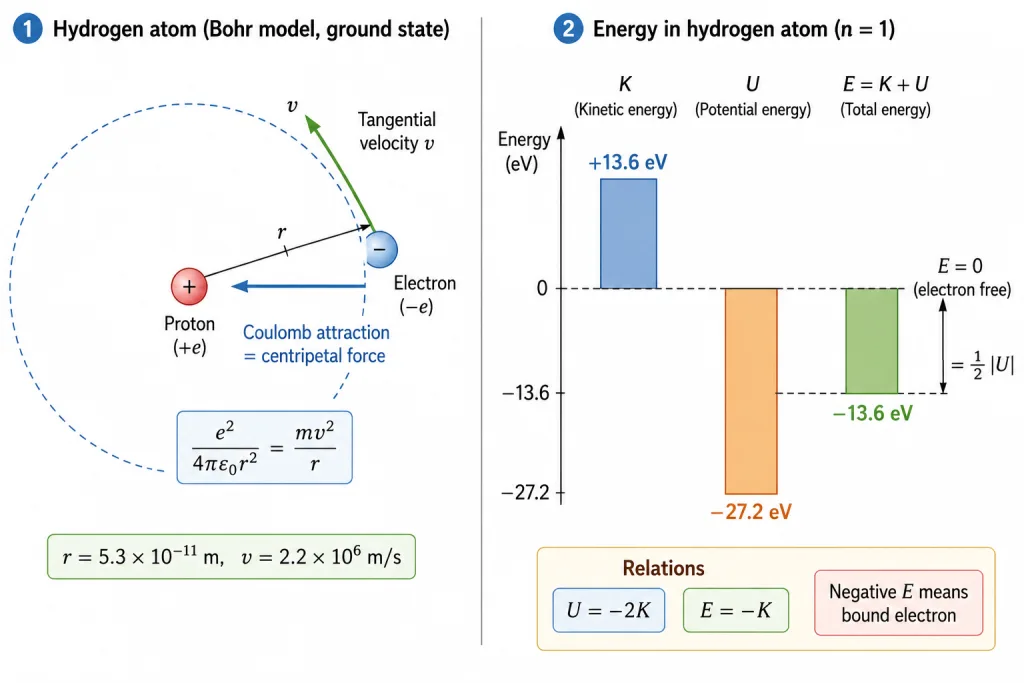
The Energy Bookkeeping: K, U and E
This is the most exam-productive algebra in the chapter. From the force balance, the kinetic energy:
The electrostatic potential energy (attractive, hence negative):
(The negative sign signifies the force is toward the nucleus, in the direction.) The total energy:
The golden ratios
These hold for every circular Coulomb orbit — Rutherford's or Bohr's. If E = -13.6 eV, then instantly K = +13.6 eV and U = -27.2 eV.
Key Point: The total energy is negative, which means the electron is bound to the nucleus. If E were positive, the electron would not follow a closed orbit — it would escape. Energy must be supplied to ionise the atom.
[NEET Important] 'Kinetic, potential and total energy of the electron in hydrogen: which is negative? What are their ratios?' — asked nearly every year somewhere. K is always positive; U negative and twice as large in magnitude; E negative and equal in magnitude to K.
[JEE Tip] These are the Coulomb-force twins of the gravitational satellite relations from Class 11 — same virial structure, different force constant. Reuse the intuition.
NCERT's Worked Numbers: The Size and Speed of Hydrogen
Example 12.3's landmark calculation: experimentally, 13.6 eV is needed to separate a hydrogen atom into a proton and an electron. So E = -13.6 eV = J, and from :
And from the force-balance relation:
Two numbers worth carrying in your head: r ≈ 0.53 angstrom (this will turn out to be the Bohr radius ) and v ≈ m/s ≈ c/137 (the fine-structure hint).
So far so good — but…
Everything above is classical and self-consistent for a frozen instant. The model even predicts sensible sizes and speeds. The problem — the fatal one — arrives the moment we remember that this orbiting electron is accelerating, and accelerating charges radiate. That catastrophe is the next section's story.
[JEE Tip] Given any ONE of E, K, U or r for a circular Coulomb orbit, you can generate all the others in two lines using . Ratio questions are testing exactly this fluency.
Solved Examples
Example 1: Radius and speed from ionisation energy (NCERT Example 12.3)
Given that 13.6 eV separates hydrogen into a proton and electron, compute the orbital radius and electron speed.
Solution:
- Total energy: E = -13.6 eV = J.
- Radius: m.
- Speed: with m = kg → m/s.
- Takeaway: the experimentally known binding energy fixes both the atom's size and the electron's speed — no quantum theory needed yet.
Example 2: The K-U-E triple [NEET Rapid]
The total energy of the electron in a hydrogen atom is -13.6 eV. Write down K and U.
Solution:
- E = -K: K = +13.6 eV.
- U = 2E: U = -27.2 eV.
- Check: K + U = 13.6 - 27.2 = -13.6 eV = E. ✔
- Takeaway: this is NCERT Exercise 12.4 — the golden ratios answer it in five seconds.
Example 3: Deriving the golden ratios [Board Derivation]
Starting from the force balance, show that U = -2K and E = -K.
Solution:
- Force balance: .
- Kinetic: .
- Potential: .
- Total: . ∎
Example 4: What negative E means [Board Conceptual]
Why must the total energy of an orbiting electron be negative?
Solution:
- Negative total energy means the electron cannot escape to infinity — it is bound.
- If E were positive, NCERT notes, the electron would not follow a closed orbit around the nucleus — it would fly off.
- The magnitude |E| is exactly the energy needed to ionise (13.6 eV for hydrogen's ground state).
- Takeaway: bound ↔ negative E is a universal rule (gravity orbits included).
Example 5: Speed as a fraction of c [JEE Numerical]
Express the hydrogen electron's speed m/s as a fraction of the speed of light.
Solution:
- .
- Answer: v ≈ c/137 — comfortably non-relativistic, justifying the classical (and later Bohr) treatment.
- Takeaway: 1/137 is the famous fine-structure constant — its appearance here is no accident, and JEE trivia occasionally pokes at it.
Example 6: If r doubles [JEE Scaling]
For a circular Coulomb orbit, how do K, U and E change if the orbital radius doubles?
Solution:
- All three scale as : , , .
- Doubling r halves each magnitude: K → K/2, U → U/2 (still negative), E → E/2 (still negative, i.e. E increases toward zero).
- Takeaway: larger orbits are less tightly bound — E rises toward zero as r grows, which is why outer Bohr levels crowd below E = 0.
Example 7: Orbit radius from speed [JEE Numerical]
An electron circles a proton at m/s. Find the orbit radius.
Solution:
- Formula: .
- Substitute: .
- Calculate: m.
- Takeaway: halving the speed quadruples the radius () — check: this is 4× the 5.3 × 10⁻¹¹ m orbit of the m/s electron. ✔
Example 8: Frequency of revolution [JEE Numerical]
Find the orbital frequency of the electron in the r = m orbit (v = m/s).
Solution:
- Formula: .
- Substitute: .
- Calculate: Hz.
- Takeaway: file this number — the next section uses it as the classically predicted initial frequency of radiated light (NCERT Example 12.4).
Example 9: Energy to ionise from a given orbit [NEET Numerical]
An electron orbits with total energy -3.4 eV. How much energy is needed to ionise it, and what are its K and U?
Solution:
- Ionisation energy = |E| = 3.4 eV (raise E to zero).
- K = -E = +3.4 eV.
- U = 2E = -6.8 eV.
- Takeaway: -3.4 eV is hydrogen's n = 2 level; the ratios work at every level, and this exact set appears in NEET repeatedly.
Example 10: Which grows when the electron slows? [Conceptual]
In a circular Coulomb orbit, the electron moves to an orbit where its speed is smaller. What happens to r, K, U and E?
Solution:
- : smaller v → larger r.
- K = → decreases.
- U = -2K → increases (less negative).
- E = -K → increases (less negative, closer to zero — less tightly bound).
- Takeaway: slow, distant electrons are loosely bound; fast, close ones tightly bound. All four quantities move together through the golden ratios.