
Emission and Absorption Spectra
Before diagnosing the classical atom's fatal illness, let's state precisely what any atomic model must explain.
Emission line spectrum
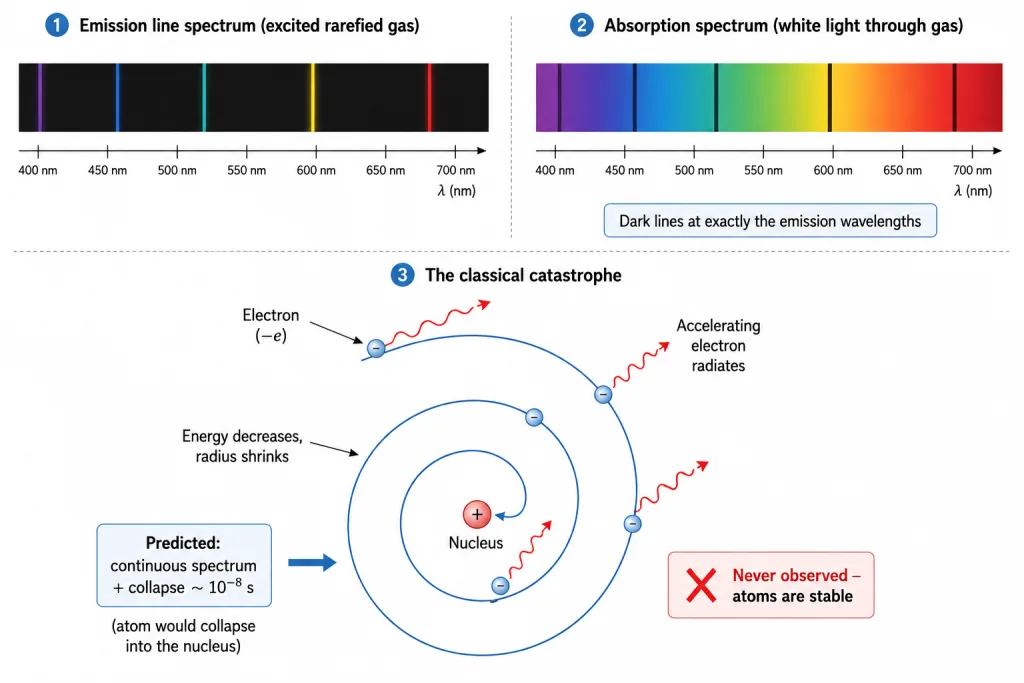
Excite an atomic gas or vapour at low pressure (usually by passing an electric current through it) and the emitted radiation contains only certain specific wavelengths: bright lines on a dark background. Hydrogen's emission spectrum (NCERT Fig. 12.5) is the canonical example. Since each element's line set is unique, emission spectra are a fingerprint for identifying the gas.
Absorption line spectrum
Now reverse the geometry: pass white light through the gas and analyse the transmitted beam with a spectrometer. You find dark lines in the continuous spectrum — at precisely the wavelengths the gas itself emits. The gas absorbs exactly what it can emit.
| Spectrum | Appearance | How produced |
|---|---|---|
| Emission | bright lines, dark background | excited rarefied gas radiates |
| Absorption | dark lines, bright continuum | white light filtered through the gas |
The Classical Catastrophe: Why Rutherford's Atom Cannot Exist
Rutherford's atom imitates the sun-planet system — but with a killer difference. Planets are held by gravity; the electron is held by the Coulomb force, and the electron is a charged particle.
Problem 1: The death spiral
An object moving in a circle is constantly accelerating (centripetal acceleration). Classical electromagnetic theory is unambiguous: an accelerating charge radiates electromagnetic waves, continuously losing energy. The orbiting electron's energy must therefore continuously decrease — it should spiral inward and fall into the nucleus (NCERT Fig. 12.6).
The classical atom is unstable. Estimates put the collapse time around s — yet hydrogen atoms have survived for billions of years.
Problem 2: The wrong spectrum
Classically, the frequency of the emitted radiation equals the frequency of revolution. As the electron spirals in, its angular velocity — and hence the emitted frequency — changes continuously. The atom should emit a continuous spectrum.
But experiment shows line spectra — discrete wavelengths only.
Key Point: Two independent, fatal contradictions: (1) classical atoms cannot be stable; (2) even while collapsing, they would emit the wrong kind of spectrum. 'Rutherford's model tells only a part of the story — classical ideas are not sufficient to explain atomic structure.'
[NEET Important] The exact chain to reproduce in one-liners: circular motion → centripetal acceleration → accelerating charge radiates → energy decreases → spiral into nucleus → continuous spectrum. Every link is quizzed.
NCERT Example 12.4: Putting a Number on the Disaster
How fast would the doomed electron radiate, at least initially? Classically, the emitted frequency equals the revolution frequency. Using Section 3's numbers (r = m, v = m/s):
So the classical atom starts by radiating at ~ Hz (ultraviolet), then sweeps continuously through higher frequencies as it spirals in — a chirp of doom, never observed.
The stage is set for Bohr
Niels Bohr, who worked in Rutherford's laboratory for several months in 1912, was convinced of the nuclear model's validity. Faced with the dilemma, he concluded in 1913 that despite electromagnetism's success at large scales, it could not be applied to processes at the atomic scale. A radical departure from classical mechanics and electromagnetism was needed — his three postulates are the next section.
[JEE Tip] Example 12.4's number ( Hz) doubles as a check on the orbital-frequency formula — JEE variants change r or v and ask for the new classical frequency, or ask for the time period s.
Solved Examples
Example 1: The classical radiated frequency (NCERT Example 12.4)
According to classical electromagnetic theory, calculate the initial frequency of light emitted by the electron revolving around the proton in hydrogen.
Solution:
- Classical rule: emitted frequency = frequency of revolution.
- Formula: with v = m/s, r = m.
- Calculate: Hz.
- Takeaway: the 'initial' matters — as the electron spirals in, this frequency would keep rising continuously, giving a continuous spectrum.
Example 2: Why the spiral? [Board Conceptual]
Explain, step by step, why classical physics predicts the electron must spiral into the nucleus.
Solution:
- Circular motion ⇒ centripetal acceleration (velocity direction changes continuously).
- Classical EM theory: an accelerating charge emits electromagnetic radiation.
- Radiation carries away energy ⇒ the electron's total energy decreases (becomes more negative) ⇒ orbit radius shrinks (E ∝ -1/r).
- Shrinking continues until the electron falls into the nucleus — the classical atom cannot be stable.
Example 3: Emission vs absorption in one experiment [NEET Conceptual]
Sodium vapour is placed in front of a white-light source; separately, the vapour is excited electrically. Compare the two observed spectra.
Solution:
- Excited vapour alone: bright emission lines (sodium's famous yellow doublet region) on a dark background.
- White light through vapour: dark absorption lines in the continuous spectrum — at exactly the same wavelengths as the emission lines.
- Reason: absorption promotes electrons using exactly the photon energies that emission releases — same level spacings, same wavelengths.
Example 4: The continuous-spectrum verdict [Board Conceptual]
Why does the classical spiral predict a continuous spectrum rather than lines?
Solution:
- Classically, radiated frequency = revolution frequency.
- As the electron spirals inward, r decreases continuously, so the angular velocity and revolution frequency change continuously.
- The emitted frequency therefore sweeps through a continuum of values → continuous spectrum.
- Observation: sharp, discrete lines. Contradiction — the second fatal wound of the classical atom.
Example 5: Classical time period [JEE Numerical]
Find the time period of revolution corresponding to the classical frequency Hz.
Solution:
- Formula: .
- Calculate: s.
- Takeaway: the electron circles ~ times per second; even a s collapse allows ~ orbits — a leisurely spiral by the electron's clock, an instant by ours.
Example 6: Frequency at half the radius [JEE Scaling]
If the spiralling electron reaches an orbit of half the original radius, what is its classical revolution frequency? (Assume circular orbits throughout.)
Solution:
- Speed-radius link: (from ).
- Frequency: .
- At r/2: Hz.
- Takeaway: is Kepler's third law in Coulomb clothing — the spiral is a rising chirp.
Example 7: Which model fails how? [NEET Matching]
Match each instability to its model: (a) electrostatic instability, (b) radiative instability.
Solution:
- (a) Thomson's model — NCERT's Points to Ponder: it is unstable electrostatically (a classical static charge arrangement cannot be in stable equilibrium — Earnshaw's theorem in spirit).
- (b) Rutherford's model — unstable because of electromagnetic radiation of orbiting electrons.
- Takeaway: 'both models constitute an unstable system' — but for entirely different reasons. A precision matching question straight from NCERT.
Example 8: What any successful model must deliver
List the experimental facts a correct atomic model must explain, as assembled so far.
Solution:
- Stability of atoms (matter endures).
- Discrete line spectra — emission AND absorption at the same characteristic wavelengths, unique to each element.
- Atomic size ~ m with a tiny nucleus ~- m (from scattering).
- Takeaway: Bohr's postulates are engineered to deliver exactly (1) and (2) while keeping Rutherford's (3). Judge the next section against this checklist.
Example 9: Energy radiated per revolution — an estimate check [JEE Conceptual]
The classical collapse takes about s, and the electron circles ~ times per second. Roughly what fraction of its ~13.6 eV binding energy does the electron shed per revolution?
Solution:
- Number of revolutions before collapse: ~ orbits.
- Energy shed per orbit: ~ eV — a whisper per lap.
- Takeaway: the radiation leak is tiny per revolution but relentless; classically nothing stops it, so collapse is certain. Bohr's postulate 1 doesn't slow the leak — it forbids it outright.
Example 10: Spot the classical assumption [Board Conceptual]
Which single classical assumption, if suspended, rescues the atom from both the stability and spectrum failures?
Solution:
- The assumption: every accelerating charge radiates continuously (applied at the atomic scale).
- Suspend it for special orbits (Bohr's stationary states) → no energy loss → stability.
- Radiation then occurs only in discrete jumps between such states → photons of fixed energies → line spectra.
- Takeaway: Bohr's revolution was surgical — one classical rule suspended at one scale, everything else retained.