
Bohr's Three Postulates (1913)
Bohr combined classical mechanics with the young quantum ideas of Planck and Einstein, packaging the fix into three postulates:
Postulate 1 — Stationary orbits
An electron in an atom can revolve in certain stable orbits without emitting radiant energy — contrary to classical electromagnetism. Each such stationary state has a definite total energy.
Postulate 2 — Quantised angular momentum
The electron revolves only in those orbits for which the angular momentum is an integral multiple of :
where h = J s is Planck's constant and n is the principal quantum number.
Postulate 3 — Quantum jumps
An electron may make a transition from one non-radiating orbit to another of lower energy, emitting a photon with energy equal to the energy difference:
(Absorption is the reverse: the atom absorbs a photon of exactly this energy and the electron jumps up.)
Key Point: Postulate 1 buys stability by decree; Postulate 2 selects which orbits exist; Postulate 3 produces line spectra. Each postulate answers one failure of the classical atom.
[NEET Important] Why quantise angular momentum and not something else? NCERT's Points to Ponder: h has the dimensions of angular momentum, and for circular orbits angular momentum is the natural quantity — 'the second postulate is then so natural!'
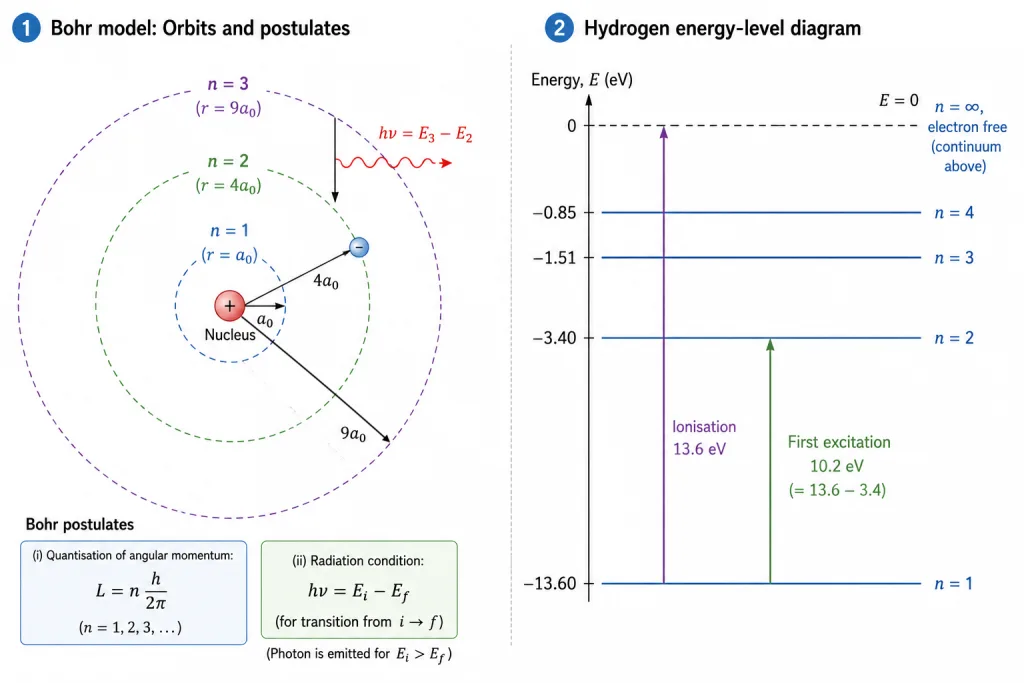
The Payoff: Quantised Radii and Energies
Combining the classical force balance (Section 3) with the quantisation condition gives the radius of the nth orbit (Eq. 12.7):
where the Bohr radius (n = 1) is
exactly the size computed classically from the 13.6 eV binding energy — now derived, not assumed. Radii grow as : 1, 4, 9, 16… times .
Substituting into gives the energy levels (Eqs. 12.8-12.10):
The ladder of levels
| n | (eV) | |
|---|---|---|
| 1 (ground) | -13.6 | |
| 2 | -3.40 | |
| 3 | -1.51 | |
| 4 | -0.85 | |
| 0 | (electron free) |
The levels crowd together as n increases, converging to E = 0 (a free electron at rest; above 0 lies a continuum of free-electron energies).
[JEE Tip] The full scaling set for hydrogen-like atoms (nuclear charge Ze): , (with for H), eV, orbital period . These four scalings answer half of all JEE/NEET questions on this chapter.
Ground State, Excited States, Ionisation
Ground state
The atom's energy is least (most negative) with the electron in the n = 1 orbit — the ground state, energy -13.6 eV, radius . At room temperature most hydrogen atoms are in the ground state.
Ionisation energy
The minimum energy to free the electron from the ground state is +13.6 eV — the ionisation energy of hydrogen. Bohr's prediction of this value agreed excellently with experiment, an early triumph of the model.
Excited states and excitation energies
Feed the atom energy (e.g. by electron collisions) and the electron can rise to higher levels — the atom is excited:
- To n = 2 (first excited state): 10.2 eV.
- To n = 3 (second excited state): 12.09 eV.
- From excited states the electron falls back, emitting photons — the atom's spectral lines (next section).
Note also: as n increases, the energy needed to ionise from that state decreases (3.4 eV from n = 2, 1.51 eV from n = 3…).
[NEET Important] Distinguish three frequently confused numbers: ionisation energy (13.6 eV, n = 1 → ∞), first excitation energy (10.2 eV, n = 1 → 2), first excitation potential (10.2 V). And remember values pair with their n: -13.6, -3.4, -1.51, -0.85 eV — instant recognition saves a minute per question.
[JEE Tip] For hydrogen-like ions, everything scales by : He ionisation from ground state = eV; Li = eV.
Solved Examples
Example 1: Speeds in the first three orbits (NCERT Exercise 12.6a)
Using the Bohr model, find the electron speed in hydrogen's n = 1, 2, 3 orbits.
Solution:
- Formula: m/s (equivalently ).
- n = 1: m/s.
- n = 2: m/s.
- n = 3: m/s.
- Takeaway: speed falls as 1/n — outer electrons amble, inner ones sprint.
Example 2: Orbital periods (NCERT Exercise 12.6b)
Find the orbital period in each of these levels.
Solution:
- Formula: ; with and , .
- n = 1: s.
- n = 2: s.
- n = 3: s.
- Takeaway: — the Kepler-like law of the Bohr atom.
Example 3: Radii of n = 2 and n = 3 orbits (NCERT Exercise 12.7)
The innermost orbit's radius is m. Find the n = 2 and n = 3 radii.
Solution:
- Scaling: .
- n = 2: m.
- n = 3: m.
- Takeaway: radii jump as perfect squares — 1 : 4 : 9 : 16.
Example 4: Energy levels of He [JEE Numerical]
Find the ground-state energy and first-excited-state energy of singly ionised helium (Z = 2).
Solution:
- Formula: eV.
- Ground state: eV.
- First excited: eV.
- Takeaway: He's n = 2 level coincides numerically with H's n = 1 — because . Such coincidences ( equal for equal Z/n) are a JEE favourite.
Example 5: Excitation energies [Board Numerical]
How much energy is required to excite hydrogen from its ground state to (a) the first excited state, (b) the second excited state? What are the corresponding excitation potentials?
Solution:
- (a) eV; excitation potential 10.2 V.
- (b) eV; excitation potential 12.09 V.
- Takeaway: 'second excited state' means n = 3 (not n = 2) — the ground state is not counted as an excitation. This naming trap costs thousands of marks yearly.
Example 6: Ionisation from an excited state [NEET Numerical]
What energy ionises a hydrogen atom already in its first excited state?
Solution:
- State: n = 2, eV.
- Ionisation energy from n = 2: eV.
- Takeaway: excited atoms are easier to ionise; as excitation increases, the freeing energy decreases (3.4, 1.51, 0.85 … eV) — exactly as NCERT notes.
Example 7: Angular momentum values [NEET Numerical]
Calculate the angular momentum of the electron in hydrogen's n = 3 orbit.
Solution:
- Postulate 2: .
- Substitute: .
- Calculate: J s.
- Takeaway: L rises in equal steps of J s; the RATIO of angular momenta between orbits is just the ratio of their n values.
Example 8: Earth as a Bohr orbit (NCERT Exercise 12.9)
Find the quantum number of Earth's orbit around the Sun (r = m, v = m/s, M = kg).
Solution:
- Quantisation: .
- Substitute: .
- Calculate: .
- Takeaway: for astronomical n, adjacent levels are so close that quantisation is imperceptible — which is why planetary motion looks perfectly continuous. Quantum effects matter only for small n.
Example 9: Which transitions from a 12.5 eV kick? (preview of NCERT Exercise 12.8)
A 12.5 eV electron beam bombards ground-state hydrogen. Which levels can be reached?
Solution:
- Available energy: 12.5 eV above the ground state, i.e. up to E = -13.6 + 12.5 = -1.1 eV.
- Check levels: n = 2 needs 10.2 eV ✔; n = 3 needs 12.09 eV ✔; n = 4 needs 12.75 eV ✘ (exceeds 12.5).
- Answer: excitation up to n = 3 only.
- Takeaway: the emitted lines then come from n = 3 → 2, 3 → 1, 2 → 1 (wavelengths in the next section). Collisional excitation needs only at least the level energy — the electron keeps the change — while photon absorption demands an exact match.
Example 10: The Z² game [JEE Numerical]
The ionisation energy of hydrogen is 13.6 eV. Find the ionisation energy of Li and the radius of its ground-state orbit.
Solution:
- Energy scaling: : ionisation = eV.
- Radius scaling: : m.
- Takeaway: triple the charge → nine times the binding, one-third the size. Hydrogen-like means hydrogen formulas with Z bolted on.