Why combine cells at all?
A single dry cell gives about 1.5 V and can safely supply only a modest current — tens of milliamperes for a penlight cell, a few amperes for a D cell before its internal resistance starts to eat away the terminal voltage. Real circuits frequently need more voltage (a torch with a 6 V bulb, a toy that needs 9 V) or more current (a device that draws several amperes without heating up the source). This is where we combine cells.
Two combinations cover most exam problems:
- Series — cells are joined end-to-end, + of one to − of the next. Voltages add.
- Parallel — all + terminals are tied together, all − terminals are tied together. Current capacity adds; voltage stays the same.
A third setup — mixed grouping — combines the two for maximum power transfer at a given load. We'll cover all three, with full derivations using the relation V=ε−Ir from Section 6.
Cells in Series — Aiding
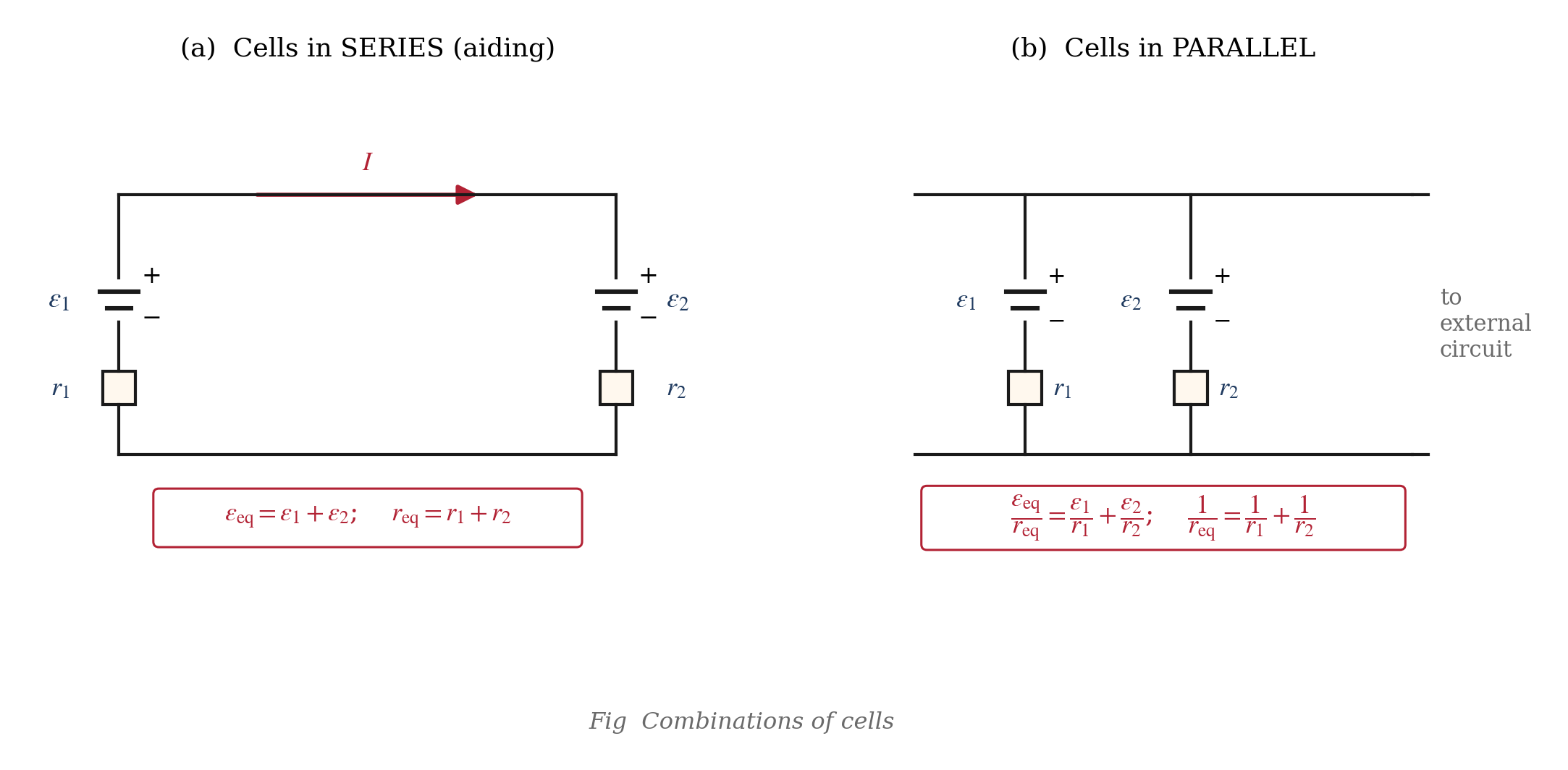
Consider two cells with EMFs ε1,ε2 and internal resistances r1,r2 connected in series (positive of the first to negative of the second), supplying a current I through an external resistance R.
The terminal voltage is
VAB=(ε1+ε2)−I(r1+r2).
Comparing with V=εeq−Ireq:
εeq=ε1+ε2,req=r1+r2.
For n identical cells each of EMF ε and internal resistance r:
εeq=nε,req=nr.
When series is useful: when the external resistance R is much larger than the internal resistance of one cell.
Series with cells opposing
If one cell is inserted in the opposite orientation, the EMFs subtract:
εeq=ε1−ε2,req=r1+r2.
Internal resistances always add in series; only EMFs carry sign.
If ε1<ε2, the net EMF is negative in the chosen direction, meaning the stronger cell drives current backward through the weaker one. The weaker one is being charged.
Sign convention trick: When walking around a loop, count an EMF as positive if you cross it from − to +, and negative if you cross it from + to −.
Cells in Parallel
Now connect two cells with the + terminals tied together and the − terminals tied together.
If I1 and I2 are the branch currents, the common terminal voltage is
VAB=ε1−I1r1=ε2−I2r2.
Also, total current is
I=I1+I2.
Solving, the equivalent cell is:
εeq=r1+r2ε1r2+ε2r1,req1=r11+r21.
Equivalently,
reqεeq=r1ε1+r2ε2.
[JEE Tip] For non-identical cells in parallel, the equivalent EMF is a weighted average, with smaller internal resistance having more influence.
Identical cells in parallel — a clean result
For m identical cells, each with EMF ε and internal resistance r, connected in parallel:
εeq=ε,req=mr.
So parallel combination keeps the voltage the same but reduces the effective internal resistance.
When parallel is useful: when the external resistance R is much smaller than the internal resistance of a single cell.
Mixed grouping — best of both worlds
Suppose N identical cells are arranged as m rows in parallel, each row containing n cells in series, so that mn=N.
Then:
εeq=nε,req=mnr.
Current through an external resistance R is
I=R+mnrnε=mR+nrNε.
For maximum current (and maximum power transfer), choose the grouping so that
R=mnr=req.
[JEE Tip] Given N cells and load R, test divisor pairs (m,n) and choose the one for which req is closest to R.
Quick comparison and decision guide
| Configuration |
εeq |
req |
When to use |
| n identical cells in series |
nε |
nr |
R≫r |
| m identical cells in parallel |
ε |
r/m |
R≪r |
| Mixed grouping |
nε |
nr/m |
when R≈nr/m |
Rule of thumb:
- Need more voltage → use series.
- Need more current capacity → use parallel.
- Need maximum power for a fixed load → use mixed grouping with R≈req.
Common traps to avoid
- In series, EMFs add algebraically but internal resistances always add positively.
- In parallel, the simple result εeq=ε holds only for identical cells.
- Terminal voltage is not the same as EMF when current flows.
- Maximum current and maximum efficiency are not the same thing.
- For mixed grouping, always use integer divisor pairs of the total number of cells.
Example 1: Three identical cells in series
Three identical cells, each of EMF 1.5 V and internal resistance 0.4 Ω, are connected in series with an external resistance of 3.0 Ω. Find the current and terminal voltage of the combination.
Solution:
For 3 identical cells in series,
εeq=3×1.5=4.5V,req=3×0.4=1.2Ω.
Current:
I=3.0+1.24.5=4.24.5≈1.07A.
Terminal voltage:
V=IR=1.07×3.0≈3.21V.
Answer: I≈1.07 A, V≈3.21 V.
Example 2: One cell reversed in series
Two cells, ε1=2.0 V, r1=0.5Ω and ε2=1.5 V, r2=0.3Ω, are connected in series with the second cell reversed across an external resistance of 2.2 Ω. Find the current and state whether cell 2 is charging or discharging.
Solution:
For opposing connection,
εeq=2.0−1.5=0.5V,req=0.5+0.3=0.8Ω.
Thus,
I=2.2+0.80.5=3.00.5≈0.167A.
The stronger 2.0 V cell drives current into the positive terminal of cell 2, so cell 2 is being charged.
Answer: I≈0.167 A; cell 2 is charging.
Example 3: Three identical cells in parallel
Three identical cells, each of EMF 2 V and internal resistance 0.6 Ω, are connected in parallel across a 1.0 Ω resistor. Find the current through the resistor and through each cell.
Solution:
For identical cells in parallel,
εeq=2V,req=30.6=0.2Ω.
Current through load:
I=1.0+0.22=1.22≈1.67A.
By symmetry, each cell supplies:
3I≈31.67≈0.56A.
Answer: Load current ≈1.67 A; current from each cell ≈0.56 A.
Example 4: Two non-identical cells in parallel
Two cells in parallel: ε1=6 V, r1=2Ω, and ε2=4 V, r2=1Ω. Find the equivalent EMF and internal resistance, and the current through an external 3 Ω resistor.
Solution:
Equivalent EMF:
εeq=2+16×1+4×2=314≈4.67V.
Equivalent internal resistance:
req=2+12×1=32≈0.67Ω.
Current through the load:
I=3+0.674.67≈1.27A.
Answer: εeq≈4.67 V, req≈0.67Ω, I≈1.27 A.
Example 5: Mixed grouping — 12 cells
12 identical cells (ε=2 V, r=0.5Ω each) are arranged as m=3 rows in parallel, each row having n=4 cells in series. Find the equivalent EMF, internal resistance, and the current through an external R=5Ω.
Solution:
εeq=nε=4×2=8V
req=mnr=34×0.5≈0.67Ω
Current:
I=5+0.678≈1.41A.
Answer: εeq=8 V, req≈0.67Ω, I≈1.41 A.
Example 6: Find the optimum grouping
You have 24 identical cells, each ε=1.5 V, r=0.3Ω. You want the maximum current through an external resistance R=0.5Ω. What is the best arrangement (m,n), and what current does it deliver?
Solution:
Optimization condition:
R=mnr⇒0.5=m0.3n⇒mn=35.
With mn=24, the nearest integer divisor pair is (m,n)=(4,6).
Then,
req=46×0.3=0.45Ω,
which is close to R=0.5Ω.
Current:
I=4×0.5+6×0.324×1.5=3.836≈9.47A.
Answer: Best grouping is 4 rows in parallel, each with 6 cells in series; I≈9.47 A.
Example 7: Power efficiency in series vs parallel
Four identical cells (ε=1.2 V, r=0.5Ω) power a 1 Ω resistor. Compute the current, the power delivered to the resistor, and the efficiency in each arrangement: (a) all four in series, (b) all four in parallel.
Solution:
(a) Series:
εeq=4.8V,req=2.0Ω
Is=1+24.8=1.6A
PR=Is2R=1.62×1=2.56W
ηs=R+reqR=31≈33%
(b) Parallel:
εeq=1.2V,req=40.5=0.125Ω
Ip=1+0.1251.2≈1.07A
PR=Ip2R≈1.14W
ηp=1.1251≈89%
Answer:
- Series: I=1.6 A, PR=2.56 W, η≈33%
- Parallel: I≈1.07 A, PR≈1.14 W, η≈89%
Example 8: Terminal voltage vs EMF
Six identical cells (ε=1.5 V, r=0.2Ω) are connected to a 3 Ω resistor. Find the terminal voltage across the combination in (a) series and (b) parallel.
Solution:
(a) Series:
εeq=9V,req=1.2Ω
I=3+1.29=2.14A
V=IR=2.14×3=6.43V
(b) Parallel:
εeq=1.5V,req=60.2≈0.033Ω
I=3+0.0331.5≈0.495A
V=IR=0.495×3=1.48V
Answer:
- Series: V≈6.43 V
- Parallel: V≈1.48 V
Example 9: Two different EMFs in parallel with a common load
Two cells, ε1=10 V, r1=1Ω and ε2=8 V, r2=2Ω, are connected in parallel across R=3Ω. Find the current in each branch.
Solution:
Let V be the common terminal voltage.
I1=110−V,I2=28−V,3V=I1+I2.
So,
3V=(10−V)+28−V.
Multiplying by 6:
2V=60−6V+24−3V
11V=84⇒V=1184≈7.64V.
Thus,
I1=10−7.64=2.36A
I2=28−7.64=0.18A
Answer: I1≈2.36 A, I2≈0.18 A.
Example 10: Maximum current from given cells
A device needs the maximum possible current from N=20 identical cells (ε=2 V, r=0.8Ω) delivered into a load R=2Ω. What grouping should be used, and what is that maximum current?
Solution:
Optimization condition:
nm=Rr=20.8=0.4,mn=20.
Two nearby divisor pairs are (m,n)=(2,10) and (4,5).
For (2,10):
I=2×2+10×0.820×2=1240=3.33A.
For (4,5):
I=4×2+5×0.820×2=1240=3.33A.
Both give the same current.
Answer: Either (m,n)=(2,10) or (4,5); maximum current is 3.33 A.
Example 11: Deciding series vs parallel
You have 4 cells (ε=1.5 V, r=1.0Ω each) and a load R=0.1Ω. Should you connect all in series, all in parallel, or mixed, to maximize current?
Solution:
Check all three possibilities.
All in series:
εeq=6V,req=4Ω
I=4.16≈1.46A
All in parallel:
εeq=1.5V,req=0.25Ω
I=0.351.5≈4.29A
Mixed (2 series in each row, 2 rows in parallel):
εeq=3V,req=1Ω
I=1.13≈2.73A
Answer: All parallel gives the maximum current.
Example 12: Parallel cells where one cell charges the other
In a parallel combination, cell 1 has ε1=6 V, r1=0.5Ω and cell 2 has ε2=4 V, r2=0.5Ω, connected across a 2 Ω resistor. Find the current through the load and through each cell.
Solution:
Let the common terminal voltage be V.
I1=0.56−V=2(6−V)
I2=0.54−V=2(4−V)
Iload=2V
Using KCL:
I1+I2=Iload
2(6−V)+2(4−V)=2V
20−4V=2V
40−8V=V
9V=40⇒V=940≈4.44V
Then,
I1=2(6−4.44)=3.11A
I2=2(4−4.44)=−0.89A
Iload=24.44=2.22A
The negative sign for I2 means cell 2 is being charged.
Answer: Iload≈2.22 A, I1≈3.11 A, I2≈−0.89 A (cell 2 charges).
