
Why does a voltmeter not measure true EMF?
We met this issue back in Section 6: a real voltmeter has finite resistance , so when you put it across a cell, it draws a small current . The voltmeter reading is therefore not the true EMF but the terminal voltage which is slightly less than .
For a chemistry-grade cell where is tiny and is huge, the difference is negligible. But for a freshly made wet cell with large , or for very precise EMF comparisons, this error is unacceptable.
The potentiometer solves this with a beautifully simple idea: at the balance point of a potentiometer, no current flows from the test cell. The test cell sees an effectively infinite-resistance voltmeter, and so the reading equals its true EMF exactly.
This is the same null-method philosophy we used in the Wheatstone bridge — get the detector to read zero, then the answer depends only on a length ratio or a known voltage drop. The potentiometer is one of the most accurate methods for measuring EMFs and small voltages.
The principle: is proportional to length on a uniform wire
A potentiometer consists of a long, uniform resistance wire connected to a steady driver cell through a rheostat that controls the current through the wire.
Let the wire have resistance per unit length . When a steady current flows through the wire, the potential difference across a length is:
Define the potential gradient . Then:
So the potential difference between the start of the wire and any point a distance along it is directly proportional to .
[JEE Tip] The potential gradient depends on the driver cell, rheostat setting, and wire resistance per unit length. For a given setup, it remains fixed.
Measuring an unknown EMF — the basic procedure
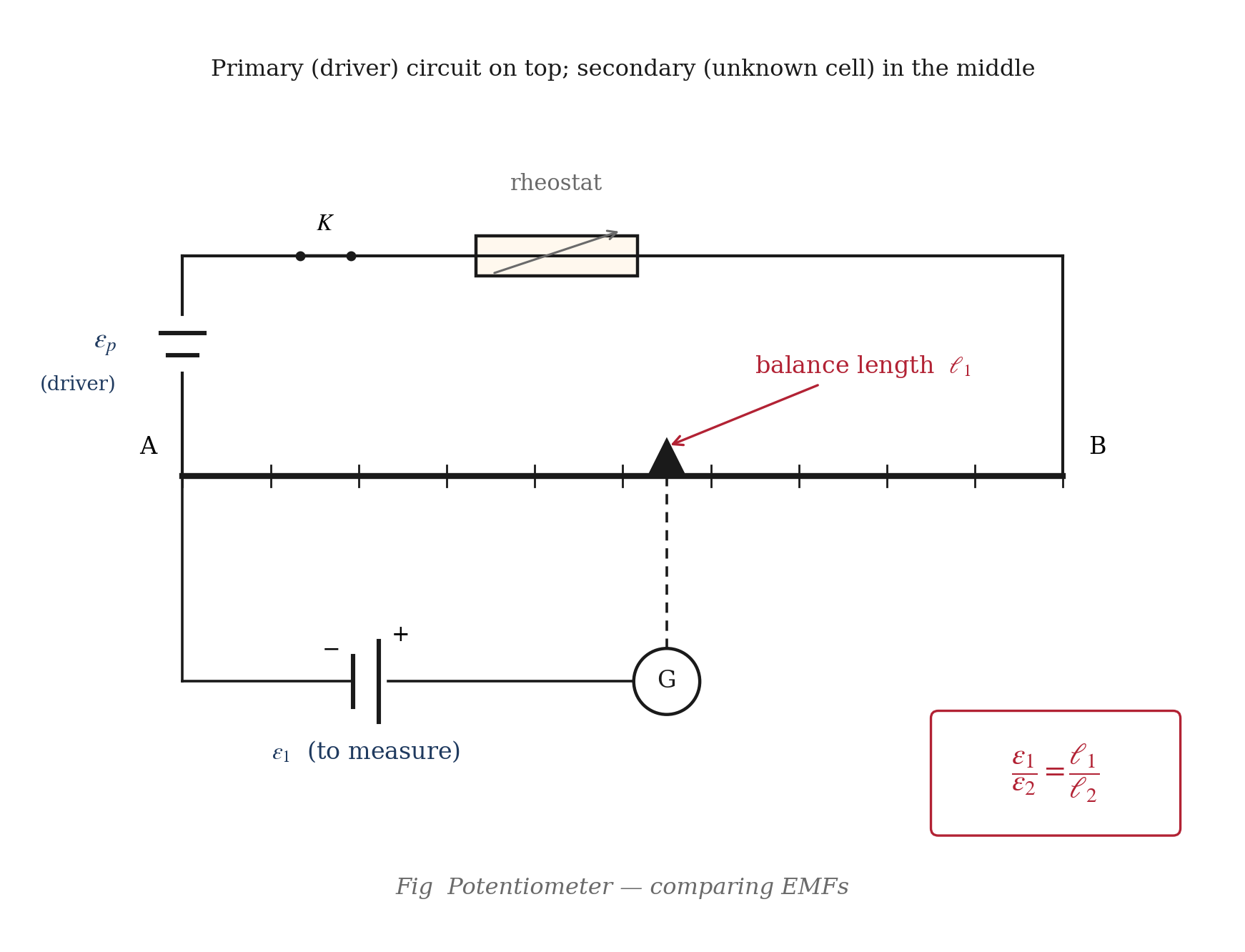
To measure the EMF of an unknown cell:
- Connect the positive terminal of the unknown cell to the same end of the potentiometer wire as the positive terminal of the driver cell.
- The other terminal of the unknown cell goes through a galvanometer to a sliding jockey.
- Slide the jockey until the galvanometer reads zero. Record the balance length .
At balance:
At this point no current flows through the unknown cell, so there is no drop across its internal resistance. Hence the reading gives the true EMF.
[NEET Important] The galvanometer resistance does not matter at balance because no current flows through it.
Comparing EMFs of two cells
Let cell 1 (EMF ) balance at length and cell 2 (EMF ) balance at length with the same driver setting. Then:
Dividing:
The potential gradient cancels, so you do not need to know .
Practical procedure:
- Balance cell 1 and note .
- Switch to cell 2 without disturbing the driver circuit and note .
- Use the ratio formula above.
[JEE Tip] If the driver current changes, the individual balance lengths change, but the EMF ratio remains unchanged as long as both measurements are taken with the same setting.
Measuring the internal resistance of a cell
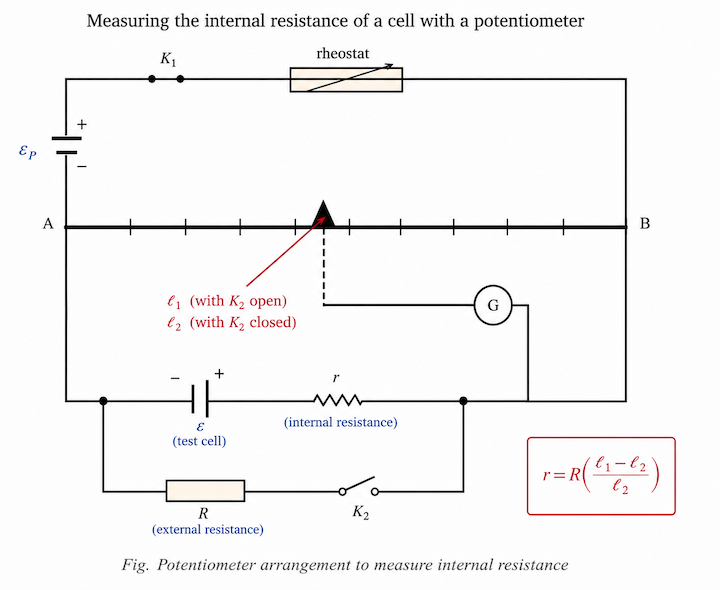
A potentiometer can also be used to measure the internal resistance of a cell.
Step 1 — Key open: With the shunt key open, no current is drawn from the cell.
Step 2 — Key closed: When a known resistance is connected across the cell, the terminal voltage becomes and the new balance length is
Therefore,
Solving for :
This is one of the most important formulas for potentiometer problems.
Sensitivity of the potentiometer
The potentiometer is more sensitive when:
- The wire is longer.
- The potential gradient is smaller.
- The galvanometer is more sensitive.
To decrease and increase sensitivity:
- Reduce the current through the wire using the rheostat.
- Use a longer wire.
- Use a wire of greater resistance per unit length.
But cannot be made too small, otherwise the required balance length may exceed the available wire length. You must always have: where is the total wire length.
Why is the potentiometer better than a voltmeter?
Advantages:
- Measures true EMF, not terminal voltage.
- No loading of the test cell at balance.
- Galvanometer resistance does not affect the result.
- Very high accuracy for small EMFs.
- Useful for comparing EMFs and measuring internal resistance.
Common pitfalls:
- Wrong polarity of the test cell.
- Driver cell not strong enough.
- Very insensitive galvanometer.
- Excess current heating the wire.
[NEET Important] If there is no balance point, first check polarity, then check whether the total potential drop across the wire is greater than the unknown EMF.
Summary and quick reference
| Quantity | Formula |
|---|---|
| Potential gradient | |
| Voltage across length | |
| EMF measurement | |
| Comparison of EMFs | |
| Internal resistance |
Key facts:
- Potentiometer is a null method.
- It measures true EMF.
- It is more sensitive when potential gradient is smaller.
- Driver cell EMF must exceed the highest EMF being measured.
Example 1 — Find the potential gradient
A potentiometer wire is 10 m long. The current through it is 0.20 A and the resistance per unit length is 1.5 Ω/m. Find the potential gradient .
Solution:
Converting units,
Answer: V/m = mV/cm
Example 2 — Calculate EMF from balance length
In a potentiometer with mV/cm, an unknown cell balances at length 200 cm. Find its EMF.
Solution:
Answer: mV
Example 3 — Comparing EMFs
In a potentiometer experiment, a Daniell cell balances at 1.10 m and a Leclanché cell balances at 1.50 m. Find the ratio . If V, find .
Solution:
So,
Answer: , and V
Example 4 — Internal resistance from two balance lengths
A cell balances at 75 cm with key open. When a 5 Ω resistor shunts the cell, the balance length drops to 60 cm. Find the internal resistance.
Solution:
Answer: Ω
Example 5 — Two cells in series and in opposition
Two cells with EMFs 1.5 V and 0.5 V balance separately at 100 cm and 33.3 cm respectively on the same potentiometer. When both cells are connected in series-aiding, what balance length is obtained?
Solution: From the first cell,
For the second cell, which is consistent.
For series-aiding connection,
Hence,
Answer: Combined balance length = 133.3 cm
Note: For series-opposing connection, the balance length would be cm
Example 6 — Effect of changing the driver current
In a potentiometer, an unknown cell of EMF 1.2 V balances at 80 cm. The driver current is then halved. What is the new balance length?
Solution: Since , halving the driver current halves .
Because and is unchanged,
Answer: New balance length = 160 cm
Example 7 — Will the potentiometer balance?
A potentiometer wire is 4 m long and has resistance 0.5 Ω/m. It is fed by a 2 V driver cell of internal resistance 1 Ω through a rheostat of 4 Ω. Can it balance an unknown cell of EMF 1.5 V?
Solution: Wire resistance:
Total driver-circuit resistance:
Current through wire:
Potential drop across wire:
Since , the potentiometer cannot balance the unknown cell.
Answer: No, balance is impossible with this setup
Example 8 — Polarity matters
In a potentiometer experiment, the galvanometer deflects in the same direction at all positions of the jockey. What does this indicate?
Solution: This indicates that the test cell is connected with wrong polarity. Its EMF opposes the wire's potential gradient at every point, so there is no balance point.
Answer: The polarity of the test cell is reversed
Example 9 — Internal resistance with given lengths
A cell balances at 110 cm with key open and at 100 cm when shunted by a 4.5 Ω resistor. Find the internal resistance.
Solution:
Answer: Ω
Example 10 — Comparison via two-way switch
A Daniell cell (1.08 V) and a Leclanché cell (1.50 V) are compared on a potentiometer with potential gradient V/cm. Find their balance lengths.
Solution: For Daniell cell,
For Leclanché cell,
Answer: Balance lengths are 90 cm and 125 cm
Example 11 — Why use a long wire?
Why is a long potentiometer wire preferred over a short one?
Solution: A longer wire gives a smaller potential gradient for the same total voltage drop. Therefore the same EMF balances at a larger length, making the measurement more precise.
Answer: Longer wire gives smaller potential gradient and hence greater sensitivity
Example 12 — Two cells, two lengths, find ratio
Two cells and connected in series-aiding balance at 200 cm. When connected in series-opposing, they balance at 100 cm. Find the ratio .
Solution: Let
Adding,
Subtracting,
Thus,
Answer: