
Why a special circuit just to measure resistance?
We already know . So in principle, you can measure any resistance by driving a known current through it and reading the voltage across. In practice, though, this runs into two problems:
- Voltmeters and ammeters are never perfect. A voltmeter has some finite resistance, so it draws a small current that changes what it's trying to measure. An ammeter has some small resistance, so it drops a tiny voltage of its own.
- For small resistances (milliohms), these errors dominate. The corrections become larger than the quantity you're trying to measure.
The Wheatstone bridge sidesteps this problem with a beautiful idea: instead of measuring currents and voltages, we adjust the circuit until the galvanometer reads exactly zero, and then use a ratio of resistances.
At the null point, the galvanometer's own resistance doesn't matter — no current is flowing through it anyway. The answer depends only on three known resistances and one unknown. This is called a null method, and it is one of the most accurate measurement techniques in physics.
The meter bridge and the potentiometer are both applications of the same idea — get the detector to read zero, then use ratios.
The circuit and the balance condition
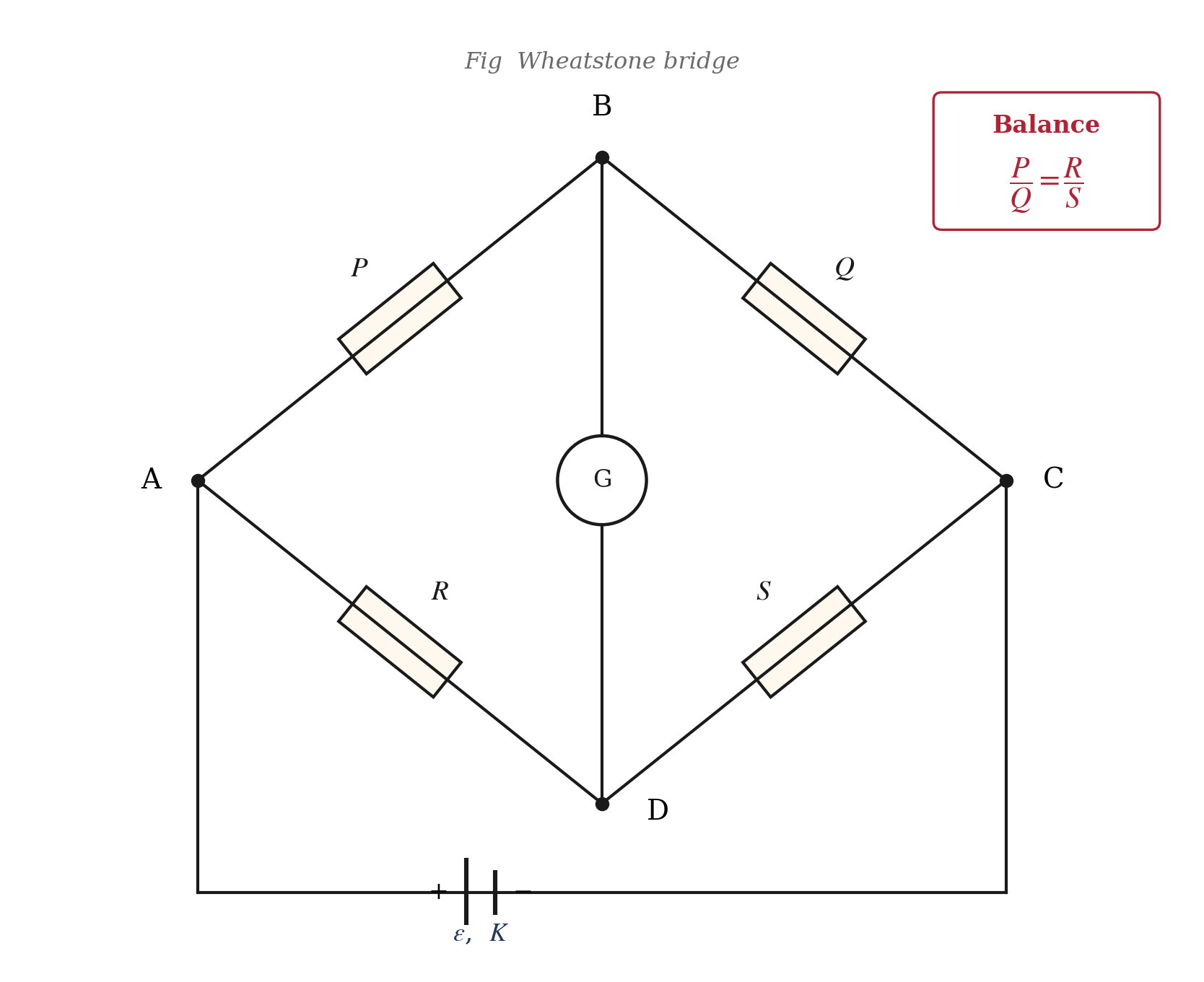
The Wheatstone bridge is four resistors — , , , — arranged in a diamond shape. A battery is connected across one diagonal; a galvanometer across the other.
Label the four corners , , , :
- has resistance , has .
- has resistance , has .
- Battery between and ; galvanometer between and .
Balance condition: the bridge is said to be balanced when the galvanometer shows zero deflection, that is, no current flows through .
Derivation using Kirchhoff's rules.
Let flow through and , and through and .
At balance, the potentials at and are equal:
Since and :
Similarly, and :
Dividing gives:
This is the balance condition of the Wheatstone bridge.
Why this is powerful. No voltage or current measurement is involved. The galvanometer only detects presence or absence of current. The balance is determined purely by the ratio of resistances.
Using the bridge to measure an unknown resistance
Say you want to measure an unknown resistance . Place it in the position. Then , , and are known; can be a resistance box that you vary.
Procedure:
- Choose a convenient ratio .
- Adjust until the galvanometer reads zero.
- At balance, .
Choose the ratio based on the rough magnitude of so that the adjustable resistance remains in a convenient range.
Accuracy considerations:
- Precision of matters directly.
- Galvanometer sensitivity helps detect smaller imbalance.
- Thermal EMFs and contact resistances matter for very small resistances.
[JEE Tip] In many problems, the Wheatstone bridge is used implicitly — you need to recognise it and exploit the balance condition quickly.
Sensitivity of the bridge
Once you're close to balance, how much does the galvanometer deflect for a small imbalance? This is called the sensitivity of the bridge.
Conceptually:
- Maximum sensitivity occurs when all four resistances are roughly of the same order of magnitude.
- Galvanometer resistance matters slightly.
- Battery EMF helps linearly, though excessive current can cause heating.
Practical rules for high-accuracy measurements:
- Make the four arms comparable.
- Use a sensitive galvanometer.
- Use a reasonably large but safe battery EMF.
- When and are very different, choose ratio arms and accordingly.
A common exam question: if the galvanometer and the battery are interchanged, the balance condition stays unchanged. Only sensitivity may differ slightly.
The meter bridge — Wheatstone's practical cousin
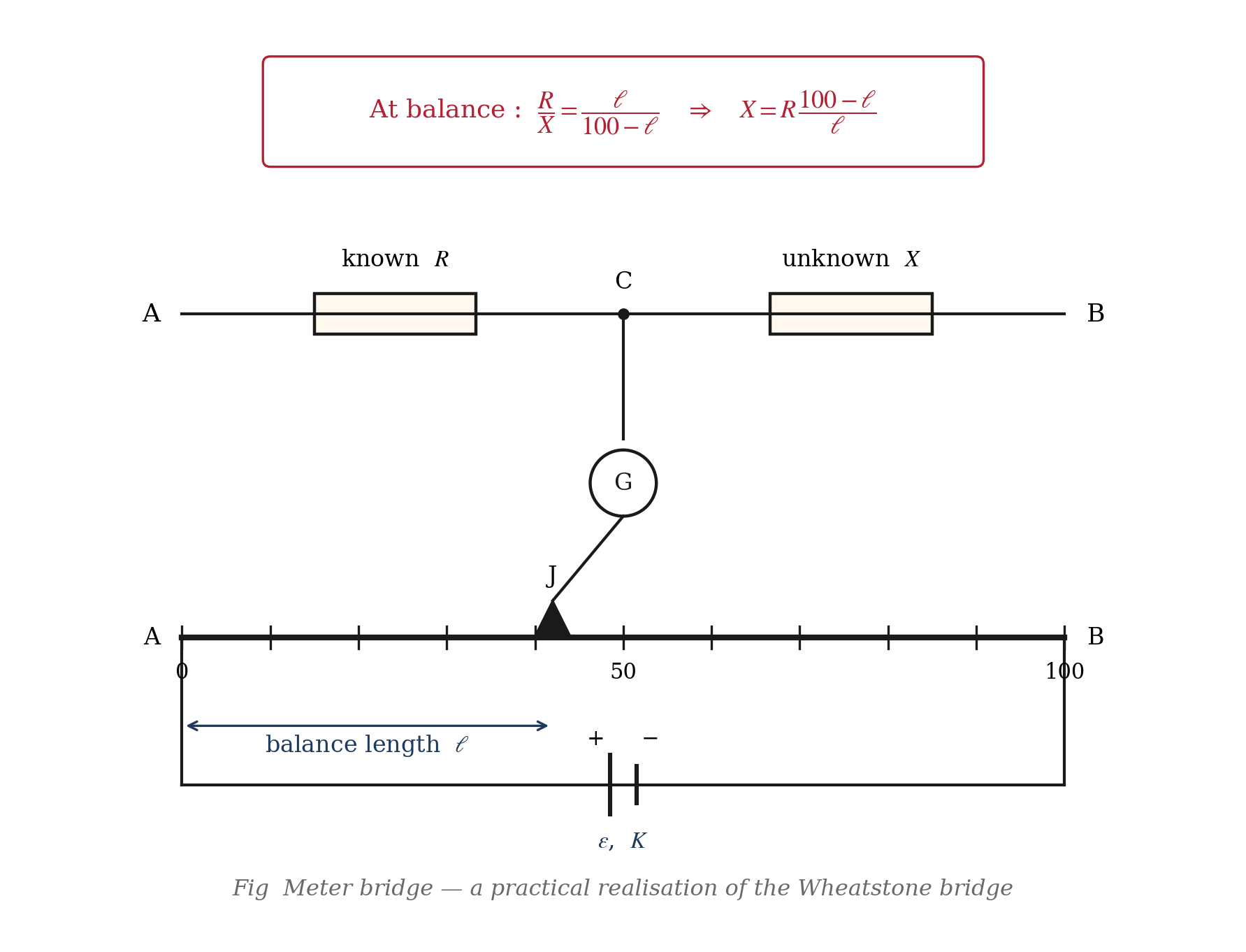
A laboratory realisation of the Wheatstone bridge replaces two of the arms with a single 1-metre-long uniform resistance wire.
Setup:
- A 1-metre wire is stretched along a metre scale.
- Two gaps hold the known resistance and the unknown .
- A jockey divides the wire into lengths and .
Because the wire is uniform, the two lengths act as resistances proportional to and respectively.
Balance condition:
Hence,
[JEE/NEET Important] For best accuracy, make the null point fall near the middle of the wire.
A clean derivation of the meter-bridge formula
Let the wire have resistance per unit length . Then:
- Left portion ( cm) has resistance
- Right portion ( cm) has resistance
At the null point:
So,
The factor cancels:
Therefore,
This shows why the result depends only on length ratio, not on the absolute resistance of the bridge wire.
Extensions: unbalanced bridges, temperature sensors, Carey Foster
When , current flows through the galvanometer. Unbalanced bridges are used in:
- Strain gauges
- Temperature sensors
- Load cells
The Carey-Foster bridge refines the meter bridge to reduce end-error effects for precision work.
These are beyond the core derivation, but the same bridge geometry and balance logic still apply.
Summary and quick reference
The Wheatstone bridge in one line: four resistors in a diamond, battery on one diagonal, galvanometer on the other. At balance the galvanometer reads zero and .
Key formulas:
| Quantity | Formula |
|---|---|
| Wheatstone balance | |
| Unknown from balance | |
| Meter-bridge balance | |
| Unknown from meter bridge | |
| Galvanometer current at balance |
Common exam tricks:
- If bridge is balanced, galvanometer current is zero.
- If battery and galvanometer are interchanged, balance condition is unchanged.
- Best sensitivity occurs when all four arms are comparable and null point is near the middle.
Example 1 — Apply the balance condition directly
In a Wheatstone bridge, the resistances in the arms are Ω, Ω, Ω. What should the value of be to balance the bridge?
Solution: Using ,
Answer: Ω
Example 2 — Is the bridge balanced?
Four resistors 10 Ω, 15 Ω, 20 Ω, 30 Ω are arranged in the arms of a Wheatstone bridge in the order . Check if the bridge is balanced.
Solution:
Since the ratios are equal, the bridge is balanced.
Answer: Yes, the bridge is balanced
Example 3 — Meter bridge with known resistance
In a meter bridge, a 5 Ω standard resistance is in the left gap and an unknown resistance in the right gap. The balance point is at 40 cm from the left end. Find .
Solution: Using with Ω and cm,
Answer: Ω
Example 4 — Finding the balance length
In a meter bridge, Ω and Ω are in the left and right gaps respectively. Where is the null point?
Solution: From we get
Answer: Balance point = 20 cm
Example 5 — Using ratio arms to measure a small resistance
You want to measure a resistance of about 0.5 Ω using a Wheatstone bridge with a resistance box that goes from 1 Ω to 1000 Ω. Which ratio arms would you pick?
Solution: Since we choose so that comes in a convenient range.
For Ω:
- If , then Ω
- If , then Ω
- If , then Ω
A convenient choice is .
Answer: Choose
Example 6 — Galvanometer current in a nearly-balanced bridge
A Wheatstone bridge has Ω and Ω. The battery EMF is 5 V and galvanometer resistance is 50 Ω. Estimate the current through the galvanometer.
Solution: Using the standard small-imbalance approximation, where Ω.
Numerator:
Denominator:
Thus,
Answer: Approximately
Example 7 — Effect of interchanging the galvanometer and battery
In a Wheatstone bridge, the galvanometer is initially across one diagonal and the battery across the other. Both are now interchanged. Does the balance point change?
Solution: The balance condition depends only on the arm resistances:
Interchanging battery and galvanometer does not change this ratio condition.
Answer: No, the balance point does not change
Example 8 — End correction in a meter bridge
In a meter bridge experiment, when Ω is placed in the left gap and in the right gap, the null is at 50 cm. When and are swapped, the null shifts to 51 cm from the left. Estimate the true value of .
Solution: Without correction, the two estimates are:
- First reading: Ω
- Second reading:
A simple corrected estimate is to take a mean value near the midpoint reading:
Answer: Ω
Example 9 — Disguised bridge in a complex circuit
Nine resistors, each of 1 Ω, are connected in a symmetric bridge-like arrangement with middle nodes connected by galvanometers. What is the current through any one of the galvanometers?
Solution: By symmetry, all corresponding middle nodes are at the same potential.
Hence no potential difference exists across any galvanometer, so no current flows through them.
Answer: Zero current through each galvanometer
Example 10 — Meter-bridge question with a twist
In a meter bridge, when a known resistance of 8 Ω is placed in the left gap and an unknown resistance in the right gap, the balance point is at 60 cm. Then a 12 Ω resistor is placed in series with . Where does the null point shift to?
Solution: First,
New resistance:
Now,
Answer: New null point = 31.6 cm
Example 11 — Conceptual: null method advantages
Why is the Wheatstone bridge considered more accurate than directly measuring using a voltmeter and ammeter?
Solution:
- It is a null method.
- It depends on resistance ratios rather than absolute current and voltage readings.
- The galvanometer resistance does not matter at balance.
- Battery emf fluctuations do not affect the balance condition.
Answer: Because it is a null method based on ratios, it is generally more accurate
Example 12 — Balanced-bridge shortcut
A 10 V battery drives current through a Wheatstone bridge whose four arms are all 4 Ω, with a 5 Ω galvanometer across the middle. What is the total current drawn from the battery?
Solution: Check balance:
So the bridge is balanced and no current flows through the galvanometer.
Each arm has series resistance:
These two 8 Ω branches are in parallel, so
Hence,
Answer: Total current = 2.5 A