
Why Resistivity Values Differ Across Materials
We have already derived that the resistivity of a material is where is the density of free charge carriers (per m) and is the mean free time between collisions. Two materials can have very different resistivities for two reasons:
- Different carrier densities () — Metals have roughly electrons/m, semiconductors have to at room temperature, and insulators have almost no free carriers.
- Different relaxation times () — Even for two metals with similar , scattering from impurities, lattice defects, and thermal vibrations can make very different.
That is why the resistivity of materials spans an astonishing 26 orders of magnitude, from superconductors () to fused quartz ().
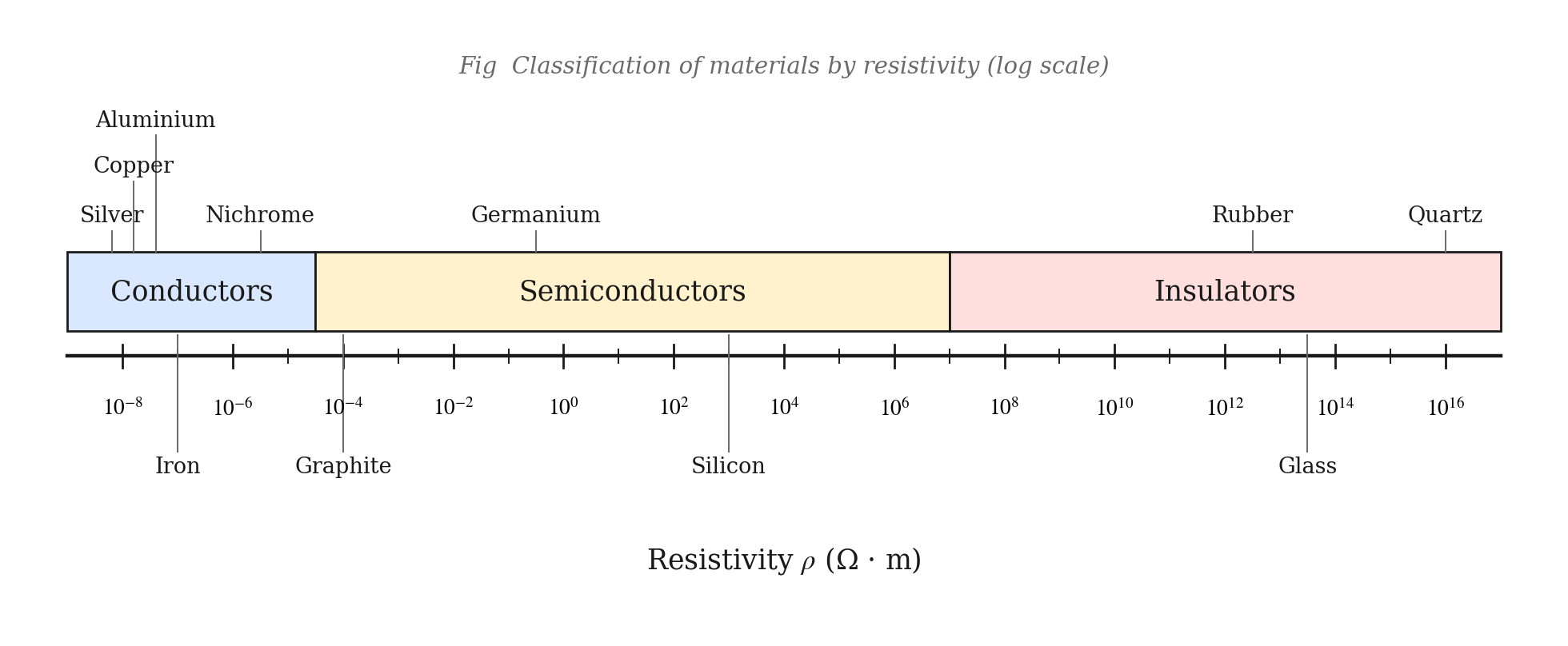
[Memory hook] Remember the three classes:
- Conductors: to (Ag, Cu, Al, Fe)
- Semiconductors: to (Ge, Si, C in graphite form)
- Insulators: to (glass, rubber, fused quartz)
Key Point: The large gap between conductors and insulators is dominated mainly by the huge difference in carrier density .
Temperature Dependence — The Big Picture
Experiments show that for almost every material, resistivity changes with temperature. But how it changes depends on the material class:
| Material class | Sign of | Reason |
|---|---|---|
| Metals (conductors) | Positive ( rises with ) | Lattice vibrations increase → smaller ; barely changes |
| Alloys (Nichrome, Manganin, Constantan) | Slightly positive, very small | Disordered lattice already produces strong scattering; extra thermal scattering adds little |
| Semiconductors | Negative ( falls with ) | Thermal energy sets free many more carriers; rise in dominates over fall in |
| Insulators | Negative (similar to semiconductors) | Carrier density is so low that any thermal generation has a huge fractional effect |
| Superconductors (below ) | = 0 | Cooper pairs move without scattering |
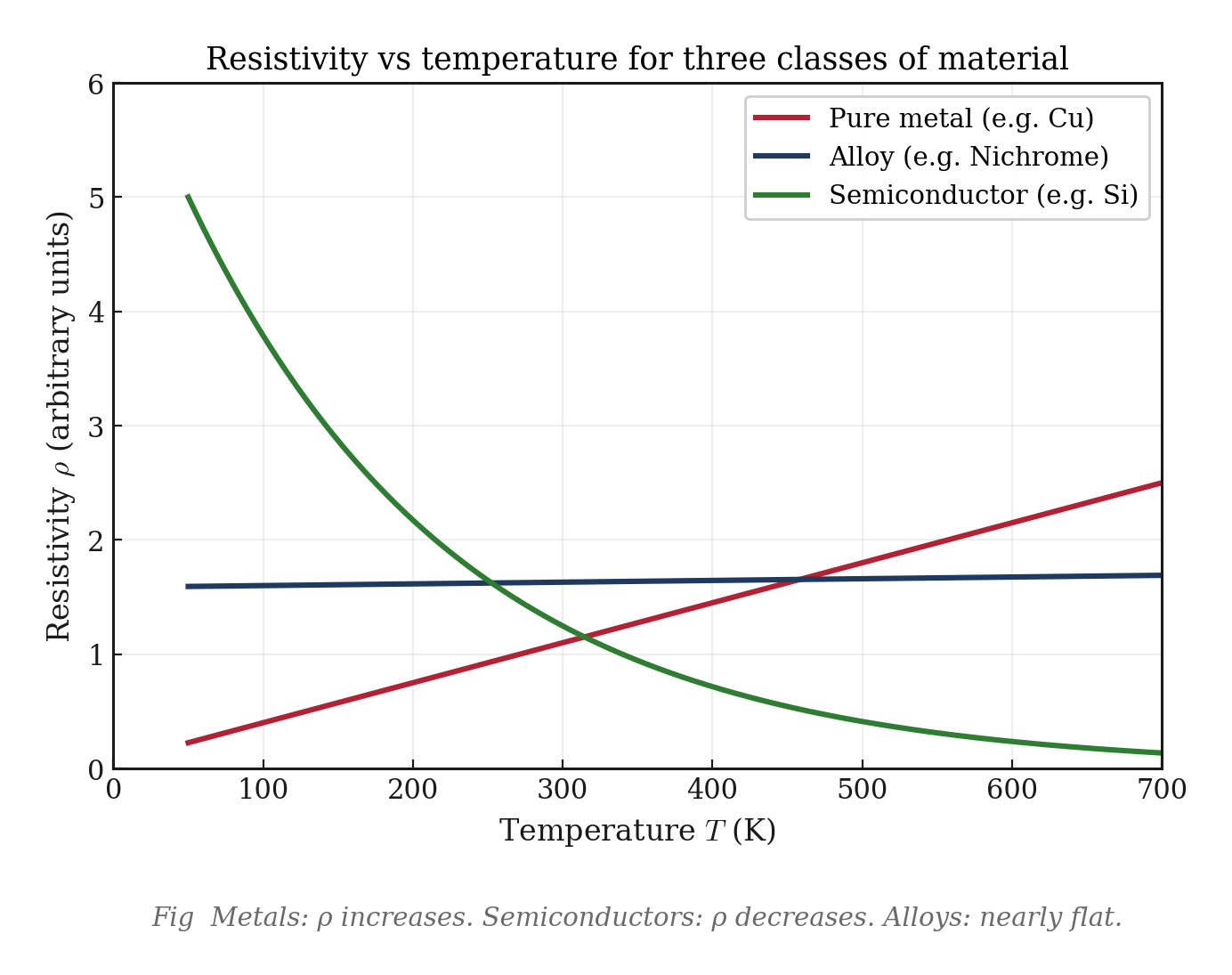
The equation helps explain these trends:
- In a metal, is fixed and drops as rises, so increases.
- In a semiconductor, as rises increases exponentially while only falls slowly, so decreases.
Quantifying the Temperature Dependence in Metals
For metals in a limited range of temperatures, resistivity varies approximately linearly with temperature:
where:
- is the resistivity at a reference temperature (usually C or C)
- is the resistivity at temperature
- is the temperature coefficient of resistivity, with SI unit K (or C)
Since the dimensions of a conductor change only slightly with temperature, the same form also holds for resistance:
Typical values of at C
| Material | (K) |
|---|---|
| Silver (Ag) | |
| Copper (Cu) | |
| Aluminium (Al) | |
| Iron (Fe) | |
| Tungsten (W) | |
| Manganin (alloy) | |
| Nichrome (alloy) | |
| Carbon (graphite) | |
| Silicon (semiconductor) |
Two things jump out:
- Pure metals all have similar ( K) — about 0.4% change per kelvin.
- Alloys have hundreds of times smaller — that is exactly why Manganin and Constantan are used to make standard resistors and resistance boxes.
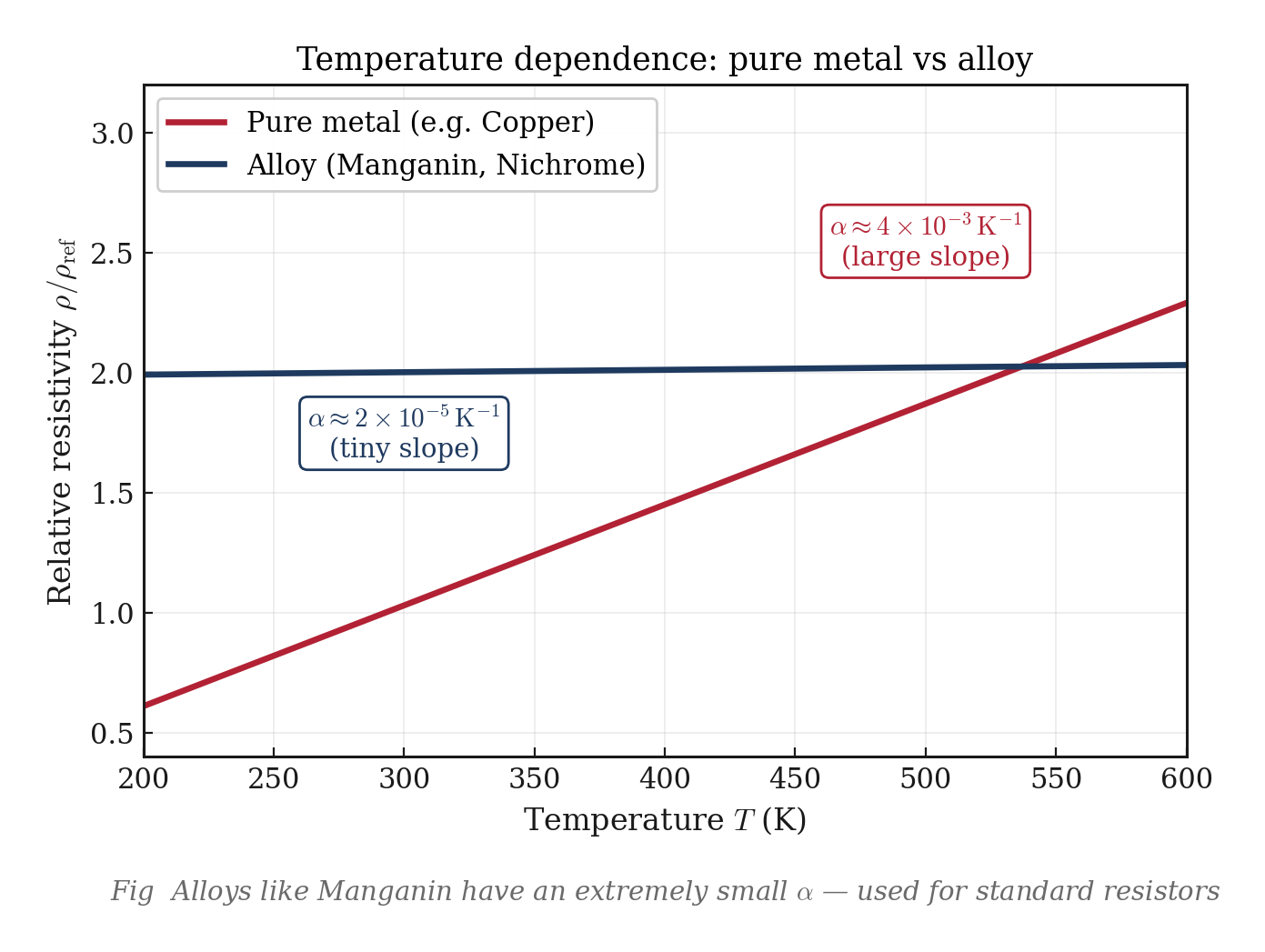
[JEE Tip] Over wide temperature ranges the relation breaks down. For a clean metal at very low , approaches a non-zero residual resistivity due to impurity scattering — it does not go to zero.
Why Do Semiconductors Have Negative ?
In a semiconductor the number of free carriers depends strongly on temperature. The density of carriers obeys (approximately):
where is the energy band gap and is Boltzmann's constant.
As increases:
- The exponential factor grows very rapidly — many more electrons can jump across the band gap.
- Hence rises much faster than falls.
- From , the rise in dominates and decreases with .
This explains why:
- A thermistor (semiconductor resistor) is used in circuits to compensate for temperature drift — its resistance falls as it heats up.
- Semiconductor thermometers exploit this strong -dependence to measure small temperature changes.
- A semiconductor at very low temperatures can behave almost like an insulator — not enough thermal energy to lift electrons into the conduction band.
[Common trap] Students sometimes say "semiconductors have negative because electrons collide less at high ." This is wrong — still decreases at higher . The real reason is the huge rise in .
Superconductivity — When Resistivity Becomes Exactly Zero
At very low temperatures, certain metals, alloys, and ceramic oxides lose all resistance — a phenomenon discovered by Kamerlingh Onnes in 1911 while cooling mercury below K. Below a material-specific critical temperature , the resistivity drops sharply to exactly zero.
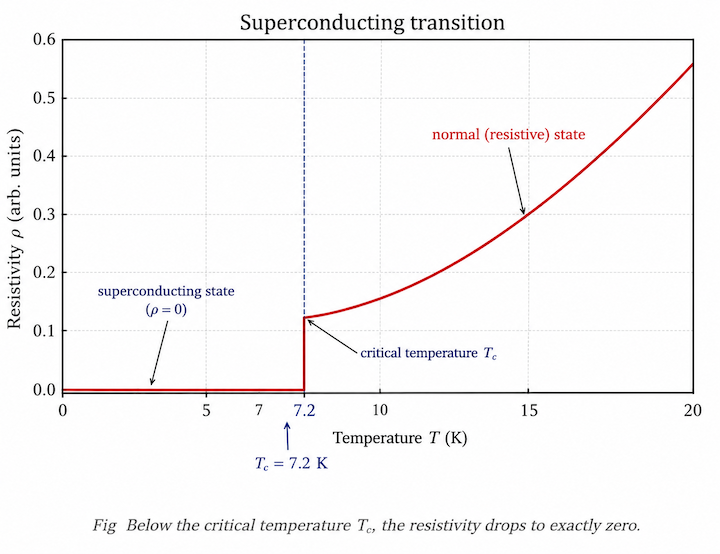
Key features:
- Below , electrons form correlated pairs (Cooper pairs) that glide through the lattice without scattering.
- A current set up in a superconducting loop can persist for years with no measurable decay — a test of to incredible precision.
- Superconductors expel magnetic fields from their interior (Meissner effect) — this is why they can levitate magnets.
Some important values
| Material | (K) |
|---|---|
| Mercury (Hg) | 4.2 |
| Lead (Pb) | 7.2 |
| Niobium (Nb) | 9.3 |
| YBaCuO (YBCO) | 92 |
| HgBaCaCuO | 134 |
Materials with K (the boiling point of liquid nitrogen) are called high-temperature superconductors. Their discovery in 1986 was a huge leap — you no longer need expensive liquid helium to cool them.
Applications
- Superconducting magnets (MRI, particle accelerators, fusion reactors).
- SQUIDs — extremely sensitive magnetometers used in biomedical imaging.
- Maglev trains — frictionless magnetic levitation.
- Efficient power transmission (zero losses).
Key Point: A superconductor does not merely have low resistance — it has exactly zero resistance, and hence zero voltage drop for any finite current below .
Solved Examples
Example 1: Resistance of Copper Wire at a High Temperature
The resistance of a copper coil at C is . Find its resistance at C. ( K)
Solution: Using we get
Final Answer:
Example 2: Finding the Temperature Coefficient
A platinum resistance thermometer reads at C and at C. Find for platinum.
Solution: Using we get
Final Answer:
Example 3: Temperature from a Measured Resistance
A tungsten filament has at C. When the bulb is lit, its resistance is . Estimate the operating temperature. ( K)
Solution:
Final Answer:
Example 4: Two Resistors in Series — Effective
A wire of copper ( K) is joined in series with a wire of iron ( K). Find the effective temperature coefficient of the combination.
Solution: For small temperature change, So,
Final Answer:
Example 5: Designing a Temperature-Stable Resistor
You want a series combination of a carbon resistor ( K) and a copper wire ( K) so that the total resistance is nearly temperature-independent. If the copper wire has resistance at C, how large should the carbon resistance be?
Solution: For zero net temperature coefficient,
Final Answer:
Example 6: Silver Wire Near a Flame
A silver wire has resistivity at C. Find its resistivity at C. ( K)
Solution: Using we get
Final Answer:
Example 7: Negative — A Thermistor
A thermistor has resistance at C. Its temperature coefficient in this range is K. Find its resistance at C.
Solution:
Final Answer:
Note: This uses the linear approximation over a small range.
Example 8: A Heating Coil's Hot Resistance
A nichrome heating coil has resistance at C. In operation, it reaches C. If K, find its hot resistance.
Solution:
Final Answer:
Example 9: Solving for the Temperature Coefficient from Two Measurements
A wire has at C and at C. Find the temperature coefficient of the wire's material, taking as reference.
Solution: Using we get
Final Answer:
Example 10: Resistance Doubles at What Temperature?
A copper conductor has at C. At what temperature will its resistance be twice its value at C? ( K)
Solution: For doubling,
Final Answer:
Example 11: Why Depends on Reference Temperature
In a data table, the temperature coefficient of copper is listed as K at C and K at C. Why are they different?
Solution: The coefficient is defined relative to a reference temperature : Since depends on the reference temperature, the quoted value of changes slightly when the reference temperature changes.
Final Answer: depends on the chosen reference temperature, so and need not be exactly equal.
Example 12: Manganin — Why It Is Special
Standard resistance coils are made of Manganin, whose temperature coefficient is about K. Compare the fractional change in resistance over C for Manganin and pure copper.
Solution: For Manganin:
For copper:
Thus copper changes 200 times more for the same temperature rise.
Final Answer:
- Manganin:
- Copper:
- Copper changes 200 times more