
From Microscopic Work to Power
In Section 2 we said that the drift velocity of electrons reaches a steady value because the energy gained from the electric field is continuously dissipated to the lattice through collisions. Let us now make that statement quantitative.
Consider a conductor of resistance carrying a current . Let be the charge that flows between two points across which the potential difference is . The work done by the electric field in pushing this charge across is:
The power delivered to the conductor — the rate at which electrical energy is converted into heat — is therefore:
Using Ohm's law , we can re-write this in two more forms:
This is Joule's law of heating — the heat dissipated in a purely resistive conductor is watts, and joules over time .
SI unit of power
The SI unit of power is the watt (W): W J s V A. Larger units:
- kilowatt (kW) W
- megawatt (MW) W
- horsepower (hp) W
[Memory hook] When in doubt, pick the formula that uses quantities the question gives you:
- Given and → use .
- Given and → use .
- Given and → use .
Energy Balance in a Simple Circuit
Consider a battery of EMF and internal resistance connected across an external resistor . The steady current is
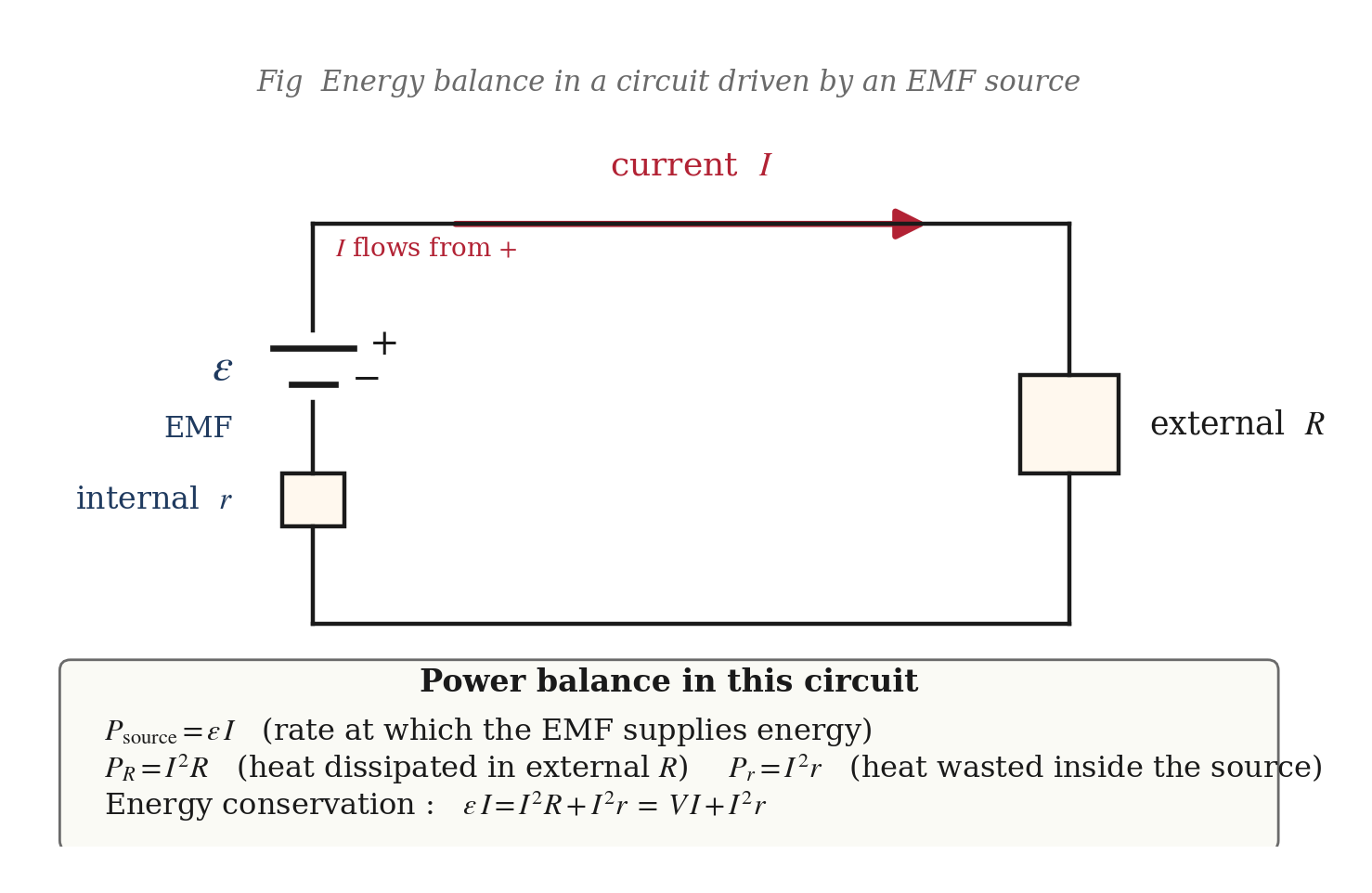
Power delivered by the source (total):
Power dissipated as heat in (useful):
Power wasted inside the source as heat in :
Energy conservation gives:
where is the terminal potential difference across the battery's external terminals.
Terminal voltage vs EMF
From the above:
So during discharge (current leaving terminal), . During charging (current forced into terminal by an external source), the sign of reverses and .
[JEE Tip] In older JEE problems, the terminal-voltage is often called the "working voltage" of the cell. It is this , not , that a voltmeter reads when the cell is supplying current.
Heating Effect of Current — Everyday Applications
The most common everyday manifestation of is heat. This simple formula explains a huge range of domestic and industrial appliances:
1. Incandescent lamps
A tungsten filament, heated to about C by , glows white-hot and radiates visible light. Only about 5% of the input electrical power emerges as visible light — the rest becomes infrared heat. This is why incandescent bulbs are being replaced by LEDs and CFLs.
2. Electric heaters and iron
Nichrome coils (m, high melting point, small ) are used because:
- High resistivity reasonable resistance in a small coil.
- High melting point (C) can glow red without melting.
- Small resistance stays nearly constant as it heats up.
3. Fuses
A fuse is a thin wire of an alloy (tin–lead) designed to melt when the current exceeds a safe limit. Since , the wire heats up as : a small over-current produces a disproportionately large heating.
4. Arc welding
An electric arc between two carbon electrodes, carrying very large currents, produces temperatures above C — hot enough to melt and fuse metals.
5. Electric kettle
A kettle rated at W on a V mains supply draws A. The resistance of its heating element is .
Key point: For a given , a lower-R appliance draws more current and dissipates more power (). This is why domestic wires to high-wattage appliances (geysers, ACs) must be thick — to handle the larger without overheating.
Why High-Voltage Transmission?
Consider transmitting power from a generating station over a long cable of resistance to a consumer at voltage . The current is
and the power lost as heat in the transmission cable is
Two massive observations:
- . Doubling the transmission voltage cuts the loss by a factor of 4!
- The thicker the cable (smaller ), the smaller the loss — but thicker wires are expensive and heavy.
Example of savings
Suppose we need to deliver kW over a line with .
- At V: A, W MW. Loss exceeds delivered power! — the cable would glow red-hot.
- At V (22 kV, common for city feeders): A, W. Tiny.
- At V (220 kV, long-distance transmission): A, W. Negligible!
This is why the grid uses step-up transformers at generating stations and step-down transformers near consumers. Voltage goes up for transmission and comes down for domestic use.
[NEET/JEE Tip] The exam-favourite derivation of this is: "For a given and line resistance , line loss ." Memorise this one-liner — it shows up in many MCQs.
Maximum Power Transfer Theorem
Consider a battery of EMF and internal resistance connected to a variable load . The power delivered to the load is:
To find when is maximum, set :
This vanishes when , and one can check this is a maximum.
Interpretation
- When : current is large but the tiny absorbs little power (most is wasted in ).
- When : voltage across is almost but current is tiny.
- The sweet spot is : exactly half the source power goes into the load and half into . Efficiency is only 50%.
Application
Audio amplifiers and RF transmitters "impedance-match" their output stage to the load () to get maximum power transfer. Power utilities do NOT try to maximise power — they try to maximise efficiency. They operate with so almost all generated power reaches the consumer.
Key point: Maximum power and maximum efficiency are different optimisation problems. For a given source, you cannot have both.
Solved Examples
Example 1: A Light Bulb
A bulb is rated " W, V". Find: (a) its resistance, (b) its current at rated conditions, (c) the energy consumed in a 3-hour day.
Solution:
Resistance:
Current:
Energy per day:
Final Answer: (a) (b) (c)
Example 2: Electric Kettle
A W, V kettle heats kg of water from C to C. Assuming all heat goes into the water, estimate the time taken. (Specific heat of water J kg K)
Solution:
Heat required:
Time:
Converting to minutes:
Final Answer: About minutes
Example 3: Fuse Wire
A safety fuse is required to protect a kW heater at V. What is the minimum suitable rated current of the fuse?
Solution:
Operating current:
A fuse must be rated slightly above the normal operating current.
Final Answer: A A fuse is appropriate
Example 4: Terminal Voltage Drop
A battery of EMF V and internal resistance is connected to a bulb. Find: (a) the current, (b) the terminal voltage of the battery, (c) the power delivered to the bulb, (d) the power wasted in the battery.
Solution:
Current:
Terminal voltage:
Power in bulb:
Power in internal resistance:
Check:
Final Answer: (a) A (b) V (c) W (d) W
Example 5: The kWh Unit
A household uses four W bulbs for hours, one W geyser for minutes, and a W fan for hours every day. At ₹ per kWh, find the monthly (30-day) electricity bill.
Solution:
- Daily energy consumption:
- Bulbs: Wh
- Geyser: Wh
- Fan: Wh
- Total: Wh kWh
Monthly consumption:
Bill:
Final Answer: Approximately ₹ per month
Example 6: Maximum Power Transfer
A V battery with internal resistance is connected to a variable resistor . Find the value of at which the power delivered to is maximum, and compute that maximum power.
Solution:
Maximum power transfer occurs when
Maximum power is
Check using current:
Final Answer:
Example 7: Two Bulbs in Series vs Parallel
Two bulbs rated " W, V" and " W, V" are connected: (a) in series across V, (b) in parallel across V. Which bulb glows brighter in each case?
Solution:
Rated resistances: So .
Parallel: Each bulb gets full rated voltage, so each dissipates its rated power. Therefore the W bulb glows brighter.
Series: Same current flows through both, and power is . The higher-resistance bulb dissipates more power, so the W bulb glows brighter.
Final Answer:
- In series: the W bulb glows brighter
- In parallel: the W bulb glows brighter
Example 8: Why Do We Use High Voltage for Long-Distance Transmission?
Compare the power loss in a transmission line of resistance delivering kW at: (a) V, (b) kV.
Solution: Using
At V:
At kV:
Final Answer:
- At V: kW loss
- At kV: W loss
The loss becomes times smaller when voltage is increased by a factor of .
Example 9: Change in Power when Resistance Changes
A conductor dissipates W when connected to a battery. A second conductor of double the resistance is now connected to the same battery instead. What is the new power dissipation?
Solution: For a fixed-voltage source, If the new resistance is , then
Final Answer: W
Example 10: Heat Generated in a Coil
A resistor carries a current of A for minutes. How much heat is generated?
Solution:
Power:
Time:
Heat:
Final Answer: J
Example 11: Bulb on Half the Rated Voltage
A " W, V" bulb is connected to a V supply. Assuming the resistance remains unchanged, find the power it dissipates.
Solution:
Rated resistance:
New power:
Final Answer: W
Example 12: Efficiency of Power Delivery
A V battery with internal resistance supplies a load. Find: (a) the efficiency , (b) the efficiency when is doubled to .
Solution:
(a) For
(b) For
Also, which gives the same result directly.
Final Answer: (a) (b)