
The Crystal and Its Bonds
Si and Ge crystallise in the diamond-like structure: every atom is surrounded by four nearest neighbours (lattice spacings: C 3.56, Si 5.43, Ge 5.66 angstrom). Each atom has four valence electrons and shares one with each neighbour, receiving a share back — the shared pairs forming covalent bonds that shuttle between atoms and hold the crystal strongly together.
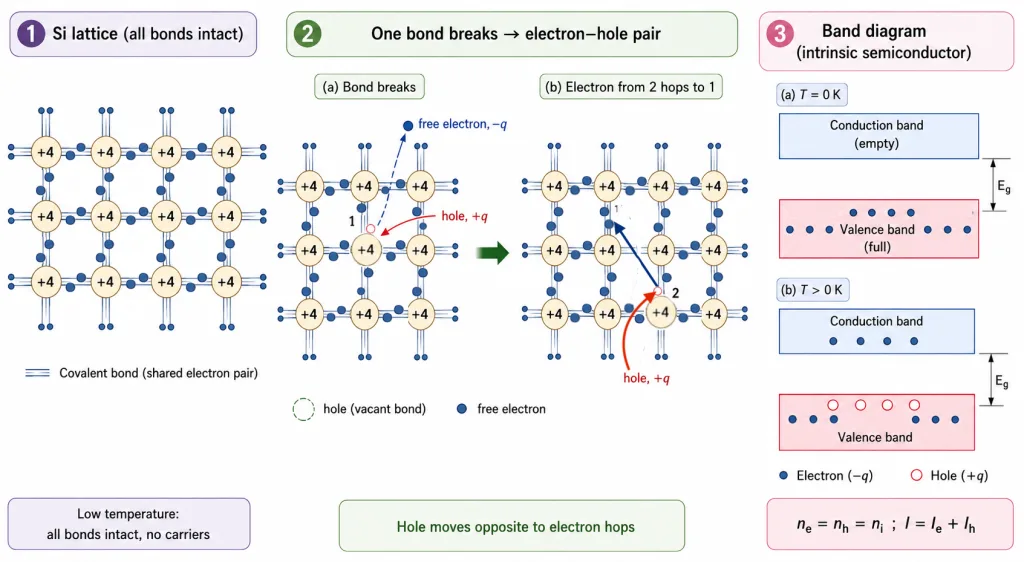
At low temperatures all bonds are intact — the idealised picture of NCERT Fig. 14.4 — and there are no free carriers.
Thermal generation: electrons AND holes
As temperature rises, thermal energy breaks a few bonds. Each break releases a free electron (charge -q) into the crystal — and the vacancy left behind acts as an effective positive charge +q: a hole.
Key Point: The hole is not a particle in its own right — it is a missing bound electron. But it behaves exactly like an apparent free particle of charge +q, and treating it so is the master trick of semiconductor physics.
In an intrinsic (pure) semiconductor:
where is the intrinsic carrier concentration.
How Holes Move, and the Two Currents
Suppose a hole sits at site 1. A bound electron from a neighbouring bond (site 2) can jump into the vacancy — now the hole is at site 2. The vacancy has effectively moved — without the originally freed electron being involved at all. That free electron wanders independently as a conduction electron.
Under an electric field:
- Free electrons drift (against the field) → electron current .
- Holes drift toward negative potential (along the field) → hole current .
(Remember: hole motion is 'only a convenient way of describing the actual motion of bound electrons' — but the convenience is total.)
Generation and recombination
Alongside generation, recombination runs continuously: a free electron collides with a hole and the pair vanishes (the bond reforms). At equilibrium, rate of generation = rate of recombination, fixing at each temperature.
The band picture
- T = 0 K: valence band full, conduction band empty — the intrinsic semiconductor behaves like an insulator.
- T > 0 K: thermal energy lifts some electrons VB → CB; the CB is partially occupied, the VB carries an equal number of holes (NCERT Fig. 14.6).
[NEET Important] Three instant-recall facts: intrinsic means ; total current has TWO components (); at 0 K the material is an insulator. [JEE Tip] grows steeply (exponentially) with temperature — so intrinsic conductivity RISES with T, opposite to metals, where lattice vibrations increase resistivity. 'Semiconductor resistance falls on heating' is the classic discriminator.
Solved Examples
Example 1: Counting bonds and carriers [Board Conceptual]
In pure silicon at low temperature, how many covalent bonds does each atom form, and what carriers exist?
Solution:
- Each Si atom shares its 4 valence electrons with 4 neighbours: 4 covalent bonds per atom (each bond shared between two atoms).
- At low temperature all bonds are intact: no free electrons, no holes — the crystal is effectively an insulator.
- Takeaway: carriers in intrinsic material exist only by thermal bond-breaking; cold crystals have none.
Example 2: The hole's charge and origin [NEET Conceptual]
What exactly is a hole, and why does it carry +q?
Solution:
- A broken bond leaves a vacancy where an electron (-q) used to be.
- The neighbourhood, previously neutral, is now short one electron: net effective charge +q localised at the vacancy.
- Bound electrons hopping into the vacancy shift it — the vacancy moves like a free positive particle.
- Takeaway: hole = electron vacancy with effective charge +q; its 'motion' is bookkeeping for bound-electron hops.
Example 3: Electron-hole pair arithmetic [Board Numerical]
In a pure Ge sample at 300 K, m⁻³. State and , and the effect of doubling the temperature qualitatively.
Solution:
- Intrinsic: m⁻³.
- Higher temperature breaks exponentially more bonds → rises steeply (not linearly).
- Takeaway: in intrinsic material the two carrier types are always equal — every broken bond makes exactly one of each.
Example 4: Two currents, one total [JEE Conceptual]
In an intrinsic semiconductor with an applied field, electrons carry 60% of the current. What carries the rest, and in which direction do the two carrier types move?
Solution:
- The remaining 40% is hole current : I = .
- Electrons (negative) drift opposite to the field; holes (positive) drift along the field, toward the negative terminal.
- Both currents ADD in the conventional sense (opposite charges moving opposite ways = same conventional current direction).
- Takeaway: the two contributions never cancel — they cooperate.
Example 5: Why intrinsic conductivity is feeble [Conceptual Numerical]
Silicon has ~ atoms/m³ but m⁻³ at 300 K. What fraction of atoms is ionised?
Solution:
- Fraction: .
- Roughly one atom in three trillion has a broken bond — conduction is a rare-event phenomenon.
- Takeaway: this feebleness is exactly why doping (next section) is needed to make useful devices.
Example 6: Recombination equilibrium [Board Conceptual]
Why doesn't the number of carriers in an intrinsic semiconductor grow without limit at fixed temperature?
Solution:
- Generation (bond-breaking) creates pairs at a temperature-dependent rate.
- Recombination — an electron colliding with a hole and refilling the bond — destroys pairs at a rate that grows with carrier numbers.
- Steady state: generation rate = recombination rate, pinning (T).
- Takeaway: is a dynamic equilibrium value, not a fixed stock.
Example 7: Semiconductor vs metal on heating [NEET Discriminator]
A metal wire and a pure Si rod are both heated. Compare the changes in their resistance and explain.
Solution:
- Metal: carrier number ~fixed; lattice vibrations scatter electrons more → resistance increases.
- Silicon: thermal generation multiplies carriers exponentially — this swamps extra scattering → resistance decreases.
- Takeaway: opposite temperature coefficients — the single most-tested intrinsic-semiconductor fact (and the basis of thermistors).
Example 8: Which electron moves in hole conduction? [Conceptual]
When a hole 'moves' from site 1 to site 2, trace the actual electron motion.
Solution:
- A bound electron in the covalent bond at site 2 jumps to the vacancy at site 1.
- Site 1 is now complete; site 2 carries the vacancy: the hole has apparently moved 1 → 2, opposite to the electron's hop.
- The originally freed conduction electron is elsewhere entirely, contributing to independently.
- Takeaway: hole current = choreography of bound electrons; conduction-electron current = free-particle motion. Two distinct channels.
Example 9: Band diagram at two temperatures [Board Sketch]
Describe the intrinsic band diagram at T = 0 K and T > 0 K.
Solution:
- T = 0 K: valence band completely full, conduction band completely empty, gap between — an insulator (NCERT Fig. 14.6a).
- T > 0 K: a few electrons occupy the conduction band (drawn as filled circles), leaving an equal number of holes (empty circles) at the top of the valence band (Fig. 14.6b).
- Takeaway: always draw equal electron and hole counts for intrinsic material — unequal counts signal doping.
Example 10: Photogeneration preview [JEE Link]
Light of wavelength 600 nm falls on Ge ( = 0.7 eV) and on C ( = 5.4 eV). In which does it create electron-hole pairs?
Solution:
- Photon energy: eV.
- Ge: 2.07 > 0.7 eV ✔ — pairs are generated (photoconductivity).
- C: 2.07 < 5.4 eV ✘ — diamond stays transparent and insulating.
- Takeaway: any energy source beating — heat, light, voltage — creates pairs; the comparison photon-energy-vs-gap runs through LEDs and photodiodes later.