
Drawing the Graph of a Linear Equation
An equation of the form , with and not both 0, is a linear equation in two variables. Its graph is a straight line: every point on the line is a solution of the equation, and every solution is a point on the line.
To draw the line, find a few solutions. Choose values of that make easy to work out, put them in a table, plot the points and join them. Two points fix a straight line. A third one guards against an arithmetic mistake, because if it does not fall on the line through the other two, one of the three is wrong.
For , that is :
| 0 | 3 | 6 | ||
|---|---|---|---|---|
| 4 | 2 | 0 | 6 |
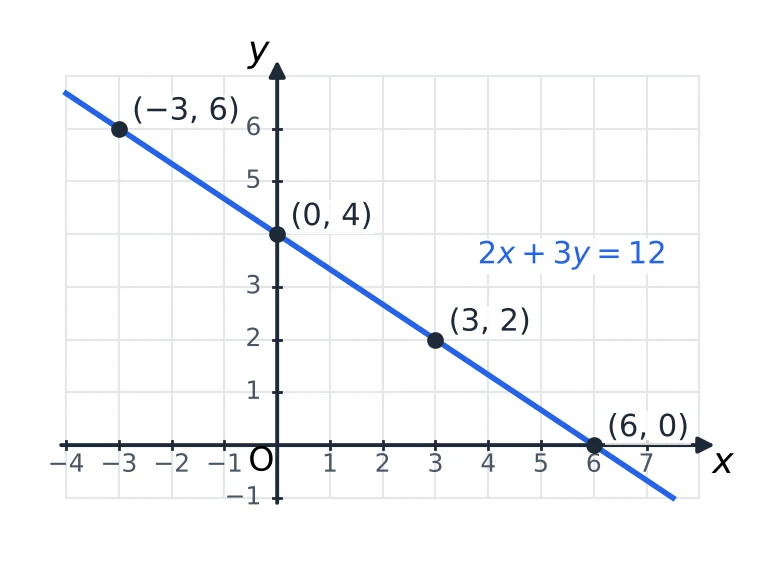
All four points lie on one line. Taking multiples of 3 for kept every a whole number; with you would get , which is hard to plot accurately.
Reading the graph. Any point on the drawn line gives a solution. The line passes through , so , satisfies . A point off the line does not: for , , not 12.
A single linear equation in two variables has infinitely many solutions, one for each point of its line. To pin down one pair of values you need a second line that crosses the first. Where two lines meet, and what that point means, comes later in this section.
Where a Line Cuts the Axes
The two points that are always easy to find are the ones on the axes.
- On the x-axis every point has . Put in the equation to find where the line cuts the x-axis.
- On the y-axis every point has . Put to find where it cuts the y-axis.
For : with , and , so the line cuts the x-axis at . With , and , so it cuts the y-axis at . Join the two points and the line is drawn.
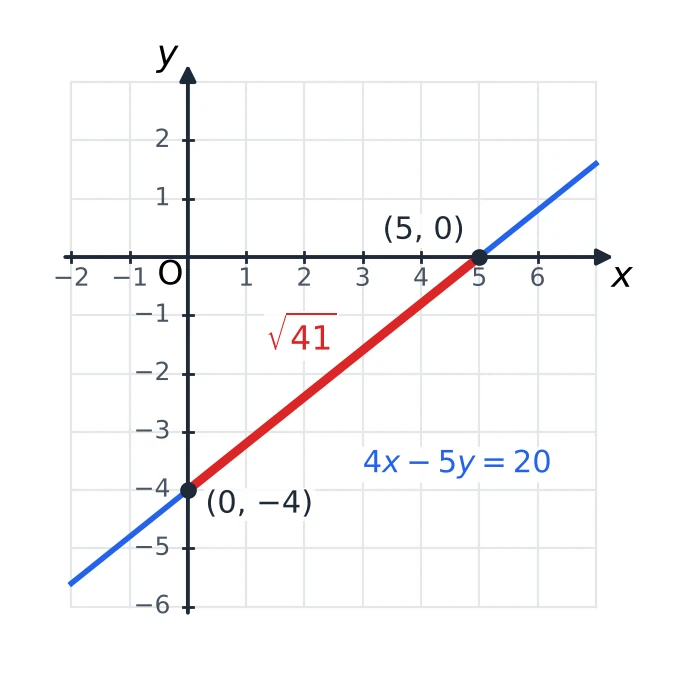
In general cuts the x-axis at and the y-axis at . (The intercept form, which shows both at a glance, is in Slope and the Equation of a Line.)
Three mistakes to watch for:
- writing the x-axis point as . A point on the x-axis has its 0 in the second place;
- taking a coefficient for the intercept: this line cuts the x-axis at 5, not at 4;
- losing the sign: gives , a point below the origin.
The piece between the axes. The segment from to is the hypotenuse of a right triangle whose legs, 5 and 4, lie along the axes. So its length is .
Which quadrants the line passes through. The two axis points tell you. This line rises to the right (slope ). Left of the y-axis it is below , in the third quadrant; between the two axis points it is in the fourth; beyond it is in the first. It never enters the second quadrant. A slanting line that misses the origin always passes through exactly three quadrants.
The Lines , , and
Some equations have only one letter in them, and they are still lines.
- is the set of all points whose x-coordinate is . It is a vertical line, parallel to the y-axis, crossing the x-axis at .
- is a horizontal line, parallel to the x-axis, crossing the y-axis at .
- is the y-axis itself, and is the x-axis. These two are easy to swap: the y-axis is the line on which is 0.
- joins the points whose two coordinates are equal, such as and . It passes through the origin at to the x-axis, cutting the first and third quadrants in half.
- joins points such as and . It passes through the origin at , through the second and fourth quadrants.
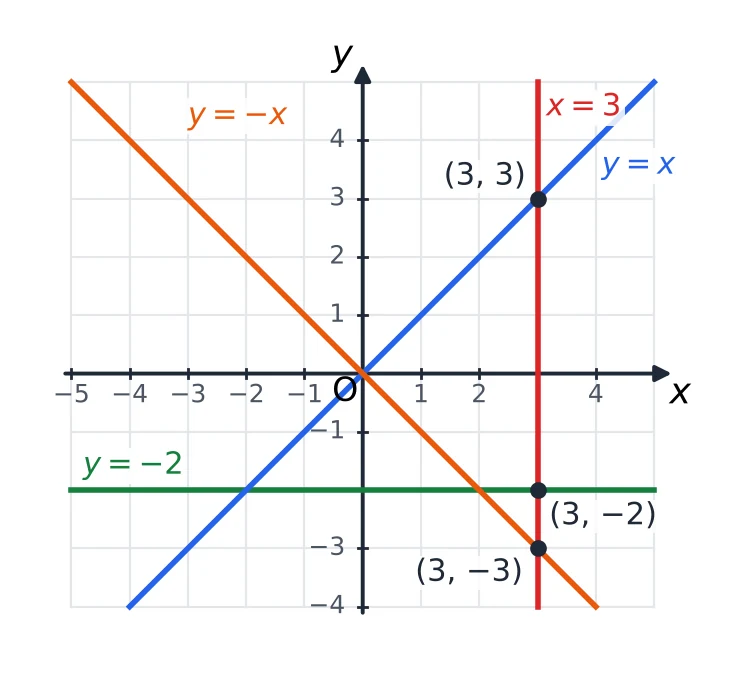
The lines and meet at , the only point that is on both. In the same way meets at and meets at .
Lines through the origin. , or any with no constant term, passes through . Such a line cuts both axes at the same point, so it cannot make a triangle with them.
[SSC Tip] When a question asks what kind of line the graph of is, the answer is a line parallel to the y-axis, even though the letter in the equation is . Reading as a line parallel to the x-axis is the mistake to avoid.
The Triangle a Line Makes with the Axes
A slanting line that does not pass through the origin cuts the two axes at two points, and these points together with the origin make a right triangle. Its two legs lie along the axes, and the right angle is at O.
For the axis points are and , so the legs are 9 and 12:
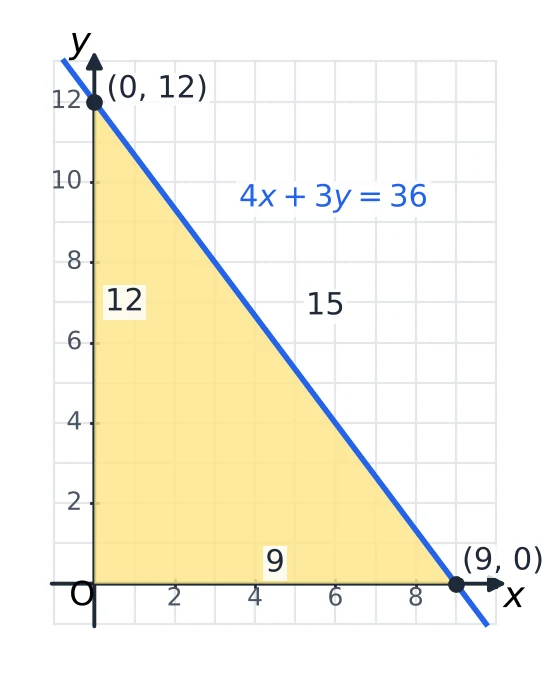
The hypotenuse, the piece of the line between the axes, is , so the perimeter of the triangle is units.
The formula. For the legs are and , so
For this gives , as before.
Negative intercepts. For the axis points are and , and the triangle lies below the x-axis, in the fourth quadrant. Lengths are never negative, so the area is square units. Use the sizes of the intercepts and drop their signs.
Finding the line from the area. If makes a triangle of area 54 with the axes, then , so and or . The two lines are parallel, one on each side of the origin, and they cut off triangles of the same size. If the question says is positive, the answer is 36.
Before 2025, CGL questions from this chapter were mostly of this kind: where a line cuts the axes, and the area it encloses with them or with another line.
[SSC Tip] Keep the . Without it the area for comes out as 108, double the true value, and that is a typical wrong option.
Where Two Lines Meet
Two lines that are not parallel cross at exactly one point. That point lies on both lines, so its coordinates satisfy both equations, and finding it means solving the pair (by elimination or substitution, as in Chapter 11).
For and , subtracting the second equation from the first removes : , so , and then . The lines meet at .
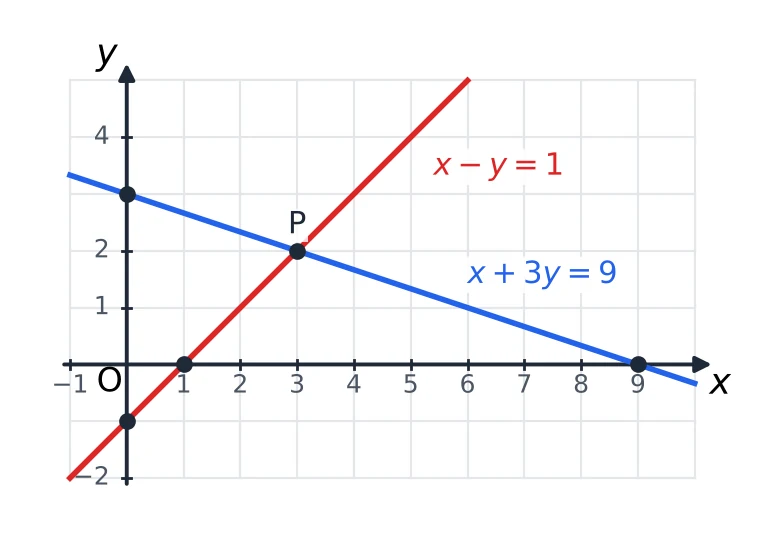
The graph agrees. The first line runs from down to , the second passes through and , and they cross at . A careful graph shows the point, but solving is faster and exact.
The meeting point is asked about in several ways.
- Its coordinates, or an expression in them. If the lines meet at , find and first. For this pair, .
- A third line through it. If the question asks which line also passes through P, find P and put it into each option. Here lies on , since .
- Its quadrant. has both coordinates positive, so it is in the first quadrant.
- An unknown in one of the lines. If and meet at a point whose y-coordinate is 4, the first line gives , so . Then the second gives , and .
When the question gives the meeting point outright, start from it: it must satisfy both equations, and each equation gives you one fact.
Area Enclosed by Two Lines and the x-axis
Two lines that cross above or below the x-axis make a triangle with it. Its three corners are the two points where the lines cut the x-axis and the point where the lines meet each other.
Take the same lines, and .
- They cut the x-axis at and .
- They meet at .
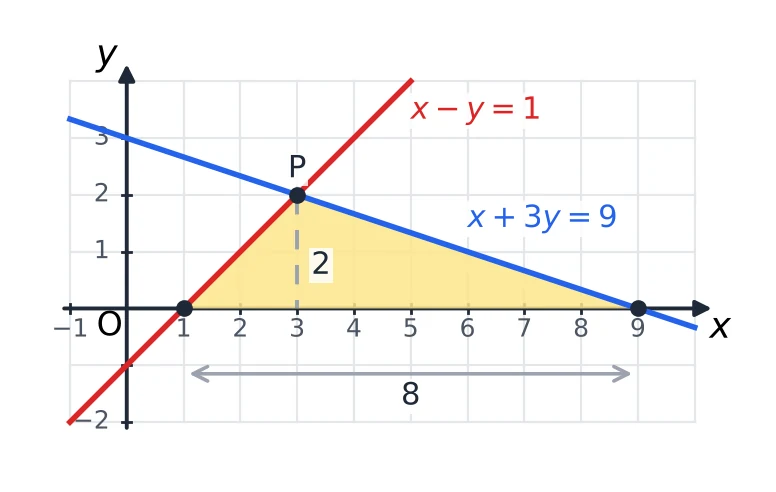
The base lies along the x-axis from 1 to 9, so it is 8 units long. The height is the distance of P from the x-axis, which is its y-coordinate, 2. So
The steps for any pair:
- Put in each equation to get the two ends of the base.
- Solve the pair to get the third corner.
- The base is the gap between the two x-values, and the height is the size of the y-coordinate of the third corner.
If one x-intercept is negative, the base is still the gap between the two values: for and 5 the base is , not 3. If the lines meet below the x-axis, the y-coordinate of the meeting point is negative, and the height is its size.
You do not need the area formula for three vertices (from Midpoint, Section Formula, Centroid and Area) here. One side lies flat on the axis, so half the base times the height is quicker and leaves less room for error.
Area Enclosed by Two Lines and the y-axis
With the y-axis, everything turns round. The base lies along the y-axis, between the two points where the lines cut it, and the height is the distance of the meeting point from the y-axis, which is its x-coordinate.
For the same two lines:
- cuts the y-axis at and cuts it at , so the base is .
- They meet at , which is 3 units from the y-axis, so the height is 3.
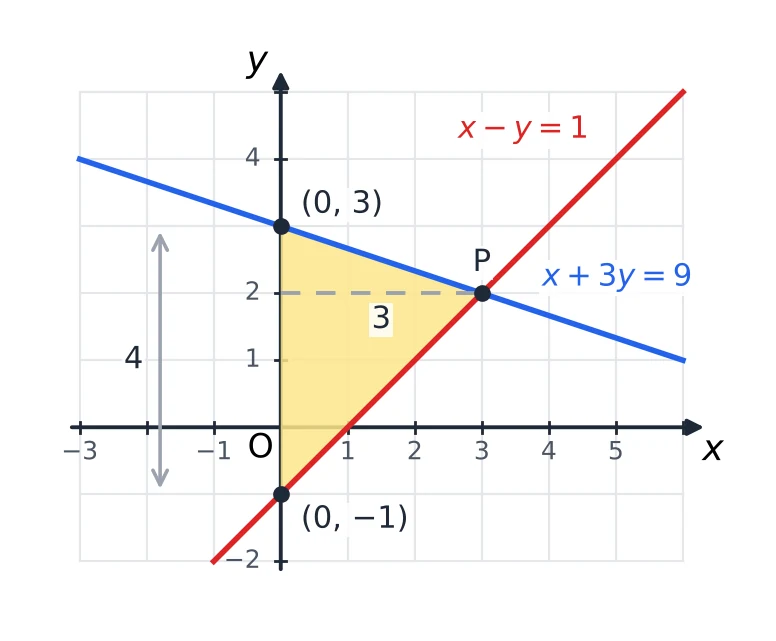
The same two lines enclose 8 square units with the x-axis and 6 with the y-axis. Using the y-coordinate of P as the height here, a mix of the two methods, would give .
Just the base. A shorter question asks only for the distance between the two axis points: the graphs of two lines meet the y-axis at P and Q; find PQ. For these lines . For the x-axis the same idea gives the gap between the two x-intercepts, here .
[SSC Tip] Read which axis the question names before you start. The area with the other axis comes from the same few numbers, so it makes a ready-made wrong option.
Areas Bounded by Lines Parallel to the Axes
Lines of the form and make rectangles and right triangles whose sides can be read straight from the equations.
A rectangle. The lines , , and enclose a 4 by 3 rectangle with corners , , and , so its area is 12 square units. In general the lines , , and enclose a rectangle of area .
For , , and the sides are and , so the area is 28 square units. The sides are the gaps between the values, not the values themselves.
A right triangle. The lines , and enclose a triangle. Its corners: and meet at ; meets at ; meets at .
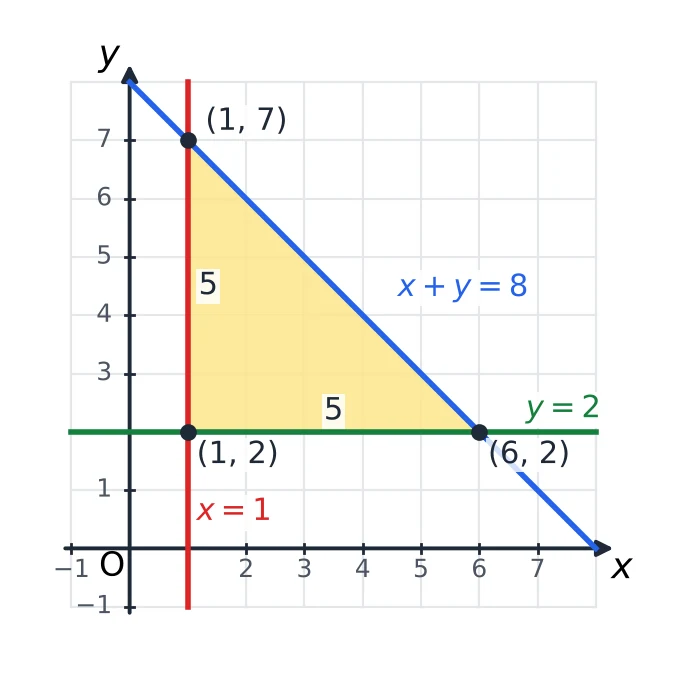
The right angle is at , where the vertical and the horizontal line cross. The legs are and , so the area is square units.
With . The lines , and the x-axis enclose the triangle with corners , and , of area 8 square units. The corner on the slanting line is found by putting into .
In all of these, first find every corner by taking the lines two at a time. Once the corners are written down, the lengths of the sides along the grid lines are simple differences.
The Triangle Formed by Three Lines
Three lines, no two of them parallel and not all through one point, make a triangle. Its corners are the three meeting points, one for each pair of lines.
Take , and .
- and : doubling the first gives ; adding it to the second, , so and . Corner .
- and : from the second, ; then , so and . Corner .
- and : subtracting, , so and . Corner .
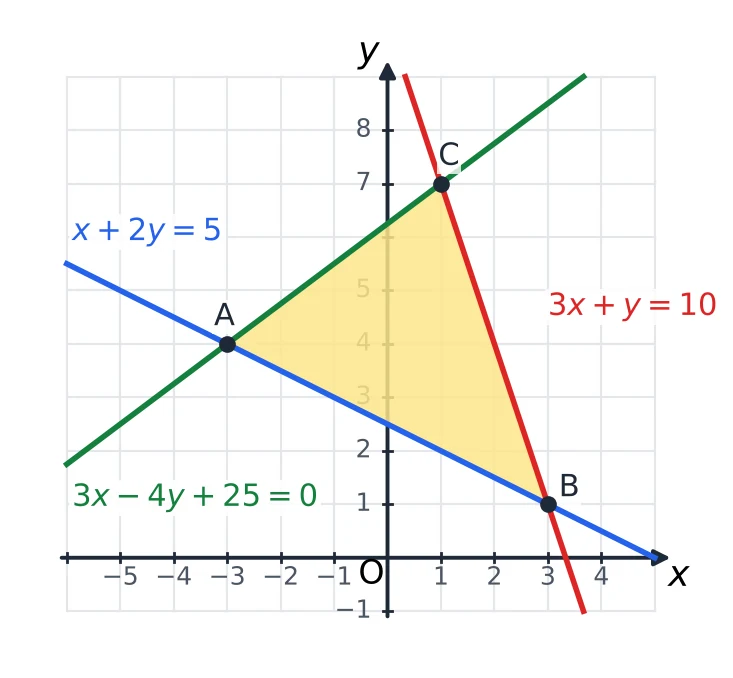
No side lies along an axis, so use the area formula for three vertices (see Midpoint, Section Formula, Centroid and Area):
When one of the three lines is an axis, or parallel to one, half the base times the height is quicker, as in the last few parts.
Check every corner. Each corner must satisfy both lines that made it. For : and . A wrong corner gives a wrong area with no warning, so this ten-second check is worth doing.
When there is no triangle. If two of the lines are parallel, the third line crosses them but the region between them is open, so no triangle forms. If all three lines pass through one point, the triangle shrinks to that point. Both cases come up in options as zero or impossible areas.
The Region Two Lines Cut Off with Both Axes
Two lines in the first quadrant, each cutting both axes, enclose with the axes a four-sided region next to the origin. Take and .
- cuts the axes at and .
- cuts them at and .
- Doubling the second equation and subtracting the first gives , so , , and the lines meet at .
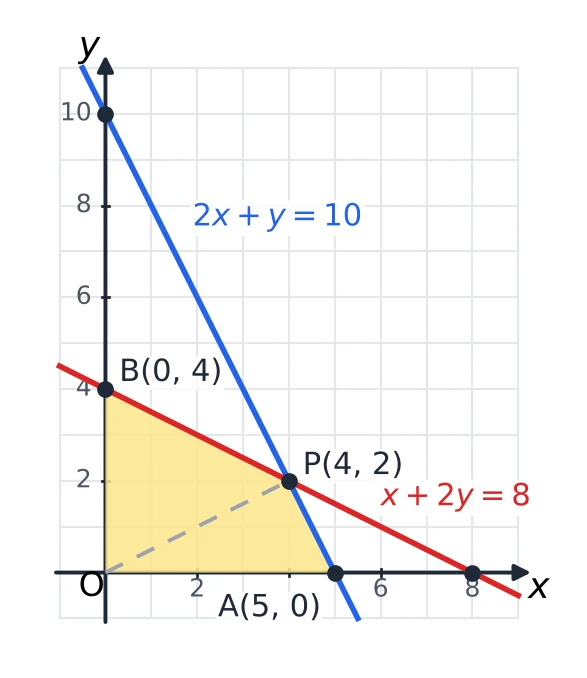
The region has corners , , and . Along each axis, the boundary is the line that cuts that axis first: on the x-axis (at 5, before 8) and on the y-axis (at 4, before 10).
Split the region along OP into two triangles.
- Triangle OAP: base on the x-axis, height = the y-coordinate of P = 2, area 5.
- Triangle OPB: base on the y-axis, height = the x-coordinate of P = 4, area 8.
The total is 13 square units.
Another way: a big triangle minus a small one. The line makes a triangle of area with the axes. Cut off from it the small triangle with corners , and P, of area , and is left.
The same picture answers two other questions. The triangle formed by the two lines and the x-axis is that small one, of area 3. The triangle formed by the two lines and the y-axis has corners , and P, so its area is .
What the Graph Says About a Pair of Equations
Draw the two lines of a pair of linear equations, and one of three things happens.
| The two lines | Common points | The pair has |
|---|---|---|
| cross | exactly one | one solution (consistent) |
| are parallel | none | no solution (inconsistent) |
| are the same line | every point of it | infinitely many solutions |
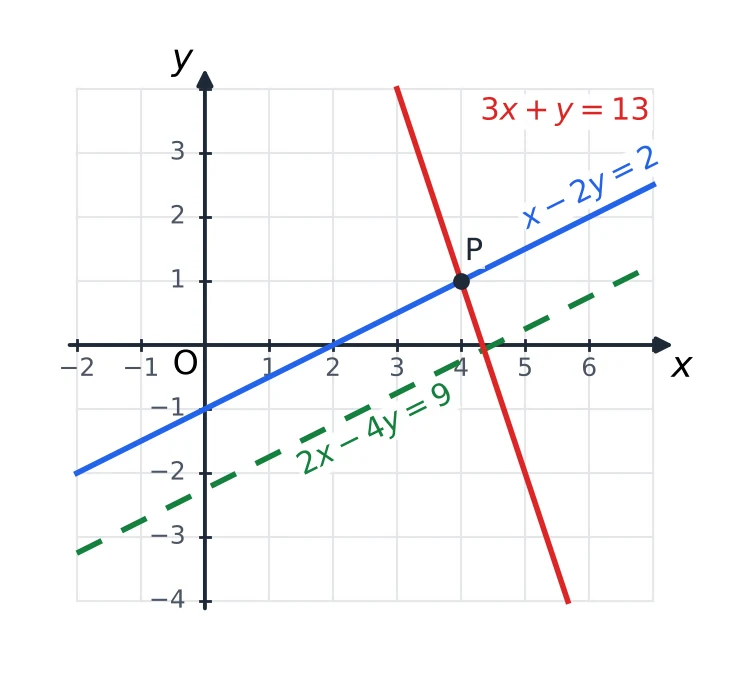
In the figure, and cross at : one solution. The line has the same slope as , namely , but a different y-intercept ( against ), so the two never meet and that pair has no solution.
The same line in disguise. The equations and look different, but the second is the first multiplied by 3. Both describe one line, and every point on it solves the pair.
Telling them apart from the equations. Compare the slopes first. Different slopes mean the lines cross. Equal slopes mean parallel or the same line; then compare the y-intercepts, and different intercepts mean parallel. The ratio test for and , which says the same thing in one line, is in Chapter 11.
Finding . For to be parallel to , the slopes must match: , so . The lines are then and, tripling the second, , with different right sides, so they are parallel. Had the first equation been , the same would have made the two lines one and the same.
[SSC Tip] Two straight lines meet in exactly one point, in no point, or in every point of a line. They can never meet in exactly two points, so an option that says two can be struck off at once.
Reading the Equation from a Graph
Sometimes the question shows a line and asks for its equation. Read two clear points off the graph, preferably where the line crosses the grid exactly.
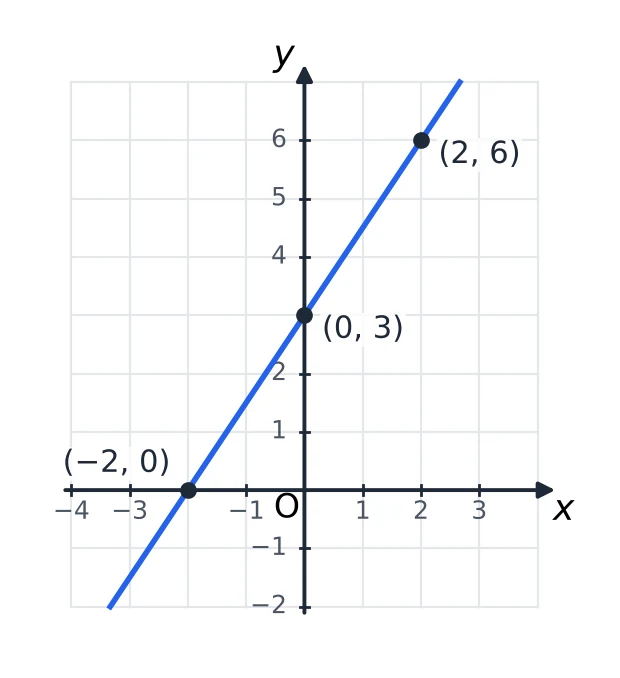
From the intercepts. The line in the figure cuts the x-axis at and the y-axis at . The intercept form gives ; multiplying by 6, , that is . The third marked point, , checks it: .
From the slope and the y-intercept. From to the line rises 3 for a run of 2, so , and it cuts the y-axis at 3. That gives , which is the same line once multiplied by 2.
Special graphs.
- An upright line through is , and a flat line through is .
- A line through the origin and is , that is .
Matching a graph to an option. It is often quicker to test the options than to build the equation. Find where each option cuts the axes (put , then ) and keep the one that matches the picture. The direction is a second check: a line that rises to the right needs and of opposite signs in , and a line that falls needs them of the same sign.
Solved Examples
Question 1
Where does the graph of cut the x-axis? (a) (b) (c) (d)
Answer. On the x-axis every point has . Then , so , and the point is (a) . The line cuts the y-axis at . Writing puts the right number in the wrong place.
Question 2
The graph of meets the x-axis at A and the y-axis at B. If O is the origin, what is the area of triangle OAB? (a) 60 square units (b) 7.5 square units (c) 15 square units (d) 30 square units
Answer. A is and B is , so OAB is a right triangle with legs 10 and 6. Its area is , that is (d) 30 square units. The formula gives the same: . Using the coefficients 3 and 5 as the legs would give 7.5.
Question 3
What is the length of the part of the line that lies between the coordinate axes? (a) 17 units (b) 23 units (c) 60 units (d) units
Answer. The line cuts the axes at and . The piece between them is the hypotenuse of a right triangle with legs 15 and 8, so its length is . The answer is (a) 17 units. The 60 is the area of that triangle, not a length.
Question 4
What is the area of the region enclosed by the lines , , and ? (a) 15 square units (b) 5 square units (c) 25 square units (d) 3 square units
Answer. These four lines make a rectangle. Its width is the gap between and , which is , and its height is the gap between and , which is also 5. So the area is , which is (c) 25 square units. The rectangle is in fact a square.
Question 5
Find the area of the triangle formed by the lines , and the x-axis. (a) 9 square units (b) 18 square units (c) 6 square units (d) 4.5 square units
Answer. The corners are where the lines meet in pairs. and the x-axis meet at the origin. meets the x-axis at and meets at . So the triangle has its right angle at , a base of 3 and a height of 6, and its area is , which is (a) 9 square units.
Question 6
The graphs of and meet at . What is the value of ? (a) 1 (b) (c) 4 (d) 5
Answer. To remove , I multiply the first equation by 2 and the second by 5: and . Adding, , so , and then gives . So , and . The answer is (d) 5.
Question 7
The graphs of and meet at a point P. Which of these lines also passes through P? (a) (b) (c) (d)
Answer. Subtracting the first equation from the second removes : , so and . P is . Now I test the options: , which fits. The others give , and , so they miss P. The answer is (c) .
Question 8
Find the area of the triangle formed by the lines , and the x-axis. (a) 48 square units (b) 24 square units (c) 6 square units (d) 12 square units
Answer. With , the first line cuts the x-axis at and the second at , so the base is . Putting into gives , so the lines meet at and the height is 6.
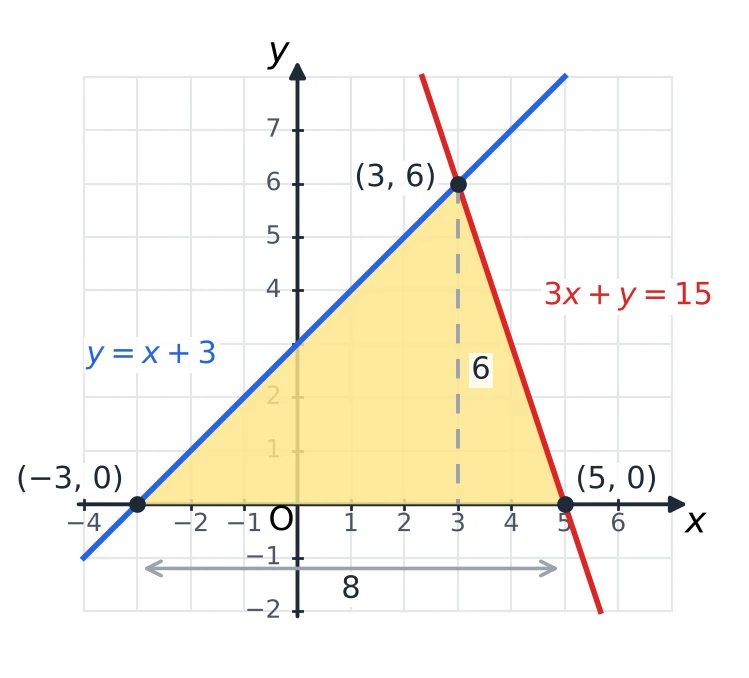
Area , which is (b) 24 square units. Taking the base as ignores the minus sign and gives 6.
Question 9
What is the area of the triangle formed by the lines , and the y-axis? (a) 25 square units (b) 40 square units (c) 20 square units (d) 16 square units
Answer. With , the first line cuts the y-axis at and the second at , so the base along the y-axis is . From the first line ; putting this into the second, , so and . The height is the distance of from the y-axis, which is 4.
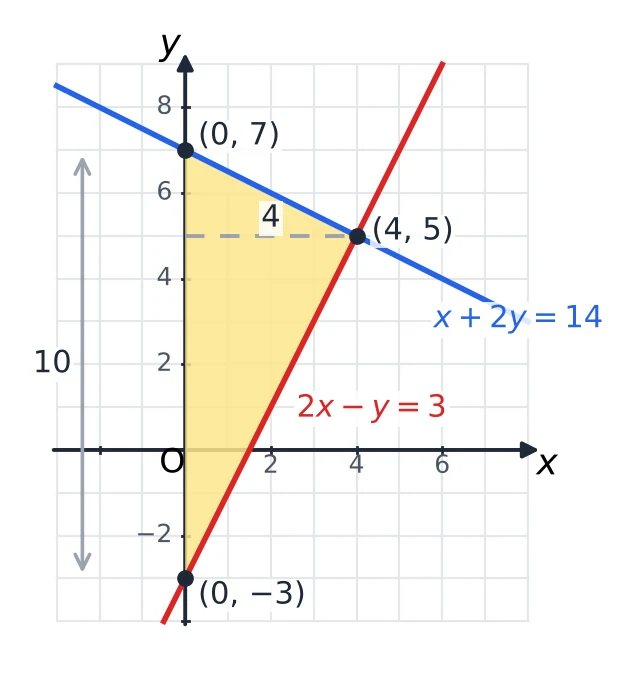
Area , which is (c) 20 square units. Using the y-coordinate 5 as the height gives 25.
Question 10
Find the area of the triangle formed by the lines , and . (a) 15 square units (b) 30 square units (c) 12 square units (d) 20 square units
Answer. I find the three corners first. and meet where , at . and meet at . The two slanting lines meet where , at .
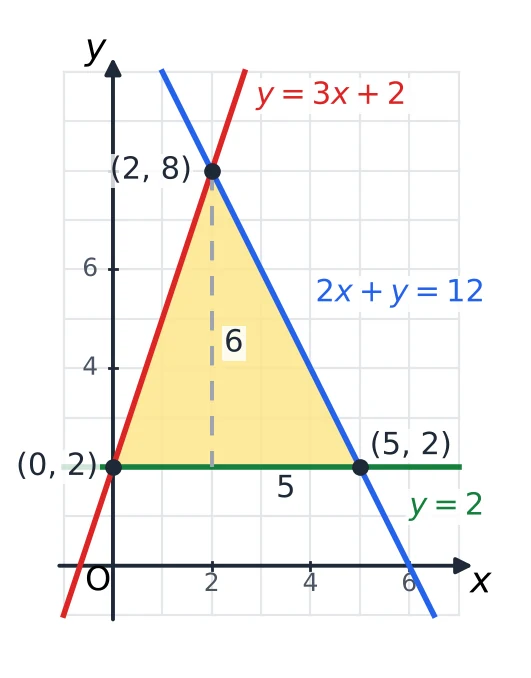
The side on is 5 long, and the top corner is above it. Area , which is (a) 15 square units.
Question 11
What is the area of the four-sided region bounded by the coordinate axes and the lines and ? (a) 16 square units (b) 26 square units (c) 9 square units (d) 13 square units
Answer. cuts the axes at and ; cuts them at and . Subtracting the second equation from the first gives , and then , so the lines meet at . Next to the origin the boundary stops at 3 on the x-axis, where crosses first, and at 8 on the y-axis, where crosses first. So the region has corners O, , and .
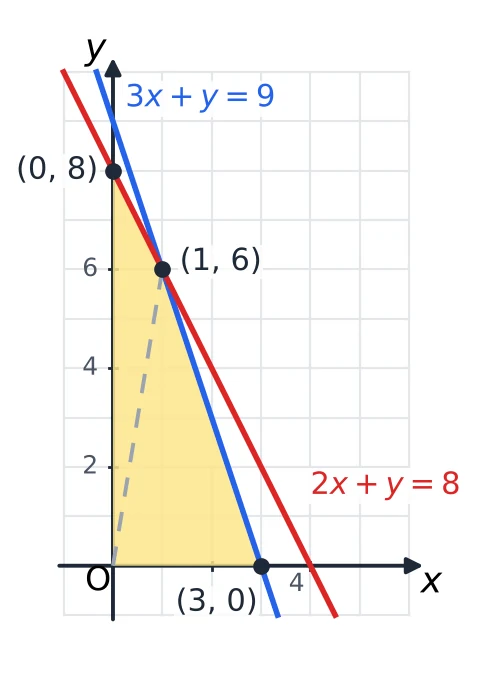
I cut it along the dashed line from O to . The lower triangle has base 3 on the x-axis and height 6, so its area is 9; the upper one has base 8 on the y-axis and height 1, area 4. The total is (d) 13 square units. The value 16 is the whole triangle that makes with the axes.
Question 12
The graph of meets the y-axis at , and the graph of meets the x-axis at . What is the value of ? (a) (b) 8 (c) 24 (d) 12
Answer. On the y-axis , so and P is : and . On the x-axis , so and Q is : and . The sum is , which is (b) 8.
Question 13
The graphs of and meet at a point whose x-coordinate is 2. What is the value of ? (a) 2 (b) 6 (c) 1 (d) 4
Answer. The meeting point lies on both lines. On the first, gives , so and the point is . Putting it into the second: , so . The answer is (a) 2.
Question 14
Find the area of the triangle formed by the lines , and . (a) 8 square units (b) 32 square units (c) 16 square units (d) 4 square units
Answer. and meet at the origin. The line meets at and at .
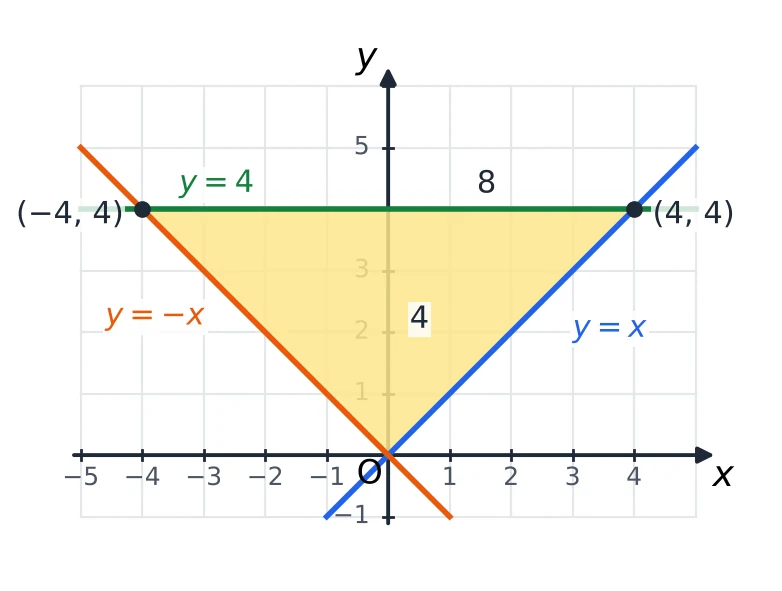
The base along runs from to 4, so it is 8 long, and the origin is 4 below it. Area , which is (c) 16 square units.
Question 15
The graphs of and meet the y-axis at P and Q. What is the length of PQ? (a) 4 (b) (c) 7 (d) 10
Answer. On the y-axis . The first line gives , so P is ; the second gives , so Q is . Both points are on the y-axis, so PQ is the gap between 7 and : . The answer is (d) 10.
Question 16
The graphs of the equations and are (a) lines that cross at one point (b) parallel lines (c) the same line (d) lines that cross at right angles
Answer. Slopes first: and . Equal slopes mean the lines are either parallel or the same line, and the y-intercepts decide which: for the first and for the second. They differ, so the graphs are (b) parallel lines, and the pair has no solution.
Question 17
How many solutions does the pair of equations and have? (a) infinitely many (b) none (c) exactly one (d) exactly two
Answer. Multiplying the first equation by 3 gives , which is the second equation. So the two equations draw the same line, and every point of that line is a solution. The pair has (a) infinitely many solutions.
Question 18
For what value of are the graphs of and parallel lines? (a) (b) 36 (c) 4 (d)
Answer. Parallel lines need equal slopes: , so . The first line is then , or after multiplying by 3. The second is : the same left side with a different right side, so the lines are parallel and do not coincide. The answer is (c) 4.
Question 19
The figure shows the graph of a straight line. What is its equation? (a) (b) (c) (d)
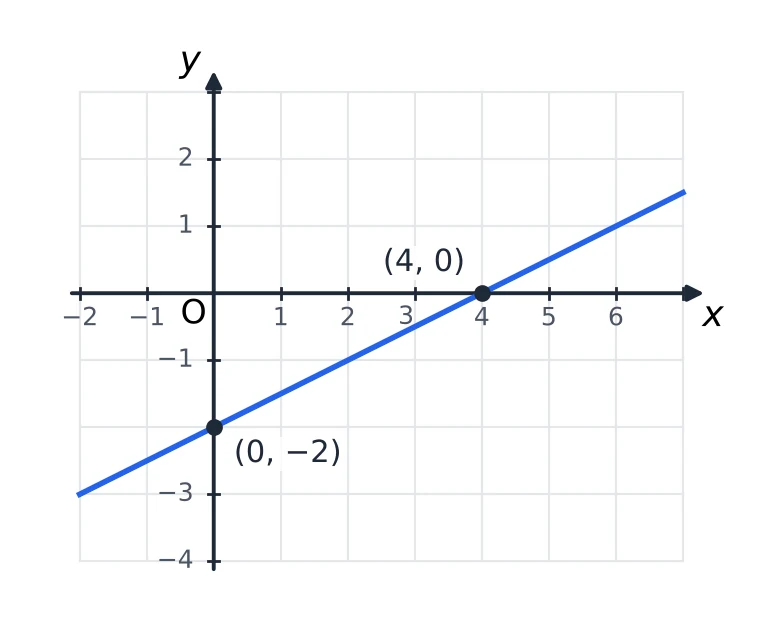
Answer. The line cuts the x-axis at and the y-axis at . Intercept form: . Multiplying by 4, . The answer is (d) . As a check, the line rises to the right, and has the positive slope .
Question 20
For what positive value of does the line make a triangle of area 27 square units with the coordinate axes? (a) (b) 18 (c) 27 (d) 9
Answer. The line cuts the axes at and , so the triangle's area is . Setting gives , so , taking the positive root as asked. The answer is (b) 18. Without the the equation would be , leading to .
Question 21
The graph of does not pass through which quadrant? (a) the first quadrant (b) the second quadrant (c) the third quadrant (d) the fourth quadrant
Answer. The line cuts the x-axis at and the y-axis at , and its slope, , is positive. Moving left from it goes further down, into the third quadrant. Between and it is in the fourth quadrant, and beyond it rises into the first. It never enters the second quadrant, where is negative and positive. The answer is (b) the second quadrant.
Question 22
Find the area of the triangle enclosed by the lines , and . (a) 18 square units (b) 12 square units (c) 9 square units (d) 6 square units
Answer. Corners first: meets at and meets at ; meets where , at .
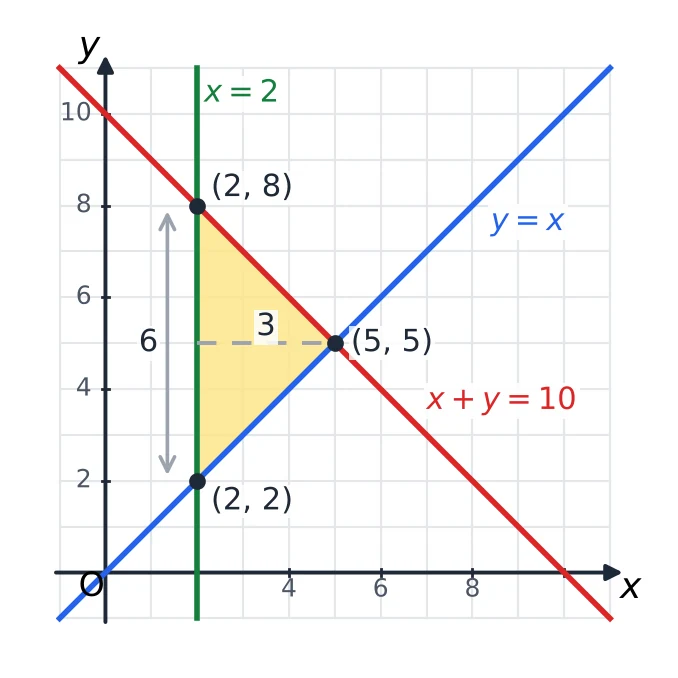
The side on is long, and the third corner is to the right of it. Area , which is (c) 9 square units.