
How to Use These Questions
These 31 questions come in mixed order, as they would in a paper: a reflection may follow a centroid, and an area may follow a pair of equations. In CGL 2025 Tier 1 most shifts had one question from this chapter, usually on slope, the midpoint, distance or the equation of a line. Before any working, sketch the axes and put the points roughly where they belong. The sketch shows which vertex is opposite which, whether a line rises or falls, and whether the sign of your answer is sensible.
Answers are left as exact numbers, fractions or surds. Only two are marked [Tier 2]: external division and the angle between two lines. The foot of the perpendicular and the distance questions near the end are Tier 1 work, so do not skip those. Most of the Tier 1 questions need four lines of working or fewer. If one took you much longer, find the matching method in Shortcuts & Speed Methods and try the question again a few days later.
Solved Examples
Question 1
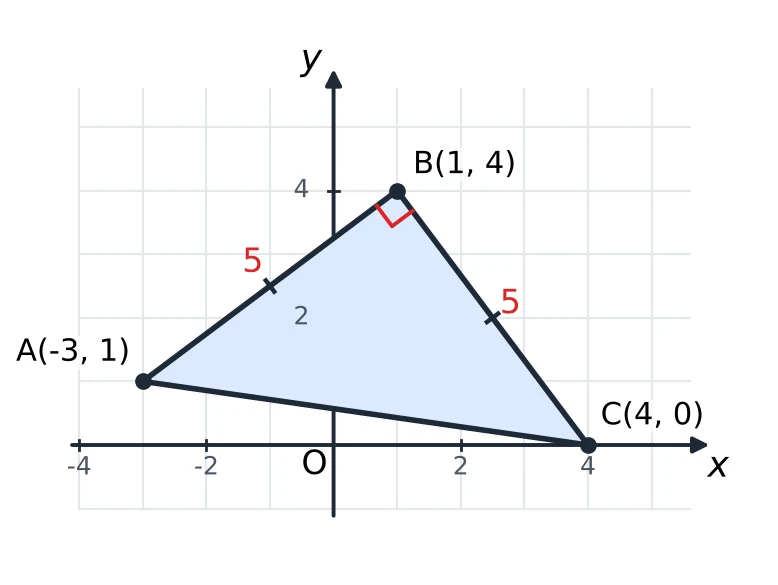
What kind of triangle has the vertices , and ? Find its area too.
Answer. I find the three sides first. AB has differences 4 and 3, so . BC has differences 3 and 4, so . AC has differences 7 and 1, so . Two sides are equal, and , so the angle at B is a right angle. The triangle is right-angled and isosceles, with the right angle at B. Its area is half the product of the two legs: 12.5 square units.
Question 2
The line through and has slope . Find p.
Answer. The slope is . Setting it equal to and cross-multiplying, , so and . To check: from to , y falls 9 while x rises 6, and .
Question 3
The point lies on the segment joining and . Find the ratio in which P divides AB, and the value of k.
Answer. The y-coordinate of P is the one I know, so I use the y's: 1 : 2. So P is one-third of the way from A to B. The x-coordinate goes from to 7, a rise of 12, and a third of 12 is 4, so .
Question 4
Find the point on the x-axis that is equidistant from and .
Answer. A point on the x-axis is . Setting : . The terms cancel and leave , so and . The point is , and it is units from each of A and B.
Question 5
Find the equation of the line through and , and the point where it cuts the x-axis.
Answer. The slope is . Point-slope form at : , so , that is . The other point checks: . Putting gives , so the line cuts the x-axis at .
Question 6
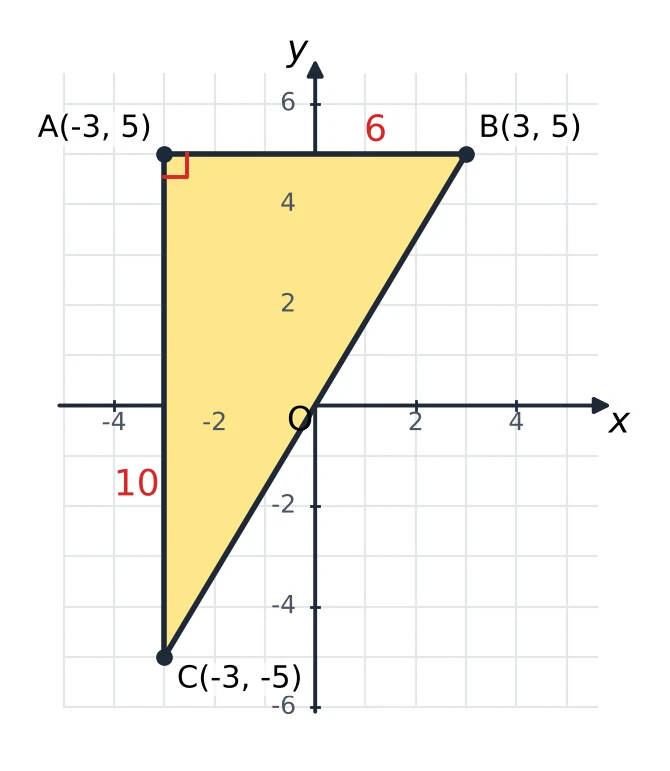
The point is reflected in the y-axis to B, and B is reflected in the origin to C. Find the area of triangle ABC.
Answer. In the y-axis only the sign of x changes, so . In the origin both signs change, so . A and B have the same y, so AB is level, and A and C have the same x, so AC is upright. The right angle is at A, with and . The area is 30 square units.
Question 7
The vertices of a triangle are , and . Find the length of the median through A, and the distance of the centroid from A.
Answer. The median from A goes to the midpoint of BC, which is . A and M have the same x, so 6 units. The centroid is , so 4 units. That is two-thirds of the median, which is what it should be.
Question 8
For what value of k is the line perpendicular to the line ?
Answer. Lines and are perpendicular when ; this is with the fractions cleared. Here , so and . To check, the slopes are and , and their product is .
Question 9
Find the value of k for which and are the same line. What happens for the other value of k that makes ?
Answer. gives , so k is 4 or . For the same line the constants must give the same ratio too, and . With the ratios are , and , all equal to , so the lines coincide: . With the first two ratios are but the third is , so the lines are parallel, and the pair has no solution.
Question 10
Find the values of a for which the distance between and is 10 units.
Answer. The y-difference is 6, so the x-difference must complete a 6-8-10 triangle: . So or , which gives or . Both points are 10 units from , one on each side of it.
Question 11
The graph shows a line L. Find its equation, and say whether the point lies on it.
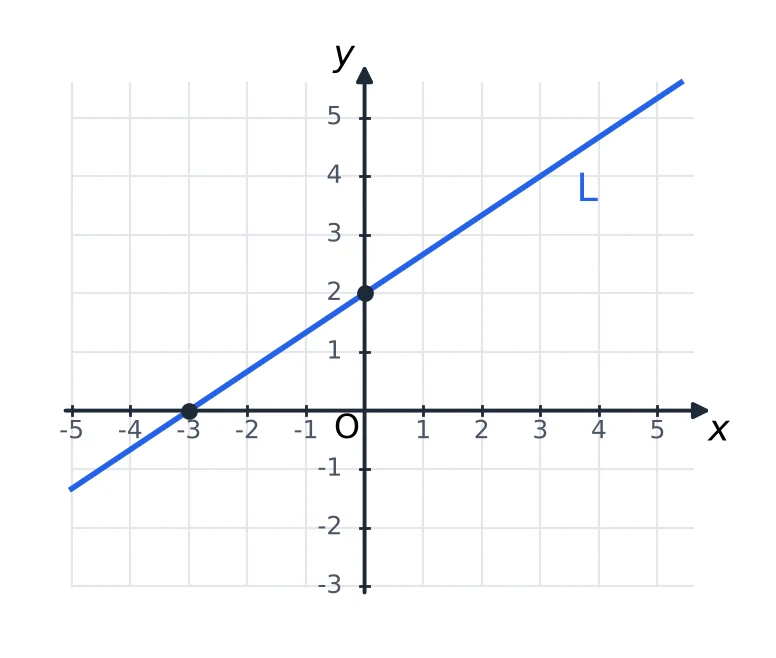
Answer. L cuts the x-axis at and the y-axis at , so in intercept form it is . Multiplying by 6 gives , so the line is . For : , so yes, it lies on L. The graph agrees: the line goes up 2 for every 3 across, a slope of , and .
Question 12
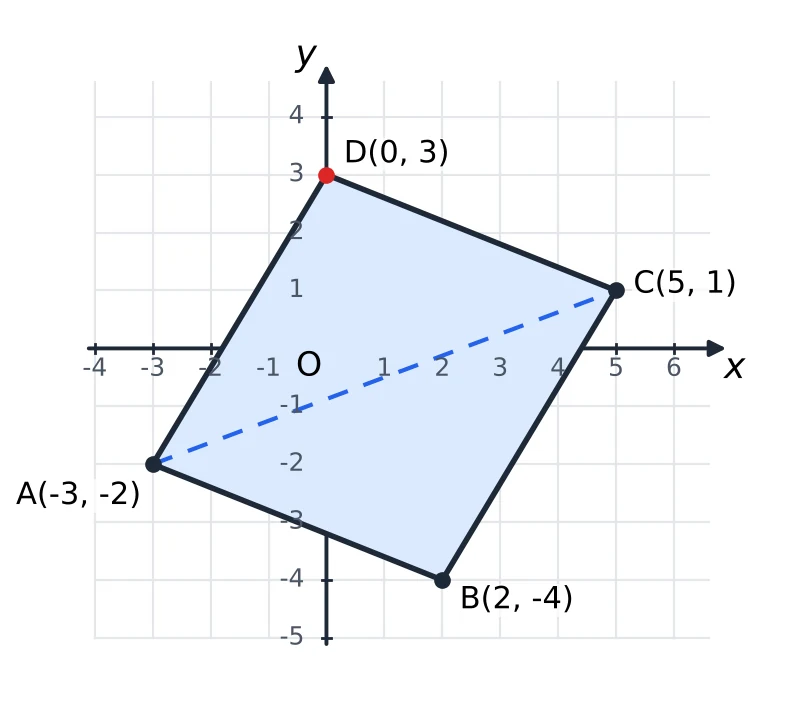
, and are three vertices of parallelogram ABCD, taken in order. Find D and the area of the parallelogram.
Answer. . The diagonal AC cuts the parallelogram into two equal triangles, so its area is twice the area of triangle ABC. I move A to the origin: B becomes and C becomes . The area of ABC is , so the parallelogram is 31 square units.
Question 13
Find the image of in the line , and then the image of that point in the line .
Answer. The line is upright, so y stays and x becomes . The first image is ; P was 7 units to the right of the line and this point is 7 units to its left. The line is level, so x stays and y becomes . The final point is .
Question 14
Find the equation of the perpendicular bisector of the segment joining and .
Answer. It passes through the midpoint of AB, . The slope of AB is , so the bisector has slope 2. Then , that is , or . To check, take another point on it, : it is from A and from B.
Question 15
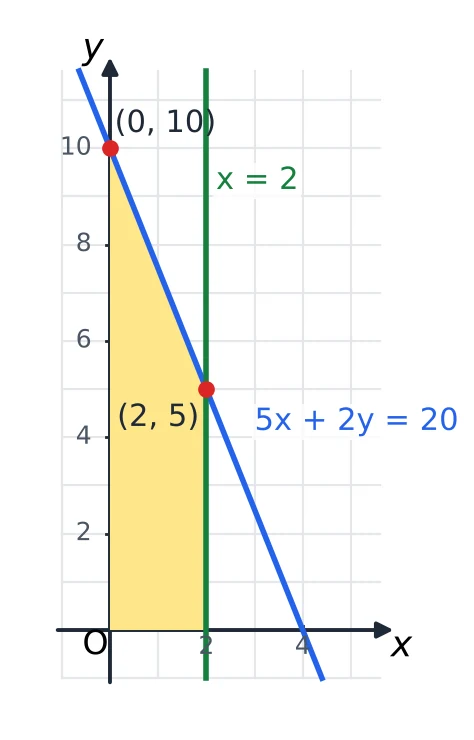
Find the area of the region bounded by the coordinate axes, the line and the line .
Answer. I find the corners. The axes meet at , and meets the x-axis at . It meets where , at , and meets the y-axis at . The region is a trapezium with upright parallel sides 10 and 5, a distance 2 apart. Area 15 square units.
Question 16
Find the points that divide the segment joining and into four equal parts.
Answer. From A to B, x changes by and y by 12. A quarter of that is a step of in x and 3 in y. Walking from A one step at a time gives , and . The middle one is the midpoint of AB, and a fourth step lands on , which is B, so the steps are right.
Question 17
A line passes through , and its x-intercept is twice its y-intercept. Neither intercept is zero. Find the equation of the line.
Answer. Let the y-intercept be b. Then the x-intercept is 2b, and the line is , or . Putting in : , so . The line is , with x-intercept 2 and y-intercept 1.
Question 18
Without solving, say whether each pair has one solution, no solution or infinitely many. Where there is exactly one, find it.
- (i) and
- (ii) and
- (iii) and
Answer. (i) The ratios are , and , all equal to : the same line, so infinitely many solutions. (ii) , but is different: parallel lines, so no solution. (iii) and differ, so the lines cross at one point. From the first equation ; then gives and . They meet at .
Question 19
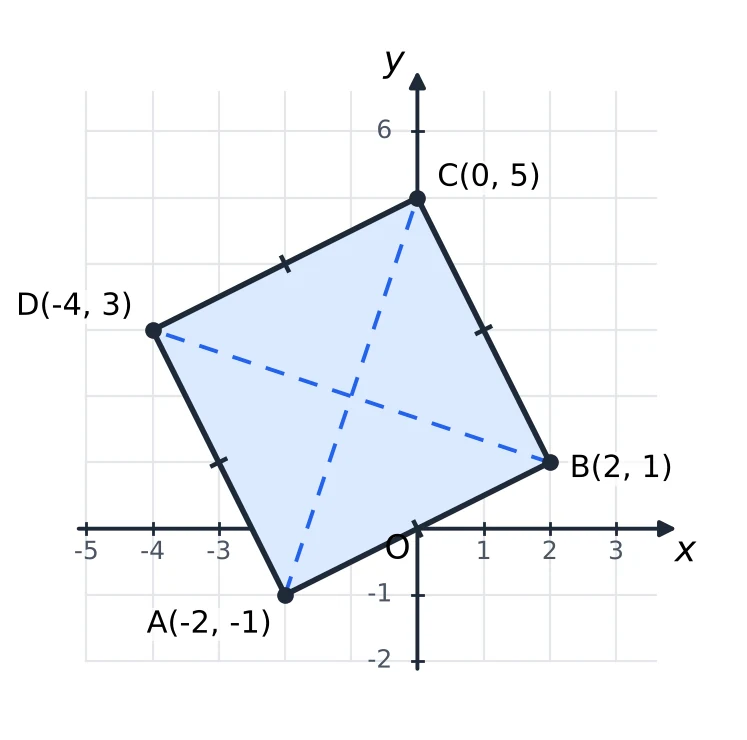
Show that , , and are the vertices of a square, and find its area.
Answer. Sides first. AB has differences 4 and 2, BC has 2 and 4, CD has 4 and 2, and DA has 2 and 4, so all four sides are . Then the diagonals: AC has differences 2 and 6, and BD has 6 and 2, so both are . Four equal sides make ABCD a rhombus, and a rhombus with equal diagonals is a square. Its area is 20 square units.
Question 20
The area of the triangle with vertices , and is 6 square units. Find k.
Answer. Two vertices are on the x-axis, so the base is , and the height is 2, the distance of from the x-axis. Then , so . That gives or : the third vertex can be on either side of .
Question 21
, and are collinear. Find k, and the ratio in which B divides AC.
Answer. From A to B, x rises 6 and y rises 3, so y rises half as much as x. From B to C, x rises 10, so y rises 5, and . For the ratio I use the x's: 3 : 5.
Question 22
The lines and meet at a point P. Find P, and the area of the triangle the two lines make with the y-axis.
Answer. From the first equation . Putting this into the second: , so and , and the point is . The y-intercepts are and 7, so the base on the y-axis is 10. The height is the distance of P from the y-axis, 3. Area 15 square units.
Question 23
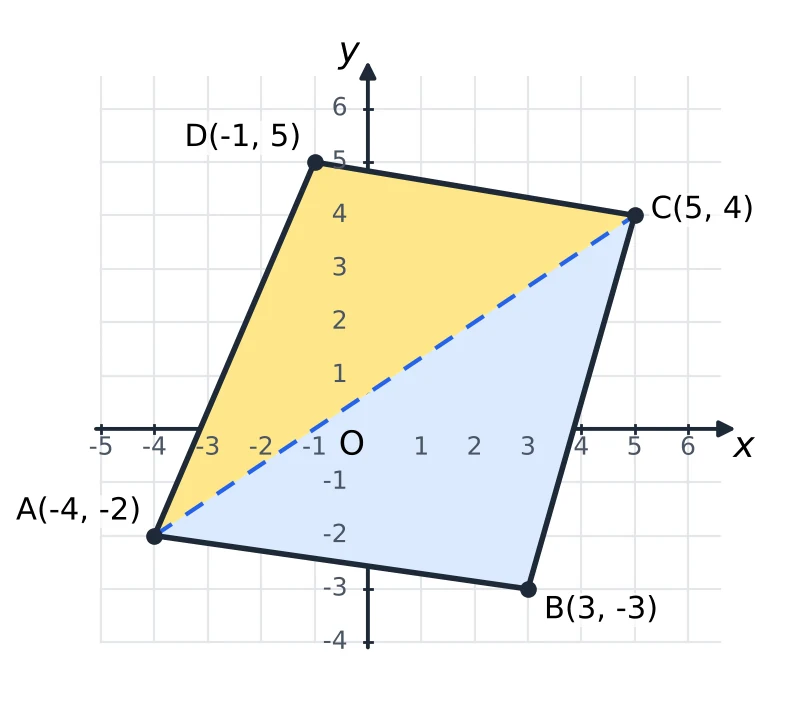
Find the area of the quadrilateral with vertices , , and , taken in order.
Answer. I cut it along AC into triangles ABC and ACD, and move A to the origin, so B, C and D become , and .
- Triangle ABC:
- Triangle ACD:
The quadrilateral is 48 square units.
Question 24
Find the equation of the line through the point where and meet, perpendicular to .
Answer. From the second, ; then , so and . A line perpendicular to has the form : swap the coefficients and change one sign. At , . The line is .
Question 25
The midpoints of the sides BC, CA and AB of triangle ABC are , and . Find the vertices of the triangle.
Answer. Each side of triangle DEF is parallel to a side of ABC, so AFDE is a parallelogram with A opposite D. By the fourth-vertex rule, . In the same way and . The vertices are , and . One check: the midpoint of BC is , which is D.
Question 26
Find the point that is equidistant from , and , and the common distance.
Answer. Call the point . Equal distances from and : after squaring, the and cancel and leave , which is . Equal distances from and : , which is . From the second, ; then , so and . The point is . Its differences from are 3 and 4, so the common distance is 5 units.
Question 27
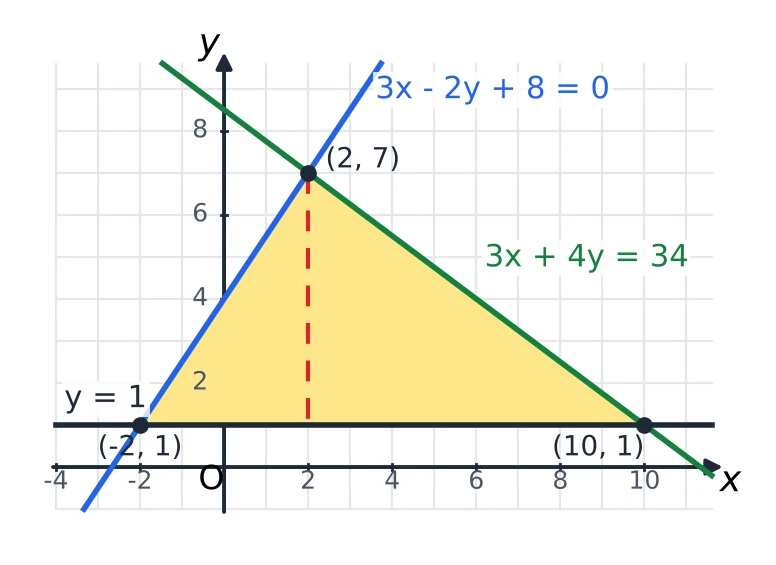
Find the area of the triangle formed by the lines , and .
Answer. I find the three corners. with gives , so . with gives , so . For the other two lines, taking from leaves , so , , and the corner is . The base along runs from to 10, so it is 12, and is above it. Area 36 square units.
Question 28
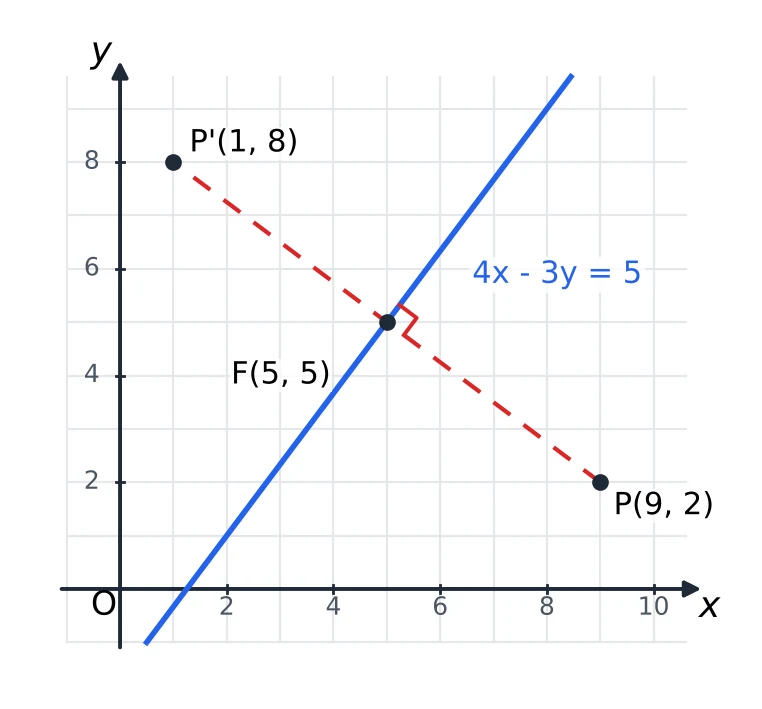
Find the foot of the perpendicular from to the line . Find also the length of this perpendicular and the image of P in the line.
Answer. The perpendicular through P has the form , and P gives . Now I solve with : multiplying the first by 4 and the second by 3 and adding gives , so and then . The foot is . PF has differences 4 and 3, so its length is 5 units. The image is as far beyond F as P is before it, so .
Question 29
[Tier 2] Find the point that divides the segment joining and externally in the ratio 2 : 1.
Answer. For external division in the ratio the section formula takes a minus sign: . With and this is . Seen another way, the point is twice as far from A as from B, on the far side of B, so B is the midpoint of A and the point. Indeed and .
Question 30
Find the distance of the point from the line . Find also the distance between the parallel lines and .
Answer. The distance of from is . Here that is units. For the parallel lines, first make the x and y coefficients match: halving the second gives , and the first is . The distance is the gap between the constants over : 2.5 units.
Question 31
[Tier 2] Find the acute angle between the lines and .
Answer. The slopes are 3 and . For the acute angle between two lines, . Here , so .