
Slope of a Line Through Two Points
The slope of a line tells you how steeply it climbs. Move along the line from one point to another: the change in is the rise, the change in is the run, and the slope is
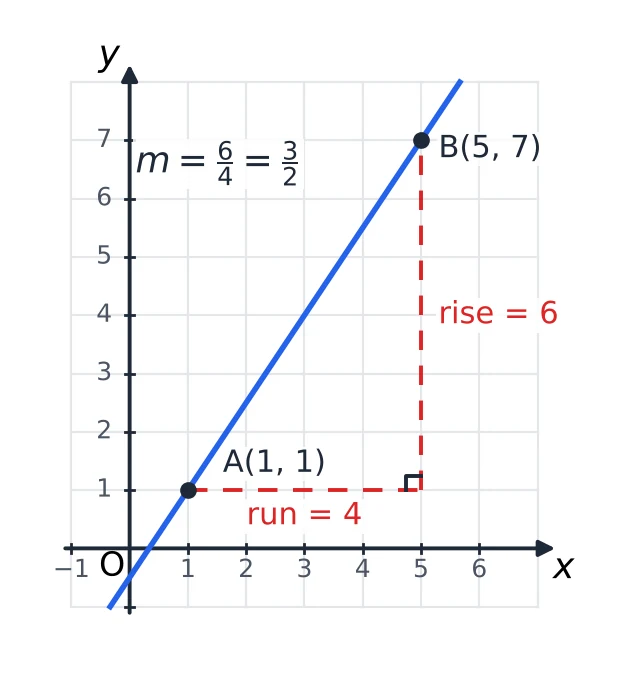
For and the run is and the rise is , so . For every 2 steps to the right, the line goes up 3.
The order of the points does not matter, as long as you use the same order on top and at the bottom: again. Mixing the orders, as in , flips the sign.
A negative slope. For and ,
This line falls as you move to the right. Subtracting a negative coordinate turns into adding, which is where sign errors creep in; write the bracket, , before you simplify.
The sign of the slope tells you the direction at a glance:
| The line, read from left to right | Slope |
|---|---|
| goes up | positive |
| goes down | negative |
| is flat (parallel to the x-axis) | 0 |
| is upright (parallel to the y-axis) | not defined, because the run is 0 |
A rough sketch of the two points is therefore a free check on the sign of your answer.
Keep on top. Turning the fraction upside down, , gives for A and B, so do not feel reassured just because your answer matches one of the options.
Slope and the Angle with the x-axis
Measure the angle that the line makes with the positive direction of the x-axis, turning anticlockwise, so that . This angle is called the inclination of the line, and
because in the rise-run triangle the rise is the side opposite and the run is the side next to it.
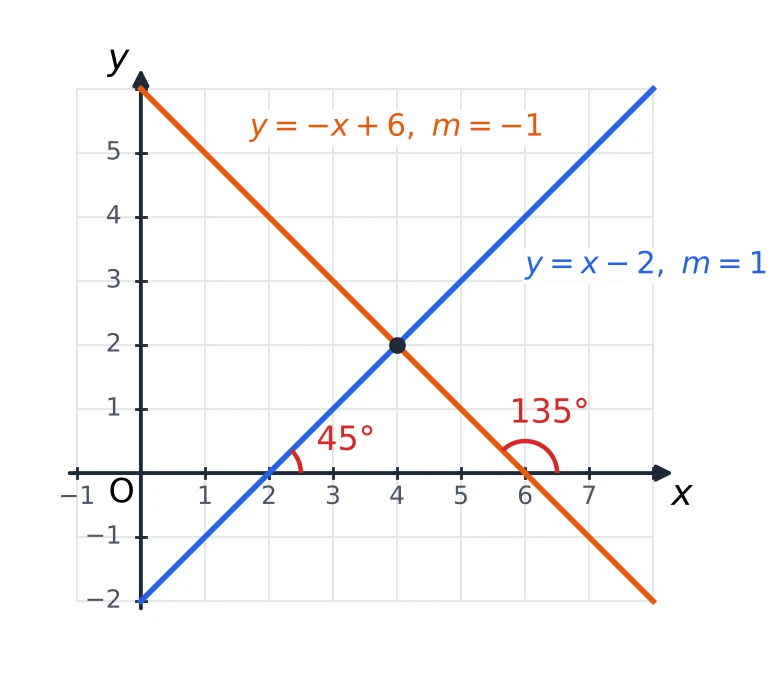
| 0 | 1 | not defined |
Angles above give negative slopes, because (see Chapter 15). In the figure, is inclined at and has slope 1, while is inclined at and has slope .
From the slope back to the angle. A slope of means . A slope of means , not : a negative slope always goes with an obtuse angle. A slope of means .
Lines parallel to the axes. On a line parallel to the x-axis, such as , every point has the same , so the rise is 0 and the slope is 0 (). On a line parallel to the y-axis, such as , the run is 0, and a rise divided by 0 has no value: the slope is not defined (). In particular the x-axis has slope 0 and the y-axis has no slope at all.
Slope 0 and slope not defined are different answers: the first belongs to a flat line, the second to an upright one.
Slope of the Line
When the line is given as an equation rather than as two points, make the subject:
The number in front of is the slope:
- :
- :
- :
- , that is :
- : here , so the slope is not defined and the line is upright
The constant term does not change the slope, so it makes no difference whether the line is written as or as . Only the signs of and matter. When the and terms are on the same side with the same sign, the slope is negative; with opposite signs, it is positive.
Untidy equations. In the term is on the other side. Either bring it across first (, slope ), or just divide by 5: . Dividing is often quicker and leaves less room for a sign error.
[SSC Tip] The slope of a line given as , or of a line perpendicular to it, was asked in several CGL 2025 shifts. The wrong options set next to the right one are usually (the minus sign lost) and (the fraction upside down). Write on paper first and then put in the numbers.
The Form
When a line is written as , both numbers can be read straight off.
- is the slope.
- is the y-intercept: putting gives , so the line cuts the y-axis at .
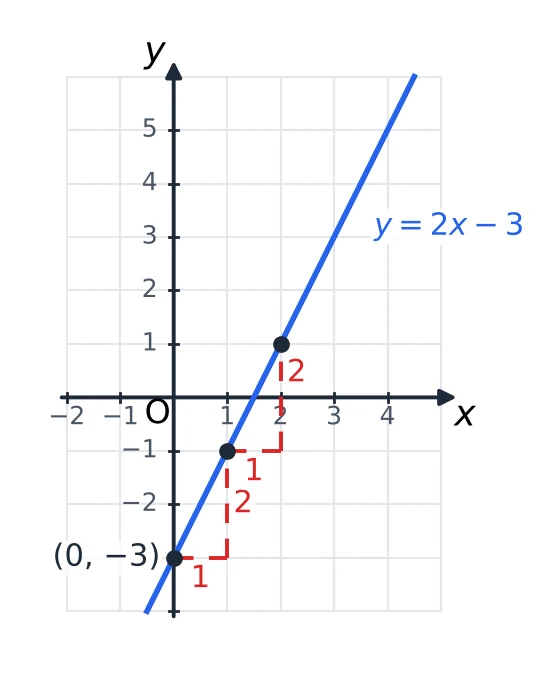
The line cuts the y-axis at . From there, each step of 1 to the right takes it up 2. Two such steps reach and , which is enough to draw it.
Writing the equation. A line with slope and y-intercept 3 is . Clearing the fraction, , that is . The options may use any of these forms, so be ready to move between them.
Lines through the origin. If the line is , which passes through . In the form the test is the same: the line passes through the origin exactly when the constant term is 0.
Finding from a point. If the line passes through , put the point in: , so and the line is .
Finding from a point. If the line passes through , then , so and .
From . The rearrangement in the last part gives the y-intercept as well: it is . For , , so the slope is and the line cuts the y-axis at .
Point-Slope Form and Two-Point Form
Point-slope form. If a line has slope and passes through , then for any other point on it, . Clearing the fraction:
A line with slope through is , so , or . Check with the point: .
Two-point form. Through two given points, find the slope first, then use either point:
Through and the slope is . Using : . Multiply by 2: , so the line is . Check with the other point: .
Through the origin and one point. Through and the slope is and , so the line is , that is, .
The same line in different clothes. , and are one line. When the options look different from your answer, compare the slope and one point, or simply multiply out.
[SSC Tip] When the question asks which equation passes through two given points, you need not build the line at all. Put both points into each option; only the right one is satisfied by both. Test both points every time, because a wrong option can easily pass through one of them.
Intercepts and the Form
The x-intercept of a line is the value where it cuts the x-axis (put ); the y-intercept is where it cuts the y-axis (put ). If these are and , the line is
This is the intercept form: with it gives , and with it gives .
Reading the intercepts of . Divide through by . The line becomes , so it cuts the x-axis at and the y-axis at .
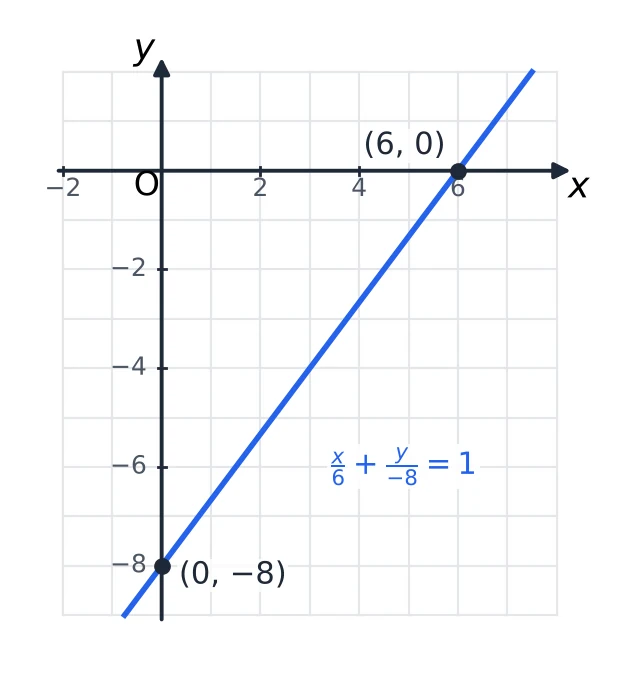
In general the x-intercept of is and the y-intercept is . The coefficient itself is not the intercept: in the coefficients are 4 and , while the intercepts are 6 and . An intercept can be negative. It is a coordinate, not a length.
A line from its intercepts. Intercepts and 3 give . Multiplying by 15, , or .
Equal intercepts. A line that cuts equal intercepts on the axes is , that is . If it passes through , then and the line is . A line through the origin also has equal intercepts (both 0), but questions mean the non-zero case. With intercepts equal in size and opposite in sign the line is ; through that gives .
A point that halves the piece between the axes. If is the midpoint of the part of the line between the axes, the line meets the axes at and , so it is . For that is , or .
Does a Point Lie on the Line? Finding an Unknown
A point lies on a line exactly when its coordinates satisfy the equation. Put them in and see whether the two sides agree.
- Is on ? , so yes.
- Is on it? , so yes.
- Is on it? , so no.
So when a question asks which point does not lie on a given line, test the options one by one: three will pass and one will fail. Start with the option whose numbers make the arithmetic easiest.
An unknown coefficient. If the line passes through , then , so .
An unknown coordinate. If the point lies on , then and . If the point is instead, and .
Two unknowns from two points. If passes through and , the points give and . Subtracting, , so and then . (The slope formula gives at once: .)
The same idea gives the points where a line meets the axes, since a point on the x-axis has and a point on the y-axis has . How those points are used to draw a line, and to find areas, is in Graphs of Linear Equations.
[SSC Tip] With negative coordinates, put each value in brackets before multiplying. For in : , so the point is on the line. Writing gives and the wrong verdict.
Parallel and Perpendicular Lines
Parallel lines rise at the same rate, so they have equal slopes: . Their intercepts differ; if the intercepts were equal too, the two equations would describe one line.
Perpendicular lines have slopes whose product is :
To get the perpendicular slope, turn the fraction upside down and change its sign. A line perpendicular to one of slope 2 has slope ; perpendicular to slope , it has slope .
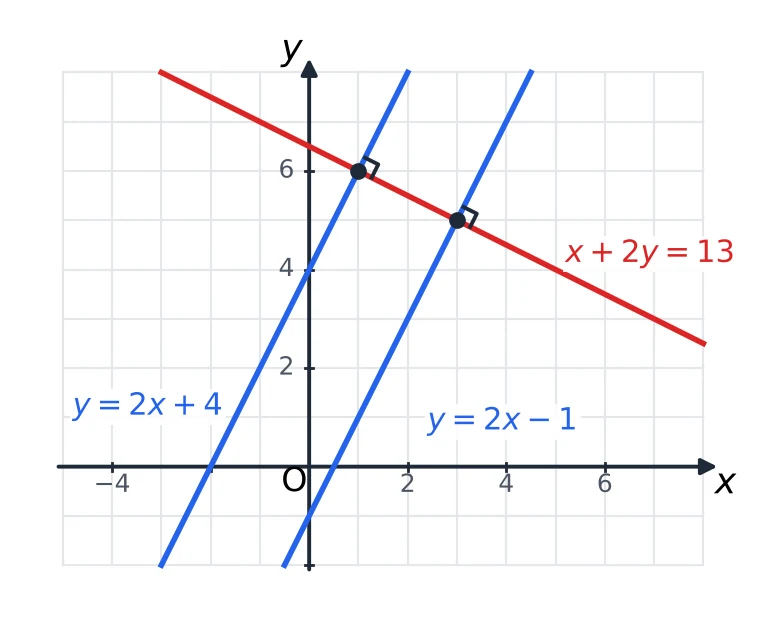
In the figure, and are parallel, and , with slope , cuts both of them at right angles, at and .
The one exception is a pair of lines parallel to the axes. The lines and are perpendicular, but has no slope, so the product rule cannot be used for them.
With equations in the form .
- A line parallel to keeps the same and terms: .
- A line perpendicular to it swaps and and changes one sign: .
- The lines and are perpendicular when .
For example, and are perpendicular, since . Their slopes, and , multiply to .
Finding . For to be parallel to , the slopes must match: , so . For the same line to be perpendicular to : , so .
For a perpendicular slope, the two wrong answers to expect are (sign changed, fraction not turned over) and (turned over, sign not changed). For slope 2 those are and ; the right one is .
A Line Through a Point, Parallel or Perpendicular; the Perpendicular Bisector
Parallel, through a point. Keep the and terms of the given line and find the new constant from the point. The line through parallel to is , and the point gives . So the line is .
Perpendicular, through a point. Swap the coefficients, change one sign, then use the point. The line through perpendicular to is with , so it is . Its slope, , times the old slope, , is .
The same line comes from slopes: the given line has slope , so the perpendicular slope is , and the point-slope form gives .
The perpendicular bisector of a segment passes through its midpoint and is perpendicular to it. Take and .
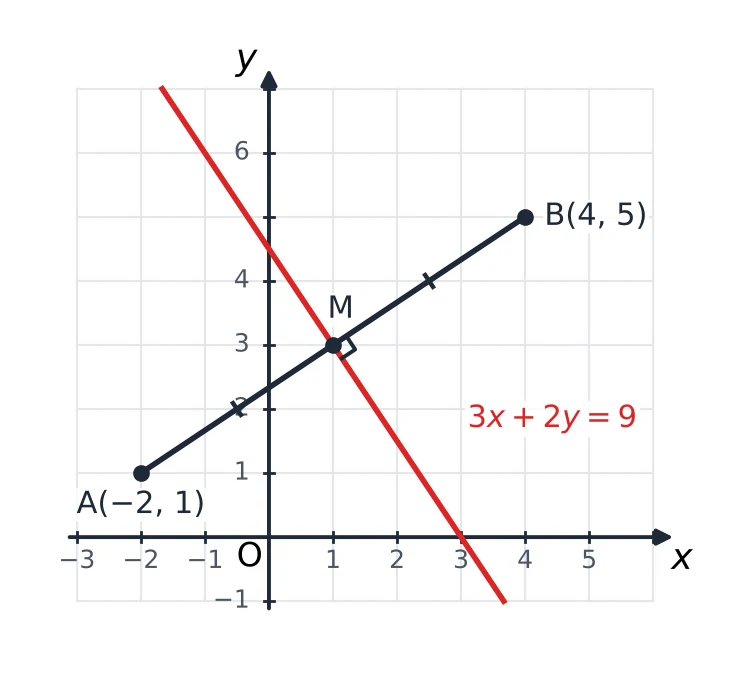
- Midpoint: (the midpoint formula is in Midpoint, Section Formula, Centroid and Area).
- Slope of AB: , so the bisector has slope .
- Bisector: , so , that is .
Every point on this line is the same distance from A and B, and that gives a second route. For a point on it, :
The squared terms cancel and is left, which is the same line. Use whichever you find quicker.
Questions also ask where the bisector cuts an axis. Here, putting in gives the y-intercept .
Three Points on One Line
Three points A, B and C lie on one straight line (they are collinear) when the slope of AB equals the slope of BC. Equal slopes make AB and BC parallel, and since the two pieces share the point B, they must be parts of the same line.
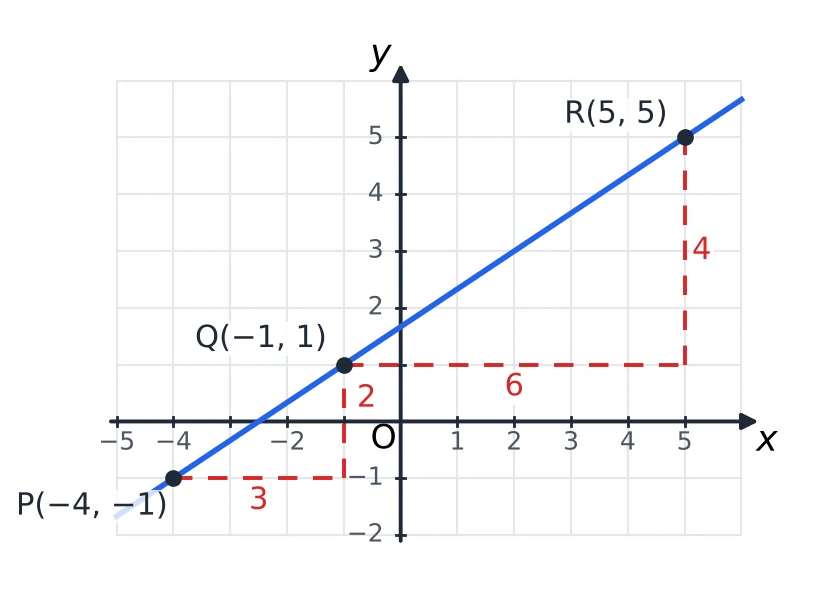
For , and :
The slopes are equal, so the three points are collinear. In the figure, every 3 steps across the line rises 2, from P to Q and again (twice over) from Q to R.
Finding . If , and are collinear, use the two known points for one slope: the slope of AC is . The slope of AB must also be 2: , so and .
Pair the unknown point with a known one, and get the slope from the two points that are fully known. That keeps the unknown in one place only.
When a slope is not defined. If two of the points have the same -coordinate, say and , their line is , and the third point is on it only if its -coordinate is also 4. The slope test fails here because division by 0 is not allowed, so look at the coordinates instead.
The other test for collinearity, that the triangle ABC has area 0, is in Midpoint, Section Formula, Centroid and Area. Both give the same answer; slopes usually need smaller numbers.
Distance from a Line, and the Angle Between Two Lines
The distance of a point from a line is the length of the perpendicular from the point to the line. For the point and the line :
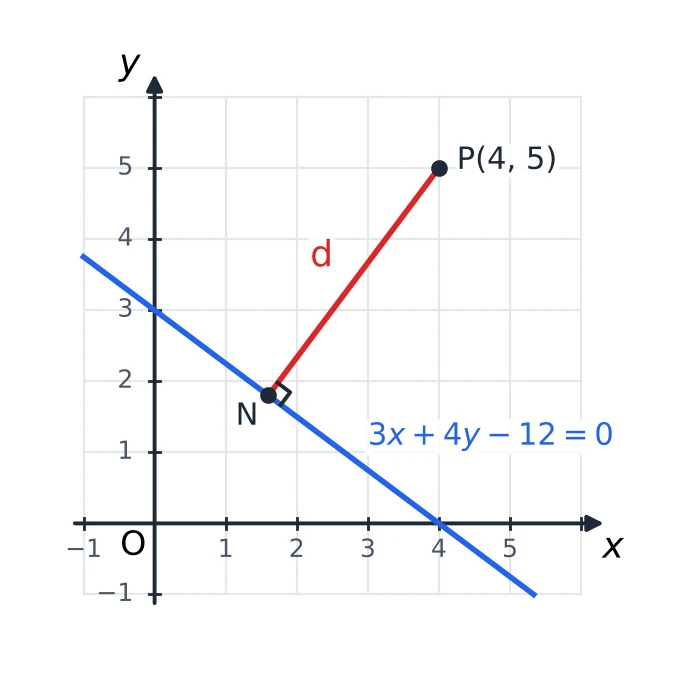
From to : . The foot of the perpendicular, N, is , but the formula does not need it.
- From the origin the top is just . The distance of O from is .
- Write the line as first, with every term on one side. Leaving on the other side flips its sign.
- If the top comes out as 0, the point is on the line.
- A circle that touches a line has its radius equal to the distance of its centre from that line.
Two parallel lines. For and the gap is , but only after the and terms have been made identical. For and , halve the second to get . Then . Using without halving gives , which is wrong.
[Tier 2] The angle between two lines is the difference of their inclinations. is inclined at and at , so they meet at . When the slopes are not standard values, the acute angle between lines of slopes and is given by
For slopes 5 and : , so the lines meet at . If the formula breaks down, and that is exactly the perpendicular case.
Solved Examples
Question 1
What is the slope of the line joining the points and ? (a) (b) (c) (d)
Answer. Rise over run: . So the slope is (c) . The line goes down from left to right, which matches the minus sign. If I had put the run on top, I would have got .
Question 2
A line makes an angle of with the positive direction of the x-axis. What is its slope? (a) (b) (c) (d)
Answer. The slope is . Since , . An angle above always gives a negative slope, so the answer is (a) .
Question 3
Find the slope of the line . (a) (b) (c) (d)
Answer. I use with and : . Making the subject gives the same thing: , so . The slope is (d) .
Question 4
What is the equation of the line with slope that cuts the y-axis at ? (a) (b) (c) (d)
Answer. In the form it is . Multiplying by 3: , so . That is (b) . To check, gives , and . The option has the right intercept but slope .
Question 5
If the line passes through the point , what is the value of ? (a) (b) 9 (c) 3 (d)
Answer. I put and into the equation: , so and . The answer is (c) 3.
Question 6
Find the equation of the line through with slope . (a) (b) (c) (d)
Answer. Point-slope form: . Multiplying by 4, , so . Check with the point: . The line is (d) .
Question 7
What is the equation of the line passing through and ? (a) (b) (c) (d)
Answer. Slope first: . Then , which simplifies to . The constant has vanished, so the line passes through the origin.
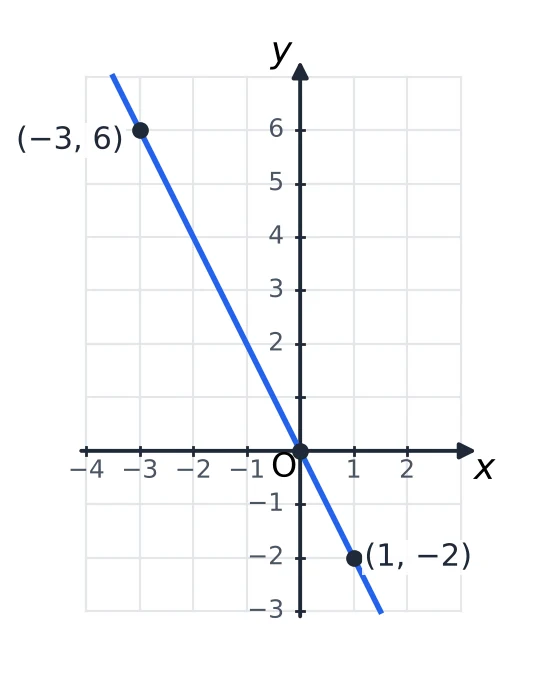
So the equation is (b) . Two of the other options pass through but not through , which is why I always test both points.
Question 8
The x-intercept and the y-intercept of the line are, respectively, (a) 7 and (b) 3 and (c) and 7 (d) 7 and 3
Answer. Putting gives , so the x-intercept is 7. Putting gives , so the y-intercept is . In intercept form the line is . The answer is (a) 7 and .
Question 9
A line passes through and cuts off equal intercepts on the two axes. Its equation is (a) (b) (c) (d)
Answer. Equal intercepts and give , which is . The point gives . So the line is (c) , cutting both axes at 13. The line also passes through the point, but its intercepts are and 23.
Question 10
The point is the midpoint of the part of a line that lies between the coordinate axes. The equation of the line is (a) (b) (c) (d)
Answer. If is halfway along the piece between the axes, the ends of that piece are found by doubling: on the x-axis and on the y-axis.
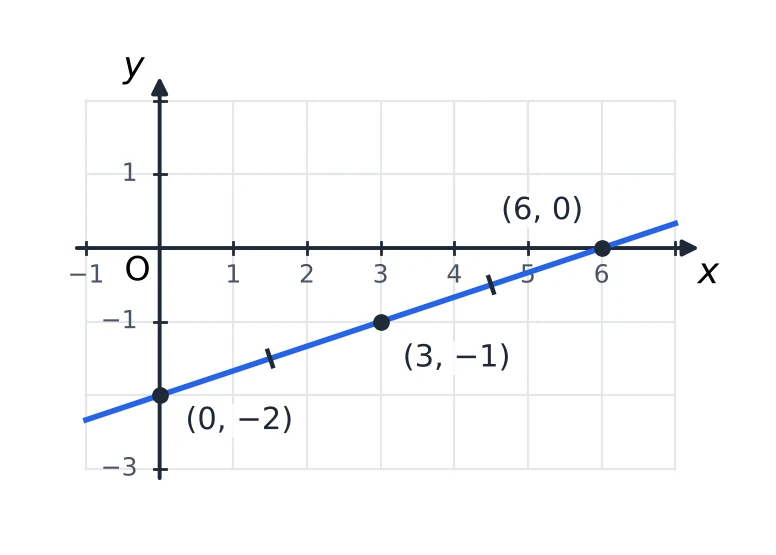
Intercept form: . Multiplying by 6, . The answer is (b) . The option does pass through , but it cuts both axes at 2, so the point is nowhere near the middle of its piece.
Question 11
Which of these points does not lie on the line ? (a) (b) (c) (d)
Answer. I test each point in . For : . For : . For : . For : , which is not 10. So the point that is not on the line is (b) .
Question 12
For what value of does the line pass through ? (a) 3 (b) (c) (d)
Answer. I put and : , so and . The answer is (a) 3. If the is taken as , the working gives and the wrong value .
Question 13
What is the slope of a line perpendicular to ? (a) (b) (c) (d)
Answer. The given line has slope . For the perpendicular I turn it upside down and change the sign, which gives . Check: . The answer is (d) .
Question 14
For what value of are the lines and parallel? (a) (b) 3 (c) (d)
Answer. Parallel lines have equal slopes. The second line has slope and the first has slope . So , which gives . Then the first line is ; multiplied by 3 it is , with the same and terms as the second line and a different constant. The answer is (a) . The value would make the lines perpendicular instead.
Question 15
For what value of is the line perpendicular to the line ? (a) (b) (c) 7 (d) 6
Answer. For perpendicular lines in this form I use : , so and . Checking with slopes: the first line becomes , slope , and the second has slope . Their product is . The answer is (c) 7.
Question 16
What is the equation of the line through parallel to ? (a) (b) (c) (d)
Answer. A parallel line keeps and changes only the constant: . The point gives . So the line is (d) . Reading as here gives 7.
Question 17
Find the equation of the line through perpendicular to . (a) (b) (c) (d)
Answer. The given line has slope , so the perpendicular has slope . Swapping the coefficients and changing one sign says the same: the line is . The point gives , so the line is , which is (a) . The option passes through the point too, but it is parallel to the given line.
Question 18
What is the equation of the perpendicular bisector of the segment joining and ? (a) (b) (c) (d)
Answer. The midpoint is . The slope of AB is , so the bisector has slope . Then , so , that is .
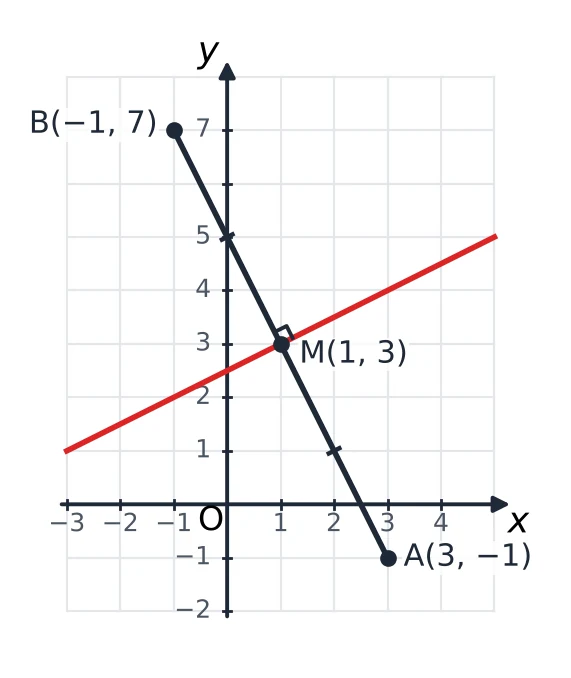
The answer is (b) . The option also passes through M, but it is the line AB itself.
Question 19
If the points , and are collinear, then is (a) 2 (b) 10 (c) 0 (d)
Answer. The two known points give the slope . The slope from to must also be 3: , so and . The answer is (a) 2.
Question 20
The line joining and is parallel to the line . What is ? (a) (b) 3 (c) (d) 1
Answer. The given line has slope , and AB must have the same slope: . So and . The answer is (d) 1.
Question 21
What is the distance of the point from the line ? (a) (b) (c) 2 (d)
Answer. I use . The top is . The bottom is . So , which is (c) 2. Dividing by instead of the square root gives .
Question 22
The distance between the parallel lines and is (a) (b) 2 (c) (d)
Answer. First I make the and terms the same: halving the second line gives . Now . The answer is (b) 2. Without halving, the top would be and the answer .
Question 23
[Tier 2] What is the acute angle between the lines and ? (a) (b) (c) (d)
Answer. The slopes are and . So the lines are inclined at and , and the angle between them is , which is (d) . The formula agrees: .