
Quadrant Signs at a Glance
Coordinate geometry questions in Tier 1 are short: two or three lines of working once you know which formula to use. Marks are lost on signs, and time on long working where one subtraction would do. The methods below are quick routes for the question types the exam sets, and most of them say where they stop working. Draw rough axes for every question, even a one-line one, because a point drawn in the wrong quadrant shows a sign mistake at once.
Fast way: going round from the top right, the signs of are , , and in the first, second, third and fourth quadrants.
- A point with is on the x-axis, and a point with is on the y-axis. Neither is in any quadrant.
- The distance of from the x-axis is , and from the y-axis it is . The distance from an axis is the other coordinate, so keep the two the right way round.
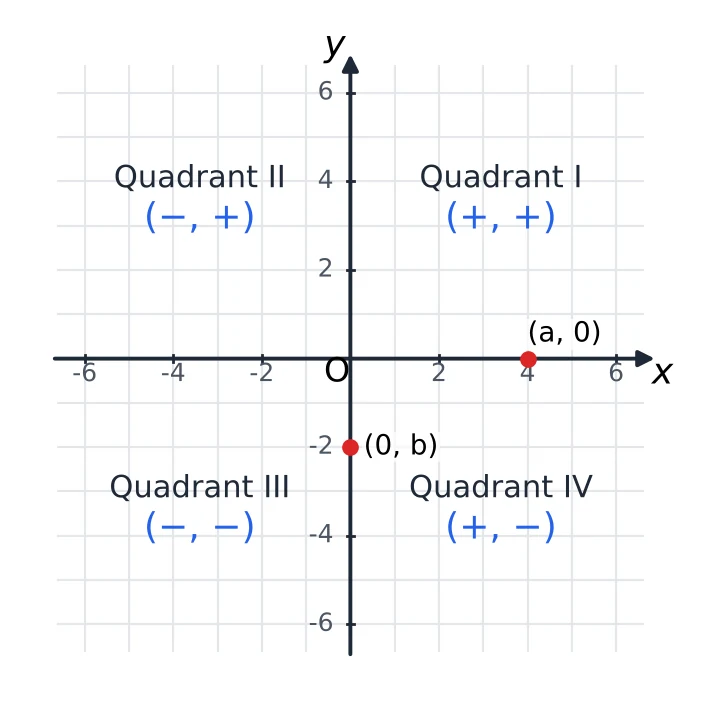
For example: is in the second quadrant, 3 units from the x-axis and 7 units from the y-axis. is on the y-axis, 5 units below the origin.
Where it fails: with letters, settle the sign of each coordinate before naming the quadrant. If , then is in the second quadrant but has a positive x and a negative y, so it is in the fourth.
Distance: Look for a Triplet
Fast way: write the two differences, and , and drop their signs. If they are two numbers of a Pythagorean triplet, or a multiple of one, the distance is the third number and no square root is needed. Keep these ready: 3-4-5, 5-12-13, 8-15-17, 7-24-25 and 20-21-29. Equal differences d and d give .
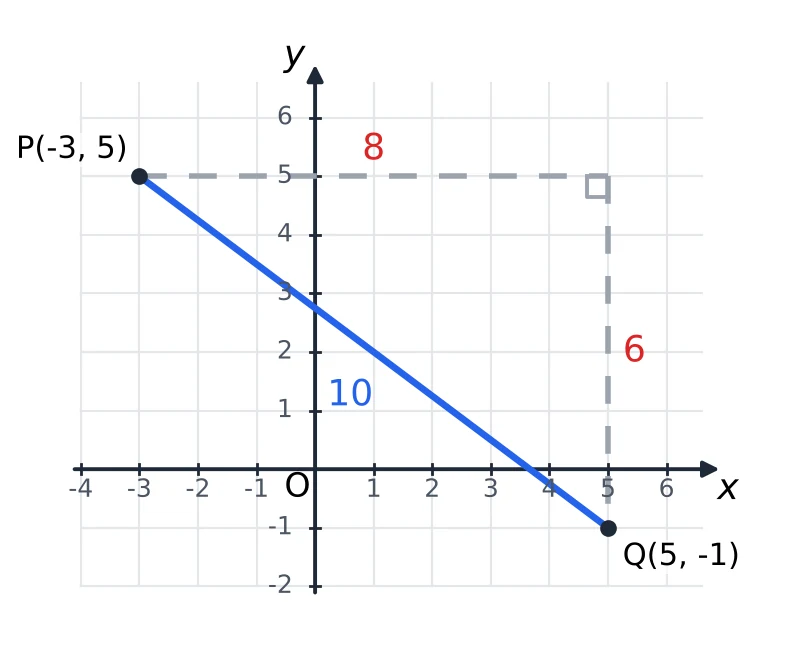
For example: for and the differences are 8 and 6. That is 3-4-5 doubled, so . The distance from the origin works the same way: is 13 units from O.
Where it fails: differences of 4 and 6 are not a triplet. Take out the common factor first: 4 and 6 are 2 times 2 and 3, so the distance is , the same as but with smaller squares.
The Other End from the Midpoint: Double and Subtract
Fast way: if M is the midpoint of AB, then , worked out for x and y separately. No equation needs to be set up.
The same idea gives the points of trisection of AB: split the change from A to B into three equal steps and walk from A.
For example: is the midpoint of AB and A is . Then .
For and the change is 12 in x and in y, so one step is 4 across and 2 down. The points of trisection are and .
Where it fails: read which trisection point is asked. The point dividing AB in the ratio 2 : 1 is two steps from A, , and it is the one nearer to B.
The Section Ratio from One Coordinate
Fast way: a point P on the segment AB divides it in the ratio where x is the x-coordinate of P. One coordinate is enough for the ratio; the other is then found from it, because P is of the way from A to B in both directions.
For example: lies on the segment joining and . From the x-coordinates, , so P is two-thirds of the way from A. The y-coordinate falls by 12 from A to B, and two-thirds of 12 is 8, so .
Where it fails: if A and B have the same x-coordinate, the x's give , so use the y's. A negative ratio means P lies outside AB, and the division is external [Tier 2].
Where an Axis Cuts a Segment:
Fast way: every point of the x-axis has . Put into the section ratio, and the x-axis divides the segment joining and in the ratio . In the same way the y-axis divides it in the ratio . In words: the ratio is the distances of A and B from that axis.
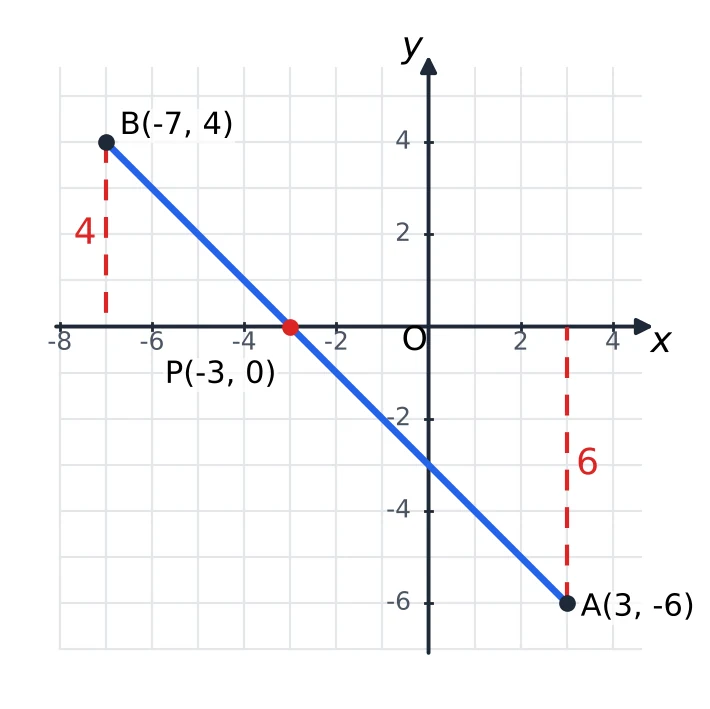
For example: for and , A is 6 below the x-axis and B is 4 above it, so the x-axis divides AB in the ratio . The point is .
Where it fails: if and have the same sign, A and B are on the same side of the axis. The ratio comes out negative and the axis meets line AB outside the segment.
[SSC Tip] The ratio is , counted from the first point named. Both 3 : 2 and 2 : 3 are likely to be in the options, so check which end is A.
The Centroid Is the Average
Fast way: the centroid of a triangle is the average of its vertices: add the three x's and divide by 3, then do the same with the y's. Turned round, a missing vertex is . The geometry of medians (the 2 : 1 split) is in Chapter 12.
For example: , and give . For a missing vertex, with , and : .
If a question gives the midpoints of the three sides instead of the vertices, average them: the triangle formed by the midpoints has the same centroid.
Fourth Vertex of a Parallelogram:
Fast way: the diagonals of a parallelogram bisect each other, so AC and BD have the same midpoint. That gives , and so worked out for x and y separately. In words: add the two neighbours of the missing vertex and subtract the vertex opposite it.
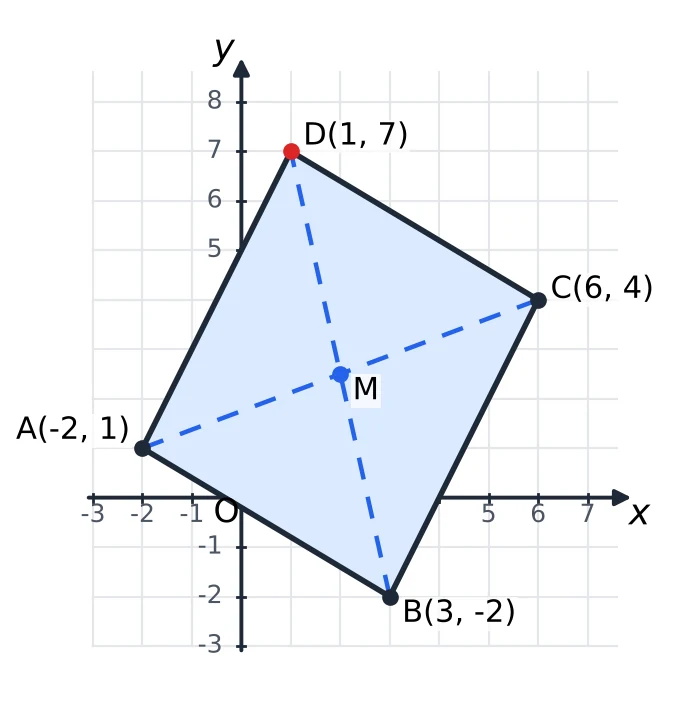
For example: , and are three vertices of parallelogram ABCD, in that order. . Both diagonals have the midpoint .
Where it fails: if the order of the vertices is not given, three parallelograms are possible, with the fourth vertex at , or . Check the options against all three.
Area with One Vertex at the Origin
Fast way: for the triangle with vertices , and , If no vertex is at the origin, move one there: subtract its coordinates from all three vertices. Sliding a triangle does not change its area. An area of 0 means the three points are collinear.
For example: O, and give square units. For , and , subtract P from each: Q becomes and R becomes , so the area is square units.
[SSC Tip] without the is the area of the parallelogram on OA and OB. It is twice the answer, and a likely wrong option.
Collinear Points: Walk in Equal Steps
Fast way: along a straight line, x and y change in a fixed proportion. To test three points, or to find a missing k, compare the change from A to B with the change from A to C: if x moves a third as far, y must also move a third as far. This is the slope test without fractions. The area test (area = 0) gives the same answer but takes longer.
For example: , and are collinear. From A to C, x rises by 9 and y falls by 6. From A to B, x rises by 3, a third of 9, so y falls by a third of 6: .
Where it fails: if two of the points have the same x-coordinate, the line is vertical, and the third point must have that x-coordinate too.
Slope Straight from the Equation:
Fast way: with x and y on the same side, has slope : the coefficient of x over the coefficient of y, with the sign changed. Its y-intercept is . In the slope can be read as it stands. The slope is also , where is the angle the line makes with the positive x-axis:
| Slope | 0 | 1 | undefined | |||
|---|---|---|---|---|---|---|
| Angle |
For example: has slope . The line has slope , so it makes with the positive x-axis.
Where it fails: the rule needs x and y on the same side. In , divide by 3 to get , slope . Taking and straight from this form gives , the wrong sign.
Parallel and Perpendicular Lines Without Finding the Slope
Fast way:
- Parallel lines have equal slopes. A line parallel to is : keep a and b, change only the constant.
- Perpendicular slopes multiply to , so the new slope is : turn the fraction upside down and change its sign. A line perpendicular to is : swap a and b, and change one sign.
- Find k by putting the given point into the new equation.
For example: the line through perpendicular to is . At : , so , and the line is . The two slopes are and , and their product is .
For the perpendicular bisector of AB, the given point is the midpoint of AB and the line is perpendicular to AB.
[SSC Tip] When a slope is , expect the options for a perpendicular slope to include , and . Only both turns the fraction over and changes the sign.
Intercepts of , and the Area They Enclose
Fast way: put to get the x-intercept , and to get the y-intercept . The line and the two axes make a right triangle with these two lengths as its legs, so The intercept form shows the two intercepts p and q directly.
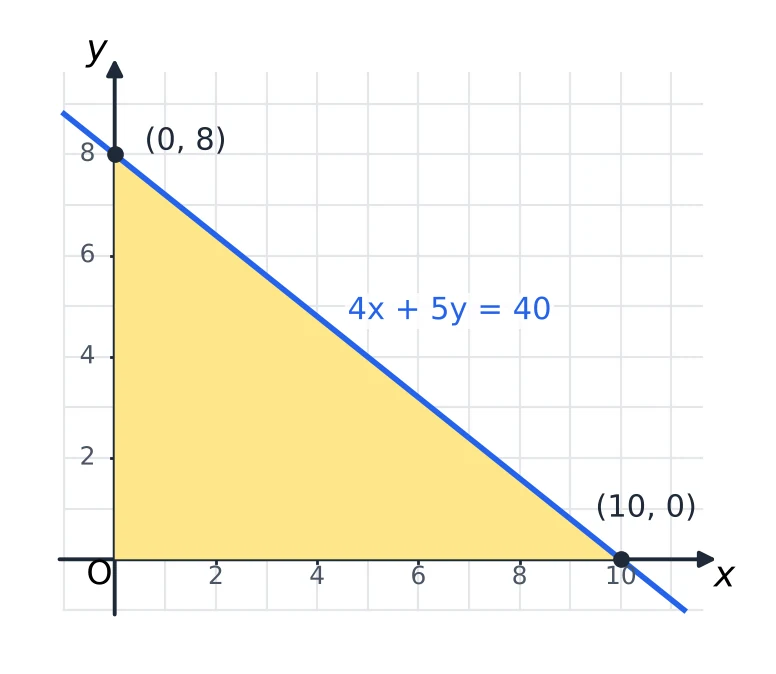
For example: cuts the x-axis at and the y-axis at , and it encloses square units with the axes. With a minus sign, has intercepts 6 and , and the area is still square units.
Where it fails: c must be the constant on the right-hand side. For , c is : the intercepts are and , and the area is 12 square units. The intercept is ; the coefficient a by itself is not an intercept.
Two Lines and an Axis: Base on the Axis, Height from the Meeting Point
Fast way: the base lies on the axis, between the two points where the lines cut that axis. The height is the distance of the meeting point of the lines from the same axis: its for the x-axis, its for the y-axis. Then the area is base height.
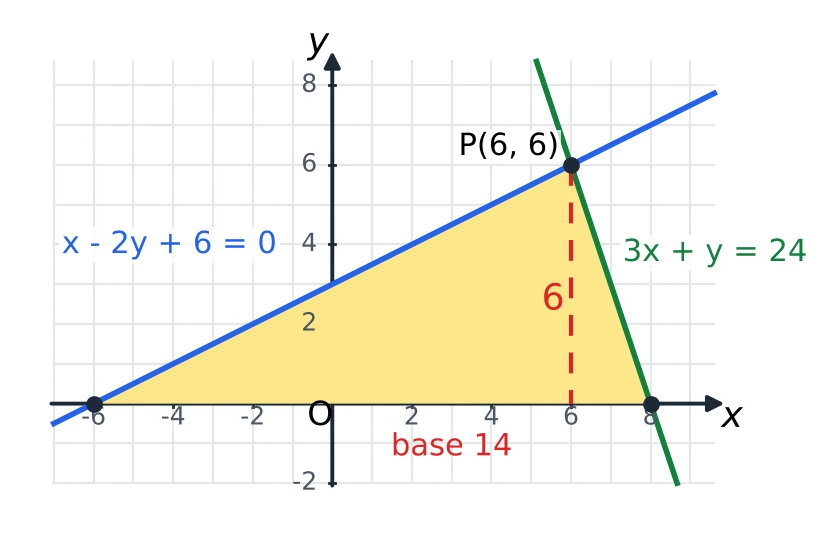
For example: and cut the x-axis at and 8, so the base is 14. From the first, ; putting this in the second gives , so and the lines meet at . The height is 6, and the area is square units.
Where it fails: for the y-axis, take the y-intercepts for the base and the x-coordinate of the meeting point for the height. Taking the base from one axis and the height from the other is the mistake to watch.
Check the Options: Put the Point In
Fast way: a point lies on a line exactly when its coordinates satisfy the equation. So when a question asks which point lies on a line, where two lines meet, or which equation passes through two given points, test the options instead of solving.
- Where two lines meet: test every option in the first equation, then only the ones that pass in the second.
- The line through A and B: the right equation is satisfied by both points.
For example: where do and meet, if the options are , , and ? The first three all satisfy ; gives and is out. In the second equation only works: .
Where it fails: a test can only rule options out. If the question asks for a value, such as k or an area, there is nothing to test, so work it out.
Reflections: Change a Sign, or Swap
Fast way: a reflection keeps the coordinate that runs along the mirror.
| Mirror | Image of |
|---|---|
| x-axis | |
| y-axis | |
| origin | |
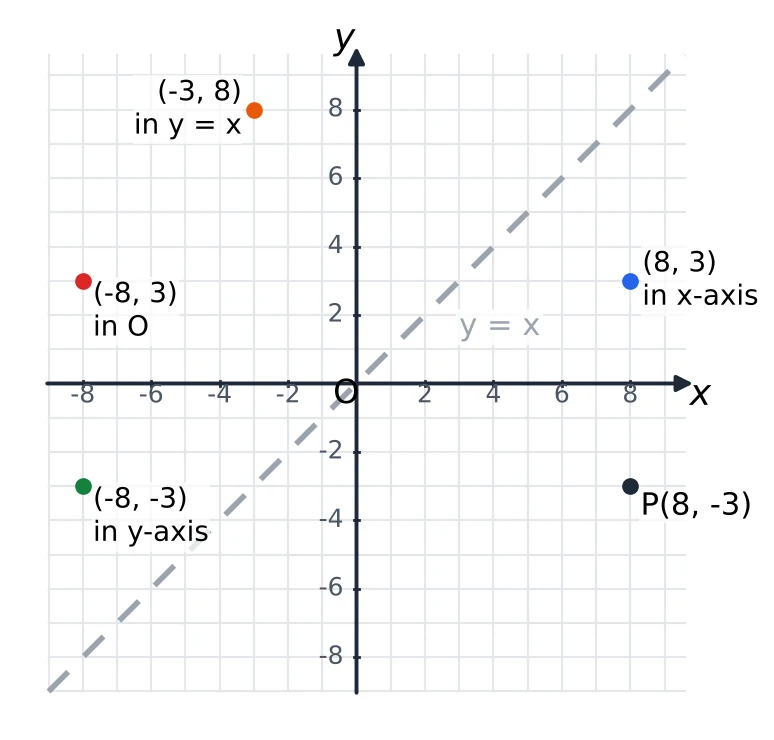
For example: goes to in the x-axis, in the y-axis, in the origin, in and in . In the line it goes to .
Where it fails: reflecting in the x-axis changes y, not x, which feels backwards at first. Think of the x-axis as a mirror lying flat: the point keeps its x and flips to the other side.
Parallel, Same Line or Crossing: Compare the Ratios
Fast way: for and , compare , and .
- : the lines cross at one point (one solution).
- : parallel lines (no solution).
- All three ratios equal: the same line (infinitely many solutions).
For a k that makes the lines parallel, put the first two ratios equal. The algebra behind this is in Chapter 11.
For example: and are parallel when , that is . The constants give , not 2, so the lines are parallel and not the same.
Where it fails: for the same line, check the constants as well. In and all three ratios are 3, so the lines coincide; with in place of the second, they would be parallel.
Solved Examples
The questions below are solved with the methods above, one or two at a time. Cover each answer and try the question in two lines or less, then compare. Four answers give the time a quick solver takes.
Question 1
If and , in which quadrant does the point lie?
Answer. b is positive, so the x-coordinate is positive. a is negative and I take away a positive b, so is negative as well. Positive x with negative y is the fourth quadrant.
Question 2
Find the distance between the points and .
Answer. The differences are and . 8 and 15 belong to the 8-15-17 triplet, so the distance is 17 units.
Question 3
The midpoint of PQ is and P is . Find Q.
Answer. Double the midpoint and take away P: . To check, the average of 5 and is , and the average of 10 and is 4.
Question 4
In what ratio does the y-axis divide the segment joining and ? Find the point where it does so.
Answer. For the y-axis the ratio is 2 : 5. So the point is of the way from . The y-coordinate drops by 14 from one end to the other, and of 14 is 4, so the point is .
Time check: about 20 seconds.
Question 5
The centroid of the triangle with vertices , and is . Find a and b.
Answer. The three x's must add up to : , so . The three y's must add up to : , so .
Question 6
, and are three consecutive vertices of parallelogram PQRS. Find S.
Answer. S is the vertex opposite Q, so . Both diagonals then have the midpoint , so it checks.
Question 7
Find the area of the triangle with vertices , and .
Answer. I move to the origin by subtracting it from all three points. The other two become and . Area 21.5 square units.
Time check: about 25 seconds.
Question 8
What angle does the line make with the positive direction of the x-axis?
Answer. Slope . The slope is negative, so the angle is more than : , and the angle is .
Question 9
Find the equation of the line through perpendicular to .
Answer. Swap the coefficients and change one sign: the line is . At , . So the line is . The slopes and multiply to .
Question 10
Find the area of the triangle formed by the line and the coordinate axes.
Answer. The intercepts are and . The minus sign only says the triangle is below the x-axis, so the legs are 10 and 12, and the area is 60 square units. From the formula: .
Time check: about 10 seconds.
Question 11
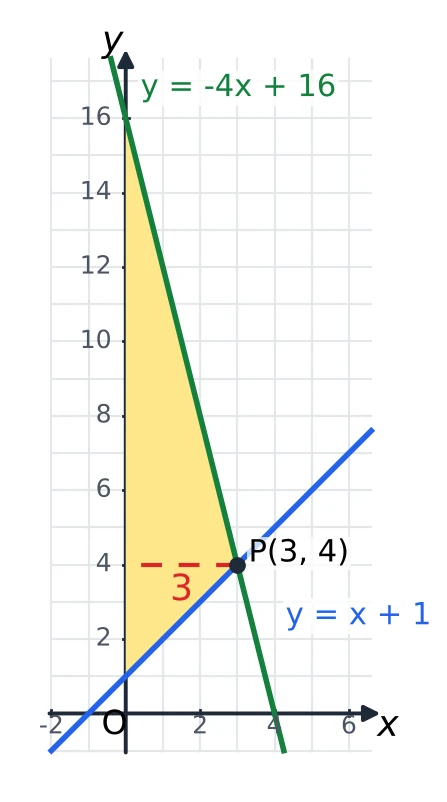
Find the area of the triangle formed by the lines , and the y-axis.
Answer. The base is on the y-axis, between the y-intercepts 1 and 16, so it is 15. The lines meet where , that is at , the point . Its distance from the y-axis is 3, so the height is 3. Area 22.5 square units.
Question 12
The point is reflected in the line , and its image is then reflected in the x-axis. Where does the point end up?
Answer. In the coordinates swap: . In the x-axis the sign of y changes: .
Question 13
For what value of k do the equations and have no solution?
Answer. No solution means the two lines are parallel, so . That gives , so . The constants give , which is not , so the lines are parallel and not the same line.
Question 14
Which of these lines passes through both and ? (a) (b) (c) (d)
Answer. I put in each. (a) gives , (b) gives , (c) gives , and (d) gives 1, not , so (d) is out. Now in the three that are left: (a) gives , while (b) gives and (c) gives . The answer is (a) .
Time check: about 30 seconds.
Question 15
For what value of p are the points , and collinear?
Answer. From to , x goes up 2 and y goes up 6, so y moves three times as far as x. From to , y goes down 12, so x goes down 4: .