
Points and Quadrants
- Signs of : first quadrant , second , third , fourth .
- x is the abscissa and y the ordinate.
- A point on the x-axis is and a point on the y-axis is ; neither lies in a quadrant.
- Distance from the x-axis ; distance from the y-axis .
For example: is in the fourth quadrant, 11 units from the x-axis and 6 units from the y-axis.
Reflections
- x-axis: . y-axis: . Origin: .
- : . : .
- : . : .
- A point and its image are the same distance from the mirror, on opposite sides.
- In any other line: find the foot F of the perpendicular, then the image is .
For example: in , goes to ; in it goes to .
Distance Formula and Shapes
- ; from the origin, .
- Triplets save the square root: 3-4-5, 5-12-13, 8-15-17, 7-24-25, 20-21-29.
- A distance with an unknown coordinate usually gives two answers.
- Shapes: find every side and both diagonals. Four equal sides: rhombus; add equal diagonals: square. Opposite sides equal: parallelogram; add equal diagonals: rectangle.
- Collinear: the two shorter distances add up to the longest.
Midpoint and Section Formula
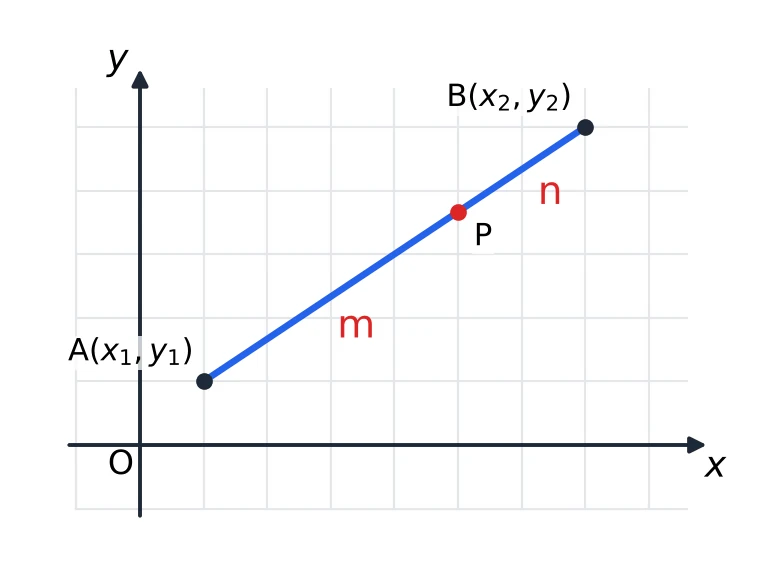
- Midpoint ; the other end is .
- Internal division in : .
- The ratio from one coordinate: .
- The x-axis divides AB in the ratio ; the y-axis in .
- [Tier 2] External division: , and the same for y.
Centroid and Area
- Centroid ; a missing vertex is .
- Parallelogram ABCD: , since the diagonals bisect each other.
- Area .
- With one vertex at O: . Otherwise move a vertex to O first.
- Area 0 means the points are collinear. A quadrilateral is two triangles.
[SSC Tip] An answer without the is twice the area, a likely wrong option.
Slope
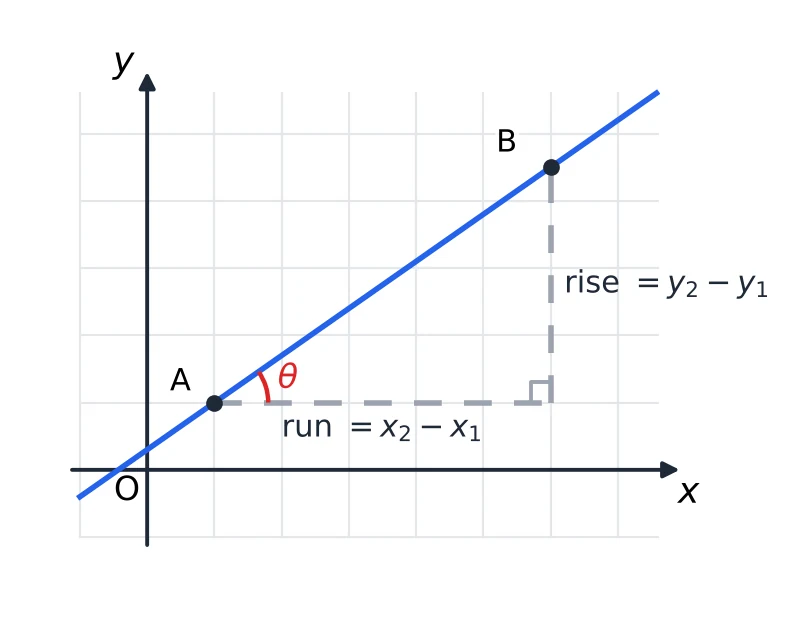
- , where is the angle with the positive x-axis.
- For , .
- Slope 1 means , means , means , means .
- A line parallel to the x-axis has slope 0; parallel to the y-axis, undefined.
- Collinear points: equal slopes.
Equation of a Line
- Slope-intercept: , where c is the y-intercept.
- Point-slope: . Through two points: find the slope, then use this form.
- Intercept form: .
- is upright and is level; is the y-axis and the x-axis.
- A point lies on a line when it satisfies the equation. To find k, put the point in.
Parallel and Perpendicular Lines
- Parallel: ; the line through a point is .
- Perpendicular: , or ; the line is .
- Perpendicular bisector of AB: through the midpoint, slope .
- Distance from to : ; between parallel lines, .
- [Tier 2] Angle: .
Graphs and Intercepts
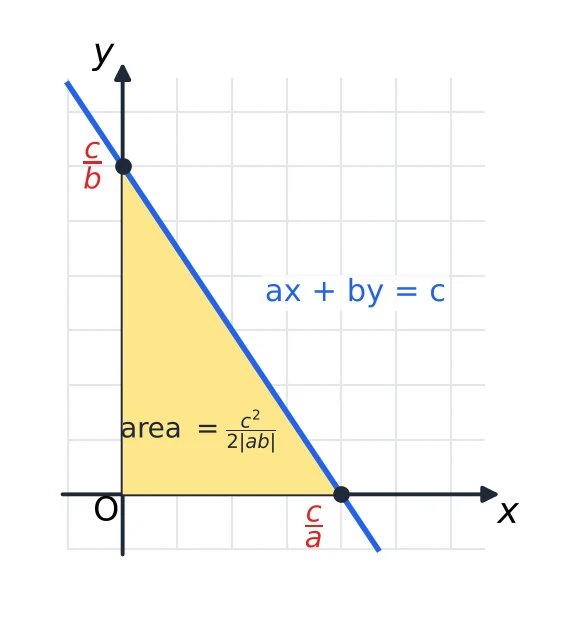
- cuts the x-axis at and the y-axis at .
- Area with the axes: .
- Two lines and the x-axis: base between the two x-intercepts, height of the meeting point.
- , , and enclose a rectangle of area .
Pairs of Lines
For and :
- : the lines cross, one solution.
- : parallel lines, no solution.
- All three ratios equal: the same line, infinitely many solutions.
- Where two lines meet: solve the pair, or test the options in both equations.
The algebra is in Chapter 11.
For example: and are parallel: , but is different.
Before the Exam
- Sketch the axes and the points every time; a wrong sign shows up at once.
- Mistakes to watch: slope as , slope for , area without the , a perpendicular slope of or , the intercept a for , a section ratio taken the wrong way round, and a reflection in the wrong axis.
If the PYQ Practice Sets or the Chapter Test are still left, do them now, against the clock.