The Axes, the Origin and the Coordinates of a Point
Coordinate geometry places every point of a flat page on two number lines. The horizontal line is the x-axis and the vertical one is the y-axis. They cross at right angles at the origin O, the point . On the x-axis, numbers to the right of O are positive and those to the left are negative; on the y-axis, up is positive and down is negative. Both axes use the same unit, and lengths in these questions are given simply in “units”.
To fix the position of a point P, drop perpendiculars from P to the two axes.
- The foot on the x-axis gives the x-coordinate, also called the abscissa.
- The foot on the y-axis gives the y-coordinate, also called the ordinate.
The point is written , with x first. In the figure, P is : 4 units to the right of the y-axis and 3 units above the x-axis.
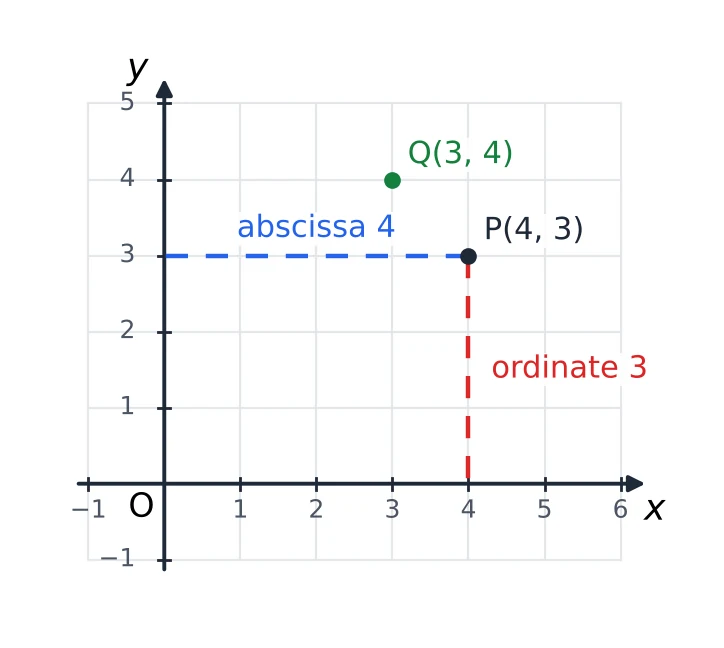
The order matters. is a different point from . Read the pair as “along, then up”: first move along the x-axis, then up or down.
What each number measures. Look at the two dashed lines in the figure. The blue one runs across to the y-axis and is 4 units long; that length is the abscissa. The red one runs down to the x-axis and is 3 units long; that is the ordinate. So the abscissa tells you how far the point is from the y-axis, and the ordinate how far it is from the x-axis. It sounds the wrong way round at first. Keep this picture in mind, because it settles the questions on the distance of a point from an axis.
A question may use the older words. “A point whose abscissa is and ordinate is 5” is simply , and “the ordinate of every point on the x-axis is zero” says that every such point has .
The Four Quadrants and the Signs
The two axes cut the plane into four regions called quadrants. They are numbered I, II, III and IV anticlockwise, starting from the top right.
| Quadrant | Sign of x | Sign of y | A point in it |
|---|---|---|---|
| I (top right) | |||
| II (top left) | |||
| III (bottom left) | |||
| IV (bottom right) |
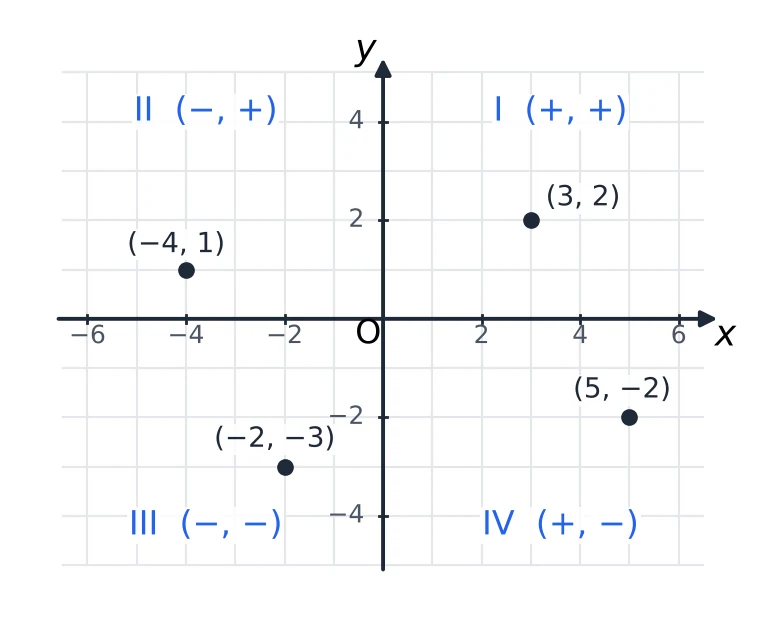
To place a point, look only at the two signs. has a negative x and a positive y, so it is in the second quadrant. is in the fourth, and in the third.
Sign questions with letters. If is in the third quadrant, then and . Now has a positive x and a negative y, so it is in the fourth quadrant; stays in the third; moves to the first. Write down the sign of each new coordinate first and only then read the table. Doing both steps in your head at once is how wrong answers creep in.
Two quick facts.
- If , the coordinates have the same sign: quadrant I or III.
- If , they have opposite signs: quadrant II or IV.
A point with or lies on an axis, and a point on an axis is in no quadrant at all. is not in the third or the fourth quadrant; it is on the y-axis, 3 units below O.
[SSC Tip] The numbering runs anticlockwise, so the fourth quadrant is the bottom right (, ). Counting clockwise by mistake swaps II and IV, and the options in these questions name all four quadrants, so the wrong count always finds a match.
Points on the Axes and the Distance from Each Axis
Every point on the x-axis has its y-coordinate equal to 0, so it looks like . Every point on the y-axis looks like . The origin is on both axes.
- is on the x-axis, 6 units to the left of O.
- is on the y-axis, 4 units above O.
A question may describe such a point in words. “A point on the y-axis 5 units below the origin” is . “A point on the x-axis at a distance of 3 units from the origin” could be or ; the words alone allow both.
Distance from each axis. For any point ,
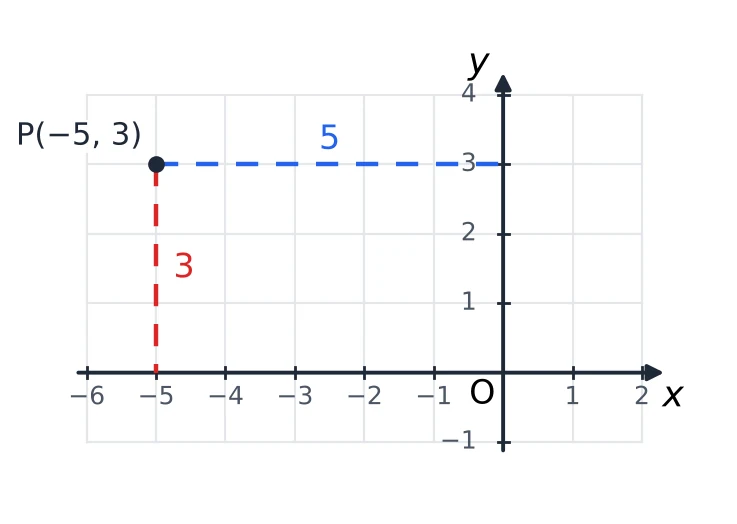
For in the figure, the red dashed line drops 3 units to the x-axis and the blue one runs 5 units across to the y-axis. So P is 3 units from the x-axis and 5 units from the y-axis.
This is the mix-up to watch for: the distance from the x-axis uses the y-coordinate. Think of the red line. It goes straight down to the x-axis, and its length is the height of the point.
Distances are never negative, which is why the modulus is there. is 7 units from the x-axis and 4 units from the y-axis.
Building a point from its distances. A point 4 units from the x-axis and 7 units from the y-axis has and . That fits four points, one in each quadrant: , , and . The question has to name the quadrant to fix one of them; in the second quadrant it is .
The Distance Formula
The distance between and is
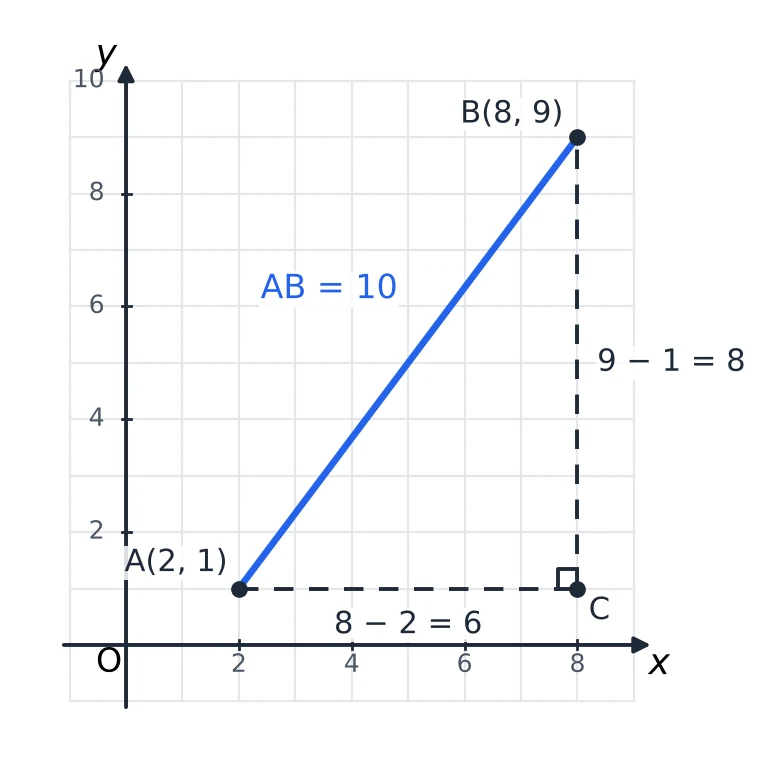
The figure shows where it comes from. Go from A straight across to C, the point directly below B. The horizontal leg AC is the difference of the x-coordinates, the vertical leg CB is the difference of the y-coordinates, and AB is the hypotenuse of the right triangle ACB. For and the legs are 6 and 8, so
Three habits keep the formula safe:
- Subtract like from like. x from x and y from y; never an x from a y.
- The order does not matter. , so start from whichever point is easier.
- Bracket the negatives. For and the differences are and , so . Writing for the first difference turns 13 into .
Same x or same y. If the two points share an x-coordinate, the segment is vertical and its length is just the difference of the y-coordinates: from to is 11 units. Points with the same y-coordinate lie on a horizontal segment, and the x-coordinates give the length.
From the origin. With one point at the formula shrinks to . The point is units from O.
Keep the triplets 3, 4, 5; 5, 12, 13; 8, 15, 17; 7, 24, 25 and their multiples, such as 6, 8, 10 and 9, 12, 15, ready. When the two differences are 9 and 12, the distance is 15 and no square root is needed.
An Unknown Coordinate from a Given Distance
When a distance is given and one coordinate is missing, square both sides of the distance formula and solve. The square root hides a , so there are usually two answers.
Find x if the distance between and is 5 units.
So or .
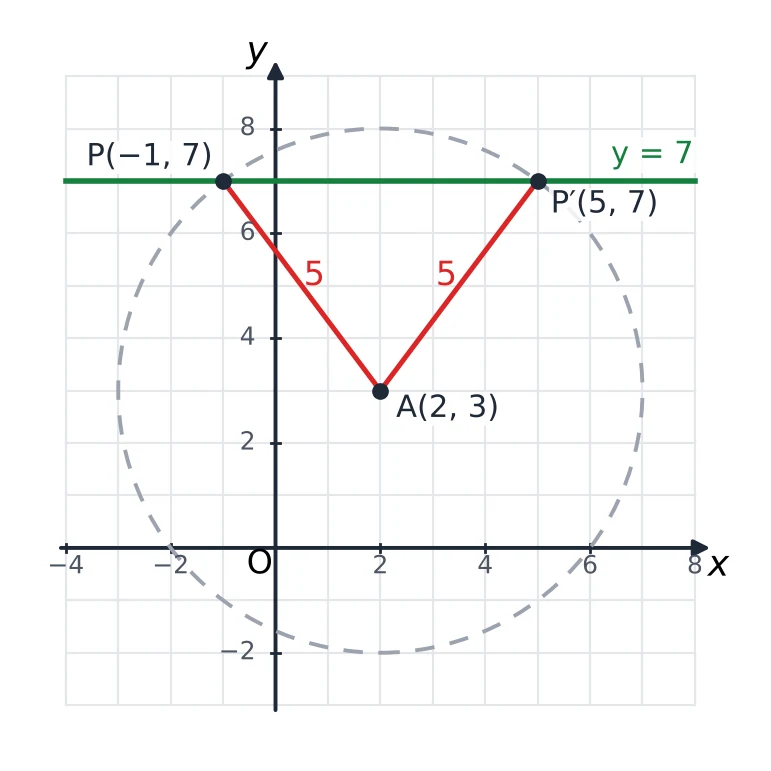
The figure shows why there are two. All the points 5 units from A lie on a circle of radius 5 round A, and the horizontal line cuts that circle twice, at and . Both answers are correct.
What to mark. The options may show both values (“ or ”) or only one of them. If only appears, that is the answer. Put the value back to check it: from to the differences are 3 and 4, so the distance is 5.
One answer, or none. If the square comes out as 0, the line just touches the circle and there is one answer. If it comes out negative, no point fits. With instead, , which is impossible: the line passes above the circle.
From the origin. For what values of k is the point 10 units from the origin? Here , so and . Both and are 10 units from O.
A Point on an Axis Equidistant from Two Points
“Equidistant” means “at the same distance”. A point on the x-axis is , so only x is unknown. Write ; the terms cancel and leave a simple linear equation.
Find the point on the x-axis equidistant from and .
So the point is . Check: and .
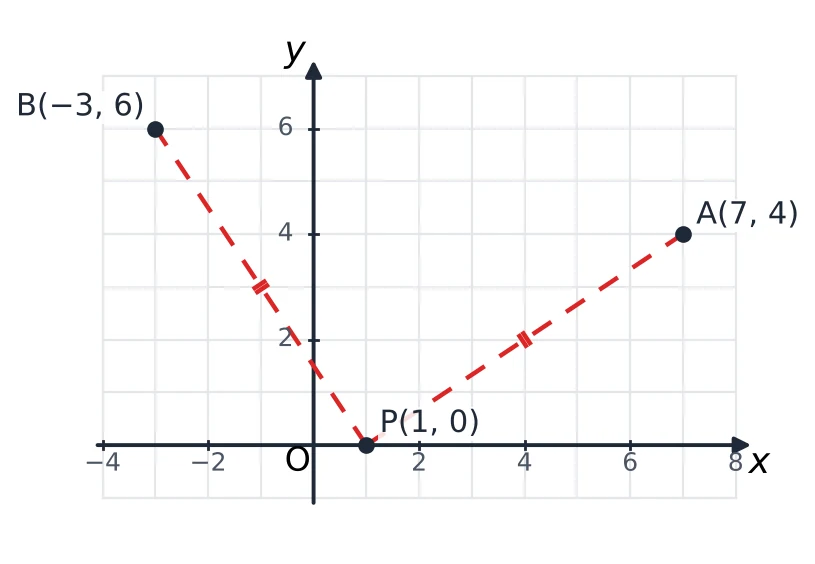
For a point on the y-axis, take and do the same with y.
Why squares. Working with and keeps square roots out of the way. Each side has exactly one , so they cancel. If an is still there after you expand, go back and check the expansion.
The midpoint is not the answer. The midpoint of AB here is , and its x-coordinate 2 looks like a fair guess for the point on the x-axis. It is wrong. P is where the perpendicular bisector of AB meets the axis, and that line is slanted, so it does not drop straight down from the midpoint.
No axis given. If is equidistant from and , then gives
That straight line is the perpendicular bisector of AB: every point on it is equally far from A and B, and the midpoint is on it. Slope and the Equation of a Line reaches the same line from slopes.
The Point Equidistant from Three Points
A point equally far from the three vertices of a triangle is its circumcentre, the centre of the circle through all three. Call it and write two equations, and . The and terms cancel in each, so you are left with a pair of linear equations.
Take , and .
- : A and B have the same y-coordinate, so the y parts are equal and , giving .
- with : , so and .
The circumcentre is , and the radius is .
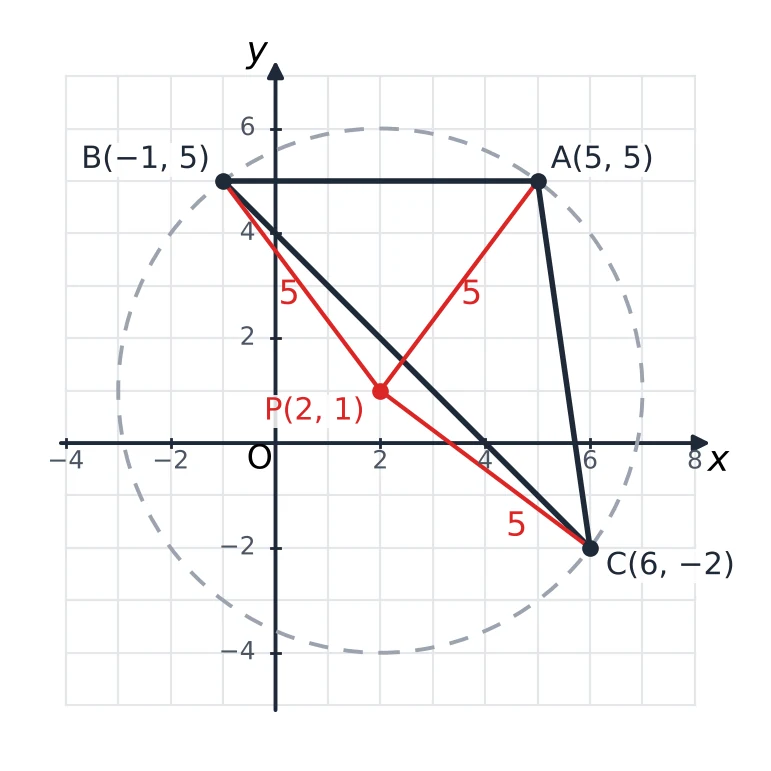
Testing the options. In a multiple-choice question it is usually faster to test each option: find its squared distance from each of the three points. The right option gives three equal numbers; for they are 25, 25 and 25. The centroid of this triangle, , is a likely wrong option, and it fails the test at once.
Right-angled triangle. If the triangle has a right angle, the circumcentre is the midpoint of the hypotenuse, because the angle in a semicircle is (Chapter 12). For the vertices , and , the right angle is at O and the circumcentre is the midpoint of the other two, , with no equations at all. The midpoint formula is in Midpoint, Section Formula, Centroid and Area.
What Kind of Triangle?
Find the three sides with the distance formula, but keep them as squares: , and . Squares are whole numbers and easy to compare, and Pythagoras needs squares anyway.
| What the squares show | The triangle is |
|---|---|
| all three equal | equilateral |
| exactly two equal | isosceles |
| all three different | scalene |
| largest = sum of the other two | right-angled |
| two equal, and largest = sum of the other two | right-angled isosceles |
Take , and :
Two squares are equal and , so the triangle is right-angled and isosceles. The right angle is opposite the longest side CA, so it is at B.
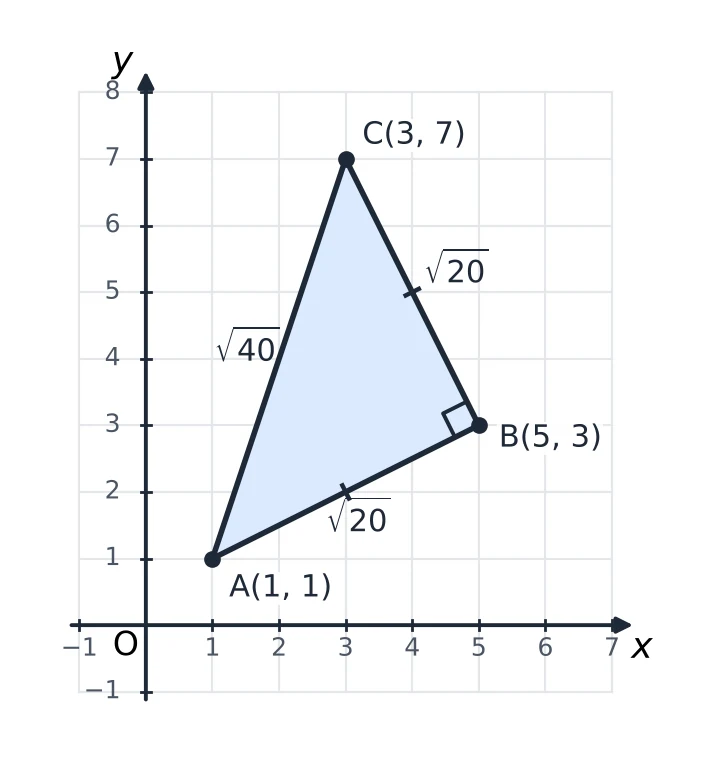
Acute or obtuse. If the largest square is more than the sum of the other two, the angle opposite it is obtuse; if it is less, all three angles are acute (Chapter 12 has the reason). Squares of 10, 17 and 29 give , less than 29, so that triangle is obtuse-angled and scalene.
Equilateral needs a surd. No equilateral triangle has all three vertices at whole-number points. So when every coordinate is a whole number, “equilateral” can be struck out at once. An equilateral triangle in a question shows a surd somewhere, as in , and , whose squared sides are 36, 36 and 36.
First make sure it is a triangle. If the two shorter sides add up exactly to the longest, the three points are on one line and there is no triangle. That test is in Collinear Points and the Perimeter of a Triangle, below.
What Kind of Quadrilateral?
For four points A, B, C and D taken in order round the figure, find the four sides AB, BC, CD, DA and the two diagonals AC and BD, all as squares.
| Sides | Diagonals | Quadrilateral |
|---|---|---|
| all four equal | equal | square |
| all four equal | unequal | rhombus |
| opposite sides equal | equal | rectangle |
| opposite sides equal | unequal | parallelogram |
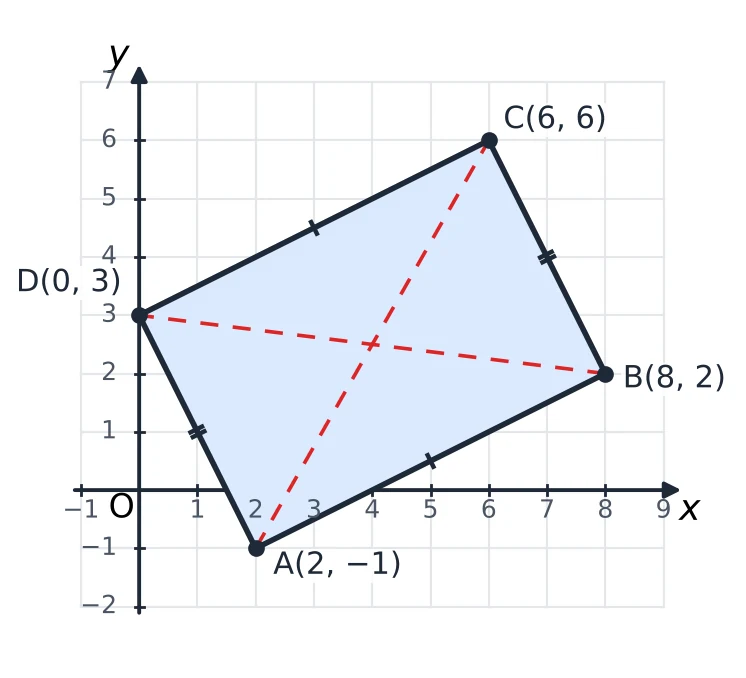
Take , , and .
- Sides: , , , . All four sides are 5.
- Diagonals: and . They are unequal.
So ABCD is a rhombus but not a square.
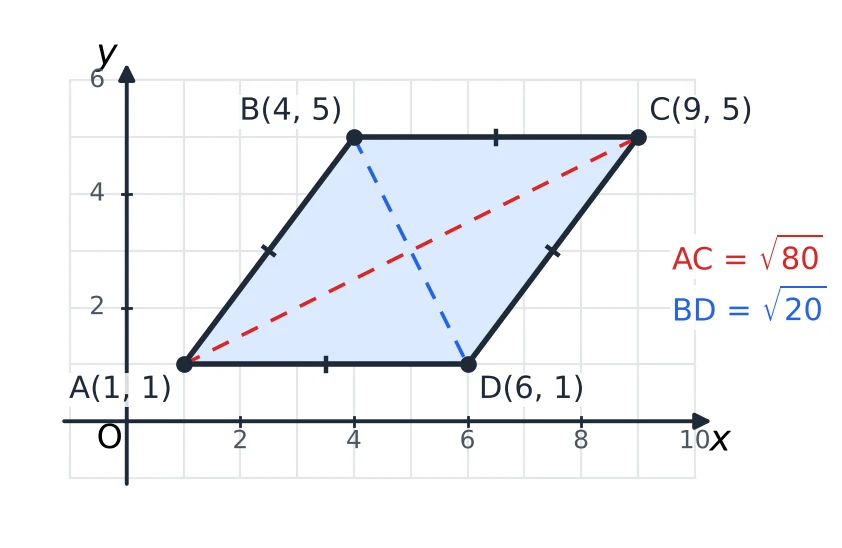
The sides alone cannot settle it. Four equal sides fit both a square and a rhombus, and equal opposite sides fit both a rectangle and a parallelogram. The diagonals decide. In the rhombus above, one diagonal is twice the other: and .
The order of the points. The vertices are meant to be in order round the figure. Join them in the wrong order and the lengths you call diagonals are really sides, so the answer comes out wrong. A rough plot on the grid takes a few seconds and shows the order.
Two other tests work on the same figures: the diagonals of a parallelogram bisect each other (Midpoint, Section Formula, Centroid and Area), and parallel or perpendicular sides show up in the slopes (Slope and the Equation of a Line). The distance test is the one to reach for when the question gives four points and asks for the name of the figure.
Collinear Points and the Perimeter of a Triangle
Three points are collinear when they lie on one straight line. With distances the test is: the two shorter distances add up exactly to the longest one.
Take , and .
Since , the points are collinear. B is the point that is not an end of the longest distance AC, so B lies between A and C.
If the two shorter distances add up to more than the longest, the points form a triangle. They can never add up to less.
When the roots look messy. Simplify the surds before you add. For , and the distances are , and . They look unrelated until you write them as , and ; then and the points are collinear. When the surds do not simplify this neatly, the area test (area 0, in Midpoint, Section Formula, Centroid and Area) or the slope test (in Slope and the Equation of a Line) is quicker.
Perimeter. Find the three sides and add them. For , and :
B and C share an x-coordinate, so BC is a vertical segment and needs no formula. The perimeter is units, and the triangle is isosceles.
Surds that do not combine stay as they are. The triangle with vertices , and has sides 4, 4 and , so its perimeter is units. Adding the 8 and the 4 under one root, as , is wrong.
[SSC Tip] In a perimeter question, mark the horizontal and vertical sides first; they are plain subtractions, and then only one side may need the full formula.
Reflections in the Axes and in the Origin
A mirror line sits exactly halfway between a point and its image, and the segment joining them is perpendicular to the mirror. Reflections in the two axes and in the origin change only signs.
| Mirror | Image of | What changes |
|---|---|---|
| x-axis | the sign of y | |
| y-axis | the sign of x | |
| origin | both signs |
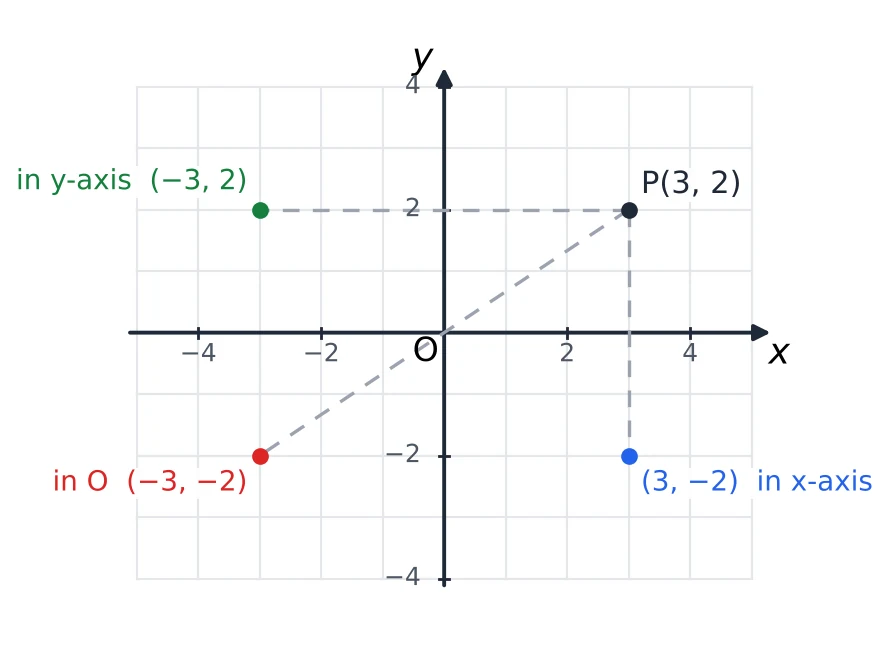
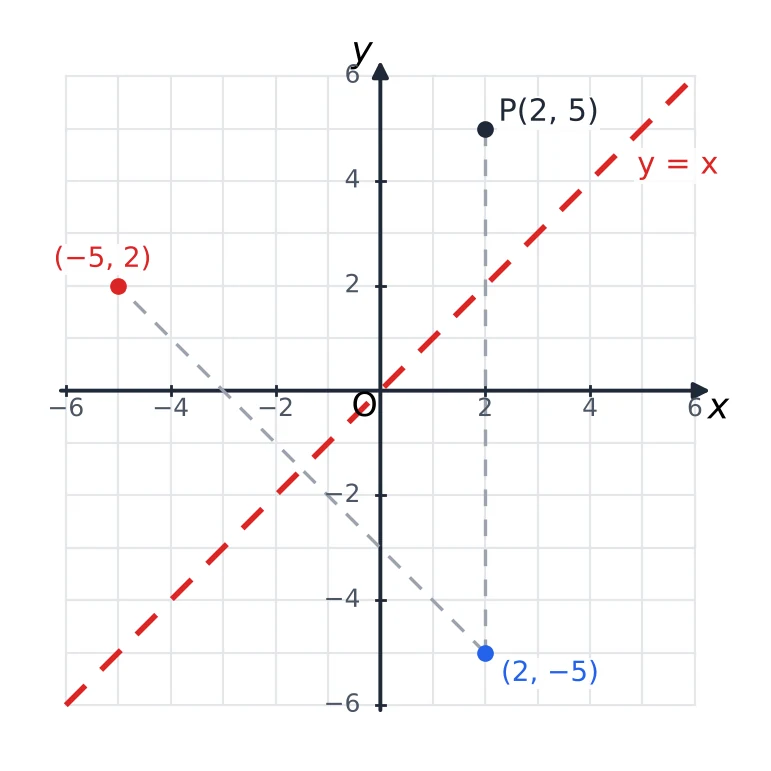
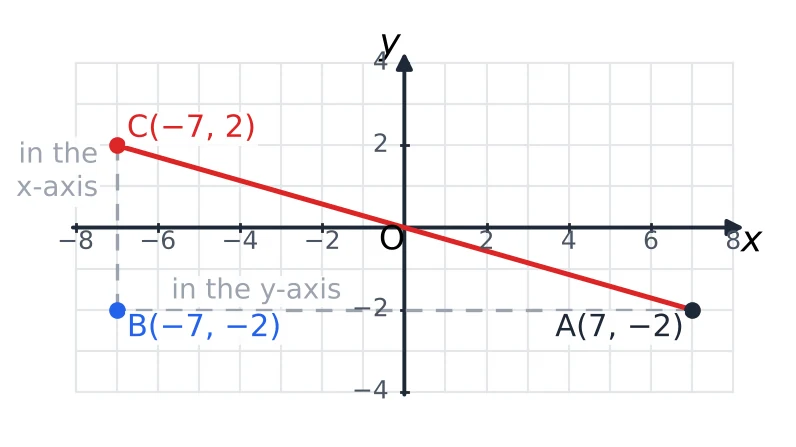
In the figure, goes to in the x-axis, to in the y-axis and to in the origin.
Which sign changes. Reflecting in the x-axis flips the point up and down. The x-axis itself does not move, and neither does the x-coordinate; only y changes sign. Say it to yourself as “in the x-axis, x stays”, and the two axes will not get swapped. That swap is the mistake to guard against in these questions.
Reflecting in the origin is the same as reflecting in one axis and then in the other, in either order. The point and its image lie on a straight line through O, at equal distances on opposite sides of it.
Distances. A point and its image in the x-axis are apart: and are 10 units apart. In the y-axis the gap is . In the origin it is , twice the distance of the point from O.
Quadrants. is in the second quadrant. Its image in the x-axis, , is in the third; in the y-axis, , in the first; in the origin, , in the fourth. The image in an axis moves to the neighbouring quadrant across that axis, and the image in the origin goes to the opposite quadrant.
Reflections in , and Lines Parallel to the Axes
| Mirror | Image of |
|---|---|
| the line | |
| the line | |
| the vertical line | |
| the horizontal line |
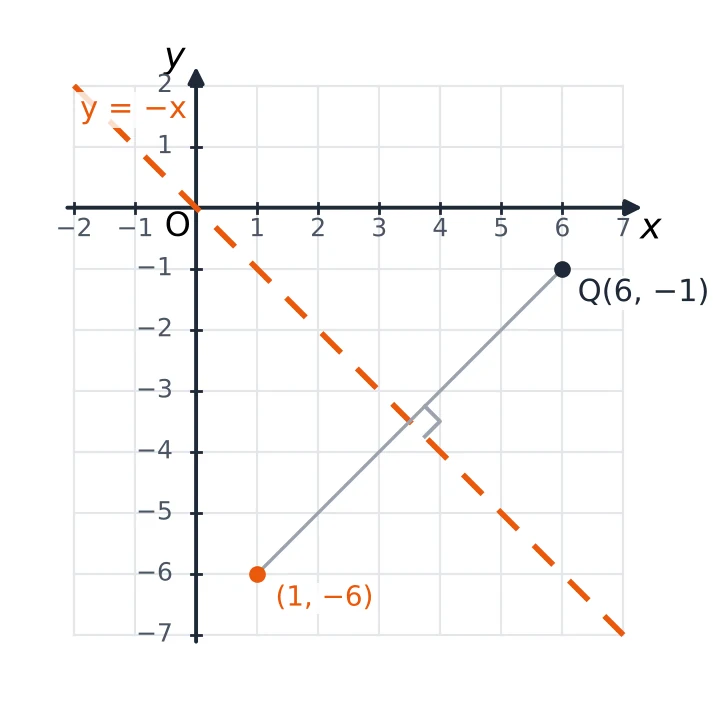
The line runs through O at to both axes. Reflecting in it swaps the two coordinates: becomes . In the coordinates swap and both change sign: becomes .
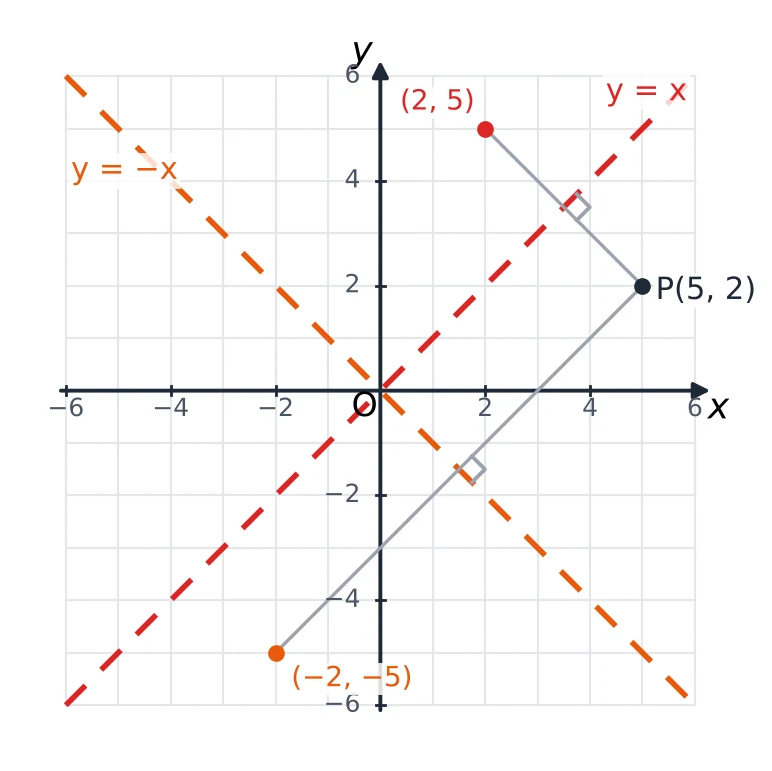
Mixed signs need a moment's care. The image of in is ; in it is . The two answers differ only in their signs, so expect both of them in the options.
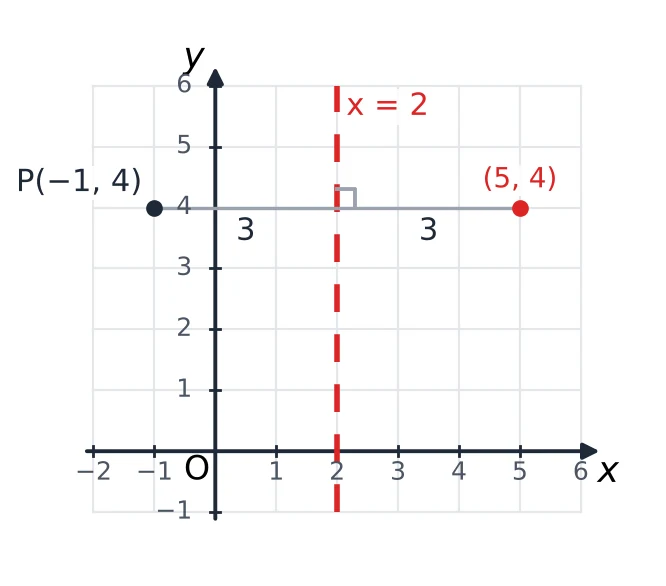
Lines parallel to the axes. In the vertical line the y-coordinate stays, and the point moves to the other side of the line, the same distance away. is 2 units to the left of , so its image is 2 units to the right, at . The formula agrees: . In the horizontal line the x-coordinate stays; the image of in is .
A check for any mirror. The midpoint of a point and its image lies on the mirror. For and the midpoint is , which is on . For and it is , which is on .
Reflection in a point. The image of in a point is the point for which M is the midpoint of , so is . This is the “other end from the midpoint” question in Midpoint, Section Formula, Centroid and Area.
Solved Examples
Question 1
The abscissa of a point is and its ordinate is . In which quadrant does the point lie? (a) First quadrant (b) Second quadrant (c) Third quadrant (d) Fourth quadrant
Answer. The abscissa is the x-coordinate and the ordinate is the y-coordinate, so the point is . Both coordinates are negative, and that happens only at the bottom left: (c) Third quadrant. Here it would not even matter which word means which, since both numbers are negative.
Question 2
If the point lies in the second quadrant, in which quadrant does the point lie? (a) First quadrant (b) Second quadrant (c) Third quadrant (d) Fourth quadrant
Answer. In the second quadrant and . For Q, the x-coordinate is b, which is positive. The y-coordinate is , and since a itself is negative, is positive too. Two positive coordinates: (a) First quadrant. I write the sign of each new coordinate on paper before I look at the quadrants; it takes five seconds and stops the double negative from fooling me.
Question 3
A point lies on the y-axis, 7 units below the origin. What are its coordinates? (a) (b) (c) (d)
Answer. On the y-axis the x-coordinate is 0, so the point is . Below the origin means y is negative, and 7 units below means . The point is (d) . has the right number in the wrong place: that point is on the x-axis, 7 units to the left of O.
Question 4
How far is the point from the x-axis? (a) 9 units (b) 4 units (c) units (d) 13 units
Answer. The distance from the x-axis is how high or low the point is, and that is the y-coordinate. Here , so the distance is (b) 4 units. I picture a line dropping straight down from the point to the x-axis; its length is 4, whatever the x-coordinate is. 9 units would be the distance from the y-axis.
Question 5
Find the distance between the points and . (a) 17 units (b) units (c) units (d) 23 units
Answer. I subtract like from like and keep the brackets: and . Then , which is (a) 17 units. The 8, 15, 17 triplet gives it at once. If the minus sign of is lost, the first difference becomes and the answer turns into .
Question 6
How far is the point from the origin? (a) 31 units (b) units (c) 25 units (d) 17 units
Answer. From the origin the distance is , so the answer is (c) 25 units. The minus sign of disappears when it is squared, so , and are all 25 units from O as well.
Question 7
The distance between and is 10 units. What are the possible values of x? (a) or (b) or (c) or (d) or
Answer. Squaring the distance: , so and . That gives or , which is (b) or . Both points really are 10 units from Q; for each one the differences are 6 and 8.
Question 8
Find the points on the x-axis that are 13 units away from . (a) and (b) and (c) and (d) and
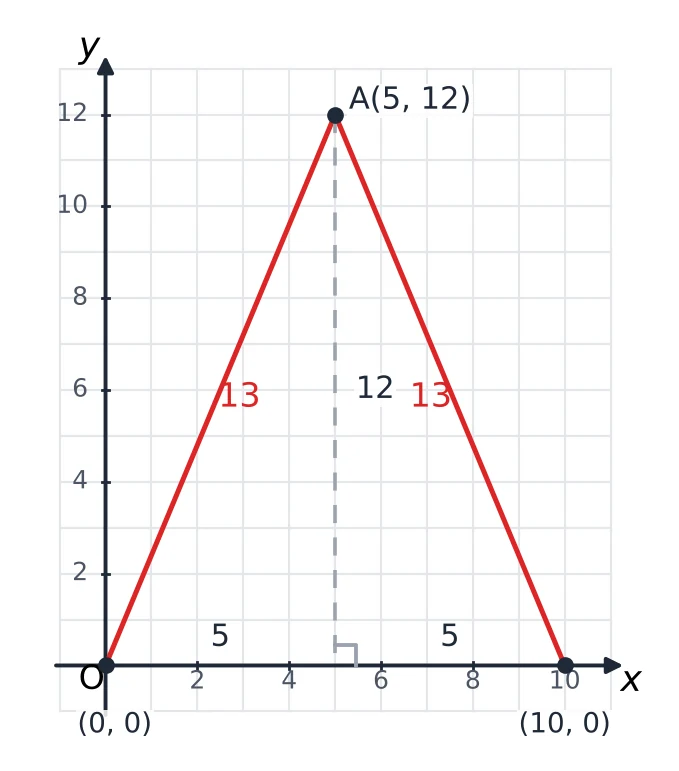
Answer. A point on the x-axis is . Then , so and . So or , and the points are (d) and . The picture shows the 5, 12, 13 triangle on each side of the point directly below A.
Question 9
Which point on the x-axis is equidistant from and ? (a) (b) (c) (d)
Answer. Let the point be . Then gives . The cancels, leaving , so and . The point is (a) , and both squared distances come to 34. lies directly below the midpoint of AB; it would be right only if A and B were at the same height.
Question 10
Find the point on the y-axis that is equidistant from and . (a) (b) (c) (d)
Answer. On the y-axis the point is . gives . Expanding, , so and . The point is (c) , and it is 5 units from both A and B.
Question 11
Which point is equidistant from , and ? (a) (b) (c) (d)
Answer. I test the options instead of solving two equations. For the squared distances are: to A, ; to B, ; to C, . All three are equal, so the point is (b) , and the circle through A, B and C has radius 5.
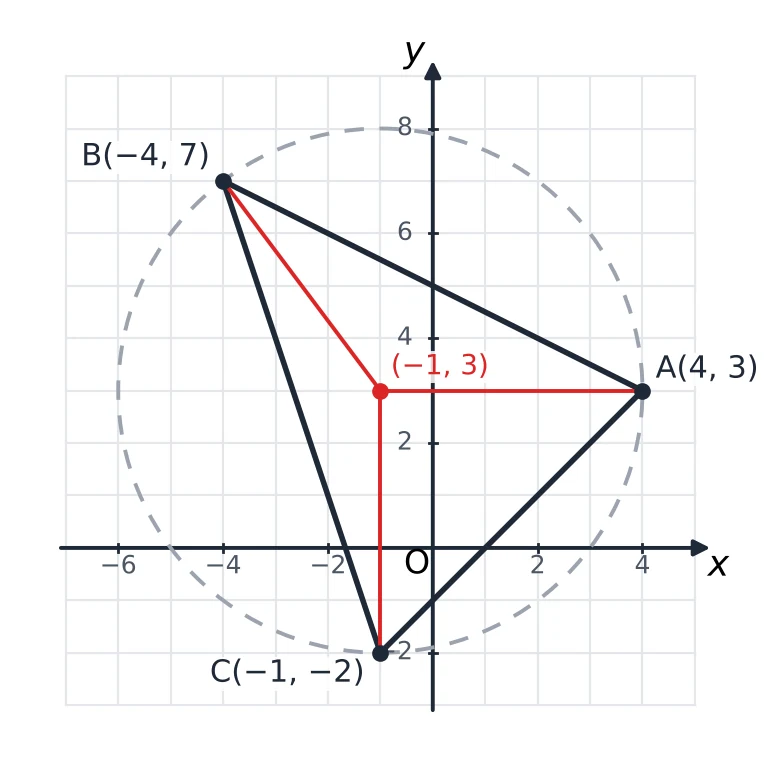
The option is the centroid, the average of the three vertices. It is a different point unless the triangle is equilateral.
Question 12
The triangle with vertices , and is (a) equilateral (b) isosceles but not right-angled (c) right-angled and isosceles (d) right-angled but not isosceles
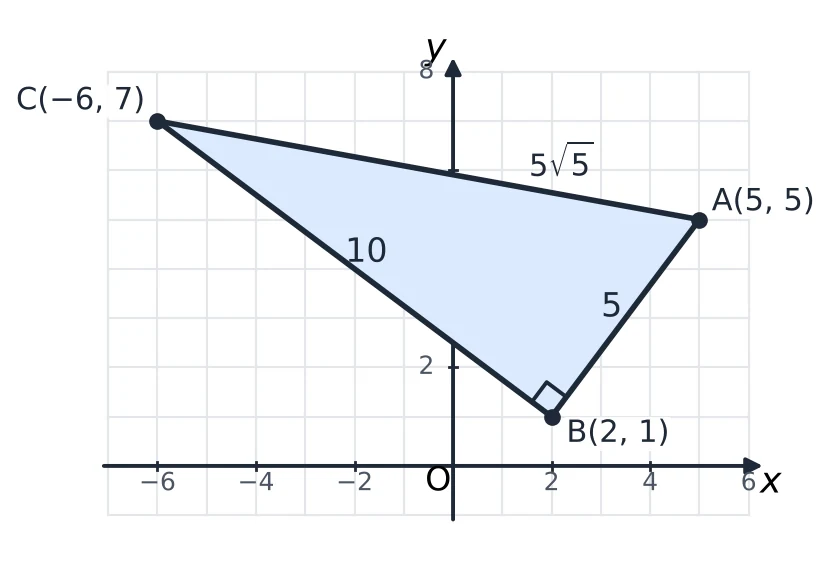
Answer. Squares of the sides: , and . All three are different, and . So the triangle has a right angle, at B, and no two sides are equal: it is (d) right-angled but not isosceles. The sides are 5, 10 and .
Question 13
The points , and are the vertices of (a) an equilateral triangle (b) a right-angled isosceles triangle (c) a scalene triangle (d) an obtuse-angled isosceles triangle
Answer. . For BC the differences are and ; squaring and adding gives , because the terms cancel. CA works out the same way, again 32. Three equal sides make it (a) an equilateral triangle. The surd in C was the hint: whole-number points can never make an equilateral triangle.
Question 14
The points , , and , taken in order, form (a) a rhombus but not a square (b) a square (c) a rectangle but not a square (d) a parallelogram but not a rectangle
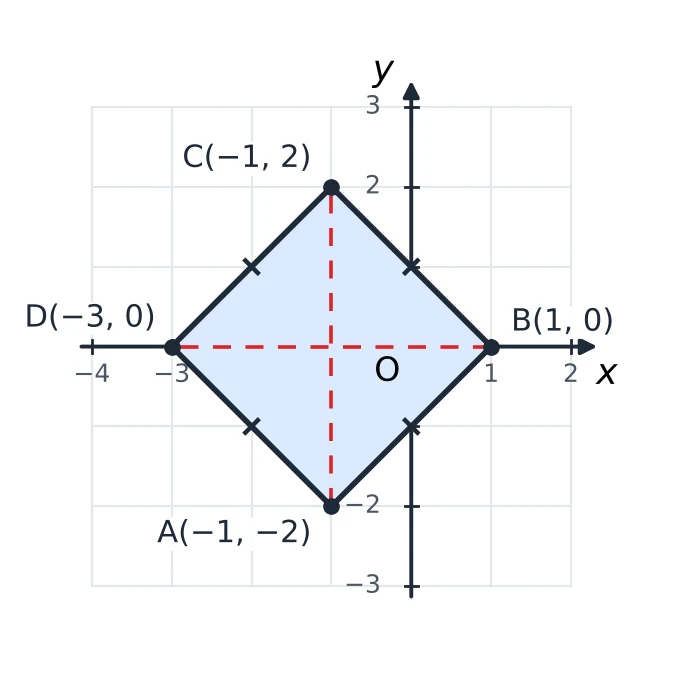
Answer. Sides: , , and . Diagonals: and . Four equal sides and equal diagonals make it (b) a square. With the sides alone I could only have said “rhombus”; the equal diagonals settle it.
Question 15
The points , , and , taken in order, form (a) a square (b) a rhombus that is not a square (c) a rectangle that is not a square (d) a parallelogram that is not a rectangle
Answer. Sides first: , , and . Opposite sides are equal, so the figure is at least a parallelogram, and neighbouring sides differ, so it is not a rhombus. Diagonals: and . Equal diagonals make it (c) a rectangle that is not a square.
Question 16
Which statement about the points , and is true? (a) C lies between A and B (b) A lies between B and C (c) B lies between A and C (d) The three points form a triangle
Answer. , and . The two shorter distances add up to the longest, , so the points are on one line. The longest distance is AB, so its two ends are the outer points and the third point is in the middle: (a) C lies between A and B.
Question 17
Find the perimeter of the triangle with vertices , and . (a) 23 units (b) 40 units (c) 60 units (d) 32 units
Answer. AB is horizontal (the y-coordinates are equal), so . BC is vertical, so . Only CA needs the formula: . The perimeter is , which is (b) 40 units. 60 is the area of this right triangle, , which answers a different question.
Question 18
What is the image of the point in the x-axis? (a) (b) (c) (d)
Answer. In the x-axis, x stays and y changes sign. So goes to (c) , the same distance below the axis as P is above it. would be the image in the y-axis.
Question 19
The point is reflected in the y-axis to give B, and B is reflected in the x-axis to give C. What are the coordinates of C? (a) (b) (c) (d)
Answer. In the y-axis the sign of x changes, so . In the x-axis the sign of y changes, so , which is (d) . Both signs have now changed, so C is the image of A in the origin, and the segment AC passes through O.
Question 20
What is the image of the point in the line ? (a) (b) (c) (d)
Answer. Reflecting in swaps the coordinates and keeps their signs, so becomes (a) . To be sure, the midpoint of the point and its image is , and that is on the line .
Question 21
What is the image of the point in the line ? (a) (b) (c) (d)
Answer. For the rule is : swap, then change both signs. Swapping gives , and changing both signs gives (b) . The midpoint of and is , which lies on , so the answer checks out.
Question 22
What is the image of the point in the line ? (a) (b) (c) (d)
Answer. The mirror is a vertical line, so the y-coordinate stays 4. P is units to the left of the mirror, so the image is 3 units to the right of it, at . The image is (c) , and the formula agrees.
Question 23
A point P is reflected in the x-axis, and the image is then reflected in the line . The final point is . Find P. (a) (b) (c) (d)
Answer. I undo the steps in reverse order. The last mirror was , and reflecting back in it gives . Before that the mirror was the x-axis, and reflecting back in it gives . So P is (a) . Going forwards to check: .