The Midpoint of a Segment
The midpoint of the segment joining and is
Each coordinate of the midpoint is the average of the two ends. For and :
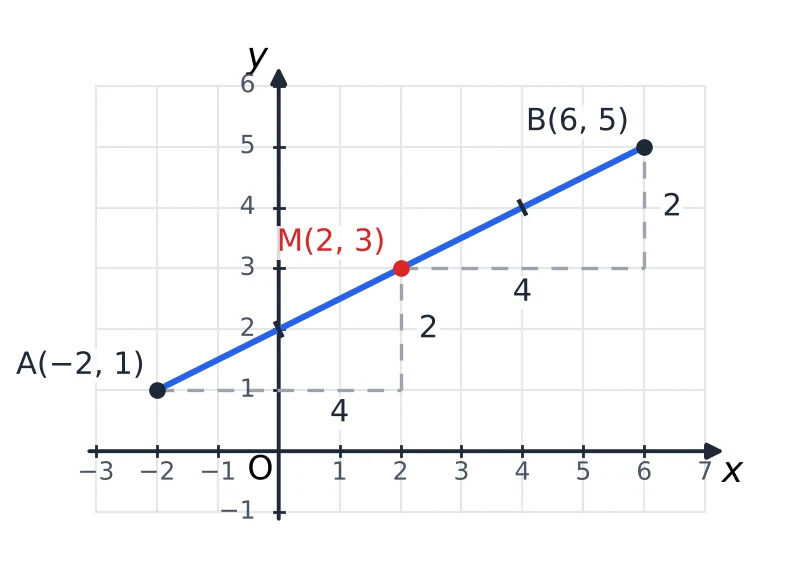
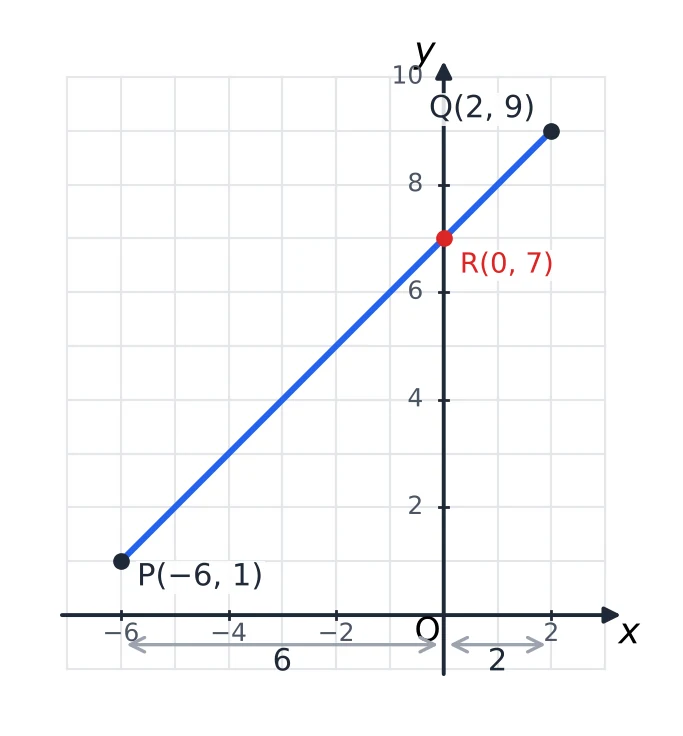
The figure shows why averaging works. Going from A to B, x rises by 8 and y by 4. Halfway along, x has risen by 4 and y by 2, so the midpoint is , the same answer.
Add, do not subtract. Half the difference, , is how far the midpoint is from each end along x; it is not a coordinate of the midpoint. Subtracting both pairs gives , the step from A to M, and that wrong point does turn up as an option.
Signs. Add with the signs: the midpoint of and is .
The other end from the midpoint. If M is the midpoint and one end is known, the other end is
Double the midpoint and take away the known end. With and , . Averaging and gives back , which checks it.
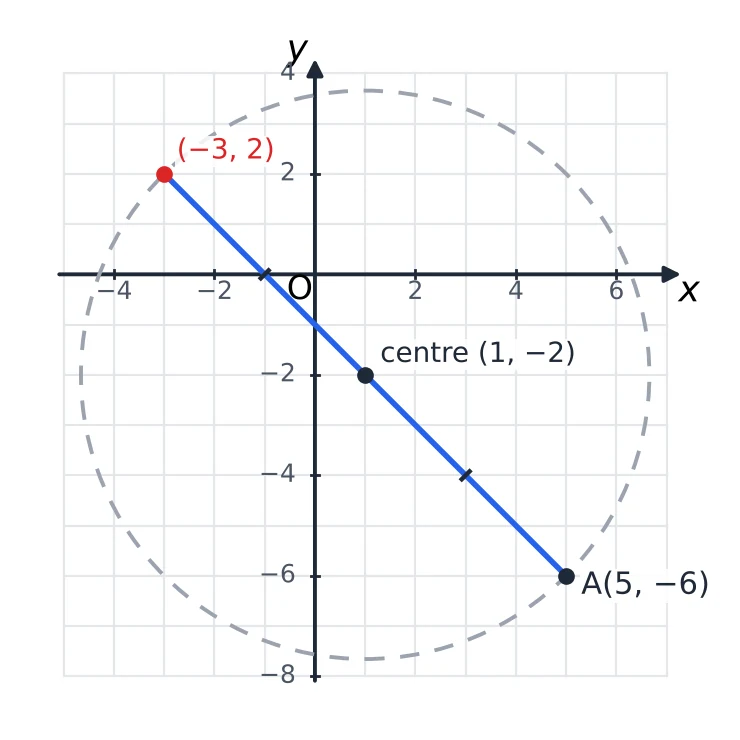
The same step answers three kinds of question: the other end of a diameter when the centre and one end are given (the centre is the midpoint), the image of a point in another point, and midpoints with letters in them. If the midpoint of and is , then and , so and .
The Section Formula
A point P on the segment AB divides it internally in the ratio m : n when . For and ,
The m, which is the part next to A, multiplies the coordinates of B, the far end, and n multiplies those of A. The cross-over looks odd, but it makes sense. P is pulled towards the end with the bigger weight, and with the point P is nearer B, so B gets the weight 2.
Take , and the ratio 2 : 1.
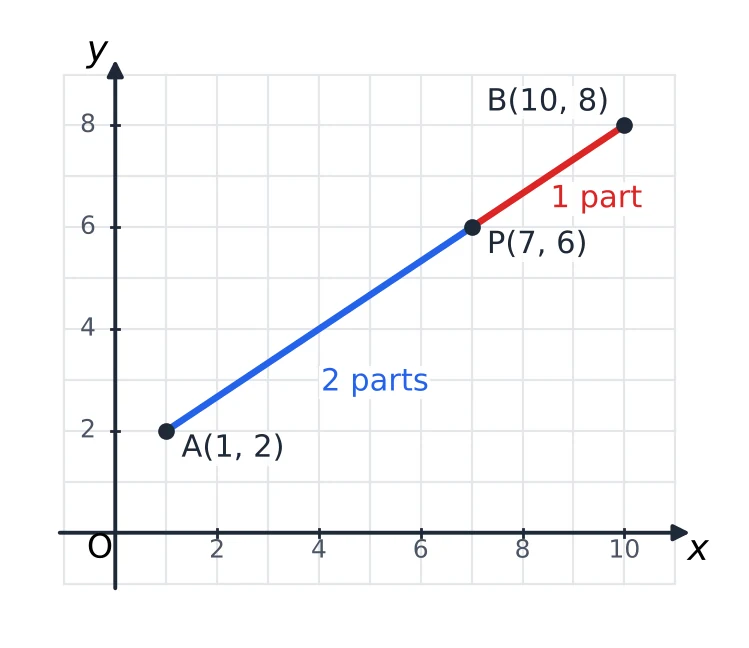
The step method. P is of the way from A to B. From A to B, x rises by 9 and y by 6, and two-thirds of that is 6 and 4. So . With small numbers this is quicker than the formula, and it cannot get the ratio the wrong way round, because you are walking out from A.
The wrong way round. Putting m with A gives . That is the point dividing AB in 1 : 2, the other point of trisection, and it is a likely wrong option. One look settles it: in the ratio 2 : 1 the point must be nearer B, and is nearer A.
The midpoint is the case . With the section formula becomes the midpoint formula.
Points of Trisection and Equal Parts
The two points of trisection of AB divide it into three equal parts. The one nearer A divides AB in 1 : 2, and the one nearer B divides it in 2 : 1.
The step method is the quickest way. Take and . From A to B, x changes by 9 and y by , so one third of the way is a step of .
- First point:
- Second point:
- One more step reaches , which is B, so the arithmetic is right.
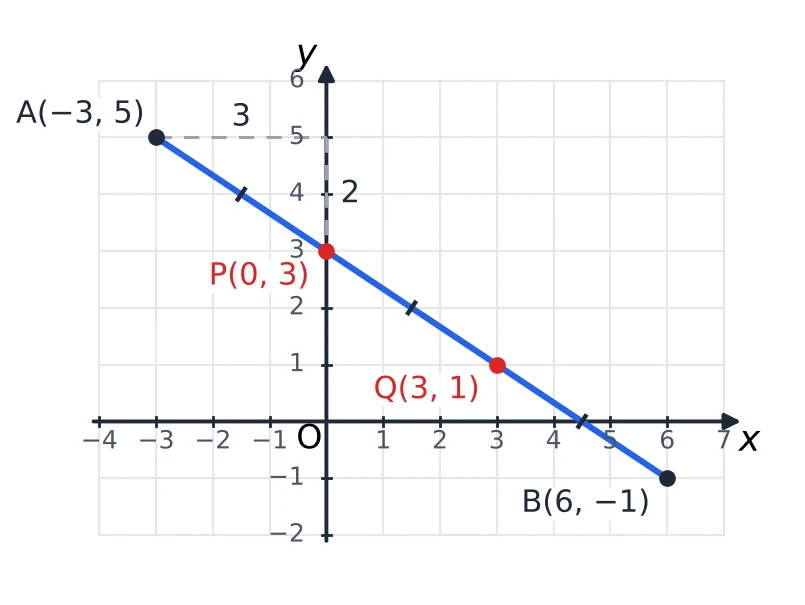
The section formula gives the same. For 1 : 2, .
Which point is asked? “The point of trisection nearer to B” is the 2 : 1 point. Read the words again before marking, since both points of trisection are offered as options.
Four equal parts. The three points that cut AB into four equal parts are the midpoint of AB and the midpoints of its two halves. Or take steps of a quarter: for and the step is , giving , and .
A fraction of the whole. “P lies on AB with ” means P is two-fifths of the way from A, so . Turning a fraction of the whole into a ratio of the two parts is where marks are lost: of AB is the ratio 2 : 3, not 2 : 5.
The Ratio in Which a Point Divides a Segment
When P is given and the ratio is wanted, take the ratio as , put it in the section formula for x, solve for k, and check with y.
Take , and .
So the ratio is , that is 2 : 5. Check with y: . It matches, so P really is on AB.
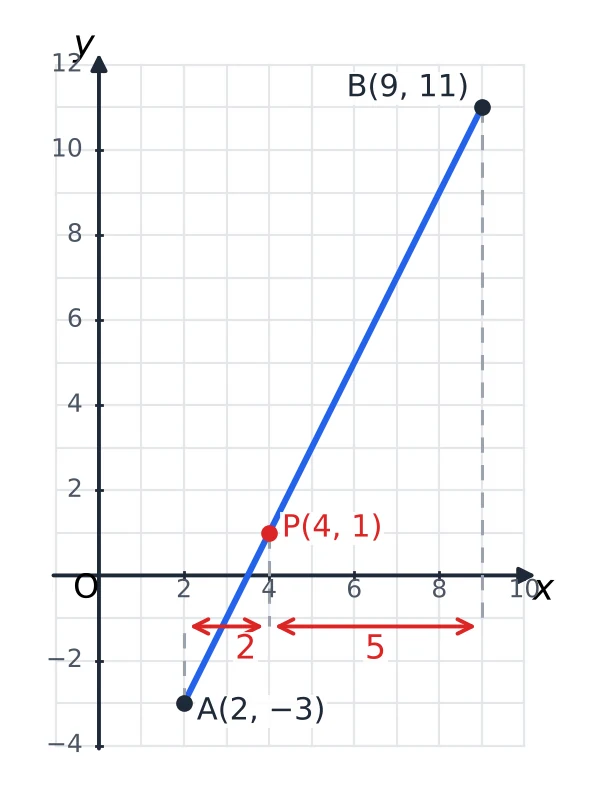
The quick way. Along a straight line, the gaps in x are in the same ratio as the lengths themselves. So
The figure shows the two gaps, 2 and 5, along the x-axis. Using y gives , the same ratio. If x and y give different ratios, P is not on AB at all. When A and B share an x-coordinate, the x-gaps are both 0, so use y.
A negative ratio. If k comes out negative, P is on the line AB but outside the segment, and the division is external.
A line instead of a point. The ratio in which a line divides AB comes from putting the section point into the line's equation. The result is easy to use: work out at A and at B, change the sign of the first, and write them as a ratio. For the line and the points and , the values are and 7, so the ratio is 3 : 7. Opposite signs at the two ends mean the line passes between them.
Where the Axes Cut a Segment
Every point on the x-axis has . So if the x-axis divides AB in , the section point has y-coordinate 0:
In words, the x-axis divides AB in the ratio , which is the size of against the size of when they have opposite signs. In the same way the y-axis divides AB in the ratio .
Take and .
- x-axis: the ratio is , and the point is .
- y-axis: the ratio is , and the point is .
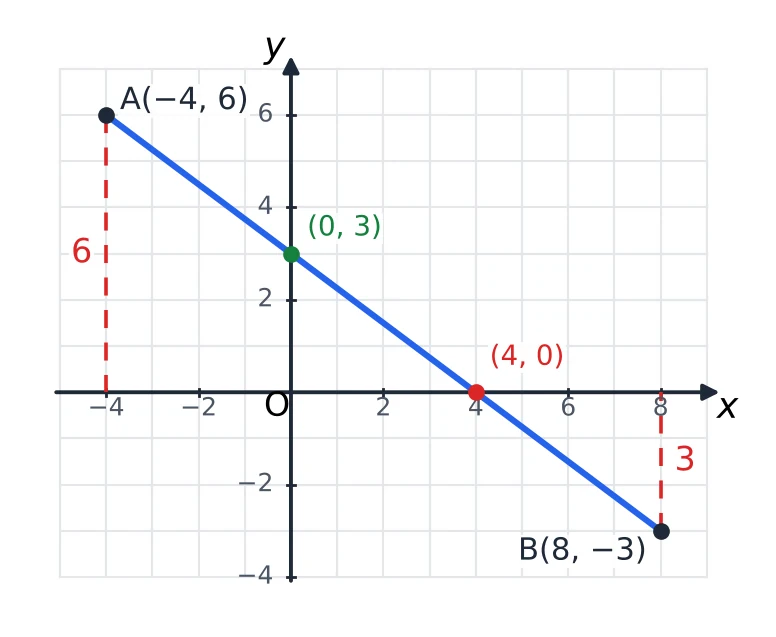
The figure makes the x-axis ratio plain. A is 6 units above the axis and B is 3 units below it, so the axis crosses AB at the point twice as far from A as from B.
Which coordinates? The x-axis ratio uses the y-coordinates, the heights above and below that axis, and the y-axis ratio uses the x-coordinates. Taking the wrong pair is the usual mistake here.
Same sign, no cut. If and have the same sign, both ends are on the same side of the x-axis and the axis does not meet the segment. The formula then gives a negative ratio, which means external division.
Once the ratio is known, only one coordinate of the point needs working out, because the other is 0.
External Division [Tier 2]
P divides AB externally in the ratio m : n when P lies on the line AB beyond A or beyond B, with . Only the signs change in the formula:
Take , and the ratio 3 : 2, externally.
Check: and , and .
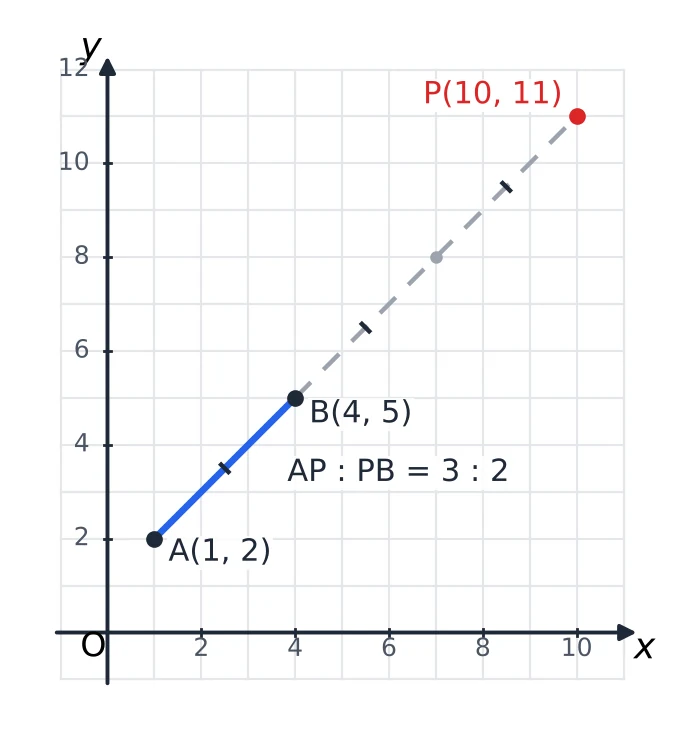
Since , AP is longer than PB, so P is beyond B. If , P is beyond A. The ratio can never be 1 : 1, since no point outside the segment is equally far from both ends; that is why never becomes 0.
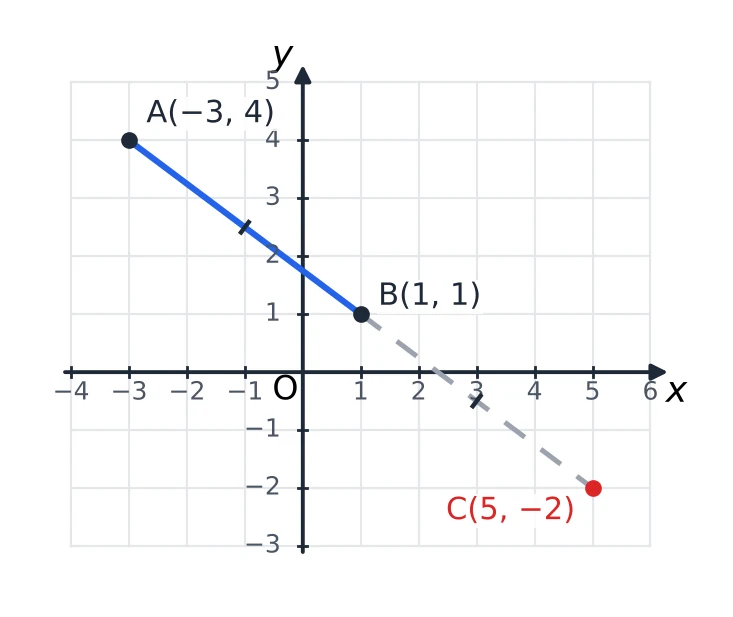
The step method again. From A to B the change is . In the ratio 3 : 2 externally, P is three of those steps from A (and two back from P is B): . The figure marks the three equal steps.
The Tier 1 form: a segment produced. Tier 1 papers ask the same idea in plain words. “AB is produced to C so that ” means B is the midpoint of AC, so C is ; with the points above, C is . “AB is produced to C so that ” means , which is the point found above. No new formula is needed for either: the first is the other end from the midpoint, the second is three steps from A.
The Centroid of a Triangle
A median joins a vertex to the midpoint of the opposite side. The three medians meet at one point, the centroid G, and its coordinates are the averages of the three vertices:
For , and :
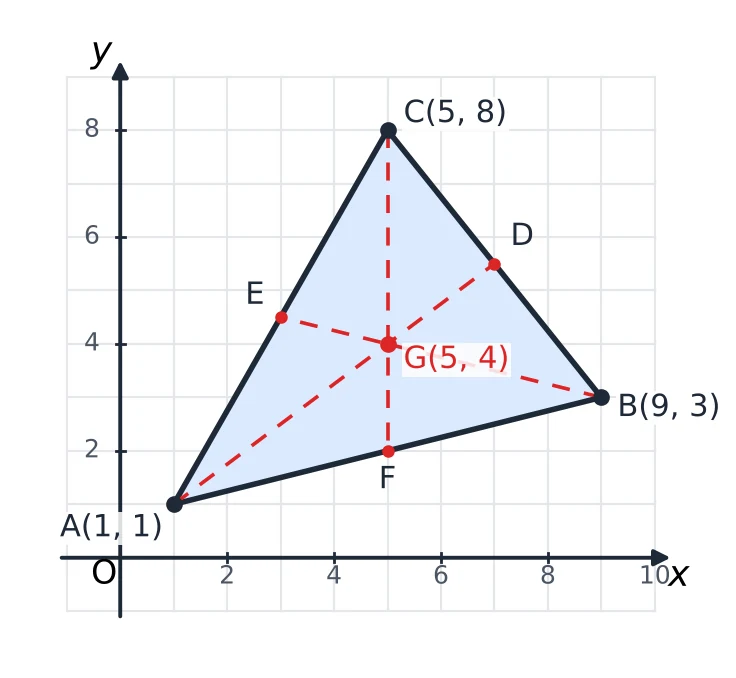
G divides each median in 2 : 1 from the vertex (Chapter 12). Here the midpoint of BC is , and the point dividing AD in 2 : 1 is , which is G again. So the centroid formula is just the section formula used on a median.
Divide by 3. The common mistake is dividing by 2, out of habit from the midpoint formula. Three vertices means three numbers added and a division by 3. The centroid always lies inside the triangle, so an answer outside it, or on a side, is wrong.
Two checks. Moving every vertex by the same amount moves the centroid by that amount. And when the origin is one vertex, the centroid is one third of the sum of the other two.
Centroid with letters. If the centroid of , and is , then the x's add up to and the y's to . So gives , and gives .
A Vertex from the Centroid, and the Triangle of Midpoints
Turn the centroid formula round. If G and two vertices are known, the third vertex is
With , and , the third vertex is . Check: and .
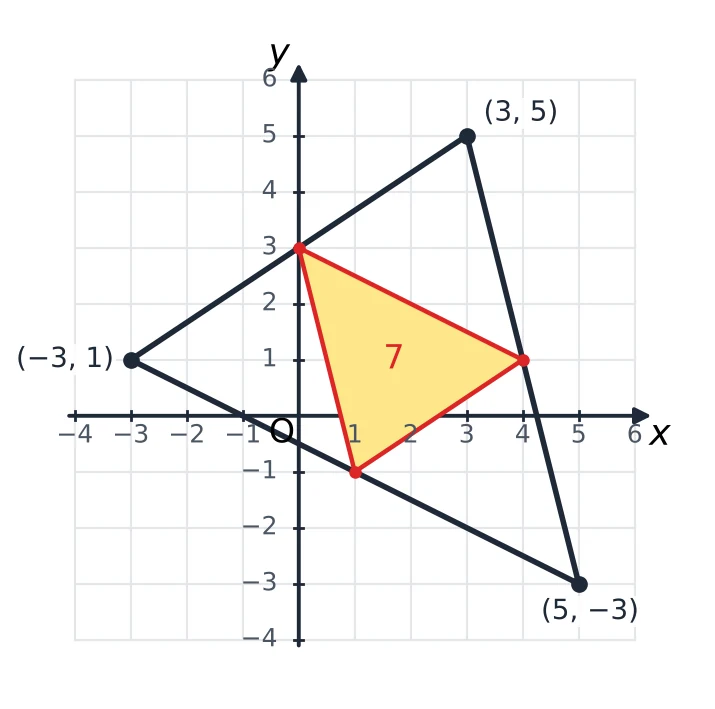
The triangle of midpoints. Join the midpoints D, E, F of the sides BC, CA and AB. The small triangle DEF has the same centroid as ABC, its sides are half as long, and its area is a quarter of the area of ABC (Chapter 12).
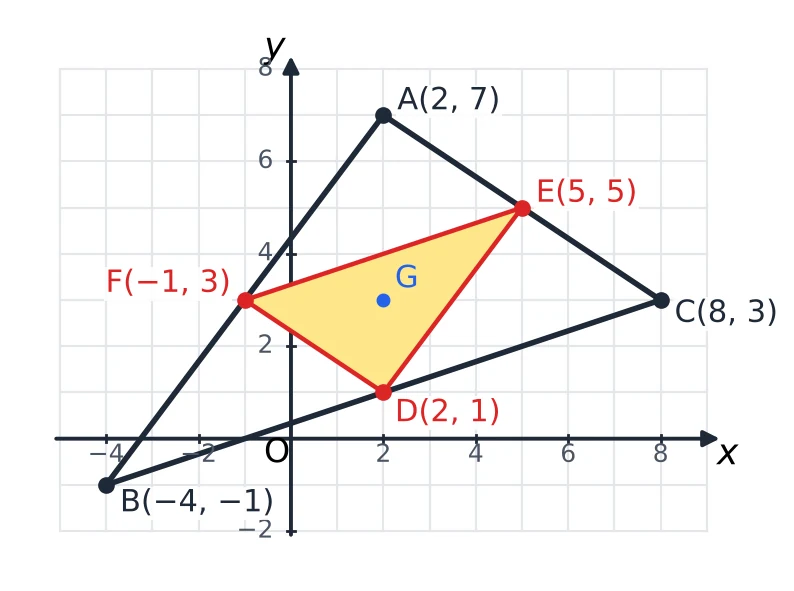
In the figure, , and have the midpoints , and . Both triangles have the centroid .
Vertices from the midpoints. If only D, E and F are given, each vertex is the sum of the two midpoints next to it minus the one opposite it, coordinate by coordinate:
Here . The reason is that AFDE is a parallelogram, and the diagonals of a parallelogram bisect each other (the next topic).
Other centres. In a right-angled triangle the circumcentre is the midpoint of the hypotenuse and the orthocentre is the vertex with the right angle. In an equilateral triangle the circumcentre, the orthocentre and the incentre all fall on the centroid.
[Tier 2] The incentre is , where a, b and c are the sides opposite the three vertices. For , and the opposite sides are 10, 8 and 6, and the incentre is .
The Fourth Vertex of a Parallelogram
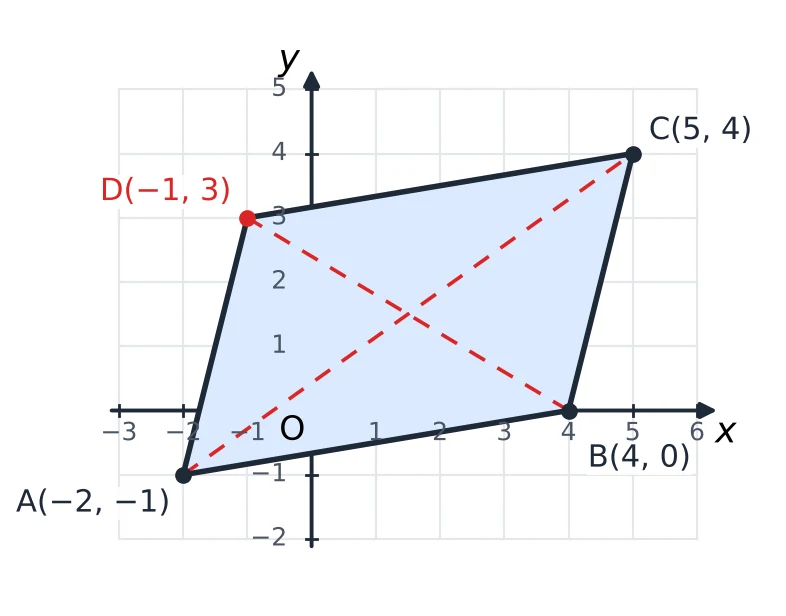
The diagonals of a parallelogram bisect each other, so in ABCD the midpoint of AC is the midpoint of BD. Doubling both midpoints gives, coordinate by coordinate,
This holds for every parallelogram, the rectangle, the rhombus and the square included.
Take the consecutive vertices , and .
Check: the midpoint of AC is , and so is the midpoint of BD.
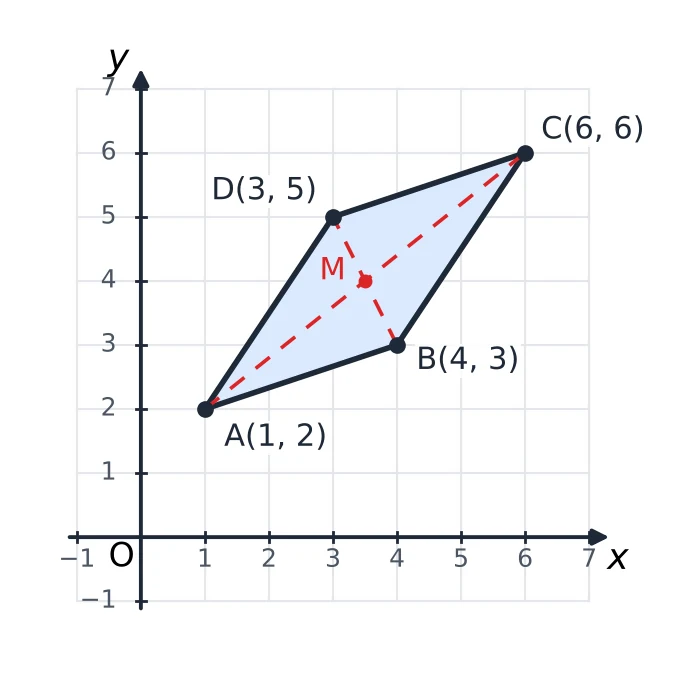
A way to remember it. The vertex you want is the sum of its two neighbours minus the vertex opposite it. D's neighbours are A and C; the vertex opposite D is B.
When the order is not given. “Three vertices of a parallelogram are A, B and C”, with nothing said about their order, allows three answers: , and . Each one makes a different pair of the given points into a diagonal. If the question names the figure ABCD, the order is fixed and there is only one answer.
Unknown coordinates. If , , and , in that order, form a parallelogram, then gives and . So and .
[SSC Tip] Before you mark, check that the diagonals' midpoints agree; it takes one line. The other two candidates, and , are the natural wrong options, and only the right vertex passes this check for the order ABCD.
The Area of a Triangle from Its Vertices
For a triangle with vertices , and ,
Each x is multiplied by the difference of the other two y's, taken round in order: , then , then .
Take , and .
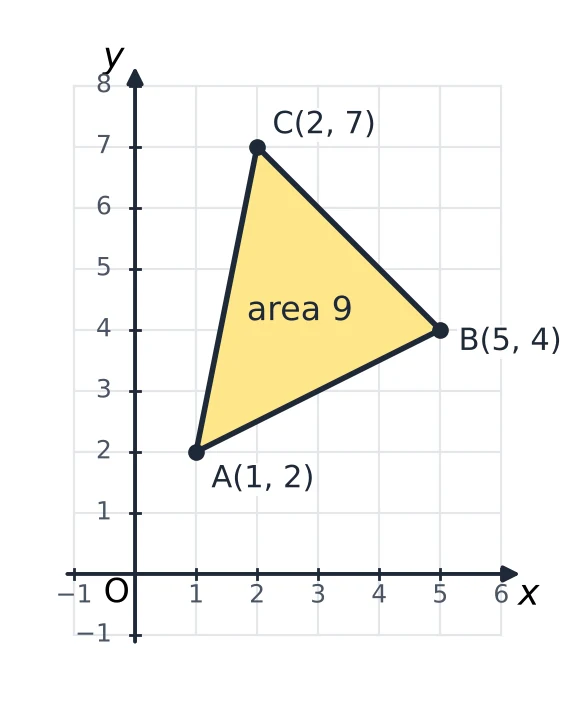
Two things to keep. The in front and the modulus round the bracket. Without the half you get 18, twice the area. The bracket comes out negative when the vertices are listed clockwise (try A, C, B: it gives ); an area is never negative, so drop the sign.
One vertex at the origin. With , and the formula shrinks to
For , and the area is sq units.
Shift a vertex to the origin. Subtract the coordinates of one vertex from all three. The triangle slides but its area does not change. Subtracting from the triangle above gives , and , and the area is again. With awkward numbers this is the cleanest route.
[SSC Tip] If one side of the triangle is horizontal or vertical, skip the formula. Take that side as the base; it is a plain difference of coordinates, and so is the height. Area = × base × height.
Collinear Points: Area Zero, and Finding k
If three points lie on one line, the “triangle” they make is flat and its area is 0. So the test for collinear points is
The and the modulus can be left out, because all that matters is whether the bracket is zero.
Find k if , and are collinear.
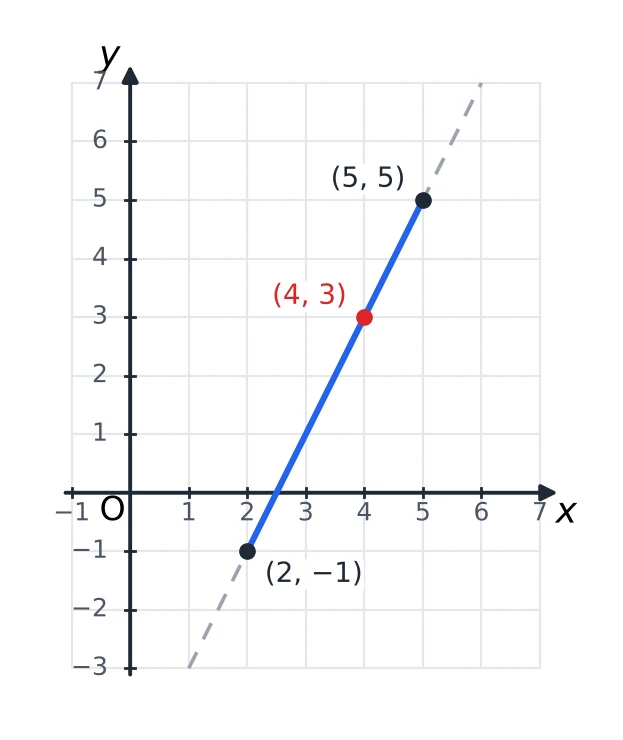
To see it another way: from to , x goes up 2 and y goes up 4; from to , x goes up 1 and y up 2. The steps are in the same proportion, so the three points are on one line.
This test needs no square roots, which makes it quicker than the distance test of Points, Distance and Reflections whenever the distances are not whole numbers. The slope test in Slope and the Equation of a Line is the third way to check the same thing.
Area given, k wanted. When the area is a number instead of 0, keep the and remember that the modulus gives two cases. The triangle with vertices , and has area . For an area of 5 sq units, , so or , giving or . The two answers put the vertex on opposite sides of the line through the other two vertices, and both triangles have the same area.
Dropping the modulus finds only ; dropping the leaves and finds or , which belong to an area of .
The Area of a Quadrilateral
Draw one diagonal to cut the quadrilateral into two triangles, find each area, and add.
Take , , and , in order. The diagonal AC splits ABCD into the triangles ABC and ACD.
So the area of ABCD is sq units.
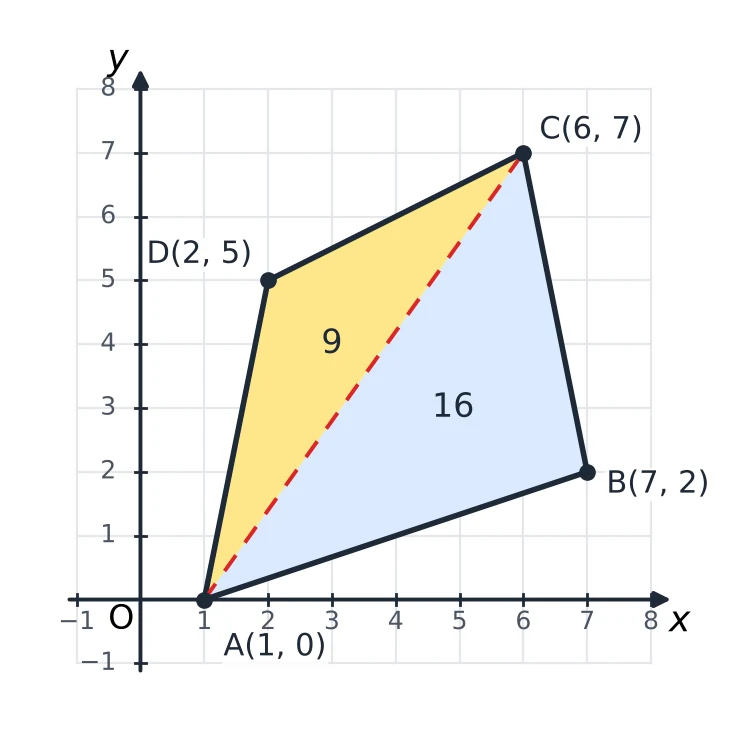
One line instead of two triangles. Write the vertices in order in two columns, x and y, and repeat the first vertex at the bottom. Then go down the list, multiplying across in a cross for each pair of rows:
| x | y |
|---|---|
| 1 | 0 |
| 7 | 2 |
| 6 | 7 |
| 2 | 5 |
| 1 | 0 |
Half of 50 is 25, as before. The same layout works for a triangle (three rows and the repeat) and for a polygon with any number of sides.
Keep the order. The vertices must go round the figure in order. Jumbled vertices make the outline cross itself, and the number that comes out is not the area.
Special shapes. A parallelogram is twice any one of the triangles made by three of its vertices. For a rhombus, half the product of the diagonals also works, with both diagonals found by the distance formula.
Solved Examples
Question 1
Find the midpoint of the segment joining and . (a) (b) (c) (d)
Answer. I add the coordinates and halve: and . The midpoint is (b) . Subtracting instead of adding gives , which is the step from A to the midpoint, not the midpoint.
Question 2
One end of a diameter of a circle is and the centre of the circle is . What is the other end of the diameter? (a) (b) (c) (d)
Answer. The centre is the midpoint of every diameter. So the other end is , which is (d) . Check: the average of and is . Averaging the centre with the given end would give , the middle of a radius.
Question 3
The midpoint of the segment joining and is . Find . (a) 4 (b) 6 (c) 3 (d) 5
Answer. From the x-coordinates, , so and . The y-coordinate of the midpoint is then , so , which gives and . So is (a) 4. I find a first because the second equation needs it.
Question 4
Find the point that divides the segment joining and internally in the ratio 3 : 2. (a) (b) (c) (d)
Answer. The 3 goes with B, the far end, and the 2 with A: and . The point is (c) . By steps it is the same: from A to B the change is , three-fifths of that is , and . is the point for the ratio 2 : 3.
Question 5
Find the point of trisection of the segment joining and that is nearer to B. (a) (b) (c) (d)
Answer. Nearer to B means . From A to B the change is , so one third of the way is a step of . Two steps from A give , which is (b) . One more step lands exactly on B, so the arithmetic is right. One step from A gives , the point of trisection nearer A.
Question 6
In what ratio does the point divide the segment joining and ? (a) 3 : 4 (b) 4 : 3 (c) 3 : 7 (d) 1 : 2
Answer. I use the gaps along x: . Along y: , the same. The two agree, so P is on AB and the ratio is (a) 3 : 4. 3 : 7 compares AP with the whole of AB instead of with PB.
Question 7
In what ratio does the x-axis divide the segment joining and , and at which point? (a) , at (b) , at (c) , at (d) , at
Answer. The x-axis ratio uses the y-coordinates: . Then the point is , so the answer is (d) , at . A check: from to , y rises 12 while x rises 6, so y reaches 0 after rising 4, when x has risen 2, at .
Question 8
The y-axis cuts the segment joining and at R. Find R. (a) (b) (c) (d)
Answer. The y-axis ratio uses the x-coordinates: . So R is three-quarters of the way from P to Q, and its y-coordinate is . R is (c) . With the ratio upside down, as 1 : 3, the y-coordinate would come out as 3.
Question 9
In what ratio does the line divide the segment joining and ? (a) 8 : 5 (b) 5 : 8 (c) 5 : 13 (d) 3 : 8
Answer. I work out at each end: at A it is , and at B it is . The signs are opposite, so the line passes between A and B. The ratio is the value at A with its sign changed against the value at B: (b) 5 : 8. To check, the point dividing AB in 5 : 8 is , and .
Question 10
[Tier 2] Find the point that divides the segment joining and externally in the ratio 4 : 1. (a) (b) (c) (d)
Answer. For external division the plus signs become minus signs: and . The point is (a) . It lies beyond B, as it must when the first number of the ratio is the bigger one: and . is the internal point for the same ratio.
Question 11
The segment AB is produced to C so that B is the midpoint of AC. If A is and B is , find C. (a) (b) (c) (d)
Answer. B is the midpoint of AC, so , which is (c) . In steps: from A to B the change is , and one more such step from B reaches C. is the point the same distance beyond A, on the wrong side.
Question 12
Find the centroid of the triangle with vertices , and . (a) (b) (c) (d)
Answer. Add the three x's and divide by 3: . Then the y's: . The centroid is (d) . Dividing by 2, out of habit from the midpoint formula, gives .
Question 13
Two vertices of a triangle are and , and its centroid is . Find the third vertex. (a) (b) (c) (d)
Answer. The three x's must add up to . The two known ones add up to , so the third x is . The three y's must add up to , and , so the third y is . The third vertex is (a) . Using twice the centroid instead of three times leads to .
Question 14
The midpoints of the sides of a triangle are , and . Find the centroid of the triangle. (a) (b) (c) (d)
Answer. The triangle formed by the midpoints has the same centroid as the original triangle, so I just average the three midpoints: , which is (b) . There is no need to find the vertices first, though they lead to the same point.
Question 15
, and are three consecutive vertices of the parallelogram ABCD. Find D. (a) (b) (c) (d)
Answer. In ABCD the diagonals AC and BD bisect each other, so . That gives , which is (c) . Both diagonals then have the same midpoint, . would complete a parallelogram in which BC, not AC, is a diagonal.
Question 16
The points , , and , taken in order, are the vertices of a parallelogram. Find x and y. (a) , (b) , (c) , (d) ,
Answer. The diagonals PR and QS bisect each other, so . For x: , so . For y: , so . The answer is (d) , . Pairing P with Q instead, as if PQ were a diagonal, leads to and .
Question 17
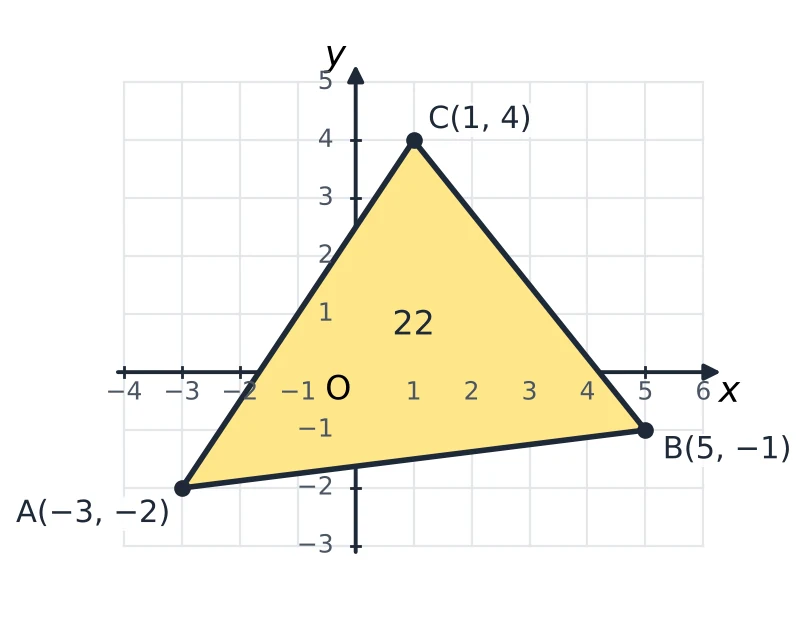
Find the area of the triangle with vertices , and . (a) 22 sq units (b) 44 sq units (c) 11 sq units (d) 18 sq units
Answer. Area , which is (a) 22 sq units. 44 is the bracket before halving.
Question 18
Find the area of the triangle with vertices , and . (a) 12 sq units (b) 18 sq units (c) 36 sq units (d) 24 sq units
Answer. With one vertex at the origin, the area is , which is (b) 18 sq units. Losing the sign of gives instead.
Question 19
For what value of k are the points , and collinear? (a) (b) 2 (c) 3 (d) 6
Answer. For collinear points the area bracket is 0: , that is , so and . The answer is (c) 3. Check with steps: from to is a move of , and from to is , the same direction.
Question 20
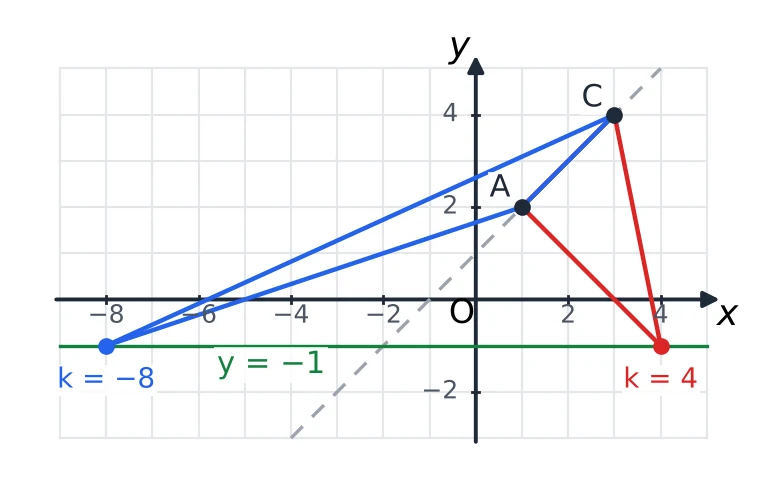
The area of the triangle with vertices , and is 6 sq units. What are the possible values of k? (a) or (b) or (c) or (d) only
Answer. The bracket is . The area is , so . The modulus allows two cases: gives , and gives . The answer is (a) or . The figure shows the two positions of the vertex , one on each side of the line through the other two vertices.
Question 21
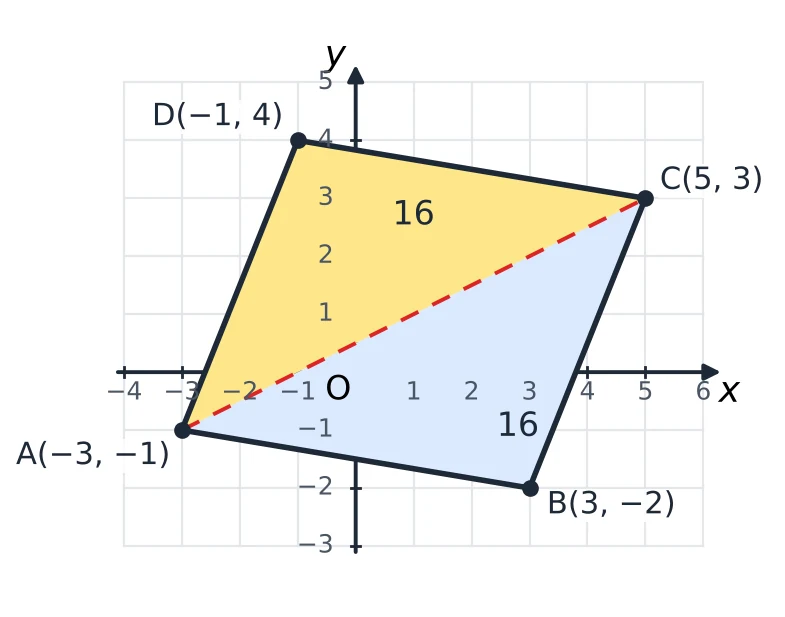
Find the area of the quadrilateral whose vertices, taken in order, are , , and . (a) 64 sq units (b) 16 sq units (c) 28 sq units (d) 32 sq units
Answer. I cut it along the diagonal AC. . . The total is , which is (d) 32 sq units. Here the diagonal happens to cut the area exactly in half.
Question 22
The vertices of a triangle are , and . Find the area of the triangle formed by joining the midpoints of its sides. (a) 14 sq units (b) 7 sq units (c) 28 sq units (d) sq units
Answer. The big triangle has area . The triangle of midpoints has a quarter of that area, so the answer is (b) 7 sq units. Working it out directly from the midpoints , and gives the same 7. 28 is the area of the original triangle, the number to divide by 4.