
Experiment, Outcome, Sample Space and Event
Probability puts a number on how likely something is. Four words come before any formula.
- An experiment is an action whose result cannot be known in advance, although every result it could have is known. Picking a number from 1 to 20 with closed eyes is an experiment. So are tossing a coin, throwing a die and drawing a card from a pack.
- An outcome is one possible result. If the number picked is 13, that is one outcome.
- The sample space is the list of all the outcomes, and is how many there are.
- An event is a set of outcomes described in words, such as “the number is even”. is the number of outcomes in it.
For “pick a number from 1 to 20”, and . The event “the number is a multiple of 6” is , so .
| Experiment | Sample space | |
|---|---|---|
| Pick a number from 1 to 20 | 20 | |
| Pick a number from 15 to 40 | 26 | |
| Pick a two-digit number | 90 | |
| Pick a day of the week | Monday to Sunday | 7 |
| Pick a letter of the word PENCIL | P, E, N, C, I, L | 6 |
Count the sample space first. From to , both included, there are numbers. So 15 to 40 has numbers, not 25. The two-digit numbers run from 10 to 99, which makes of them, not 99 and not 100. A wrong total spoils the answer even when the favourable count is right.
Coins and dice, and cards and balls, have sample spaces of their own, and they are taken up in Coins and Dice and in Cards, Balls and Bags. The experiments here are numbers, letters and days of the week, which need nothing more than careful counting.
Equally Likely Outcomes and the Formula
Outcomes are equally likely when none of them has a better chance than another. A fair coin, an unbiased die and a number picked “at random” all have equally likely outcomes. When a question says “at random”, it is telling you exactly this.
For equally likely outcomes, the probability of an event is
An outcome is favourable when the event happens in it.
A number is picked at random from 1 to 20. For the probability that it is a multiple of 4, the favourable outcomes are 4, 8, 12, 16 and 20, so
Cancel to lowest terms before you look at the options. They are printed in lowest terms, so will not be there but will.
When the results are not equally likely. The wheel below has 8 equal parts, 3 red and 5 blue. The pointer stops on red or on blue, but these two results are not equally likely, because blue covers more of the wheel. Saying “two colours, so the chance of red is ” is wrong. The 8 equal parts are the equally likely outcomes:
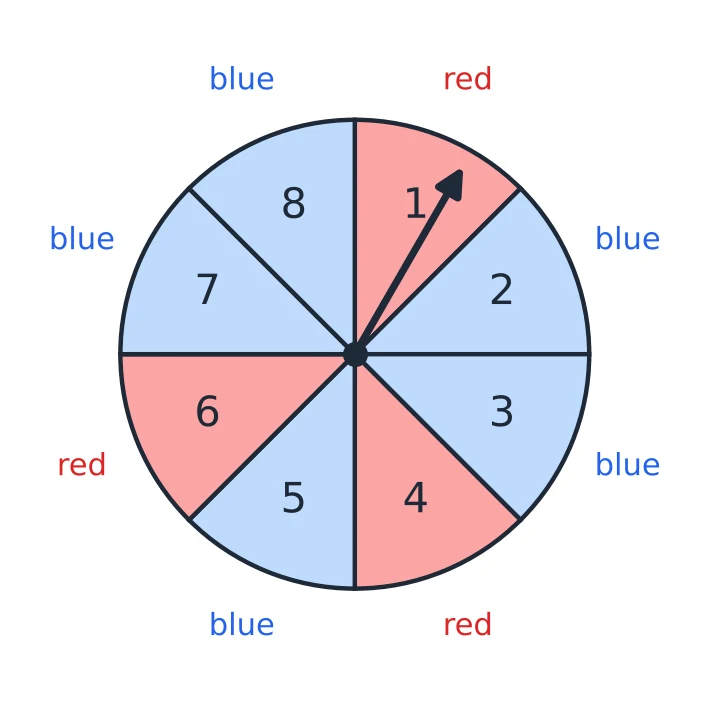
The same thinking settles “a number from 1 to 10 is picked; what is the chance that it is a prime?”. Prime and not prime are two results, but not equally likely ones. The ten numbers are the equally likely outcomes, and 4 of them (2, 3, 5 and 7) are prime, so .
So before using the formula, break the experiment into outcomes that are equally likely, and count those.
Probability Lies Between 0 and 1
The favourable outcomes are part of the sample space, so is at least 0 and at most . Dividing by gives
- An impossible event has no favourable outcome, so its probability is 0. A number from 1 to 20 that is a multiple of 25: there is none, so the probability is 0.
- A sure event (also called a certain event) happens in every outcome, so its probability is 1. A number from 1 to 20 that is less than 21: all 20 numbers qualify, and the probability is .
Every other event has a probability strictly between 0 and 1. The closer it is to 1, the more likely the event is to happen; the closer to 0, the less likely.
“Which of the following cannot be the probability of an event?” This is a one-line question. Test each option against the range.
- , 0.8, 0 and 1 can all be probabilities.
- , 1.2 and 105% are more than 1, so none of them can.
- A negative number, such as , can never be a probability.
A fraction whose top is bigger than its bottom is more than 1, and that is the quickest kind to spot. Percentages follow the same rule: a probability lies between 0% and 100%, both included.
Sure is not the same as likely. An event with probability 0.99 is very likely, but it is not sure. Only an event that happens in every single outcome has probability 1.
The Complement: The Event Not Happening
Every outcome either belongs to or does not. The outcomes outside make up the event “not ”, also written or . Between them, and “not ” hold every outcome exactly once, so their probabilities add up to 1:
A number is picked from 1 to 50, and we want the probability that it is not a multiple of 7. The multiples are 7, 14, 21, 28, 35, 42 and 49, so and
Listing the 43 other numbers would take far longer.
Use it when the opposite is shorter to count. For “not a perfect square” from 1 to 100, the perfect squares are , ten of them, so the answer is .
With decimals and percentages. If the probability that a train is late is 0.15, the probability that it is on time is . If the chance of rain tomorrow is 30%, the chance of no rain is 70%.
The complement does its biggest job in “at least one” questions, which are taught in Combined Events.
[SSC Tip] When a question has the word “not” in it, expect both and in the options. Underline “not” as you read, and check which of the two you have worked out before you mark.
Odds in Favour and Odds Against
Odds compare the favourable outcomes with the unfavourable ones, not with the total.
A number is picked from 1 to 12. The primes are 2, 3, 5, 7 and 11, five numbers, and the other seven are not prime. So the odds in favour of a prime are , the odds against are , and .
From odds to a probability. Odds of in favour mean that in every equally likely outcomes, are favourable:
- Odds in favour of give .
- Odds of against put the unfavourable count first. The favourable count is 4, so .
From a probability to odds. If , then 2 outcomes in 11 are favourable and 9 are not. The odds in favour are and the odds against are .
The mistake to watch for is reading odds of as a probability of . The 4 counts only the unfavourable outcomes; the total is , so the probability is . Add the two terms of the ratio to get the bottom of the fraction, every time.
Which word comes first. “Odds in favour” starts with the favourable count and “odds against” with the unfavourable one. Odds of in favour and odds of against describe the same event.
A Number Picked at Random: Even, Odd, Prime, Square
When a number is picked from 1 to , the total is and the work is in counting the favourable numbers. The number facts are in Chapter 1; these are the counts the questions need.
Even and odd. From 1 to 40 there are 20 of each. When is odd, the odd numbers are one more: from 1 to 35 there are 18 odd and 17 even numbers, so .
Multiples of a number. Divide by the number and drop the remainder. For multiples of 8 from 1 to 70, with remainder 6, so there are 8 of them (8, 16 and so on up to 64) and .
Primes. 1 is not a prime, and 2 is the only even prime. These counts are worth knowing by heart:
| Numbers | 1 to 10 | 1 to 20 | 1 to 30 | 1 to 50 | 1 to 100 |
|---|---|---|---|---|---|
| Primes | 4 | 8 | 10 | 15 | 25 |
From 1 to 50, . Counting 1 as a prime would make it , and you can expect that wrong value in the options.
Perfect squares and cubes. Count the whole numbers whose square is at most . From 1 to 60 the squares are 1, 4, 9, 16, 25, 36 and 49, seven of them, so . The cubes from 1 to 100 are 1, 8, 27 and 64, so . 1 is both a square and a cube; do not leave it out.
Factors. For “a factor of 24”, list the factors in pairs: , , , . That is 8 factors, and if the number is picked from 1 to 24, the probability is . Pairing them off makes sure that 1 and the number itself are not missed.
Multiples of One Number or Another
“A multiple of 3 or 5” means a multiple of 3, of 5, or of both. Count each list, then take away the numbers that were counted twice.
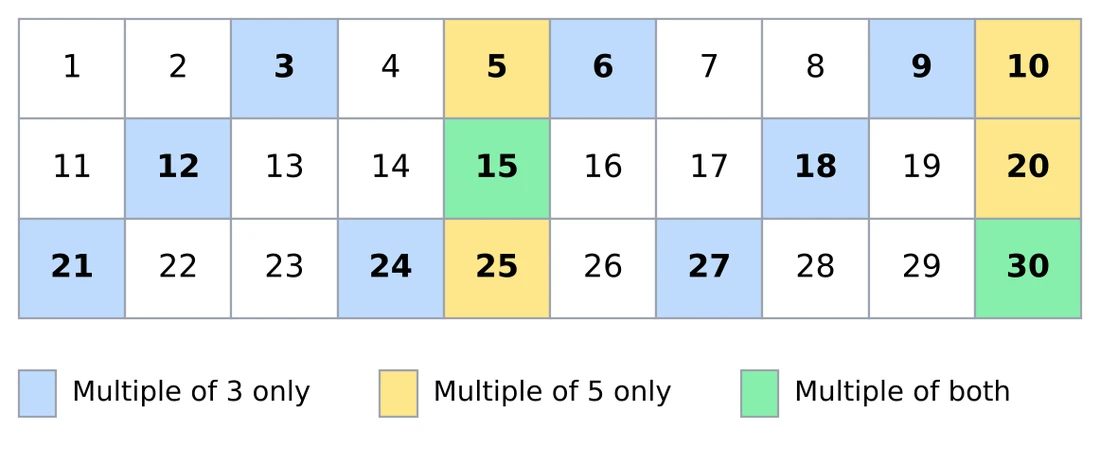
From 1 to 30 there are 10 multiples of 3 and 6 multiples of 5. The numbers 15 and 30 are on both lists (the green cells), so adding 10 and 6 counts them twice. The right count is
The numbers counted twice are the multiples of the LCM, here 15. In general,
From 1 to 50 there are 16 multiples of 3, 10 of 5 and 3 of 15, so numbers and the probability is . Adding 16 and 10 alone gives , which counts 15, 30 and 45 twice.
“And” is the overlap alone. A multiple of both 4 and 6 is a multiple of their LCM, 12, and not of 24. From 1 to 50 these are 12, 24, 36 and 48, so the probability is .
“Neither” is the complement. Neither a multiple of 3 nor of 5, from 1 to 30: numbers, so the probability is .
One list or the other, but not both. Count each list, then take the overlap away twice, once from each list. From 1 to 30, multiples of 3 or 5 but not both: , so the probability is .
A range that does not start at 1. Count the multiples up to the top end and take away those below the bottom end. For multiples of 7 from 20 to 80, there are 11 up to 80 and 2 up to 19, so of them (21, 28 and so on up to 77). The total is , so the probability is .
Two-Digit Numbers with a Condition on the Digits
There are 90 two-digit numbers, from 10 to 99, so the total is 90 in all of these questions. The tens digit runs from 1 to 9 and the units digit from 0 to 9. Write the condition as a rule on the two digits, then count.
Both digits the same. 11, 22, 33 and so on to 99: 9 numbers, so .
The digits add up to a given number. For a digit sum of 8: 17, 26, 35, 44, 53, 62, 71 and 80. That is 8 numbers and . 80 is on the list because the units digit can be 0. 08 is not, because a two-digit number cannot start with 0.
The tens digit is larger than the units digit. With tens digit 1 the units digit can only be 0, which gives the number 10. With tens digit 2 it can be 0 or 1, which gives two numbers, and so on, up to nine numbers for tens digit 9. That is numbers, and .
A digit that appears at least once. For numbers with at least one 5, tens digit 5 gives 50 to 59, ten numbers, and units digit 5 gives 15, 25 and so on to 95, nine numbers. 55 is on both lists, so the count is and .
Divisible by a number. The two-digit multiples of 8 run from to , which is numbers, so .
For three-digit numbers the total is 900 (100 to 999), and the counting works the same way.
A Letter Picked from a Word
Each letter of the word, repeats included, is one outcome. The word PROBABILITY has 11 letters,
P, R, O, B, A, B, I, L, I, T, Y
so , even though only 9 different letters appear. B and I come twice each.
- .
- The vowels are O, A, I and I, which makes 4, so . Only A, E, I, O and U are taken as vowels; Y counts as a consonant.
Repeated letters count every time. ACCOMMODATION has 13 letters:
| Letter | A | C | O | M | D | T | I | N |
|---|---|---|---|---|---|---|---|---|
| Times | 2 | 2 | 3 | 2 | 1 | 1 | 1 | 1 |
, and the consonants C, C, M, M, D, T and N give . Working with the 8 different letters would give , as if the word had one O instead of three.
A letter from the alphabet. There are 26 letters, 5 vowels and 21 consonants, so .
A letter of the alphabet that is in a given word. Now the sample space is the alphabet, in which each letter appears once, so count the different letters of the word. MATHEMATICS uses M, A, T, H, E, I, C and S, eight different letters. The probability that a letter picked from the alphabet is one of them is . All 11 letters of the word count only when the letter is picked from the word itself.
Calendar Questions: 53 Sundays in a Year
A week has 7 days, and . So an ordinary year is 52 full weeks and 1 extra day. The 52 weeks give 52 of every day. The extra day can be any of the 7 days of the week, and the year has 53 Sundays only if that day is a Sunday:
A leap year has days, so there are 2 extra days, and they are next to each other in the week. There are 7 possible pairs:
| Pair | Two extra days |
|---|---|
| 1 | Sunday and Monday |
| 2 | Monday and Tuesday |
| 3 | Tuesday and Wednesday |
| 4 | Wednesday and Thursday |
| 5 | Thursday and Friday |
| 6 | Friday and Saturday |
| 7 | Saturday and Sunday |
Sunday is in 2 of the 7 pairs (the first and the last), so
Treating the leap year as 365 days would give , which is the answer for an ordinary year.
“Or” and “and” with two days. Read them off the same seven pairs.
- 53 Sundays or 53 Mondays: pairs 1, 2 and 7 have a Sunday or a Monday, so the probability is .
- 53 Sundays and 53 Mondays: only pair 1 has both, so the probability is .
- 53 Sundays and 53 Wednesdays: no pair has both, since the two extra days are next to each other. This is an impossible event, with probability 0.
Months. The same idea works for a month. A 31-day month is 4 weeks and 3 extra days in a row. These can start on any of the 7 days, and Sunday is in 3 of those 7 runs, so the probability of 5 Sundays is . A 30-day month has 2 extra days, which gives , and February of a leap year (29 days) gives . February of an ordinary year is exactly 4 weeks, so 5 Sundays in it is impossible.
[SSC Tip] If the question names a year, decide first whether it is a leap year. A year divisible by 4 is a leap year, except a century year, which must be divisible by 400: 2024 and 2000 are leap years, 1900 and 2100 are not.
Probability as a Fraction, a Decimal or a Percentage
A probability can be written in three ways that mean the same thing:
To turn a fraction into a percentage, multiply by 100: . To go back, divide by 100 and cancel: . The fraction values from Chapter 3 save time here:
| Fraction | ||||||
|---|---|---|---|---|---|---|
| Decimal | 0.5 | 0.25 | 0.2 | 0.125 | 0.15 | 0.333… |
| Percentage | 50% | 25% | 20% | 12.5% | 15% |
When the question asks for a percentage. A number is picked from 1 to 40, and the probability that it is a multiple of 5 is , which as a percentage is 20%. Give the answer in the form the question asks for, because the options will be in that form.
The complement in any form. If the probability of an event is 0.36, the probability that it does not happen is , or 64%. With percentages, take the given value away from 100%.
Comparing probabilities. Which is more likely: an event A with probability , B with probability 0.4, or C with probability 42%? Write all three as decimals: , then 0.40 and 0.42. C is the most likely, though only just ahead of A. Changing everything into one form takes a few seconds and stops a guess based on how the numbers look.
Solved Examples
Question 1
A number is chosen at random from the numbers 18 to 54, both included. What is the probability that it is a multiple of 6? (a) (b) (c) (d)
Answer. First the total. From 18 to 54 there are numbers, not 36. The multiples of 6 in this range are 18, 24, 30, 36, 42, 48 and 54, which is 7 numbers. So the probability is (b) . Both ends of the range are multiples of 6 here, so I checked that I had counted them.
Question 2
A number is picked at random from 1 to 40. What is the probability that it is a factor of 40? (a) (b) (c) (d)
Answer. I wrote the factors of 40 in pairs: , , and . That is 8 factors, so the probability is , which cancels to (a) . Writing them in pairs made sure I did not miss 1 and 40.
Question 3
A wheel is divided into 12 equal parts: 5 parts are red, 4 are green and 3 are yellow. The wheel is spun once. What is the probability that the pointer does not stop on red? (a) (b) (c) (d)
Answer. The equally likely outcomes are the 12 equal parts, not the 3 colours. Red has 5 parts, so the parts that are not red number , and the probability is (c) . Saying “two colours out of three are not red” would give , but green and yellow together do not cover two-thirds of the wheel.
Question 4
Which of the following cannot be the probability of an event? (a) (b) 0 (c) (d) 1
Answer. A probability has to be from 0 to 1, both included. 0 and 1 are allowed: they belong to an impossible event and a sure event. is between them. has a bigger top than bottom, so it is more than 1 and cannot be a probability: (c) .
Question 5
A number is picked at random from 1 to 60. What is the probability that it is not a multiple of 4? (a) (b) (c) (d)
Answer. Counting the multiples of 4 is quicker than counting the rest: . So the probability of a multiple of 4 is , and the probability that the number is not one is , that is (a) .
Question 6
The odds in favour of an event are 4 : 9. What is the probability that the event happens? (a) (b) (c) (d)
Answer. Odds of 4 : 9 mean 4 favourable outcomes for every 9 unfavourable ones. So out of outcomes, 4 are favourable, and the probability is (d) . I did not write , because the 9 is not the total.
Question 7
The probability of an event is . What are the odds against the event? (a) 3 : 8 (b) 8 : 3 (c) 11 : 3 (d) 8 : 11
Answer. 3 outcomes out of 11 are favourable, so are not. Odds against put the unfavourable count first, so the answer is (b) 8 : 3.
Question 8
A number is chosen at random from 1 to 40. What is the probability that it is a prime number? (a) (b) (c) (d)
Answer. The primes up to 40 are 2, 3, 5, 7, 11, 13, 17, 19, 23, 29, 31 and 37. I count 12 of them, so the probability is , or (d) in lowest terms. I kept 1 out of the list, since 1 is not a prime, and kept 2 in, since it is.
Question 9
A number is picked at random from 1 to 60. What is the probability that it is a multiple of 4 or 6? (a) (b) (c) (d)
Answer. Multiples of 4: . Multiples of 6: . The multiples of 12, the LCM of 4 and 6, are on both lists, and there are of them. So the count is and the probability is , which is (a) . Adding 15 and 10 without taking away the 5 would give .
Question 10
A number is picked at random from 1 to 100. What is the probability that it is a perfect square or a perfect cube? (a) (b) (c) (d)
Answer. Squares: 1, 4, 9, 16, 25, 36, 49, 64, 81 and 100, which is 10. Cubes: 1, 8, 27 and 64, which is 4. 1 and 64 are on both lists, so I count them once: . The probability is , and that cancels to (c) .
Question 11
A two-digit number is chosen at random. What is the probability that the sum of its digits is 12? (a) (b) (c) (d)
Answer. There are 90 two-digit numbers. For a digit sum of 12 the tens digit has to be at least 3, because the units digit can be at most 9. So the numbers are 39, 48, 57, 66, 75, 84 and 93, seven of them, and the probability is (b) .
Question 12
A two-digit number is chosen at random. What is the probability that both its digits are odd? (a) (b) (c) (d)
Answer. The tens digit can be 1, 3, 5, 7 or 9, and so can the units digit. Each of the 5 tens digits goes with each of the 5 units digits, so there are such numbers, from 11 up to 99. Out of the 90 two-digit numbers that makes , and dividing both by 5 leaves (d) .
Question 13
A two-digit number is chosen at random. What is the probability that it is a perfect square? (a) (b) (c) (d)
Answer. The two-digit squares start at and end at : 16, 25, 36, 49, 64 and 81. That is 6 out of 90 numbers, so the probability is , which is (a) . With 99 at the bottom by mistake, I would have got .
Question 14
A letter is chosen at random from the word STATISTICS. What is the probability that it is a consonant? (a) (b) (c) (d)
Answer. STATISTICS has 10 letters: S, T, A, T, I, S, T, I, C, S. The vowels are A, I and I, so the consonants are . The probability is (c) . Every S and every T counts separately, because each one is a separate letter that could be picked.
Question 15
A letter is picked at random from the word MISSISSIPPI. What is the probability that it is S? (a) (b) (c) (d)
Answer. The word has 11 letters: M once, I four times, S four times and P twice. Four of the 11 are S, so the probability is (b) . The word has only 4 different letters, but M, which comes once, is not as likely to be picked as S, which comes four times.
Question 16
A letter is chosen at random from the English alphabet. What is the probability that it is one of the letters of the word LETTER? (a) (b) (c) (d)
Answer. This time the letter is picked from the alphabet, not from the word, and each of the 26 letters is there only once. LETTER uses four different letters, L, E, T and R, so 4 of the 26 are favourable. The probability is , which is (d) .
Question 17
What is the probability that an ordinary year (not a leap year) has 53 Fridays? (a) (b) (c) (d)
Answer. 365 days are 52 weeks and 1 day. The 52 weeks give 52 Fridays. The one extra day can be any of the 7 days, and only when it is a Friday does the year get a 53rd Friday. So the probability is (a) .
Question 18
What is the probability that a leap year has 53 Fridays or 53 Saturdays? (a) (b) (c) (d)
Answer. A leap year is 52 weeks and 2 days, and the 2 extra days are next to each other. The 7 possible pairs run from (Sunday, Monday) to (Saturday, Sunday). The pairs with a Friday or a Saturday are (Thursday, Friday), (Friday, Saturday) and (Saturday, Sunday). That is 3 out of 7, so the answer is (c) . If I had taken 2 pairs for Friday and 2 for Saturday, I would have counted (Friday, Saturday) twice and got .
Question 19
A month with 30 days is chosen. What is the probability that it has 5 Wednesdays? (a) (b) (c) (d)
Answer. 30 days are 4 weeks and 2 days. So the month has 4 of every day, plus 2 extra days next to each other. Wednesday is in 2 of the 7 possible pairs, (Tuesday, Wednesday) and (Wednesday, Thursday), and the probability is (b) .
Question 20
The probability that an event does not happen is 0.62. What is the probability, as a percentage, that it happens? (a) 62% (b) 3.8% (c) 0.38% (d) 38%
Answer. The two probabilities add up to 1, so the probability that it happens is . As a percentage that is , so the answer is (d) 38%.