
Mutually Exclusive Events
Two events are mutually exclusive if they cannot happen together: when one of them happens, the other cannot.
- One die is thrown: 'a 2' and 'a 5' are mutually exclusive.
- One card is drawn: 'a heart' and 'a spade' are mutually exclusive.
- One ball is drawn: 'red' and 'blue' are mutually exclusive.
For such events the probabilities simply add:
A die is thrown. The chance of a number less than 3 or more than 4 is .
Not mutually exclusive. 'A heart' and 'a king' can happen together, because the king of hearts is both. On a die, 'an even number' and 'a prime number' can happen together, because 2 is both. For pairs like these, plain adding counts something twice; the addition rule below deals with them.
Events that cover every case. If the events are mutually exclusive and one of them must happen, their probabilities add up to 1. A team wins, draws or loses a match. If and , then , and .
Chances compared with each other. Three candidates P, Q and R stand for one post, and exactly one of them will get it. P is twice as likely as Q to get it, and Q is twice as likely as R. Call R's chance . Then Q's is and P's is , and
So P gets the post with probability , Q with and R with .
An event and its complement, 'A' and 'not A', are the simplest pair of this kind. They cannot happen together and one of them must happen, which is why .
The Addition Rule
When A and B can happen together, adding and counts the outcomes that belong to both twice. Take them away once:
Here 'A or B' means A, or B, or both. In set notation the same rule is : means “or”, means “and”, and means “not A”. So , neither A nor B, is .
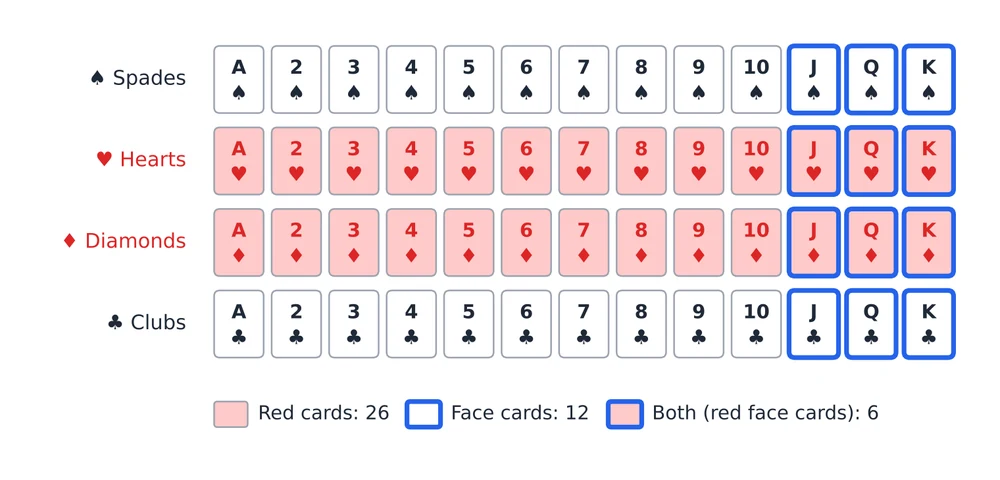
A card is drawn from a pack of 52. Let A be 'a red card' and B be 'a face card'. In the figure the red cards are shaded and the face cards have a thick border; the 6 red face cards have both.
Counting the cards one by one gives the same 32, as in Cards, Balls and Bags. The formula is needed when a question gives probabilities instead of a pack to count.
With given probabilities. If , and , then .
Neither. . In the same case it is .
Only A. .
Exactly one of A and B. ; in the same case .
Finding the overlap. The rule can be turned round. If , and , then
Percentages of a group. In a hostel, 60% of the students like tea, 50% like coffee and 25% like both. For a student picked at random, , so the chance that the student likes neither is , that is . A percentage becomes a probability when divided by 100 (see Chapter 3).
Three groups and 'exactly one'. In a class of 50, 30 students take Hindi, 25 take Sanskrit and 20 take Urdu; every student takes at least one, and 4 take all three. Let students take exactly one language and exactly two. Counting students: , so . Adding the three subject lists counts each student once for every language taken: , so . Subtracting, and , so .
A quick check on any answer: is never more than 1 and never less than the larger of and . If comes to more than 1, the two events must overlap.
Independent Events
Two events are independent if one happening does not change the chance of the other. Two coins, a coin and a die, two draws with replacement, two people working separately: each of these pairs is independent. For independent events,
Why it works. Bag X has 3 red balls out of 8, and bag Y has 2 red balls out of 5. One ball is drawn from each bag. There are equally likely pairs (any ball of X with any ball of Y), and of them are red with red. So
More than two events. Multiply all of them. If three machines, working on their own, run through a day with probabilities 0.9, 0.8 and 0.5, all three run with probability .
Independent or not? Draws without replacement are not independent, because the first ball changes what is left (see Cards, Balls and Bags). When a question gives , and , you can test it: the events are independent exactly when . With , and , they are.
Independent is not the same as mutually exclusive.
| Mutually exclusive | Independent | |
|---|---|---|
| Meaning | cannot happen together | one has no effect on the other |
| 0 | ||
Two mutually exclusive events (each possible on its own) can never be independent: once one happens, the other's chance drops to 0.
Both rules in one question. If A and B are independent with and , then , and .
Both, Neither, Exactly One, At Least One
With two independent events, a question can ask for any of four cases. Take two students, A and B, who try a problem on their own. A solves it with probability and B with probability , so A fails with probability and B with probability .
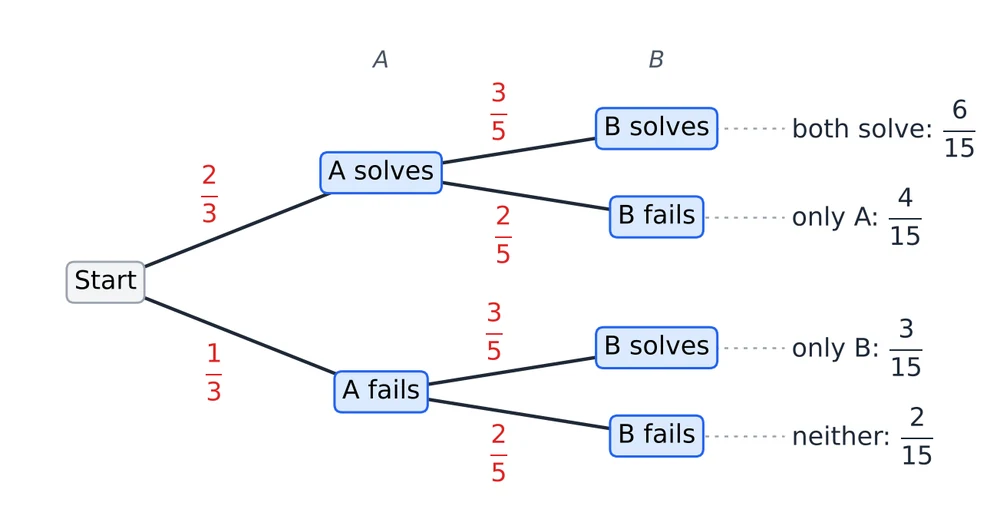
The tree has four paths. Each path's probability is the product along it:
| Case | Working | Probability |
|---|---|---|
| Both solve | ||
| Only A solves | ||
| Only B solves | ||
| Neither solves |
The four add up to . From the table:
- Both: .
- Neither: .
- Exactly one: only A or only B, .
- At least one: everything except 'neither', . This is also both plus exactly one, .
- At most one: everything except 'both', .
In general, if the two chances are and ,
[SSC Tip] Two mistakes are worth guarding against here. Working 'at least one' as 'exactly one' leaves out 'both' ( in place of ). Adding the two chances gives , which is more than 1 and cannot be a probability. Go through 'neither' and subtract from 1.
Two or Three People: Solving a Problem, Hitting a Target
'The problem is solved' means at least one person solves it. 'The target is hit' means at least one shot hits it. Both are 'at least one' questions, so work through the case where everyone fails.
Three students. A, B and C, working on their own, can solve a problem with probabilities , and .
Exactly one of them solves it in three ways (only A, only B, only C):
All three solve it with probability .
'Times out of' is a probability. 'A hits the target 3 times in 5 shots' means . If B hits once in 2 shots and both fire one shot each, the target is hit with probability .
One person, several shots. A shooter hits with probability on each shot, and the shots do not affect each other. In 3 shots, , so .
How many shots are needed? With a hit chance of a shot, the chance of missing all of shots is . For at least a 90% chance of a hit, this has to be or less. Three shots leave , which is too big; four leave , which is small enough. So 4 shots are needed.
Exactly k Successes in n Tries
When the same thing is tried times, independently, with the same chance of success every time (a shooter firing shots, a coin tossed times, a die thrown times), the chance of exactly successes is
Why it works. A shooter hits with probability and fires 4 shots. One way of getting exactly 2 hits is hit, hit, miss, miss, with probability . Every other order (hit, miss, hit, miss and so on) has the same probability, and the number of orders is the number of ways to pick which 2 of the 4 shots hit, . So
The count in one line. is the number of ways to choose of the tries: , , , (as in Cards, Balls and Bags), and , since choosing the tries that succeed also fixes the ones that fail; so .
A coin. With every record of tosses has probability , so the formula becomes . Exactly 2 heads in 6 tosses: .
At least and at most. Add the exact cases, or take them away from 1. For the 4 shots with :
- no hit:
- exactly one hit:
- at least two hits:
The mistake to avoid is leaving out . The above is the chance of one particular order of hits and misses, not of exactly 2 hits.
Exactly One: Truth, Selection and Survival
Some questions dress up 'exactly one' and 'both' in other words. The working does not change.
Speaking the truth. A speaks the truth in 70% of cases and B in 90%, independently. Both are asked about the same fact.
- They contradict each other when exactly one of them tells the truth: .
- They agree when both tell the truth or both do not: .
In symbols, if the two speak the truth with probabilities and ,
The two answers add up to 1. 'Agree' is more than 'both tell the truth' (0.63): two people who both give the false answer to a yes-or-no question also agree. As a percentage, they contradict each other in 34% of cases.
Selection. A brother and a sister apply for two different posts. The brother is selected with probability and the sister with probability , independently.
- Only one of them is selected: .
- Both are selected: .
- Neither is selected: , so at least one is selected with probability .
Living to a given age. The chance that a man will be alive 20 years from now is 0.7, and for his wife it is 0.6. 'Only the wife will be alive' needs the man not alive and the wife alive: .
In every one of these, write the two 'not' chances first ( and ), build each case as a product, and add the cases the question asks for.
Choosing a Bag First, Then a Ball
In a two-step question the first step decides which bag is used and the second step draws a ball from it. Draw a tree, multiply along each path, and add the paths that end in the event you want.
Bag I has 3 red and 2 black balls; bag II has 2 red and 4 black balls. A bag is chosen at random and one ball is drawn from it.
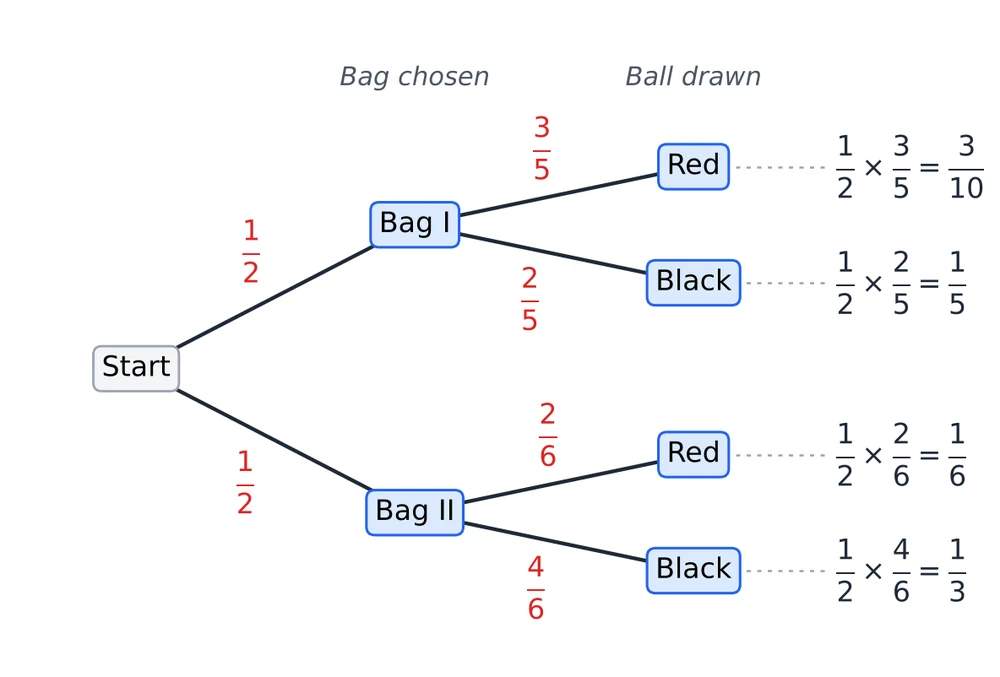
The two red paths give
and so .
Don't pour the bags together. Putting all 11 balls in one heap gives for red, which is wrong. Each bag has the same chance of being chosen, but bag II holds more balls, so each ball in it is less likely to come out.
When the choice is not fifty-fifty. A die is thrown: if it shows 1 or 2, bag I is used, otherwise bag II. Now bag I has a chance of :
Moving a ball across. One ball is taken at random from bag I and put into bag II without looking at it, and then a ball is drawn from bag II. The moved ball is red with probability , and then bag II has 3 red balls out of 7; it is black with probability , and then bag II has 2 red out of 7.
[SSC Tip] Write the chance of each first step on the tree before anything else. The two wrong turns in these questions are pouring the bags together and treating the bags as equally likely when a die or a coin says otherwise.
Tossing a Coin Until Something Happens
A coin is tossed until a head appears, but not more than 3 times. The possible records are H, TH, TTH and TTT.
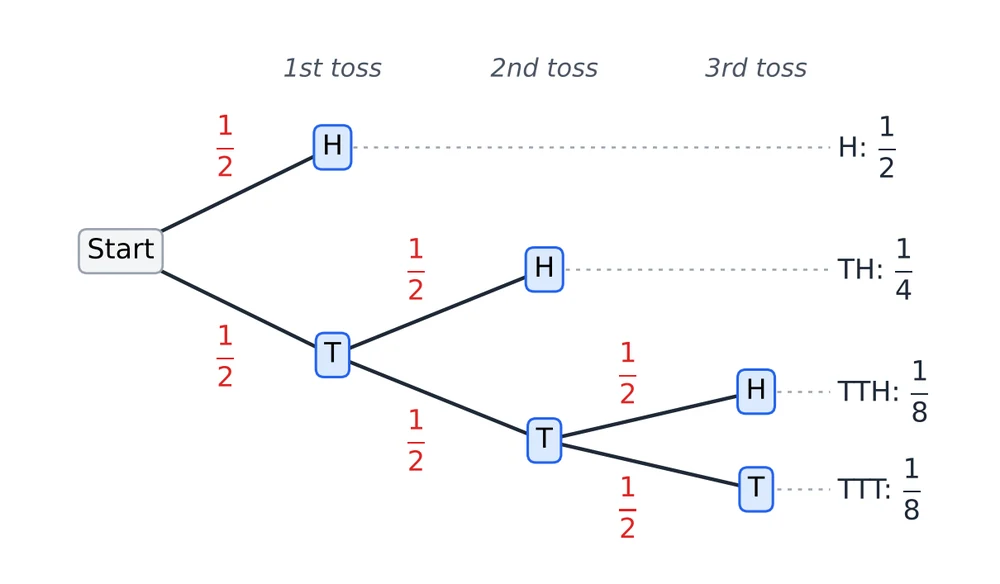
These four records are not equally likely. Each extra toss multiplies the chance by :
| Record | H | TH | TTH | TTT |
|---|---|---|---|---|
| Probability |
- A head appears at some point: .
- All three tosses are made: TTH or TTT, .
- The first head comes on the third toss: .
Do not give each record a chance of : half the time the game stops after the very first toss.
Taking turns. A and B toss a coin in turn, A first, and whoever gets the first head wins. In the first round A wins at once with probability . B tosses only if A got a tail, so B wins in that round with probability . If both get tails, the game starts again exactly as before. So in every round A's chance is double B's, and over the whole game A : B = 2 : 1:
The same reasoning works with a die. If the first to throw a six wins, A's chance in a round is and B's is . So A : B = 6 : 5 and .
A game with a limit. If each of them may toss at most twice (A, B, A, B), A wins on the 1st or 3rd toss: . B wins on the 2nd or 4th: . Nobody wins with probability , and the three add up to 1.
Solved Examples
Question 1
In a hockey match, the probability that a team wins is 0.4 and the probability that the match is drawn is 0.25. What is the probability that the team does not lose? (a) 0.35 (b) 0.65 (c) 0.6 (d) 0.1
Answer. Win, draw and lose cannot happen together, and one of them has to happen. 'Does not lose' means the team wins or draws, so I just add: . That is (b) 0.65. The 0.35 left over is the chance of losing.
Question 2
A card is drawn at random from a pack of 52 cards. What is the probability that it is an honour card (ace, king, queen or jack) or a black card? (a) (b) (c) (d)
Answer. Honour cards: 16. Black cards: 26. The black honours, 4 spades and 4 clubs, are in both, so . The answer is (d) .
Question 3
For two events A and B, , and . What is ? (a) 0.2 (b) 0.175 (c) 0.15 (d) 0.85
Answer. I turn the addition rule round: . So the answer is (a) 0.2. Multiplying 0.35 by 0.5 would be right only if A and B were independent, and nothing says they are.
Question 4
In a club, 45% of the members read newspaper A, 35% read newspaper B and 20% read both. A member is picked at random. What is the probability that the member reads neither newspaper? (a) (b) (c) (d)
Answer. First the members who read at least one: . The rest, , read neither. As a probability, 40% is , which is (c) . Forgetting to take away the 20% would make the readers 80% and leave only .
Question 5
A and B are independent events with and . What is the probability that A or B happens? (a) 0.72 (b) 0.9 (c) 0.18 (d) 0.54
Answer. Independent, so . Then the addition rule: . Another way: neither happens with probability , and . Either way it is (a) 0.72.
Question 6
The probability of rain on Saturday is 0.3 and on Sunday is 0.4, and the two days do not affect each other. What is the probability that it rains on at least one of the two days? (a) 0.7 (b) 0.12 (c) 0.46 (d) 0.58
Answer. I go through 'no rain on either day': . So at least one rainy day has probability , which is (d) 0.58. Just adding counts the chance of rain on both days twice.
Question 7
Bag P has 4 white and 5 black balls. Bag Q has 3 white and 7 black balls. One ball is drawn from each bag. What is the probability that both balls are white? (a) (b) (c) (d)
Answer. The two draws are from different bags, so they are independent. White from P: . White from Q: . Both: . The answer is (b) .
Question 8
Bag P has 4 white and 5 black balls. Bag Q has 3 white and 7 black balls. One ball is drawn from each bag. What is the probability that one ball is white and the other is black? (a) (b) (c) (d)
Answer. Two ways. White from P and black from Q: . Black from P and white from Q: . Together , which is (c) . Stopping after the first way would give .
Question 9
Two students A and B try a problem on their own. A can solve it with probability and B with probability . What is the probability that the problem is solved? (a) (b) (c) (d)
Answer. The problem is solved if at least one of them solves it. Both fail with probability . So the problem is solved with probability , that is (a) .
Question 10
Two students A and B try a problem on their own. A can solve it with probability and B with probability . What is the probability that exactly one of them solves it? (a) (b) (c) (d)
Answer. Only A: . Only B: . Exactly one is the two added: , so (d) . A check: both is and neither is , and .
Question 11
Three friends, working on their own, can solve a puzzle with probabilities , and . What is the probability that the puzzle gets solved? (a) (b) (c) (d)
Answer. Nobody solves it: . So it gets solved with probability , which is (b) . Adding the three chances would give , too big because the cases where two or three of them solve it are counted more than once.
Question 12
A hits a target 4 times in 5 shots and B hits it 5 times in 6 shots. Both fire one shot at the target. What is the probability that the target is hit? (a) (b) (c) (d)
Answer. A misses with probability and B with . Both miss: . The target is hit if at least one hits, so . The answer is (c) .
Question 13
Three shooters hit a target with probabilities , and , each firing one shot on their own. What is the probability that the target is hit at least twice? (a) (b) (c) (d)
Answer. At least twice means exactly two hits or three hits. Exactly two: . All three: . Together , which is (a) .
Question 14
An archer hits the centre of a target with probability on each arrow, and the arrows do not affect each other. If 5 arrows are shot, what is the probability that exactly 4 of them hit the centre? (a) (b) (c) (d)
Answer. One order, such as four hits and then a miss, has probability . The miss can be any one of the 5 arrows, so there are such orders. So , which is (d) . Stopping at one order is the mistake that leads to .
Question 15
A die is thrown 4 times. What is the probability of getting a six exactly twice? (a) (b) (c) (d)
Answer. Each throw gives a six with probability and something else with . One order, say six, six, other, other, has probability . The two sixes can fall on any 2 of the 4 throws, ways. So , that is (b) .
Question 16
A speaks the truth in 60% of cases and B in 90% of cases. In what percentage of cases are they likely to contradict each other when stating the same fact? (a) 58% (b) 42% (c) 54% (d) 36%
Answer. They contradict each other when exactly one of them tells the truth. A true and B false: . A false and B true: . Together , that is (b) 42%. The other 58% are the cases in which they agree.
Question 17
Ravi and Meena appear for an interview for two different posts. The probability that Ravi is selected is and that Meena is selected is . What is the probability that only one of them is selected? (a) (b) (c) (d)
Answer. Ravi yes and Meena no: . Ravi no and Meena yes: . Only one: . The answer is (c) .
Question 18
Box A has 4 green and 2 white balls, and box B has 3 green and 5 white balls. A box is chosen at random and a ball is drawn from it. What is the probability that the ball is green? (a) (b) (c) (d)
Answer. I follow the two paths. Box A, then green: . Box B, then green: . Adding: , which is (a) . Putting all 14 balls together would give , but the boxes are not the same size.
Question 19
A die is thrown. If it shows 6, a ball is drawn from bag I, which has 3 red and 1 blue ball; otherwise a ball is drawn from bag II, which has 1 red and 4 blue balls. What is the probability that the ball drawn is red? (a) (b) (c) (d)
Answer. Bag I is used only when the die shows 6, so its chance is , and bag II's is . Red by way of bag I: . Red by way of bag II: . Total: . So the answer is (d) .
Question 20
Bag A contains 4 white balls and 1 black ball, and bag B contains 3 white and 4 black balls. One ball is taken at random from bag A and put into bag B without looking at it. A ball is then drawn from bag B. What is the probability that it is white? (a) (b) (c) (d)
Answer. Two cases for the moved ball. It is white with chance , and then bag B has 4 white out of 8. It is black with chance , and then bag B has 3 white out of 8. So , which is (b) . Bag B has 8 balls after the move, not 7.
Question 21
A coin is tossed until a head appears or until it has been tossed 4 times, whichever comes first. What is the probability that the coin is tossed exactly 4 times? (a) (b) (c) (d)
Answer. The fourth toss happens only if the first three are all tails: . After that the game ends whatever the fourth toss shows (TTTH or TTTT). So the answer is (c) . The five records H, TH, TTH, TTTH and TTTT are not equally likely, so 2 out of 5 does not work.
Question 22
A and B throw a die in turn, A first. Whoever first throws a number greater than 4 wins. What is the probability that A wins? (a) (b) (c) (d)
Answer. A number greater than 4 means 5 or 6, a chance of on each throw. In one round A wins with , and B wins with , because B throws only if A has failed. If both fail, the game starts afresh. So their chances are in the ratio , and A wins with probability , that is (a) .