
The Pack of 52 Cards
A question that begins 'a card is drawn from a well-shuffled pack of 52 cards' expects you to know the pack by heart. Once you do, every card question is plain counting.
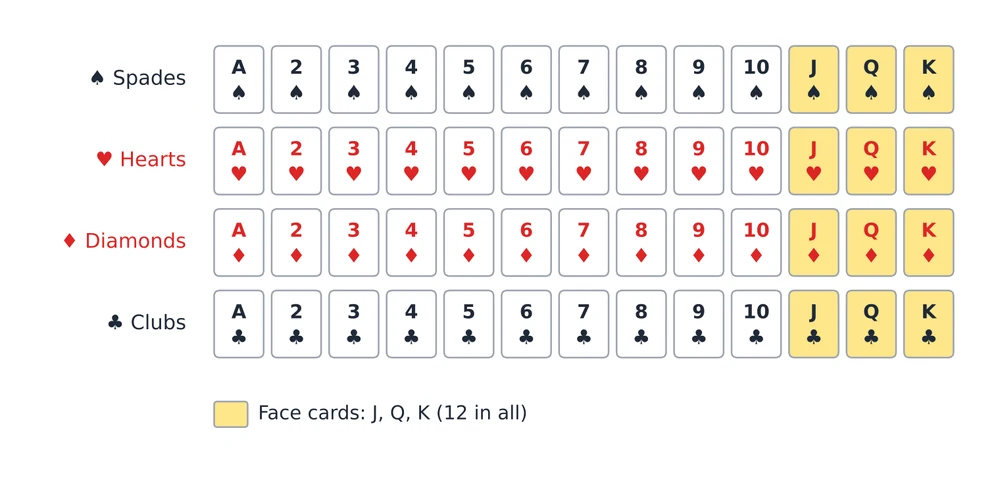
- Suits. There are 4 suits of 13 cards each. Spades (♠) and clubs (♣) are black; hearts (♥) and diamonds (♦) are red. So the pack has 26 red cards and 26 black cards.
- Ranks. Each suit runs ace, 2, 3, 4, 5, 6, 7, 8, 9, 10, jack, queen, king. Every rank appears once in each suit, so there are 4 aces, 4 kings, four 7s and so on. Of the 4 cards of any rank, 2 are red and 2 are black.
- Face cards. The jack, queen and king are the face cards (also called court cards or picture cards). That is 3 in each suit and 12 in the pack, 6 red and 6 black. The ace is not a face card.
- Honour cards. The ace, king, queen and jack of each suit, 16 cards in all. Some question setters also count the 10 as an honour, so if a question lists the honours in brackets, use its list.
- Number cards. The cards 2 to 10: 9 in each suit, 36 in all.
| Kind of card | How many in the pack |
|---|---|
| One suit (say hearts) | 13 |
| Red cards (or black cards) | 26 |
| One rank (say kings) | 4 |
| Red kings (or black queens) | 2 |
| Face cards | 12 |
| Red face cards (or black face cards) | 6 |
| Face cards of one suit | 3 |
| Honour cards | 16 |
| Number cards, 2 to 10 | 36 |
| Cards that are not hearts | 39 |
'Well shuffled' and 'drawn at random' both mean that each of the 52 cards is equally likely to come out. So for one card,
A pack of 52 has no jokers. If the question says that some cards are taken out first, the total is no longer 52: count what is left.
One Card with a Condition
Count the cards that fit the condition, divide by 52, and cancel at the end.
- A red king: there are 2 (the kings of hearts and diamonds), so .
- A face card: .
- A black face card: .
- Not a heart: 39 cards are not hearts, so . The complement gets there faster: .
'Or' questions: count each card once. For 'a spade or a king' there are 13 spades and 4 kings, but the king of spades is in both lists. The cards that fit are the 13 spades and the other 3 kings, 16 cards in all:
In the same way, 'a red card or a queen' covers the 26 red cards and the 2 black queens, 28 cards, so . Adding 26 and 4 to get 30 would count the two red queens twice. This is the addition rule in counting form; Combined Events writes it as a formula.
'Neither A nor B' questions. Count the cards that are one or the other, and take them away from 52. Neither a heart nor a face card: the hearts are 13, and the face cards that are not hearts are 9, so 22 cards are ruled out and 30 remain. .
When some cards are removed. Suppose all 12 face cards are taken out and a card is drawn from the remaining 40. The chance that it is an ace is , not . Change the total, and change the count too if some of the removed cards were of the kind the question asks about.
A quick way to cancel: . A count that is a multiple of 4 leaves 13 at the bottom (), any other even count leaves 26 (), and a count that is a multiple of 13 cancels further (, ).
Choosing Two or Three Things at Once
When two or three balls or cards are drawn together, their order does not matter: the pair (king, 7) is the same pair as (7, king). The number of ways of choosing things out of is written and read 'n C r'. Most questions need it only for , 2 and 3; Combined Events adds one more use, for repeated tries.
Choosing one. .
Choosing two. The first thing can be any of the , and the second any of the remaining . That makes picks in order, but every pair has been counted twice (A then B, and B then A). So
Check it with 5 balls A, B, C, D, E. The pairs are AB, AC, AD, AE, BC, BD, BE, CD, CE, DE, which is 10, and .
Choosing three. There are picks in order, and each group of three turns up 6 times (ABC, ACB, BAC, BCA, CAB, CBA). So
For 5 balls, . Choosing 3 to take out is the same as choosing 2 to leave behind, which is why .
| 4 | 5 | 6 | 7 | 8 | 9 | 10 | 12 | |
|---|---|---|---|---|---|---|---|---|
| 6 | 10 | 15 | 21 | 28 | 36 | 45 | 66 | |
| 4 | 10 | 20 | 35 | 56 | 84 | 120 | 220 |
For cards you will also meet , and .
Using it. For things drawn together,
When the selection takes some things from one group and some from another, multiply the choices. One red ball out of 5 and one blue out of 4 can be picked in ways; two red out of 5 and one blue out of 4 in ways.
Two Cards Drawn Together
Two cards drawn together can be any of
pairs, and every pair is equally likely. Count the favourable pairs the same way.
| Both cards are | Favourable pairs | Probability |
|---|---|---|
| kings | ||
| red | ||
| face cards | ||
| of the same suit |
One of each kind. One red and one black: pairs, so . A king and a queen: pairs, so .
'Both red', 'both black' and 'one of each colour' cover every possible pair, so their probabilities add to 1: . A check like this catches a wrong count.
At least one. 'At least one red card' is every pair except those with no red card, that is, except 'both black'. Both black is pairs, the same as both red. So
Cancel before you multiply. , because the 2s cancel. So for 'both kings' you may write straight away. This product is the one-after-another method, explained further down.
[SSC Tip] , so once a two-card answer is cancelled, its denominator is built only from 2, 3, 13 and 17 (17, 51, 102, 221, 663 and so on). An answer of yours with a 5 or a 7 underneath means a miscount.
A Bag of Coloured Balls
Balls of different colours in a bag, marbles in a jar, pens in a box, bulbs in a carton: all of them are handled like cards. Count the ones that fit and divide by the total.
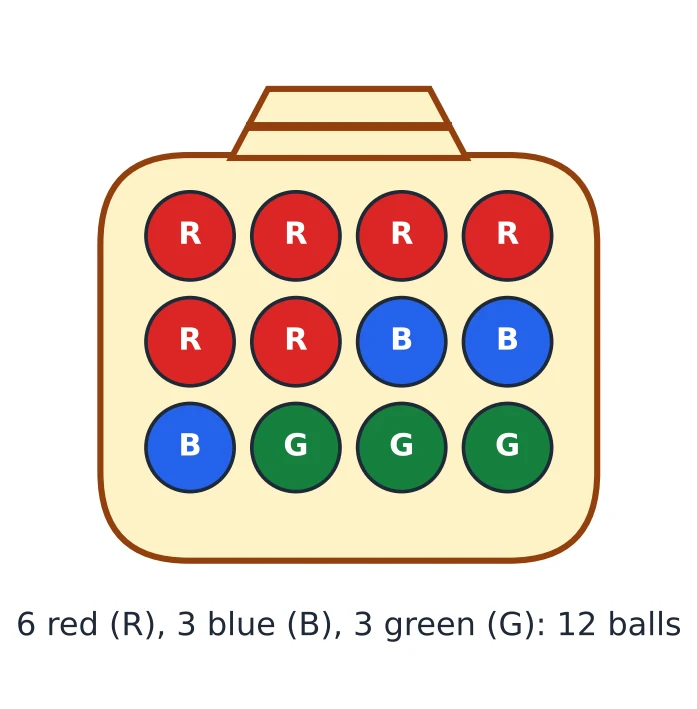
This bag has 6 red, 3 blue and 3 green balls, 12 in all. One ball is drawn at random.
- , and . The three add up to 1, as they must, since the ball has one of these colours.
- .
- . A ball cannot have two colours, so here the counts simply add.
- , because there is no yellow ball.
When the bag changes. If 3 more green balls are put in, the bag has 15 balls and 6 of them are green, so . Both the count and the total change; changing only one of them is a mistake.
Colours given as a ratio. If red, blue and green balls are in the ratio 2 : 3 : 5, you do not need the actual numbers: .
Defective items. A box of 25 bulbs has 4 that do not work. The chance that a bulb picked at random works is . 'Good' and 'defective' play the part of two colours.
Two or Three Balls Drawn Together
Take the same bag of 6 red, 3 blue and 3 green balls, and draw two balls together. There are possible pairs.
- Both red. pairs, so .
- One red and one blue. pairs, so .
- Both of the same colour. Two red, two blue or two green: pairs, so .
- Two different colours. Everything else: pairs, so . Counted directly it is , the same.
- At least one green. No green means both balls are taken from the 9 red and blue ones: pairs. So .
Now draw three balls together. There are selections.
- All three red. , so .
- One of each colour. , so .
- Two red and one blue. , so .
The method does not change: count all the selections, count the favourable ones by multiplying the choices from each colour, then divide and cancel.
The mistake to watch for is counting colour patterns instead of balls. 'Red and red' is one pattern, but it stands for 15 different pairs of balls. Each pair of balls is equally likely; the colour patterns are not.
One After Another: With and Without Replacement
Sometimes the balls or cards are drawn one at a time, and the question says what happens to the first one.
Without replacement. The first ball stays out, so the second draw is from a smaller bag. Take a bag of 6 white and 3 black balls and draw two, one after the other.
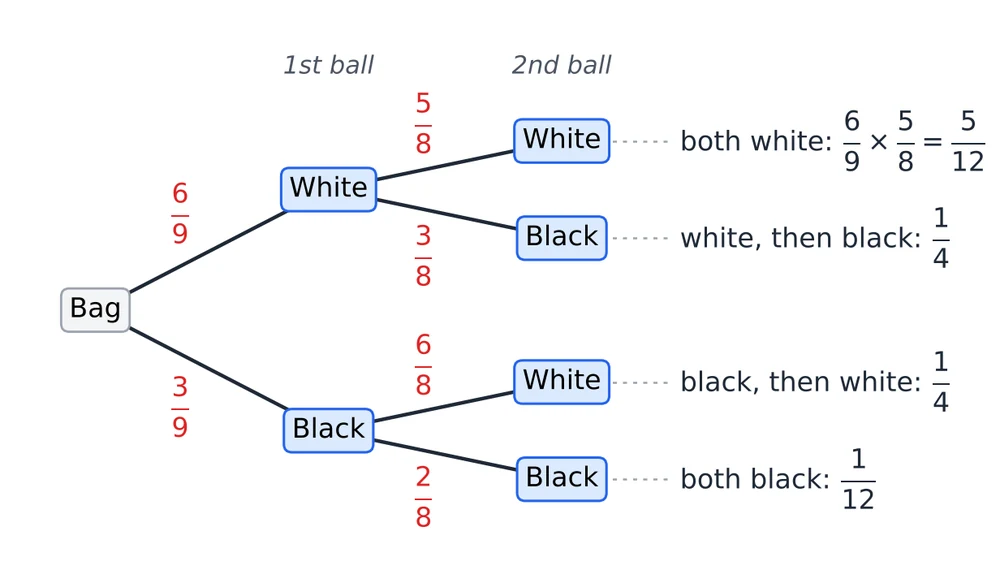
Multiply along each path of the tree. White and then white has probability , because once a white ball is out, 5 white balls are left among 8. White then black is , and black then white is too. The four paths add up to 1.
Read the order in the question:
- 'The first is white and the second is black' is one path: .
- 'One is white and the other is black' allows either order: .
Drawing two together gives the same answers as drawing them one after the other without replacement: for both white, and for one of each colour.
With replacement. The first ball is put back before the second draw, so the bag is the same both times and the first draw has no effect on the second. Both white: .
Three draws. The same rules carry on. From this bag, three draws with replacement give all white with probability ; without replacement it is .
Cards work the same way. Two aces one after the other: without replacement ; with the first card put back, .
[SSC Tip] Unless the question says the first ball or card is put back ('replaced', 'with replacement'), take the draws as without replacement. 'Together', 'at once' and 'one after the other' all mean the second draw is from the smaller bag.
Finding a Missing Number of Balls
Here the probability is given and a count is missing. Write the probability as count over total and solve.
The total from one colour. A bag has 8 green balls and some yellow ones, and . Then 8 is of the total, so the total is , and 12 balls are yellow.
An unknown inside the total. A bag has 10 red balls and blue balls, and .
Check: 5 blue balls out of 15 is . The appears in the total as well, which is why it sits in the denominator.
Several colours with given probabilities. A bag has red, white and black balls, with and , and there are 12 black balls. The black balls take the rest of the probability: . So 12 is of the total, the total is , and there are 8 red and 20 white balls.
The probability changes when balls are added. A bag has 20 balls, of them red. When 10 more red balls are put in, the probability of red doubles.
Before: . After: . It has doubled. A wrong equation here usually adds the new balls to the red count but not to the total.
[SSC Tip] When the options are four small numbers, putting each one back into the bag can be quicker than solving. For the last bag, try 5: becomes , which is double.
Tickets Numbered 1 to n
A box holds tickets numbered from 1 to , one number on each, well mixed. Drawing one ticket is the same as picking a whole number from 1 to at random, as in Basics of Probability; for counting multiples and primes, see Chapter 1.
One ticket from 1 to 50: the multiples of 6 are 6, 12, 18 and so on up to 48, which is tickets. So .
Two tickets drawn together. Take tickets 1 to 20. There are pairs, and of the 20 numbers, 10 are even and 10 are odd.
- Both even: pairs, so .
- The sum is even: both even or both odd, pairs, so .
- The sum is odd: one even and one odd, pairs, so . With the line before, it makes 1.
- The product is even: the product is odd only when both numbers are odd, so .
- Both are prime: the primes up to 20 are 2, 3, 5, 7, 11, 13, 17 and 19, which is 8 numbers (1 is not a prime). So .
With replacement. If a ticket is drawn, put back, and then a second ticket is drawn, the two draws do not affect each other. From tickets 1 to 20, both even then has probability , against when the two are drawn together.
The odd and even rules settle most of these questions: odd + odd and even + even are even, odd + even is odd, and a product is odd only when every number in it is odd.
Solved Examples
Question 1
A card is drawn at random from a well-shuffled pack of 52 cards. What is the probability that it is a face card of diamonds? (a) (b) (c) (d)
Answer. Diamonds have three face cards: the jack, the queen and the king of diamonds. So 3 cards out of 52 fit, and the probability is (c) . I have to be careful not to answer , which is the chance of a face card of any suit.
Question 2
A card is drawn at random from a well-shuffled pack of 52 cards. What is the probability that it is a club or a face card? (a) (b) (c) (d)
Answer. I count the clubs first: 13. Then the face cards that are not clubs, the jacks, queens and kings of the other three suits: 9 more. That makes 22 cards, and . So the answer is (a) . Adding 13 and 12 would count the jack, queen and king of clubs twice.
Question 3
A card is drawn at random from a well-shuffled pack of 52 cards. What is the probability that it is neither a spade nor an ace? (a) (b) (c) (d)
Answer. The cards I have to leave out are the 13 spades and the aces that are not spades, which are 3. That is 16 cards out, so 36 cards are left. The probability is , which is (d) .
Question 4
The four aces are taken out of a pack of 52 cards. A card is then drawn at random from the remaining cards. What is the probability that it is a face card? (a) (b) (c) (d)
Answer. After the aces go, 48 cards are left, and all 12 face cards are still among them. So the probability is , that is (b) . If I kept 52 at the bottom I would get , but the pack is smaller now.
Question 5
Two cards are drawn together at random from a well-shuffled pack of 52 cards. What is the probability that both are spades? (a) (b) (c) (d)
Answer. All pairs: . Pairs of spades: . So . The short way gives the same: . The answer is (c) .
Question 6
Two cards are drawn together at random from a well-shuffled pack of 52 cards. What is the probability that one of them is a heart and the other is a diamond? (a) (b) (c) (d)
Answer. A heart can be picked in 13 ways and a diamond in 13 ways, so there are such pairs. Out of 1326 pairs, that is . The pair is drawn together, so I do not multiply by 2 for the order. I mark (a) .
Question 7
Two cards are drawn together at random from a well-shuffled pack of 52 cards. What is the probability that at least one of them is an ace? (a) (b) (c) (d)
Answer. 'At least one ace' is easier from the other side. No ace means both cards are among the 48 that are not aces: pairs. So and . The answer is (d) . 'Exactly one ace' would leave out the pairs with two aces.
Question 8
Two cards are drawn one after the other, without replacement, from a pack of 52 cards. What is the probability that the first is a king and the second is an ace? (a) (b) (c) (d)
Answer. First a king: 4 out of 52. The king stays out, so 51 cards are left, and all 4 aces are still there: 4 out of 51. So . The question fixes the order (king first), so I do not double it, and the answer is (a) .
Question 9
A card is drawn from a pack of 52 cards and put back, and the pack is shuffled. A second card is then drawn. What is the probability that both cards are face cards? (a) (b) (c) (d)
Answer. The first card is put back, so both draws are from the full pack of 52 and each has a chance of a face card. Both: , which is (b) . Without putting the card back it would have been .
Question 10
A bag contains 4 red, 6 white and 5 black balls.
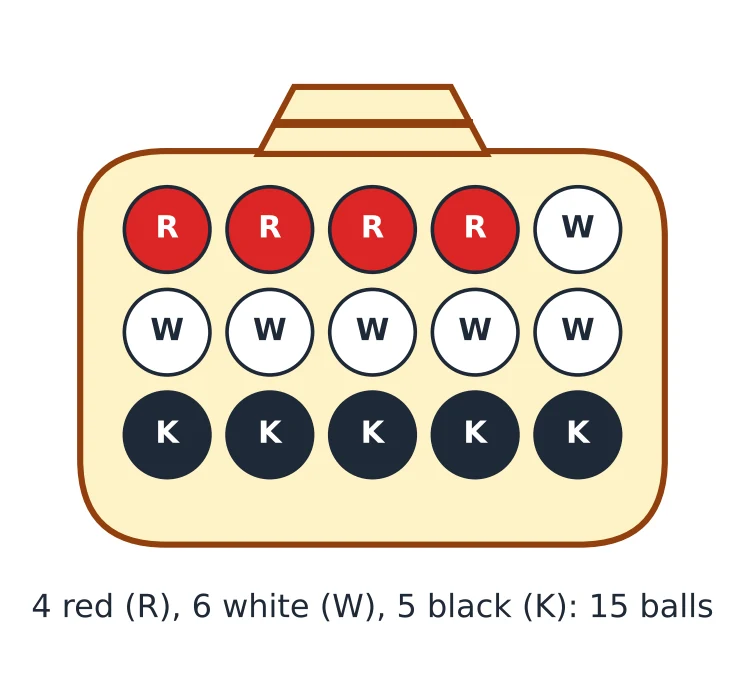
One ball is drawn at random from the bag. What is the probability that it is not white? (a) (b) (c) (d)
Answer. Not white means red or black: balls out of 15. So . The other way round: white is , and . The answer is (c) .
Question 11
From the same bag, two balls are drawn together. What is the probability that both are black? (a) (b) (c) (d)
Answer. Pairs in all: . Pairs of black balls: . So , which is (d) .
Question 12
From the same bag, two balls are drawn together. What is the probability that one is red and the other is white? (a) (b) (c) (d)
Answer. One red ball out of 4 and one white out of 6 can be chosen in ways. Out of 105 pairs that gives . So the answer is (a) .
Question 13
A bag contains 4 red, 6 white and 5 black balls. Two balls are drawn together. What is the probability that both are of the same colour? (a) (b) (c) (d)
Answer. Same colour means two red, two white or two black. Two red: . Two white: . Two black: . Together pairs out of 105, so . I keep the three colours apart and add at the end. The answer is (b) .
Question 14
A bag contains 3 red, 4 green and 2 blue balls. Three balls are drawn together at random. What is the probability that the three balls are of three different colours? (a) (b) (c) (d)
Answer. All selections of 3 from 9: . One of each colour: ways. So . That is (b) . Dividing 24 by would be wrong, because 504 counts the draws in order and 24 does not; it leads to .
Question 15
A bag contains 3 red, 4 green and 2 blue balls. Three balls are drawn together at random. What is the probability that none of them is green? (a) (b) (c) (d)
Answer. With no green, all three are picked from the 5 red and blue balls: ways. Out of selections, I get , so (a) .
Question 16
A bag contains 7 white and 3 black balls. Two balls are drawn one after the other without replacement. What is the probability that the first is black and the second is white? (a) (b) (c) (d)
Answer. First black: 3 out of 10. That ball stays out, so the bag now has 9 balls and all 7 white ones are still in it: 7 out of 9. So , which is (d) .
Question 17
A bag contains 7 white and 3 black balls. A ball is drawn, its colour is noted and it is put back. Then a second ball is drawn. What is the probability that one ball is white and the other is black? (a) (b) (c) (d)
Answer. The ball goes back, so both draws are from the same 10 balls. White then black: . Black then white: . The question allows either order, so I add the two: . The answer is (c) . Stopping at one order gives only half of it.
Question 18
A bag contains 3 red and 2 green balls. A ball is drawn, its colour is noted and it is put back. This is done three times. What is the probability that all three balls drawn are red? (a) (b) (c) (d)
Answer. The ball goes back every time, so each draw is from the same 5 balls and gives red with probability . The three draws do not affect each other, so I multiply: . That is (b) . Without putting the balls back it would be .
Question 19
A bag contains 12 white balls and some red balls. The probability of drawing a red ball is . How many red balls are in the bag? (a) 9 (b) 16 (c) 21 (d) 7
Answer. Let the red balls be . Then , so , and . Check: 9 red out of 21 is . So the bag has (a) 9 red balls. Another way: white is of the bag, so the bag holds balls, and 9 of them are red.
Question 20
A bag contains red, blue and green balls only. The probability of drawing a red ball is and that of drawing a blue ball is . If there are 10 green balls, how many blue balls are there? (a) 8 (b) 24 (c) 6 (d) 4
Answer. Green has the rest of the probability: . So 10 balls are of the bag, and the bag holds balls. Blue is a quarter of 24, which is (c) 6. The 8 is the number of red balls.
Question 21
A box has 25 tickets numbered 1 to 25. Two tickets are drawn together at random. What is the probability that both numbers are odd? (a) (b) (c) (d)
Answer. From 1 to 25 there are 13 odd numbers (1, 3, 5 and so on up to 25) and 12 even ones. Pairs in all: . Pairs of odd numbers: . So both are odd with probability : (b) .
Question 22
From the same box of tickets numbered 1 to 25, two tickets are drawn together. What is the probability that the product of the two numbers is even? (a) (b) (c) (d)
Answer. A product is odd only when both numbers are odd, and that chance was in the last question. So the product is even with probability , which is (d) . 'Both even' is not enough here: one even number is all a product needs.