
One Coin and Two Coins
A coin has two faces, head (H) and tail (T). For a fair coin they are equally likely, so
Two coins. Toss a ₹1 coin and a ₹2 coin together. Each can fall in two ways, so there are outcomes:
HT means a head on the ₹1 coin and a tail on the ₹2 coin, and TH is the other way round. They are two different outcomes. This stays true when the two coins look exactly alike: call one the first coin and the other the second, and the four outcomes do not change. Tossing one coin twice gives the same four outcomes, with the first letter for the first toss.
| Event | Favourable outcomes | Probability |
|---|---|---|
| Two heads | HH | |
| Exactly one head | HT, TH | |
| No head | TT | |
| At least one head | HH, HT, TH |
Why not three outcomes? Someone who writes the outcomes as “two heads, one head, no head” has only 3 of them, and gets for exactly one head. Those three results are not equally likely: one head can happen in two ways (HT and TH), while the other two happen in one way each. List the coins separately and the four outcomes come out right.
Three Coins: Eight Outcomes
Each coin doubles the number of outcomes, so three coins give . The tree lists them. The first coin splits into H and T, each branch splits again for the second coin, and again for the third.
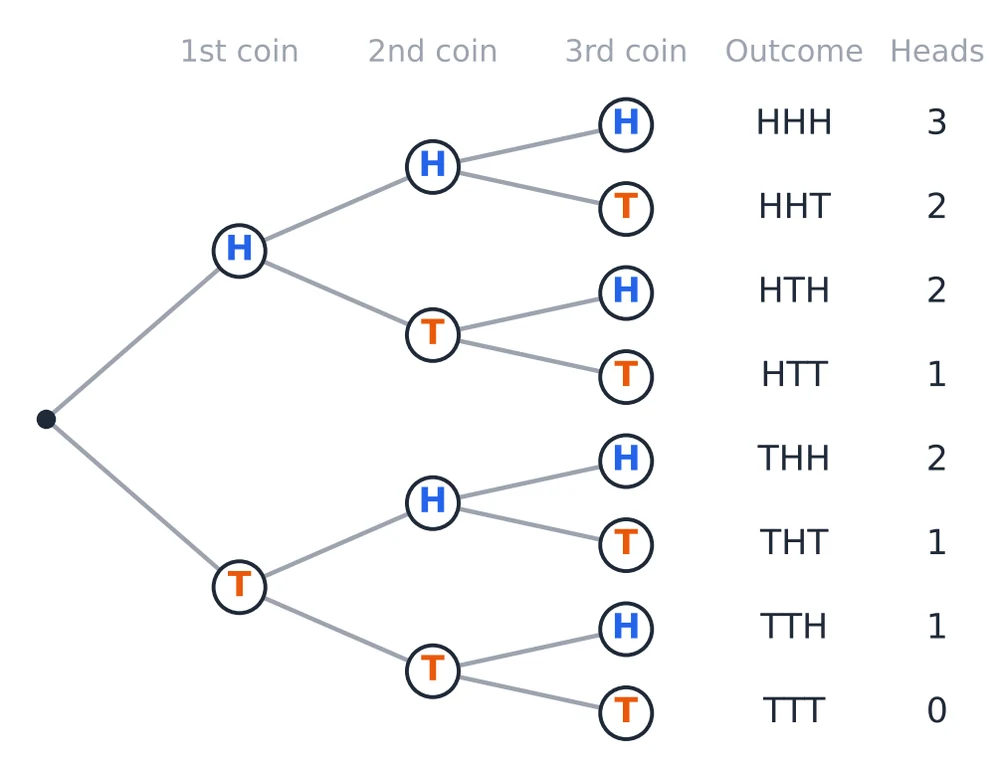
Grouped by the number of heads:
| Heads | 3 | 2 | 1 | 0 |
|---|---|---|---|---|
| Outcomes | HHH | HHT, HTH, THH | HTT, THT, TTH | TTT |
| Count | 1 | 3 | 3 | 1 |
The counts 1, 3, 3, 1 add up to 8. So with three coins:
Tails work the same way: exactly 2 tails is the same event as exactly 1 head, so it is also . Tossing one coin three times gives the same eight outcomes as tossing three coins once.
For coins the total is , so four coins give 16 outcomes. The method does not change; only the list gets longer.
Exactly, At Least and At Most
These words decide which columns of the heads table you add. With three coins:
- Exactly 2 heads: only the outcomes with 2 heads, .
- At least 2 heads: 2 or more, so 2 heads or 3 heads: .
- At most 1 head: 1 or fewer, so 1 head or none: .
- More than 2 heads: 3 heads only, .
“At least one” by the complement. At least one head fails in just one outcome, TTT. So
In the same way, “at most 2 heads” fails only in HHH, so it is also .
A head and a tail both appear. This fails only when all three coins show the same face, HHH or TTT:
More heads than tails. With three coins there is no tie, so this means 2 or 3 heads: .
Do not work “at least one” as “exactly one”. With three coins, exactly one head is and at least one head is , and you can expect both in the options. Read “at least” as “this many or more” and “at most” as “this many or fewer”, and the right columns follow.
One Die
A die (plural: dice) is a cube with the numbers 1 to 6 on its faces. An unbiased die shows each face with the same chance, so
| Event | Favourable outcomes | Probability |
|---|---|---|
| An even number | 2, 4, 6 | |
| A prime number | 2, 3, 5 | |
| A number more than 4 | 5, 6 | |
| A number at least 4 | 4, 5, 6 | |
| A multiple of 3 | 3, 6 | |
| A factor of 6 | 1, 2, 3, 6 | |
| Not a 6 | 1, 2, 3, 4, 5 |
Two points cause most of the mistakes with one die. First, 1 is not a prime, so “a prime number” on a die has 3 favourable outcomes, not 4. Second, “more than 4” leaves out 4 itself, while “at least 4” keeps it; the two answers above differ for exactly that reason.
Sure and impossible. “A number less than 7” happens on every throw, so it is a sure event with probability 1. “A 7” can never happen, so its probability is 0.
Reading the event. “An odd prime” is 3 or 5, so its probability is . “A factor of 6” includes 1 and 6 themselves. Write out the favourable faces each time; with only six of them, listing takes a few seconds and leaves no room for doubt.
Two Dice: The 36 Outcomes
When two dice are thrown, each of the 6 faces of the first die can go with each of the 6 faces of the second, so there are outcomes. Write each as a pair (first die, second die). Think of one die as red and the other as blue: (2, 5) means 2 on the red die and 5 on the blue one, and (5, 2) is a different outcome. Throwing one die twice gives the same 36 pairs.
Most two-dice questions are about the sum of the two numbers. This grid gives every sum, with the first die down the left and the second across the top:
| 1st die / 2nd die | 1 | 2 | 3 | 4 | 5 | 6 |
|---|---|---|---|---|---|---|
| 1 | 2 | 3 | 4 | 5 | 6 | 7 |
| 2 | 3 | 4 | 5 | 6 | 7 | 8 |
| 3 | 4 | 5 | 6 | 7 | 8 | 9 |
| 4 | 5 | 6 | 7 | 8 | 9 | 10 |
| 5 | 6 | 7 | 8 | 9 | 10 | 11 |
| 6 | 7 | 8 | 9 | 10 | 11 | 12 |
The cells along each diagonal from bottom-left to top-right have the same sum. The sum 7 fills the longest diagonal, six cells, while the sums 2 and 12 have one cell each.
11 sums, but 36 outcomes. The sums run from 2 to 12, which makes 11 possible sums, but they are not equally likely. Taking the probability of a sum of 9 as treats a sum with one cell (like 2) the same as a sum with six (like 7). The equally likely outcomes are the 36 cells, so every two-dice answer starts with 36 at the bottom.
Order counts. (3, 5) and (5, 3) are two cells, not one. That is why a sum of 8 has five ways and not three: (2, 6) and (3, 5) each come with their turned-round pair, and (4, 4) stands alone.
The Number of Ways to Get Each Sum
Count the cells on each diagonal of the grid:
| Sum | 2 | 3 | 4 | 5 | 6 | 7 | 8 | 9 | 10 | 11 | 12 |
|---|---|---|---|---|---|---|---|---|---|---|---|
| Ways | 1 | 2 | 3 | 4 | 5 | 6 | 5 | 4 | 3 | 2 | 1 |
The ways climb by one from the sum 2 up to 7 and fall by one from 7 to 12, and they add up to 36. For a sum the number of ways is ; for a sum of 9, that is .
A sum of 8. The pairs are (2, 6), (3, 5), (4, 4), (5, 3) and (6, 2). (4, 4) is a single cell, since both dice show the same number, and the other four come as two pairs turned round. So
A sum of 7 has the most ways, six, so its probability is .
Sums the same distance from 7 have the same probability. 6 and 8 both have 5 ways, so both have probability ; 3 and 11 both have 2 ways, so both have . Knowing one half of the table gives the other half.
Listing a sum without the table. For a sum of 8, run the first die from the smallest value that works and pair it with the number that completes the sum: 2 with 6, 3 with 5, 4 with 4, 5 with 3, 6 with 2. The first die cannot be 1, because the second would need to show 7.
Sums with a Condition
For a condition on the sum, list the sums that qualify, add their ways from the table, and put the total over 36.
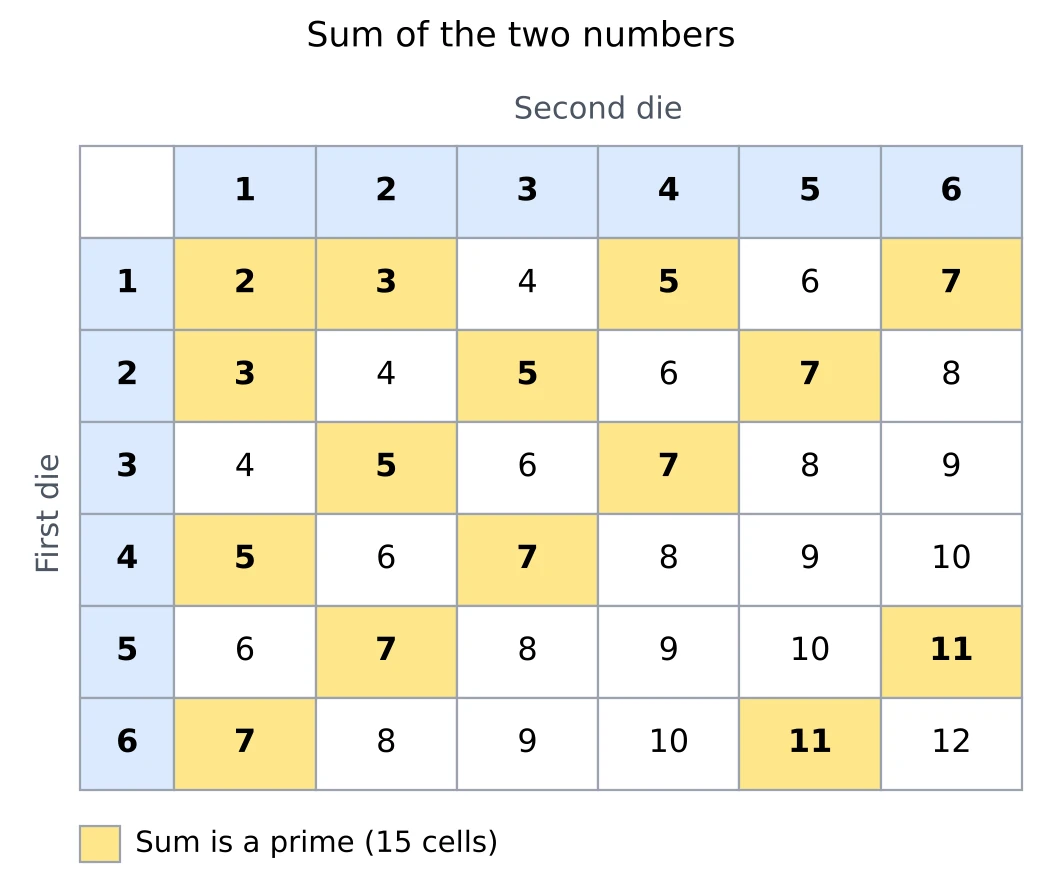
The sum is a prime. The prime sums are 2, 3, 5, 7 and 11, the shaded cells. Their ways add up to , so
A sum of 1 is not possible and 9 is not a prime, so these five sums are all there is.
The sum is a multiple of 3. The sums 3, 6, 9 and 12 have ways, so the probability is .
The sum is at least 10. The sums 10, 11 and 12 have ways, so the probability is . “More than 10” drops the sum 10 and leaves .
The sum is even. A sum is even when both numbers are even or both are odd, which is cells, so the probability is . The odd sums take the other half.
Small sums by the complement. For “the sum is more than 4”, count the sums 2, 3 and 4 instead: ways. So the probability is .
[SSC Tip] Write the row of ways, 1 2 3 4 5 6 5 4 3 2 1, at the top of the rough sheet before you start a two-dice question. Each sum question then becomes a small addition over 36.
Doublets, and Which Die Shows More
A doublet is a throw in which both dice show the same number: (1, 1), (2, 2) and so on to (6, 6). These are the 6 cells on the diagonal of the grid, shaded yellow below.
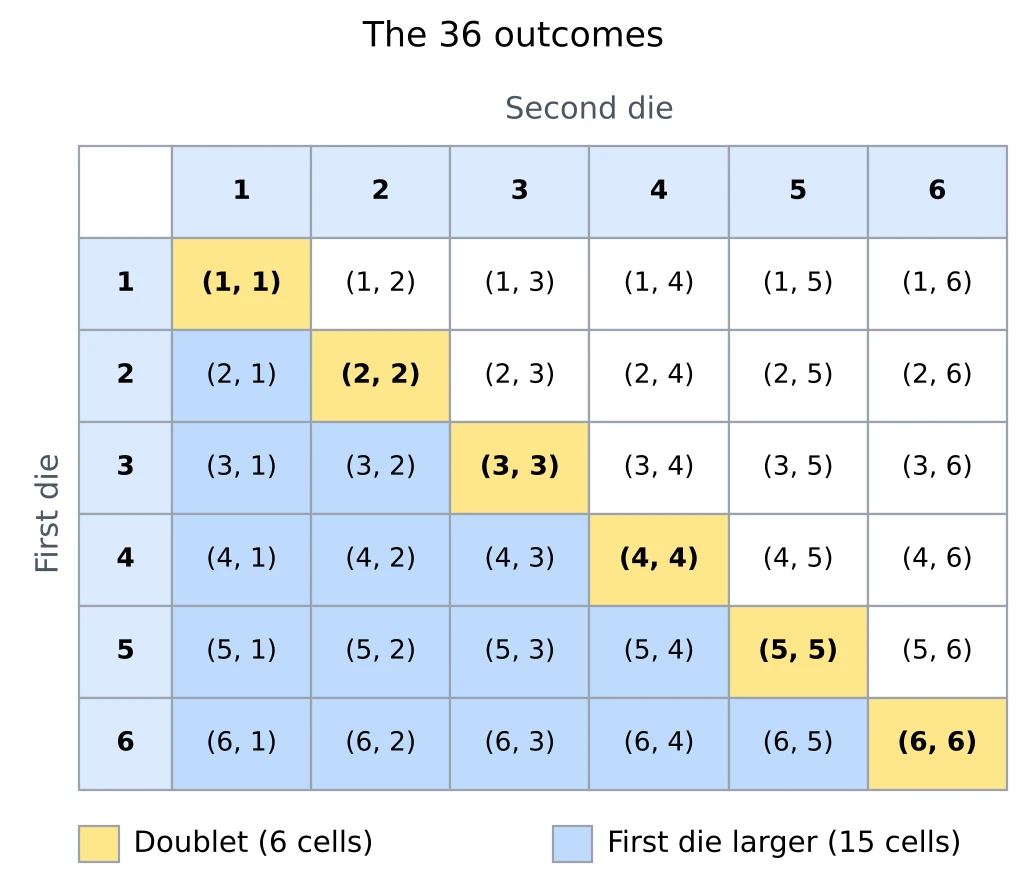
- . “The same number on both dice” is the same event.
- . This is also “different numbers on the two dice”.
- A doublet of prime numbers is (2, 2), (3, 3) or (5, 5), so its probability is .
- One particular doublet, such as a double six, is a single cell: .
The first die shows more than the second. Take away the 6 doublets and 30 cells are left. They split evenly: in 15 the first die shows more, and in the other 15 the second does. So
These 15 are the blue cells, all below the diagonal. “The first die shows more” is not the same as “the dice show different numbers”, which takes in all 30 cells off the diagonal and has probability .
A number on a particular die. “The first die shows 4” is a whole row of the grid, 6 cells, so its probability is , just as with one die. The second die can show anything.
Product and Difference of the Two Numbers
Product. Fill the grid with products instead of sums, or count the pairs directly.
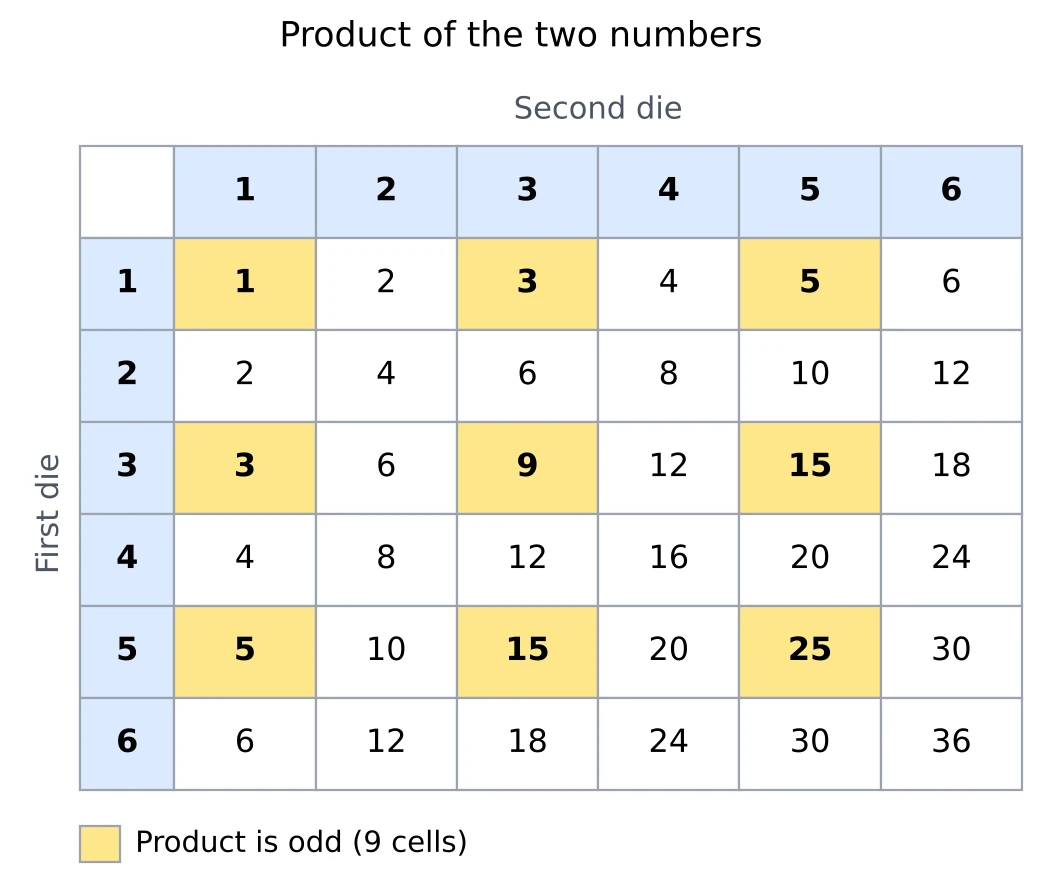
- The product is odd only when both numbers are odd, which is cells, the shaded ones. So .
- The product is even is the complement: . One even number on either die makes the product even, which is why 27 of the 36 cells are even.
- The product is 12: (2, 6), (6, 2), (3, 4) and (4, 3), four cells, so .
- The product is a multiple of 5: this needs a 5 on at least one die. The complement is quicker: with no 5, each die has 5 choices, so cells. That leaves cells, and .
Difference. “The difference of the numbers” means the larger minus the smaller, so it runs from 0 to 5:
| Difference | 0 | 1 | 2 | 3 | 4 | 5 |
|---|---|---|---|---|---|---|
| Ways | 6 | 10 | 8 | 6 | 4 | 2 |
These add up to 36. A difference of 4 comes only from (1, 5) and (2, 6) and these two turned round, 4 cells, so . A difference of 0 is a doublet.
“And” and “or” on the grid. “The sum is 6 and the throw is a doublet” needs both in the same cell, and only (3, 3) has both: . “The sum is 6 or the throw is a doublet” takes the 5 cells with sum 6 and the 6 doublets, but (3, 3) is in both groups, so it is counted once: cells and a probability of . Combined Events turns this into a formula; on the grid you can see the overlap directly.
A Coin and a Die Together
A coin and a die thrown together give outcomes, each a face of the coin with a number:
- A head and a multiple of 3: H3 and H6, so .
- A tail and a 1: only T1, so .
- A head or a number less than 3: the six head outcomes H1 to H6, plus T1 and T2. H1 and H2 are already among the heads, so they are not counted again. That makes 8 outcomes, and .
“And” needs both parts in the same outcome; “or” needs at least one of them. For “or”, count each outcome once. The outcomes that satisfy both parts (H1 and H2 here) are the ones that get counted twice by mistake.
For “and”, the coin and the die do not affect each other, so the probabilities can also be multiplied: , the same as the count. This product rule for independent events is taught in Combined Events.
Two coins and a die would give outcomes, and the listing works the same way.
Three Dice: The Simple Cases
Three dice give outcomes, written as triples such as (2, 5, 5). Listing all of them is out of the question, but the simple questions need only a few.
- All three show the same number: (1, 1, 1), (2, 2, 2) and so on to (6, 6, 6), which is 6 outcomes. So .
- The sum is 18: only (6, 6, 6) gives 18, so . A sum of 3 needs (1, 1, 1) and has the same probability.
- Not all the same: the complement of the first case, .
The total is , because each die multiplies the number of outcomes by 6, just as each coin doubles it. Putting at the bottom adds the faces when they should be multiplied.
Solved Examples
Question 1
A coin is tossed twice. What is the probability of getting at least one tail? (a) (b) (c) (d)
Answer. The four outcomes are HH, HT, TH and TT. Only HH has no tail, so at least one tail happens in the other 3. The probability is (c) . I could also do it as , taking away the chance of HH.
Question 2
Two coins are tossed together. What is the probability that both show the same face? (a) (b) (c) (d)
Answer. The same face means HH or TT. That is 2 of the 4 outcomes (HH, HT, TH, TT), so the probability is (a) . If I had written the outcomes as “two heads, two tails, one of each”, I would have got , but “one of each” happens in two ways, HT and TH.
Question 3
Three coins are tossed. What is the probability of getting exactly one tail? (a) (b) (c) (d)
Answer. Exactly one tail means the tail can be on the first, the second or the third coin: THH, HTH and HHT. That is 3 of the 8 outcomes, so the probability is (b) .
Question 4
Three coins are tossed. What is the probability of getting at most two tails? (a) (b) (c) (d)
Answer. At most two tails means 0, 1 or 2 tails. The only outcome left out is TTT, with three tails. Taking its away from 1 leaves (d) . Working it as exactly two tails would give only .
Question 5
Three coins are tossed together. What is the probability that all three show the same face? (a) (b) (c) (d)
Answer. All the same face means HHH or TTT, which is 2 of the 8 outcomes. So the probability is , that is (a) . I remembered that TTT counts as well as HHH; with only HHH I would have written .
Question 6
A die is thrown once. What is the probability of getting an odd prime number? (a) (b) (c) (d)
Answer. The primes on a die are 2, 3 and 5, and the odd ones among them are 3 and 5. So 2 of the 6 faces are favourable, and the probability is , or (c) in lowest terms. 1 is odd but not a prime, so it stays out.
Question 7
A die is thrown once. What is the probability that the number on it is a factor of 12? (a) (b) (c) 1 (d)
Answer. The factors of 12 are 1, 2, 3, 4, 6 and 12. A die cannot show 12, so the favourable faces are 1, 2, 3, 4 and 6, which is 5 of the 6. The probability is (b) . Only 5 fails.
Question 8
Two dice are thrown together. What is the probability that the sum of the numbers is 9? (a) (b) (c) (d)
Answer. The pairs that add up to 9 are (3, 6), (4, 5), (5, 4) and (6, 3). The first die cannot be 1 or 2, because the second would need 8 or 7. That is 4 of the 36 outcomes, so the probability is , which is (d) . If I had counted (4, 5) and (5, 4) as one, I would have got only 2 pairs and .
Question 9
Two dice are thrown. What is the probability that the sum of the numbers is less than 6? (a) (b) (c) (d)
Answer. Less than 6 means a sum of 2, 3, 4 or 5. From the ways table these have 1, 2, 3 and 4 ways, so cells, and cancels to (b) .
Question 10
Two dice are thrown. What is the probability that the sum of the numbers is a multiple of 5? (a) (b) (c) (d)
Answer. The sum is between 2 and 12, so the multiples of 5 it can be are 5 and 10. They have 4 and 3 ways, so there are 7 cells, and the probability is (a) . Taking 2 of the 11 sums would give , but the sums are not equally likely.
Question 11
Two dice are thrown. What is the probability that the sum of the numbers is a factor of 12? (a) (b) (c) (d)
Answer. The factors of 12 are 1, 2, 3, 4, 6 and 12, and a sum of two dice can be any of them except 1. The sums 2, 3, 4, 6 and 12 have ways. The probability is , so the answer is (d) .
Question 12
Two dice are thrown. What is the probability of getting a doublet of odd numbers? (a) (b) (c) (d)
Answer. A doublet of odd numbers is (1, 1), (3, 3) or (5, 5). These are 3 of the 36 cells, and cancels to (c) . All six doublets together would give , but the even ones do not count here.
Question 13
Two dice are thrown. What is the probability that the product of the numbers is 4? (a) (b) (c) (d)
Answer. The pairs with product 4 are (1, 4), (4, 1) and (2, 2). (2, 2) is only one cell, because turning it round gives the same pair. So there are 3 cells, and the answer is (a) .
Question 14
Two dice are thrown. What is the probability that the product of the numbers is a multiple of 3? (a) (b) (c) (d)
Answer. It is easier to count the opposite. The product is not a multiple of 3 only when neither die shows 3 or 6, so each die shows 1, 2, 4 or 5. That gives cells. The rest, , are favourable, and the probability is , which is (d) .
Question 15
Two dice are thrown. What is the probability that the difference between the two numbers is 3? (a) (b) (c) (d)
Answer. The pairs with a difference of 3 are (1, 4), (2, 5), (3, 6), and the same three turned round: (4, 1), (5, 2), (6, 3). That is 6 cells out of 36, so the probability is (c) . Without the turned-round pairs I would have had only half of them.
Question 16
Two dice, one red and one blue, are thrown. What is the probability that the number on the red die is twice the number on the blue die? (a) (b) (c) (d)
Answer. The red die has to show the bigger number, twice the blue one. So the pairs (red, blue) are (2, 1), (4, 2) and (6, 3). The blue die cannot show 4 or more, since the red one would need 8 or more. That is 3 cells, a probability of (b) . Here I must not turn the pairs round, because the question says which die is the bigger one.
Question 17
Two dice are thrown. What is the probability that the sum of the numbers is less than 5 or the throw is a doublet? (a) (b) (c) (d)
Answer. A sum less than 5 means a sum of 2, 3 or 4, which has cells. There are 6 doublets. Two cells, (1, 1) and (2, 2), are in both groups, so I count them once: cells. The probability is , and halving both leaves (d) . Without taking away the 2 shared cells I would have got .
Question 18
A coin is tossed and a die is thrown together. What is the probability of getting a tail and an odd number? (a) (b) (c) (d)
Answer. There are outcomes. A tail with an odd number is T1, T3 or T5, which is 3 of them. Three out of twelve is (a) . As a check, as well.
Question 19
A coin is tossed and a die is thrown. What is the probability of getting a head or a number greater than 1? (a) (b) (c) (d)
Answer. Listing the outcomes that work would take a while, so I looked for the ones that fail. To fail, the coin must show a tail and the die must show 1, which is only T1. So 11 of the 12 outcomes work, and the probability is (c) . would be the answer for a head and a number greater than 1, which is a different question.
Question 20
Three dice are thrown together. What is the probability that all three show the same even number? (a) (b) (c) (d)
Answer. Three dice have outcomes. The same even number on all three means (2, 2, 2), (4, 4, 4) or (6, 6, 6), so 3 outcomes. Dividing the top and bottom of by 3 leaves (b) .