
Write the Total First
Probability questions in the paper are short, and nearly all the time in them goes into counting. Each method below cuts that counting down. Start every question by writing the total number of outcomes: it is the bottom of your fraction, and it also tells you which options are possible at all.
| What is done | Total outcomes |
|---|---|
| 1, 2, 3 or 4 coins tossed | 2, 4, 8, 16 |
| n coins, or one coin tossed n times | |
| 1, 2 or 3 dice thrown | 6, 36, 216 |
| A coin and a die | 12 |
| One card from a pack | 52 |
| Two cards drawn together | |
| A number picked from 1 to n | n |
For example: two coins and a die are thrown together. The total is , and 'two heads and a six' is only one of these outcomes, so its probability is .
'At Least One': Find 'None' and Subtract
When to use it: the question says 'at least one' or 'at least once'. Listing the cases with one, two or three successes is slow, while the case with none is usually a single line.
For example: four coins are tossed. 'No head' is only TTTT, so the probability of at least one head is . When a die is thrown three times, 'no six' takes of the 216 outcomes, so at least one six has probability .
Where it fails: 'exactly one' is a different question. With two dice, exactly one six has 10 outcomes and at least one six has 11; the pair (6, 6) makes the difference.
Sums of Two Dice: Read the Diagonals
In the grid of two dice, the cells with the same sum lie on one slanting line. The sum 7 has the longest line, six cells, and every step away from 7 loses one cell. So a sum s can be made in ways. In the grid below, the six blue cells make 7 and the four yellow ones make 9.
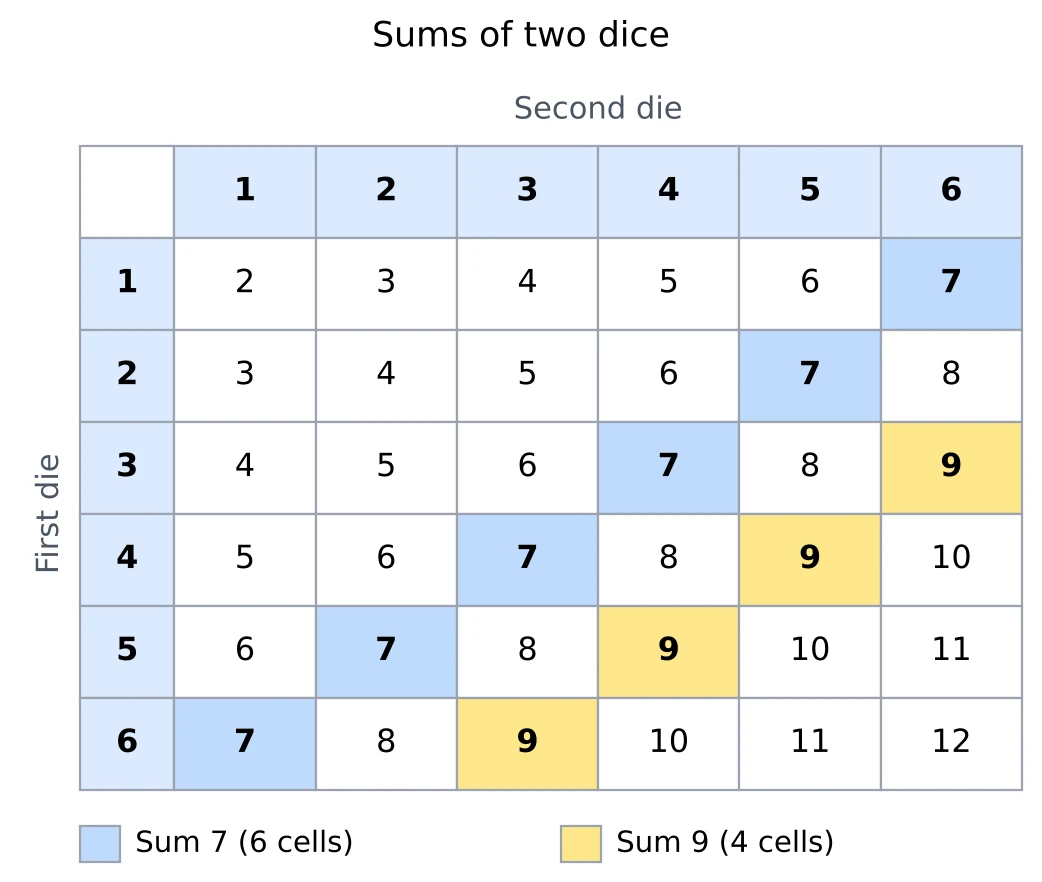
| Sum | 2 | 3 | 4 | 5 | 6 | 7 | 8 | 9 | 10 | 11 | 12 |
|---|---|---|---|---|---|---|---|---|---|---|---|
| Ways | 1 | 2 | 3 | 4 | 5 | 6 | 5 | 4 | 3 | 2 | 1 |
For example: a sum of 8 has ways, so its probability is . 'A sum of more than 9' takes the last three columns, ways, which is .
Where it fails: the 11 sums are not equally likely. A sum of 12 has probability , and is wrong for every sum.
[SSC Tip] 'Two dice', 'a pair of dice' and 'a die thrown twice' all have the same 36 outcomes.
Ready Counts for Two Dice
Learn these counts out of 36; with them, most two-dice questions need no listing at all.
| Event | Ways | Probability |
|---|---|---|
| A doublet (both dice the same) | 6 | |
| Sum even (or sum odd) | 18 | |
| Sum a prime: 2, 3, 5, 7 or 11 | 15 | |
| Sum a multiple of 3 | 12 | |
| Sum a multiple of 4 | 9 | |
| Product odd | 9 | |
| Product even | 27 | |
| At least one six | 11 | |
| First number bigger than the second | 15 |
The product is odd only when both numbers are odd, ways. A difference of k, for k from 1 to 5, has ways: 10, 8, 6, 4 and 2.
For example: the probability that the sum is neither 7 nor 11 is .
Exactly k Heads: Use
With n coins, or one coin tossed n times, the outcomes with exactly k heads number : the ways of choosing which k of the n tosses show heads. These three rows are worth learning.
| Coins | 0 heads | 1 | 2 | 3 | 4 | 5 | Total |
|---|---|---|---|---|---|---|---|
| 3 | 1 | 3 | 3 | 1 | 8 | ||
| 4 | 1 | 4 | 6 | 4 | 1 | 16 | |
| 5 | 1 | 5 | 10 | 10 | 5 | 1 | 32 |
For example: with five coins, exactly 3 heads is , and at most one head is .
Watch the order: 'one head and one tail' with two coins is HT or TH, two outcomes, so its probability is . Counting it once leads to , which is right only for 'a head first and then a tail'.
Two Separate Things: Multiply the Parts
When a question joins two things that do not affect each other, such as a coin and a die, two different dice or two bags, the chance of 'this on the first and that on the second' is the product of the two chances. There is no need to list the 12 or 36 outcomes.
For example: a coin is tossed and a die is thrown. A tail with a number greater than 4 has probability . When two dice are thrown, an even number on the first and a number greater than 2 on the second has probability .
Where it fails: 'or' questions. A head or a number less than 3 is not . Take the opposite instead: a tail with 3 or more is , so a head or a number less than 3 is .
Cards: Count by Group
| Group | Cards |
|---|---|
| One suit (spades, clubs, hearts or diamonds) | 13 |
| Red (hearts, diamonds) or black (spades, clubs) | 26 |
| One rank (four aces, four kings, four sevens) | 4 |
| Face cards (J, Q, K) | 12: 6 red, 6 black |
| Honours (A, K, Q, J) | 16 |
| Number cards (2 to 10) | 36 |
Find the group, put its count over 52 and cancel. Since , the bottom of a one-card answer is always 52, 26, 13, 4, 2 or 1.
For example: a black face card is one of 6 cards, so its probability is . A card that is not a heart is one of 39, so .
'Or' Questions: Add, Then Take Away the Overlap
For 'A or B', add the two counts and subtract the cases that are both, because they were counted twice.
- A spade or a king: cards, so .
- A black card or an even-numbered card (2, 4, 6, 8, 10): cards, so .
- A card numbered 2, 3 or 4, or a club: cards, so .
Numbers work the same way. The multiples of k from 1 to n are n divided by k, with the remainder dropped (Chapter 1).
For example: a number from 1 to 70 is a multiple of 2 or 7 in ways, since the 5 multiples of 14 are in both lists. So the probability is .
No overlap: when the two groups cannot meet, there is nothing to subtract. A heart or a black ace is .
Two Balls Drawn Together:
Two balls drawn together from n balls can be chosen in ways, and two red ones from r red balls in ways. The halves cancel, so
For 'one red and one blue', the pairs number , with no halving. Useful values: , , , and . For three balls, .
For example: a bag has 7 red, 5 white and 3 black balls, and two are drawn together. Both white: . One red and one black: .
One After Another: Multiply Shrinking Fractions
When cards or balls are drawn one after another without replacement, each draw has one item fewer, so the bottom goes down by one each time (and so does the top, when the same kind is drawn again). With replacement, the fraction stays the same. Drawing two together gives the same answer as drawing them one after another without replacement.
For example: a bag has 6 green and 9 yellow balls, and two are drawn one after the other without replacement. Both are green with probability , the same as for two drawn together. With the first ball put back, it is .
Watch the order: from a bag of 3 red and 7 blue balls, 'red first, then blue' is . 'One red and one blue' allows blue first as well, so it is twice as much, .
A Missing Count from a Given Probability
Turn the probability into parts. If the probability of red is , the red balls are a parts of a total of b parts, and the other balls are parts.
For example: a bag has 6 green balls and some yellow ones, and the probability of drawing a green ball is . Green is 2 parts out of 5, so one part is 3 balls. The bag holds balls, and 9 of them are yellow.
When the given probability is for two balls drawn together, write it as and look for the n that fits. Testing the options is quicker than solving for n.
Odds to Probability in One Step
Odds compare the two sides of an event, so add them to get the total.
- Odds in favour a : b give .
- Odds against a : b give .
- Going back, a probability of gives odds in favour of .
For example: the odds against a team winning are 7 : 4. It wins with probability and loses with probability . A probability of 0.35 is , so the odds in favour are 7 : 13.
Where it fails: odds of 7 : 4 are neither nor . The bottom of the probability is always the total of the two sides, here 11.
Calendar Questions: Count the Spare Days
A leap year has 366 days, which is 52 full weeks and 2 days over. The two spare days are one of seven pairs: (Sun, Mon), (Mon, Tue), and so on up to (Sat, Sun). A day of the week comes 53 times only when it is a spare day. An ordinary year has 365 days and only one spare day.
- 53 Sundays in a leap year: 2 of the 7 pairs, so .
- 53 Sundays in an ordinary year: .
For example: a leap year has 53 Sundays or 53 Wednesdays when the pair is (Sat, Sun), (Sun, Mon), (Tue, Wed) or (Wed, Thu), so the probability is . For two days next to each other, such as Sunday or Monday, the pair (Sun, Mon) is shared, which leaves 3 pairs and .
Two People Trying: Multiply the Failures
When two people try something independently, with chances p and q, start from their chances of failing, and .
- Neither succeeds: .
- At least one succeeds (the problem is solved, the target is hit): .
- Exactly one succeeds: .
- Both succeed: .
For example: A solves a problem with probability and B with probability . Neither solves it with probability , so the problem gets solved with probability . Exactly one of them solves it with probability .
With three people, 'nobody succeeds' is the product of three failures.
Cross Out Impossible Options First
- A probability lies from 0 to 1, so an option above 1 goes at once.
- In lowest terms, the bottom of the answer divides the total: 36 for two dice, 8 for three coins, 52 for one card, 216 for three dice.
- 'At least one' is never smaller than a single case, and 'both' is never bigger than either part.
For example: two dice are thrown, and the options for are , , and . Of 9, 24, 7 and 11, only 9 divides 36, so the answer is before any counting. The count agrees: ways, and .
Solved Examples
Each question below matches one method from the notes. Try it on paper before reading the answer, and see how many you finish inside a minute.
Question 1
A die is thrown twice. What is the probability that at least one of the two throws shows a number greater than 4?
Answer. It says 'at least one', so I find 'none' first. One throw shows 4 or less with probability , and both throws do with probability . So at least one throw is above 4 with probability .
Question 2
Two dice are thrown. What is the probability that the sum is 6 or 9?
Answer. From the diagonals, a sum of 6 has ways and a sum of 9 has ways. That is 9 ways out of 36, so the probability is .
Question 3
Two dice are thrown. What is the probability that the two numbers differ by 4 or more?
Answer. A difference of k has ways, so a difference of 4 has 4 ways and a difference of 5 has 2. That makes 6 ways out of 36, and the probability is . The pairs are (1, 5), (2, 6), (1, 6) and the same three the other way round.
Time check: about 15 seconds.
Question 4
Four coins are tossed together. What is the probability of getting exactly two heads?
Answer. The row for four coins is 1, 4, 6, 4, 1, so exactly two heads has 6 outcomes out of 16. The probability is .
Question 5
A coin is tossed and a die is thrown. What is the probability of getting a tail or a number that is a factor of 6?
Answer. It is an 'or', so I take the opposite: a head and a number that is not a factor of 6. The factors of 6 on a die are 1, 2, 3 and 6, so only 4 and 5 are left, and the opposite is . The answer is .
Question 6
A number is picked at random from 1 to 90. What is the probability that it is a multiple of 6 or of 9?
Answer. There are multiples of 6 and multiples of 9. The numbers in both lists are the multiples of 18, and there are 5 of them. So numbers work, and the probability is .
Question 7
A card is drawn from a well-shuffled pack of 52. What is the probability that it is a king or a black face card?
Answer. There are 4 kings and 6 black face cards, but the two black kings are in both groups. So cards work, and the probability is .
Question 8
Two cards are drawn together from a pack of 52. What is the probability that each of the two cards is an ace or a king?
Answer. Aces and kings together make 8 cards, so with the shortcut it is . I cancel before multiplying: 8 and 52 share 4, which leaves .
Question 9
Two cards are drawn one after the other from a pack of 52, and the first card is put back before the second is drawn. What is the probability that the first card is a king and the second a heart?
Answer. The card goes back, so the second draw is from the full pack again and the two parts just multiply: .
Question 10
A box has 10 bulbs, of which 3 are defective. Two bulbs are taken out together. What is the probability that at least one of them is defective?
Answer. 'None defective' means both bulbs are good ones, picked from the 7: . So at least one is defective with probability .
Question 11
A bag has 3 white, 4 black and 5 red balls. Three balls are drawn together. What is the probability that they are of three different colours?
Answer. First the total: . One ball of each colour can be picked in ways. So the probability is .
Question 12
A bag has 5 red balls and some blue balls. When two balls are drawn together, the probability that both are red is . How many blue balls are in the bag?
Answer. If the bag has n balls, both red is . Setting gives , so . The bag has 6 blue balls.
Time check: about 30 seconds.
Question 13
The odds in favour of an event are 3 : 8. What is the probability that the event does not happen?
Answer. The two sides add up to . The event happens in 3 parts and fails in 8, so the probability that it does not happen is .
Question 14
What is the probability that a leap year has 53 Tuesdays but not 53 Wednesdays?
Answer. For 53 Tuesdays the spare pair must hold a Tuesday: (Mon, Tue) or (Tue, Wed). The second pair also gives 53 Wednesdays, so only (Mon, Tue) is left. The probability is .
Question 15
A hits a target with probability and B with probability . Each fires one shot. What is the probability that the target is hit?
Answer. The target is missed only if both miss: . So it is hit with probability .