
How to Use These Questions
These 33 questions follow the chapter's order: numbers, letters, the calendar and odds first, then coins and dice, cards, and bags of balls, and at the end the questions that join two or more events. Many of them need two steps, such as an 'or' with an overlap, a complement after a product, or a bag chosen before a ball is drawn. Before you count, write the total and decide whether the draw is with or without replacement.
Give each question about a minute, as in the paper. If one runs well past that, note the step that held you up (the total, the overlap, or whether the first ball went back) and come back to that question after the practice sets.
Solved Examples
Question 1
A number is picked at random from 1 to 150. What is the probability that it is a multiple of 10 or of 15?
Answer. There are multiples of 10 and multiples of 15. The numbers in both lists are the multiples of 30, not 150, because 30 is the smallest number that both 10 and 15 divide. There are 5 of them. So numbers work, and the probability is .
Question 2
A two-digit number is chosen at random. What is the probability that it is divisible by 3 but not by 9?
Answer. Two-digit numbers run from 10 to 99, so there are 90 of them. The multiples of 3 among them go from 12 to 99, that is from to , which is 30 numbers. The multiples of 9 go from 18 to 99, which is 10 numbers, and every one of them is also a multiple of 3. So numbers work, and the probability is .
Question 3
A letter is chosen at random from the word ENGINEERING. What is the probability that it is a vowel?
Answer. ENGINEERING has 11 letters: E, N, G, I, N, E, E, R, I, N, G. The vowels are E, I, E, E and I, so 5 of the 11, and the probability is . I counted each repeated letter every time it appears, because each of the 11 letters is one equally likely choice. Counting only the different letters (E, N, G, I, R) would give , which is wrong.
Question 4
A leap year is chosen at random. What is the probability that it has 53 Fridays, 53 Saturdays or 53 Sundays?
Answer. A leap year is 52 weeks and 2 spare days in a row. The spare pair must hold at least one of Friday, Saturday and Sunday: (Thu, Fri), (Fri, Sat), (Sat, Sun) or (Sun, Mon). That is 4 of the 7 pairs, so the probability is . Three days might suggest or , but listing the pairs settles it.
Question 5
The probability of an event is 0.15. What are the odds in favour of it?
Answer. . Out of 20 parts, 3 are for the event and 17 against it. Odds in favour put the 'for' side first, so they are 3 : 17.
Question 6
A number is picked at random from 1 to 80. What is the probability that it is a perfect square or a perfect cube?
Answer. The perfect squares up to 80 are 1, 4, 9, 16, 25, 36, 49 and 64, which is 8 numbers. The cubes are 1, 8, 27 and 64, which is 4. Both 1 and 64 are in the two lists, so I count numbers. The probability is .
Question 7
Four coins are tossed. What is the probability of getting at least two tails?
Answer. Tails follow the same row as heads: 1, 4, 6, 4, 1 for 0 to 4 tails. Two, three or four tails give outcomes out of 16, so the probability is . The quicker way is to take away 0 and 1 tail: .
Question 8
Four coins are tossed. What is the probability that they show more heads than tails?
Answer. With four coins, 'more heads than tails' means 3 heads or 4 heads. Two heads and two tails is a tie, so it does not count. The row 1, 4, 6, 4, 1 gives outcomes out of 16, and the probability is .
Question 9
A coin is tossed three times. What is the probability that two heads never come one right after the other?
Answer. Only 8 outcomes, so I listed them and kept the ones with no HH side by side: TTT, TTH, THT, HTT and HTH. That is 5, so the probability is . The three I dropped are HHT, THH and HHH.
Question 10
Two dice are thrown. What is the probability that the sum is 9 or the two numbers are the same?
Answer. A sum of 9 has 4 ways and the doublets are 6. A doublet always has an even sum, so no pair is in both groups and there is nothing to subtract. The count is , and the probability is .
Question 11
Two dice are thrown. What is the probability that the product of the two numbers is a perfect cube?
Answer. The product is at most 36, so the only cubes it can be are 1, 8 and 27. 1 needs (1, 1), and 8 needs (2, 4) or (4, 2). 27 would need , and no die shows 9. That is 3 pairs, and the probability is .
Question 12
Two dice are thrown. What is the probability that the numbers on them differ by at least 3?
Answer. A difference of k has ways, so differences of 3, 4 and 5 give ways. The probability is .
Question 13
Two dice are thrown. What is the probability that the sum is divisible by 2 or by 3?
Answer. Even sums have 18 ways, and sums divisible by 3 (3, 6, 9 and 12) have 12 ways. The sums 6 and 12 are in both, with ways. So there are ways, and the probability is .
Question 14
Two coins are tossed and a die is thrown. What is the probability of getting at least one head on the coins and a number greater than 4 on the die?
Answer. The coins and the die don't affect each other, so I multiply. At least one head with two coins is , and a 5 or a 6 on the die is . So the probability is .
Question 15
A card is drawn from a pack of 52. What is the probability that it is a heart or a face card of a black suit?
Answer. There are 13 hearts and 6 black face cards. A heart is red, so no card is in both groups and there is nothing to subtract. That gives cards, and the probability is . It does not cancel, since 19 and 52 have no common factor.
Question 16
A card is drawn from a pack of 52. What is the probability that it is not a king, not a queen and not a heart?
Answer. Kings, queens or hearts: , because the king and queen of hearts are in both groups. The other cards are none of these, so the probability is .
Question 17
Two cards are drawn together from a pack of 52. What is the probability that both are diamonds or both are clubs?
Answer. Two diamonds can be chosen in ways, and two clubs in another 78, so 156 pairs. A pair cannot be both at once, so there is nothing to subtract. All pairs number , and the probability is .
Question 18
Two cards are drawn together from a pack of 52. What is the probability that one is a spade and the other a red ace?
Answer. There are 13 spades and 2 red aces, and no card is both. So the pairs number , and the probability is .
Question 19
Two cards are drawn one after the other from a pack of 52, with the first card put back before the second draw. What is the probability that the first is a red card and the second a king?
Answer. The first card goes back, so the two draws are separate and I multiply: . Even if the first card is a red king, the king is back in the pack for the second draw.
Question 20
Two cards are drawn together from a pack of 52. What is the probability that at least one of them is a face card?
Answer. I find 'no face card' first. Then both cards are among the 40 that are not face cards: . Since , this is . So at least one face card has probability .
Question 21
Tickets numbered 1 to 30 are put in a box and one is drawn at random. What is the probability that its number is a prime or a multiple of 5?
Answer. The primes up to 30 are 2, 3, 5, 7, 11, 13, 17, 19, 23 and 29, which is 10 numbers. The multiples of 5 are 5, 10, 15, 20, 25 and 30, which is 6. Only 5 is in both lists. So tickets work, and the probability is .
Question 22
A bag has 6 red, 4 blue and 2 white balls. Two balls are drawn together. What is the probability that both are of the same colour?
Answer. All pairs: . Same-colour pairs: two red in ways, two blue in and two white in just 1 way. That is 22 pairs, so the probability is .
Question 23
From the same bag, three balls are drawn together. What is the probability that there is one ball of each colour?
Answer. All sets of three: . One of each colour: . So the probability is , and dividing both by 4 gives .
Question 24
From the same bag, a ball is drawn and put back, and then a second ball is drawn. What is the probability that the first is red and the second white?
Answer. With the ball put back, the bag is the same for both draws: .
Question 25
A box has 12 pens, of which 4 are defective. Three pens are taken out together. What is the probability that none of them is defective?
Answer. All three must be good pens, chosen from the 8: ways out of . The probability is . The same count also tells me that at least one pen is defective with probability .
Question 26
A bag has 4 green balls and some yellow balls. Two balls are drawn together, and the probability that both are green is . How many yellow balls are in the bag?
Answer. With n balls in all, both green is . So , which gives . The bag has 12 balls, so it has 8 yellow balls.
Question 27
A and B are independent events with and . Find .
Answer. They are independent, so . Then . I checked it the other way: neither happens with probability , and is the same.
Question 28
A, B and C hit a target with probabilities , and . Each fires one shot. What is the probability that the target is hit?
Answer. The target is missed only if all three miss: . So it is hit with probability .
Question 29
With the same three shooters, what is the probability that at least two of them hit the target?
Answer. Exactly two hit in three ways, each with one miss:
- A and B hit, C misses:
- A and C hit, B misses:
- B and C hit, A misses:
All three hit with probability . Adding the four, .
Question 30
A speaks the truth in 75% of cases and B in 85% of cases. In what percentage of cases are they likely to contradict each other when stating the same fact?
Answer. They contradict each other when exactly one of them tells the truth. A true and B false: . A false and B true: . Together that is 0.325, so they contradict each other in 32.5% of cases.
Question 31
Bag I has 4 red balls and 1 black ball, and Bag II has 3 red and 5 black balls. A die is thrown. If it shows a prime number, a ball is drawn from Bag I; otherwise a ball is drawn from Bag II. What is the probability that the ball drawn is red?
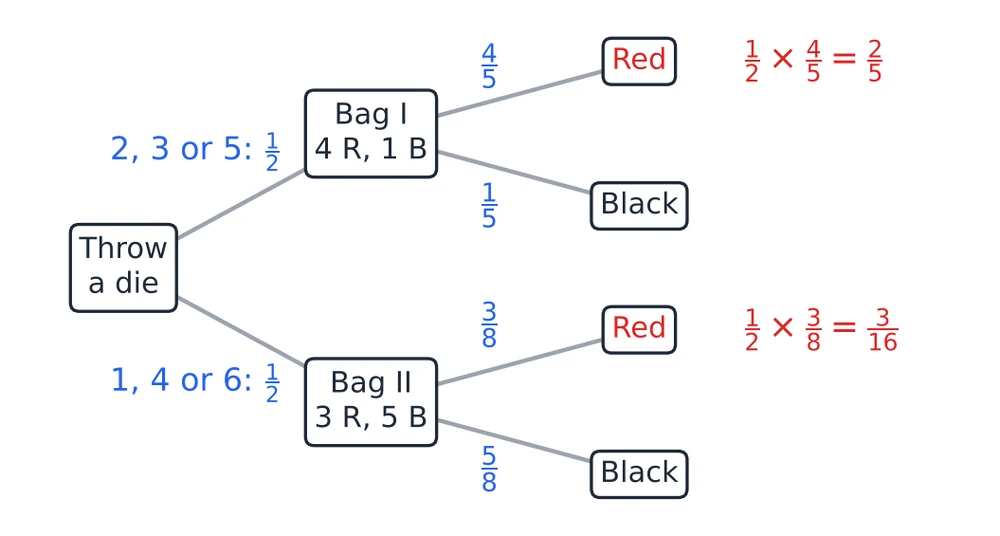
Answer. The primes on a die are 2, 3 and 5, so the die picks Bag I with probability and Bag II with probability . Along the two red paths of the tree, and . Adding the two paths, the probability is .
Question 32
A year that is not a century year is chosen at random. What is the probability that it has 53 Sundays?
Answer. One such year in four is a leap year. A leap year has 53 Sundays with probability , and an ordinary year with probability . So the chance is .
Question 33
The odds in favour of an event A are 2 : 3, and the odds against an event B are 5 : 2. The two events are independent. What is the probability that at least one of them happens?
Answer. From the odds, and . Neither happens with probability , so at least one happens with probability .