
Counting Triangles by Groups
A counting question shows a figure made only of straight lines and asks: "How many triangles are there in the given figure?" The four options are numbers close to each other, so a rough guess does not work. You need a way of counting that finds every triangle once and only once.
Pieces first, then bigger shapes
The lines cut the figure into small pieces, the regions with no line running through them. Count in groups:
- the single pieces that are triangles,
- the triangles made of two pieces,
- the triangles made of three pieces, then four, and so on,
- the whole figure, if it is a triangle.
Write the subtotal of each group as you go, like 3 + 2 + 1. When you join pieces, check that the shape you get really is a triangle: three straight sides, with no bend in any of them.
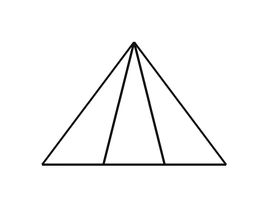
For example: in the picture, two lines run from the top corner down to the base. They cut the big triangle into 3 thin pieces, and each piece is a triangle, so that is 3. Two pieces side by side also make a triangle: the left one with the middle one, and the middle one with the right one, so 2. All three together make the big triangle: 1. That is 3 + 2 + 1 = 6 triangles.
Why groups work
Counting at random goes wrong in two ways. You count one triangle twice from two different starting points, or you stop after the small ones and never look at the big ones. Groups stop both mistakes. Each triangle belongs to exactly one group, and the last group makes you look at the biggest shapes.
Time check: a counting triangles question should take 45–60 seconds.
Solved Questions
Question 1
How many triangles are there in the given figure?
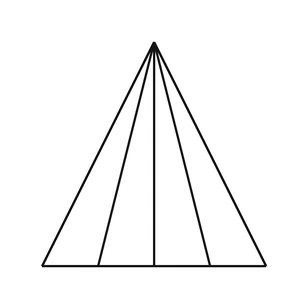
(a) 6 (b) 9 (c) 10 (d) 12
Answer. Every line inside starts at the top corner, so count by groups along the base. The three lines cut the big triangle into 4 thin pieces, and each piece is a triangle: 4. Two pieces side by side also make a triangle, and there are 3 such pairs. Three pieces side by side: 2. All four together make the big triangle: 1. Add the groups: 4 + 3 + 2 + 1 = 10. So the answer is (c) 10.
Question 2
How many triangles are there in the given figure?
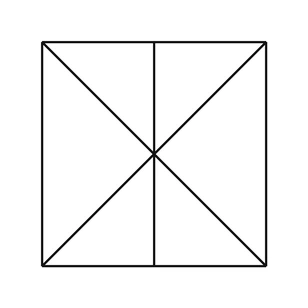
(a) 10 (b) 12 (c) 14 (d) 16
Answer. Start with the single pieces. The two diagonals cut the square into four triangles that meet at the centre, and the upright middle line splits the top one and the bottom one into two. So there are 6 single pieces, and all of them are triangles. Next, two pieces together: the top triangle (from the centre to the two top corners) is made of two pieces, and so is the bottom one, which gives 2. Then each diagonal cuts the square into two halves, and every half is a triangle made of three pieces: 4 halves. The whole figure is a square, not a triangle. 6 + 2 + 4 = 12. So the answer is (b) 12.
Question 3
How many triangles are there in the figure given below?
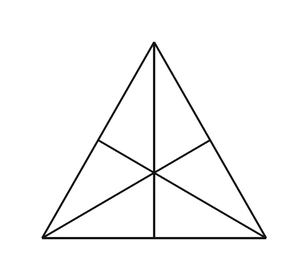
(a) 10 (b) 13 (c) 15 (d) 16
Answer. Each corner sends a line to the middle of the opposite side, and the three lines cross at one point inside. Around that point there are 6 small triangles: 6. Two neighbouring pieces make a triangle only when they sit along the same side of the big triangle, with their top at the crossing point. There is one such pair on each side, so 3. Each line from a corner cuts the big triangle into two halves, and each half is a triangle of three pieces: 3 lines × 2 halves = 6. The whole triangle: 1. 6 + 3 + 6 + 1 = 16. So the answer is (d) 16.
Name the Corners and Count Corner by Corner
When the lines inside start from different corners, the pieces become odd shapes and groups get hard to keep track of. Then name the points instead.
Label the points
Copy the figure roughly on your sheet and put a letter at every corner and at every point where two lines cross. Use A for the top corner and go on with B, C, D along the bottom. A triangle is now three letters, such as ABD, and checking it is easy: are AB, BD and DA all drawn lines?
Count corner by corner
List every triangle that has A as a corner. Then list the triangles that have B but not A. Then C, without A or B, and so on. You never go back to a letter you have finished, so no triangle is counted twice.
Lines from one corner
There is a quick way to find the triangles at one corner. Say several lines leave corner A and one more line crosses all of them. Any two of the lines from A, together with the crossing line, make a triangle. So you only need the number of pairs:
| Lines leaving the corner | Pairs, so triangles on each crossing line |
|---|---|
| 3 | 3 |
| 4 | 6 |
| 5 | 10 |
| 6 | 15 |
The rule behind the table: n lines make n × (n − 1) ÷ 2 pairs.
For example: four lines leave the top corner of a triangle (its two sides and two lines inside), and one level line crosses the triangle. The level line makes 6 triangles with them and the base makes 6 more, so 12 in all. Nothing is missed, because every triangle in such a figure has the top corner.
[SSC Tip] Before you start, look at where the inside lines begin. If they all leave one corner, count pairs. If they leave different corners, label the points and go corner by corner.
Solved Questions: Corner by Corner
Question 4
How many triangles are there in the given figure?
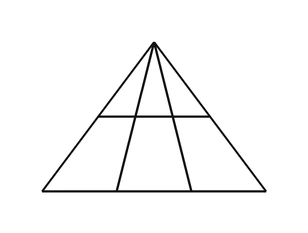
(a) 12 (b) 13 (c) 15 (d) 18
Answer. Look at where the lines start. Two lines start at the top corner and one line runs level across. So every triangle here has the top corner as one of its corners, and its bottom side lies on the level line or on the base. Four lines leave the top corner: the two sides and the two inside lines. Any two of them make a triangle with the level line, and 4 lines give 6 pairs, so there are 6 triangles above the level line. The same 6 pairs make 6 taller triangles with the base. The pieces below the level line have four sides, so they add nothing on their own. 6 + 6 = 12. So the answer is (a) 12.
Question 5
How many triangles are there in the figure given below?
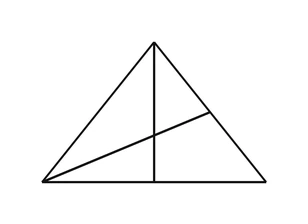
(a) 6 (b) 8 (c) 9 (d) 10
Answer. Label the points. A is the top corner, B the bottom-left corner and C the bottom-right corner. The line from A meets the base at its middle, D. The line from B meets the right side at its middle, E. These two lines cross at O. Now go corner by corner. Triangles with corner A: ABC, ABD, ADC, ABE, ABO and AOE, which makes 6. Triangles with corner B but not A: BOD and BEC, which makes 2. Every other set of three points (from C, D, E and O) has a side that is not drawn, such as OC. 6 + 2 = 8. So the answer is (b) 8.
Question 6
Count the number of triangles in the given figure.
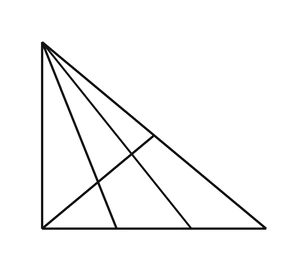
(a) 12 (b) 13 (c) 15 (d) 16
Answer. Label the points. A is the top corner, B the bottom-left corner and C the bottom-right corner. The two lines from A meet the base at P and Q (P nearer B). The line from B ends at E, the middle of AC, and it crosses AP at X and AQ at Y. Take corner A first. Four lines leave A: AB, AP, AQ and AC. Each pair of them makes a triangle with the base, which gives 6. Each pair also makes a triangle with the line BE: ABX, ABY, ABE, AXY, AXE and AYE, another 6. Now the triangles with corner B but not A: BPX, BQY and BCE, which is 3. No triangle is left without A or B. 6 + 6 + 3 = 15. So the answer is (c) 15.
Ready Counts for Common Figures
A few figures turn up again and again. Knowing their counts saves time, and you can always check them by groups.
| Figure | Triangles |
|---|---|
| a triangle with 1 line from the top corner to the base | 3 |
| a triangle with 2 lines from the top corner to the base | 6 |
| a triangle with 3 lines from the top corner to the base | 10 |
| a triangle with 4 lines from the top corner to the base | 15 |
| a square with both diagonals | 8 |
| a square with both diagonals and both middle lines | 16 |
| a triangle cut into 4 by joining the middles of its sides | 5 |
| a triangle cut into 9 small triangles in three rows | 13 |
Lines from the top corner
With k lines from the top corner, the base is cut into k + 1 pieces. The count is then 1 + 2 + … + (k + 1), which is the same as (k + 1) × (k + 2) ÷ 2. For 3 lines: 4 × 5 ÷ 2 = 10.
If the triangle also has level lines across it, each level line carries just as many triangles as the base does. So with m level lines, multiply by m + 1. Three lines from the top corner and one level line give 10 × 2 = 20.
Squares with diagonals
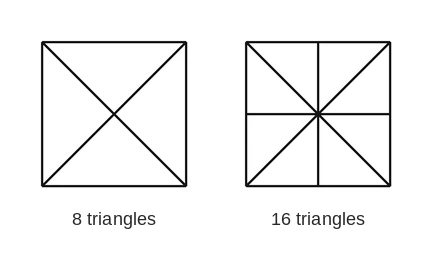
A square with both diagonals has 4 small triangles meeting at the centre and 4 halves of the square, two for each diagonal: 4 + 4 = 8.
Add both middle lines and there are 8 small pieces, 4 triangles made of two pieces (each has a side of the square as its base and the centre as its top), and 4 halves made of four pieces: 8 + 4 + 4 = 16.
Triangles cut into small triangles
When a triangle is cut into rows of small triangles, some of the small ones point down. With three rows there are 9 small triangles (6 pointing up and 3 pointing down), 3 made of four small ones, and the whole triangle: 9 + 3 + 1 = 13. Do not skip the ones that point down.
A ready count fits only that exact figure. If one line is added, missing or stops short, count by groups.
Solved Questions: Using Ready Counts
Question 7
How many triangles are there in the given figure?
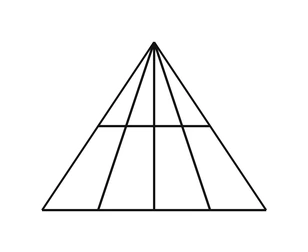
(a) 10 (b) 14 (c) 18 (d) 20
Answer. Three lines leave the top corner, and one level line runs across. Every triangle has the top corner. Each strip is cut into 4 pieces by the lines from the top, so along any one base line there are 4 × 5 ÷ 2 = 10 triangles. The level line carries 10 and the bottom side carries another 10. Ten is the count for the plain fan, so writing 10 means the level line was forgotten. 10 + 10 = 20. So the answer is (d) 20.
Question 8
How many triangles are there in the given figure?
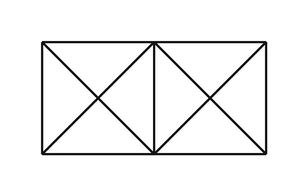
(a) 16 (b) 18 (c) 20 (d) 22
Answer. The figure is two squares side by side, each with both diagonals. Each one is the ready-count figure with 8 triangles, so the two squares give 8 + 8 = 16. Now look for triangles that cross the shared side. The diagonal of the left square that runs down to the bottom of the shared side and the diagonal of the right square that runs back up from there make, with the long top side, one big triangle pointing down. Its twin points up, with its top at the top of the shared side and its base along the long bottom side. That is 2 more. 8 + 8 + 2 = 18. So the answer is (b) 18.
Question 9
How many triangles are there in the figure given below?
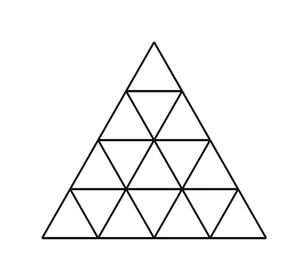
(a) 20 (b) 26 (c) 27 (d) 28
Answer. Count by size. The smallest triangles fill four rows: 1 + 3 + 5 + 7 = 16, which is 10 pointing up and 6 pointing down. Triangles two rows tall, made of 4 small ones: 3 + 2 + 1 = 6 point up, and 1 points down, its top side being the whole second level line and its point at the middle of the base. So that size gives 7. Triangles three rows tall: 2 + 1 = 3. The whole triangle: 1. The one that points down is the one most often missed. 16 + 7 + 3 + 1 = 27. Time check: counting size by size like this fits in 45–60 seconds. So the answer is (c) 27.
Two Common Mistakes: Big Shapes and Short Lines
Most wrong answers in counting come from two habits.
Forgetting the big shapes
After the small pieces it is easy to feel finished. But the triangles made of many pieces are the ones most often missed, and the biggest of all is often the outer figure itself. End every count with two questions: is the whole figure a triangle, and are the halves cut off by each long line triangles?
A line that stops short
A triangle counts only if all three of its sides are drawn the whole way. Look at where every line ends. A line that stops at the centre, or stops at a level line instead of reaching the base, makes no triangle beyond its end.
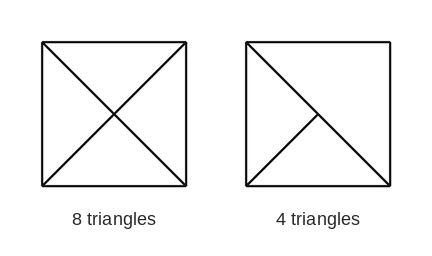
In the first figure both diagonals run from corner to corner, and there are 8 triangles. In the second figure one diagonal stops at the centre. The full diagonal still cuts the square into two halves, and the short line splits one half into two pieces. That is 2 + 2 = 4. Anyone who writes 8 here has counted triangles whose sides are not drawn.
Follow every line
Before you count, run your pencil along each line from end to end. Note where it starts, where it stops and which crossing points it really passes through. It takes a few seconds and can save you a wrong answer.
[SSC Tip] When your count is just below one of the options, check the big outer shape and the halves first. When it is above every option, look for a line that stops short.
Solved Questions: Watch the Lines
Question 10
How many triangles are there in the given figure?
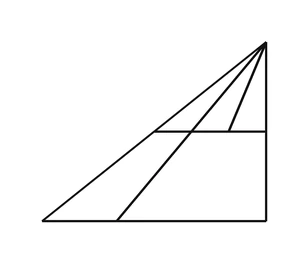
(a) 9 (b) 10 (c) 11 (d) 12
Answer. Like Question 4, this triangle has lines from the top corner and one level line. But follow each line to its end: one of the lines from the top corner stops at the level line and never reaches the base. Above the level line, four lines from the top corner reach it (the two sides and both inside lines), so there are 6 pairs and 6 triangles. Down at the base only three lines arrive: the two sides and the long inside line. That is 3 pairs, so 3 tall triangles. 6 + 3 = 9. If you got 12, you used the short line as if it went all the way down. So the answer is (a) 9.
Question 11
Count the number of triangles in the given figure.
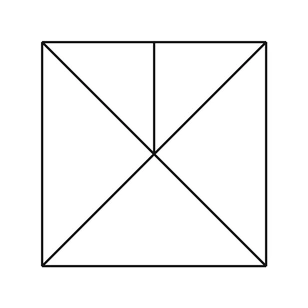
(a) 8 (b) 9 (c) 10 (d) 12
Answer. Compare this with Question 2. Here the upright line starts at the top side and stops at the centre. It splits only the top triangle, so there are 5 single pieces. Two pieces together: the whole top triangle, and the two lower halves of the square (each is the left or the right triangle together with the bottom one), which makes 3. Three pieces together: the two upper halves of the square, which hold both pieces of the top triangle: 2. The short line cannot make any triangle below the centre, because it ends there. 5 + 3 + 2 = 10. So the answer is (c) 10.
Counting Squares
For squares, sort by size instead of by pieces.
A square grid
In a grid of n × n small squares, a square of side 1 fits in n × n places, a square of side 2 fits in (n − 1) × (n − 1) places, and so on down to 1 place for the whole grid. So the total is 1² + 2² + … + n².
| Grid | Squares |
|---|---|
| 2 × 2 | 4 + 1 = 5 |
| 3 × 3 | 9 + 4 + 1 = 14 |
| 4 × 4 | 16 + 9 + 4 + 1 = 30 |
| 5 × 5 | 25 + 16 + 9 + 4 + 1 = 55 |
A grid that is longer than it is tall
For a grid m squares wide and n squares tall, count each size the same way: side 1 fits m × n times, side 2 fits (m − 1) × (n − 1) times, and you stop when the shorter side runs out. A grid 5 squares wide and 3 tall has 15 + 8 + 3 = 26 squares.
Diagonals make tilted squares
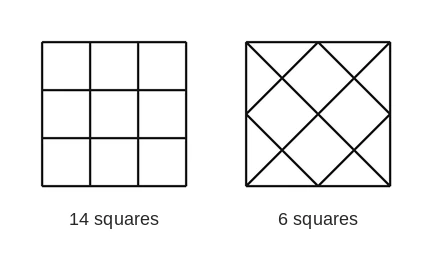
When a figure has slanting lines, look for squares standing on a corner. A tilted square needs four slanting sides. The tilted square that joins the middles of the four sides of a square is one, as in the second picture. When both diagonals are drawn as well, they pass through the middles of its sides and cut it into 4 smaller tilted squares. With the big upright square that makes 1 + 1 + 4 = 6. Count the upright squares and the tilted squares separately, then add.
A missing line
If part of a line is missing, a square counts only when all four of its sides are fully drawn. Small squares beside the gap merge into one bigger piece, and some larger squares lose a side. Count size by size and check every side that runs past the gap.
Time check: a counting squares or rectangles question should take 40–60 seconds.
Solved Questions: Squares
Question 12
How many squares are there in the given figure?
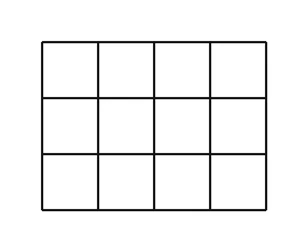
(a) 12 (b) 20 (c) 22 (d) 24
Answer. Count the squares size by size. The grid is 4 squares wide and 3 squares tall. Small squares: 4 × 3 = 12. Squares two units wide fit in 3 places across and 2 down, so 3 × 2 = 6. Squares three units wide fit in 2 places across and 1 down, so 2. A square four units wide would need four rows, and there are only three. 12 + 6 + 2 = 20. So the answer is (b) 20.
Question 13
How many squares are there in the figure given below?
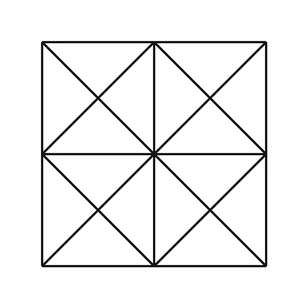
(a) 5 (b) 6 (c) 8 (d) 10
Answer. Count the upright squares first: the 4 small squares and the big outer square, 5 in all. Now the squares standing on a corner. The four slanting lines that join the middles of the sides make one tilted square. The two diagonals of the big square pass through the middles of its sides, so they cut it into 4 smaller tilted squares, each with one corner at the centre. That is 1 + 4 = 5 tilted squares. If you stopped at 5, you counted only the upright ones. 5 + 5 = 10. So the answer is (d) 10.
Question 14
How many squares are there in the given figure?
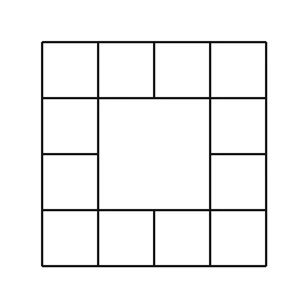
(a) 18 (b) 20 (c) 26 (d) 30
Answer. Without the gap this would be a 4 × 4 grid with 30 squares, but the four short lines in the middle are missing. So the middle four small squares have become one open square two units wide. Small squares: 16 − 4 = 12. Squares two units wide: there are 9 places for them, but 8 of those need a side along one of the missing lines. Only the open square in the middle has all four sides, so 1. Squares three units wide use only the outer lines and the lines one step in, which are all complete, so 4. The whole square: 1. 12 + 1 + 4 + 1 = 18. So the answer is (a) 18.
Question 15
How many squares are there in the figure given below?
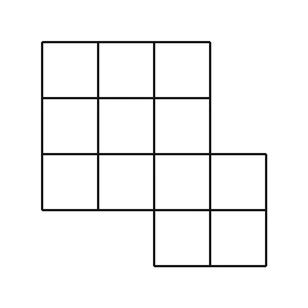
(a) 14 (b) 17 (c) 18 (d) 21
Answer. Treat the figure as two grids. The big grid is 3 × 3, so it has 9 + 4 + 1 = 14 squares. The small grid at the bottom-right is 2 × 2 and shares one small square with the big grid. It adds 3 new small squares and its own outer square, so 4 more. Last, look for squares that cross the join using lines of both grids. A square two units wide sitting across the join would need a side where no line is drawn, so there are none. Forgetting the outer square of the small grid gives 17. 14 + 4 = 18. So the answer is (c) 18.
Counting Rectangles
The stem says "Squares also count as rectangles", so every square in the figure is counted too.
Two upright lines and two level lines
Every rectangle is made by two upright lines (its left and right sides) and two level lines (its top and bottom). So you never have to hunt for rectangles one by one. Count pairs of lines instead.
| Lines | Pairs |
|---|---|
| 2 | 1 |
| 3 | 3 |
| 4 | 6 |
| 5 | 10 |
| 6 | 15 |
| 7 | 21 |
A grid m pieces wide and n pieces tall has m + 1 upright lines and n + 1 level lines. The number of rectangles is the pairs of upright lines times the pairs of level lines.
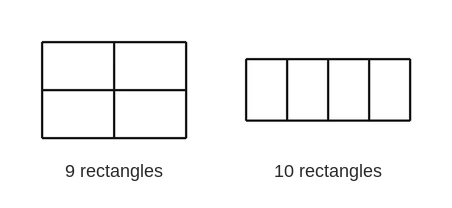
For example: a grid 2 pieces wide and 2 pieces tall has 3 upright lines and 3 level lines, so 3 × 3 = 9 rectangles. A single row of 4 pieces has 5 upright lines and only 2 level lines, so 10 × 1 = 10.
Lines that do not run all the way
The pair rule works only when every upright line meets every level line. When a line stops part of the way, split the count by top and bottom sides. First take the rectangles whose top and bottom are full lines. Then take the ones that use the short line, which can only pair with the upright lines it actually meets. Add the parts.
Before you multiply, run your eye along each level line and each upright line to be sure it crosses the whole figure.
Solved Questions: Rectangles
Question 16
How many rectangles are there in the given figure? (Squares also count as rectangles.)
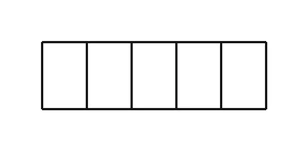
(a) 10 (b) 15 (c) 18 (d) 21
Answer. All the rectangles here sit in one row, so each one is fixed by its left side and its right side. There are 6 upright lines, and any two of them make a rectangle with the top and bottom sides: 6 × 5 ÷ 2 = 15 pairs. By groups it comes out the same: 5 single pieces, 4 made of two, 3 made of three, 2 made of four and 1 made of all five. 5 + 4 + 3 + 2 + 1 = 15. So the answer is (b) 15.
Question 17
How many rectangles are there in the given figure? (Squares also count as rectangles.)
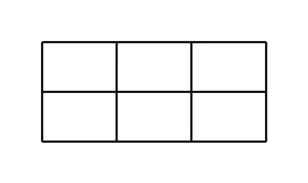
(a) 9 (b) 12 (c) 16 (d) 18
Answer. A rectangle needs two upright lines and two level lines. The grid has 4 upright lines, which give 4 × 3 ÷ 2 = 6 pairs, and 3 level lines, which give 3 pairs. Every pair of upright lines goes with every pair of level lines, so there are 6 × 3 = 18 rectangles. By rows, as a check: 6 in the top row, 6 in the bottom row and 6 of full height. 6 + 6 + 6 = 18. Time check: with the pair rule this takes well inside 40–60 seconds. So the answer is (d) 18.
Question 18
How many rectangles are there in the given figure? (Squares also count as rectangles.)
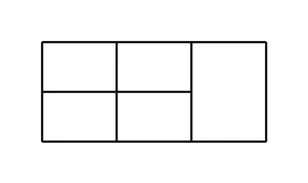
(a) 12 (b) 14 (c) 16 (d) 18
Answer. This is the grid of Question 17, except that the middle level line stops at the third upright line from the left. Rectangles of full height use the top and bottom sides, and all 4 upright lines meet both, so there are 6 pairs and 6 rectangles. Rectangles in the top half need the middle line as their bottom side. It meets only the first three upright lines, which give 3 pairs: 3 rectangles. The bottom half gives 3 more in the same way. Using the full grid count of 18 is the trap. 6 + 3 + 3 = 12. So the answer is (a) 12.