
Paper Folding and Transparent Sheets
The part of the paper that stays never moves. Each fold lays a flap on top of it, so after two folds some parts are two or four layers thick.
Opening the folds
- Open the folds in reverse order: the last fold first, one at a time.
- Each time you open a fold, every hole gets a twin on the other side of that crease, at the same distance from it. The twin is a mirror image, not a copy.
- A hole punched through k layers shows as k holes on the opened sheet. Two folds on the middle lines give 4 copies of every hole. A narrow strip folded in only doubles the holes punched through the strip.
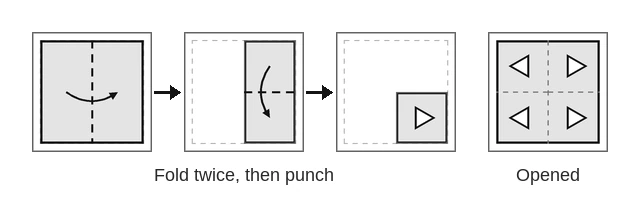
In the picture the sheet is folded left over right, then top down, and one triangle pointing right is punched. Opening the top fold gives a twin straight above it, still pointing right. Opening the left fold gives twins on the left, pointing left. So all four triangles point away from the upright crease.
Which way a twin points
| Crease | A shape pointing right becomes | A shape pointing up becomes |
|---|---|---|
| Upright | pointing left | still pointing up |
| Level | still pointing right | pointing down |
| Diagonal from the top-left corner | pointing down | pointing left |
| Diagonal from the top-right corner | pointing up | pointing right |
A circle looks the same after any mirror, so it only checks places. A triangle, a star or a slanting bar can also check direction.
The near misses
- a twin copied instead of mirrored, so it points the same way as the original,
- the holes of one layer missing,
- holes mirrored across a line that was never a crease,
- an extra hole, or every hole in place but one pointing the wrong way.
Transparent sheets
- The sheet folds at a middle line. Marks on the part that stays do not move.
- Marks on the part that folds over are mirrored across the fold line and land on the other half, so you see both sets together.
- Wrong options: the flap's marks slid across without flipping, a mark missing, or the picture you would get if the other half had been folded over.
Time check: paper folding takes 30–45 seconds, and a transparent sheet 25–35 seconds.
Embedded Figures and Figure Completion
Embedded figures
- X must appear exactly as drawn: the same size and the same direction, only moved. A turned or mirrored copy does not count.
- Lines of the option may run on past the ends of X's lines. X is still there.
- Find X's odd corner first, such as two lines meeting at an unusual angle or a short tail. Look for that corner in each option, then check the other lines that leave it.
- The wrong options usually hold X turned 90°, X mirrored, X with one line missing or shorter, or X with one angle changed.
- In the reverse form ("which option figure is embedded in the given figure") the big figure is given. Take each small option in turn and look for it in the big one, same size and same direction.
Figure completion
Say which symmetry the three quarters show before you look at the options.
| The three quarters show | The missing quarter is |
|---|---|
| A mirror, left to right | the quarter beside it, flipped left to right |
| A mirror, top to bottom | the quarter above or below it, flipped top to bottom |
| A quarter turn | the quarter before it (going clockwise) turned 90° clockwise |
| A half turn | the opposite quarter turned 180° |
To tell a quarter turn from a mirror, follow one part that points or curls. In a quarter turn it goes round the centre the same way in every quarter, like the blades of a fan. In a mirror pattern, two neighbouring quarters are mirror images of each other. If a pattern has both, either way gives the same quarter.
The wrong options are near misses:
- the quarter beside the gap flipped as if in a mirror, the favourite trap in a quarter-turn pattern,
- a quarter copied without turning it,
- the right quarter with one mark or line missing or added.
Time check: an embedded figure takes 30–40 seconds, and a figure completion 20–30 seconds.
Counting: Formulas and Ready Counts
Count in groups and write each subtotal: single pieces, then shapes made of two pieces, then of three or four, then the whole figure. Most slips are a group left out, often the big outer shape or the triangles made of two or four pieces.
Lines from one corner
If lines from one corner of a triangle cut the opposite side into k pieces, there are 1 + 2 + … + k triangles, which is k(k + 1) ÷ 2. Each line drawn across, parallel to that side, adds the same number again. So with p such lines, multiply by (p + 1).
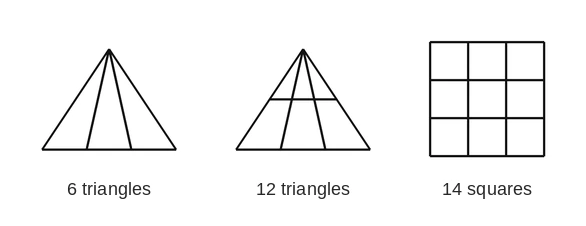
In the picture, two lines from the top cut the base into 3 pieces: 1 + 2 + 3 = 6 triangles. One level line across gives a second set of 6, so 12. The 3 × 3 grid has 9 + 4 + 1 = 14 squares and 36 rectangles.
Ready counts
| Figure | Count |
|---|---|
| Square or rectangle with both diagonals | 8 triangles |
| Square with both diagonals and both middle lines | 16 triangles |
| Triangle with a line from each corner to the middle of the opposite side | 16 triangles |
| Triangle with the middles of its sides joined | 5 triangles |
| Grid of 2 × 2, 3 × 3 and 4 × 4 squares | 5, 14 and 30 squares |
| Grid of 3 × 2 and 3 × 3 squares | 18 and 36 rectangles |
Grid formulas
- Squares in an n × n grid: 1² + 2² + … + n².
- Squares in an m × n grid, m the longer side: m × n + (m − 1)(n − 1) + (m − 2)(n − 2) + …, until a bracket reaches 0. For a 4 × 3 grid: 12 + 6 + 2 = 20.
- Rectangles in an m × n grid: pick 2 of the m + 1 upright lines and 2 of the n + 1 level lines, so [(m + 1)m ÷ 2] × [(n + 1)n ÷ 2]. For 3 × 2: 6 × 3 = 18. Squares count as rectangles here, and the question says so.
- A short extra line inside a grid only adds the shapes that use it as a side. Count those on their own and add them on.
Time check: counting triangles takes 45–60 seconds, and counting squares or rectangles 40–60 seconds.
[SSC Tip] Write the subtotals in a column on your rough sheet. If you have to leave the question and come back, the column shows at once which group is still to be counted.
Dice, Nets and Painted Cubes
Dice from positions
- Faces seen together on one dice are never opposite.
- First list the faces seen next to the asked face. If there are four different ones, the sixth face is opposite it.
- Two positions with one face in common: read each dice clockwise (top, right, left) starting from the common face. Faces in matching places are opposite. If the common face sits in the same place on both dice, just compare the faces in the same places.
- Two positions with two faces in common: the two faces that are not shared are opposite.
- These dice are not standard dice, so never assume that opposite faces add up to 7.
Cube nets
- In a row of three or more squares, skip one: the first and third are opposite, and so are the second and fourth.
- Squares that touch side by side on the sheet are never opposite.
- Once two pairs are found, the last two squares are opposite.
- Which cube can be made: first strike out every cube that shows an opposite pair. If the three faces of a cube meet at one corner on the sheet, go round that corner clockwise. On the cube, clockwise from the top goes top, right face, left face. The two orders must match, or the cube is a mirror image.
Painted cubes
A cube of n × n × n painted on all faces and cut into n³ equal small cubes:
| Painted faces | Where the small cubes are | How many |
|---|---|---|
| 3 | at the corners | 8 |
| 2 | along the edges, not at corners | 12 × (n − 2) |
| 1 | on the faces, not on edges | 6 × (n − 2)² |
| 0 | inside | (n − 2)³ |
For n = 5 these are 8, 36, 54 and 27, which add up to 125.
- A cuboid of a × b × c painted all over has 8 corner cubes, 4(a − 2) + 4(b − 2) + 4(c − 2) cubes with two faces painted, 2[(a − 2)(b − 2) + (b − 2)(c − 2) + (c − 2)(a − 2)] with one face, and (a − 2)(b − 2)(c − 2) with none. For 3 × 5 × 6 that is 8 + 32 + 38 + 12 = 90.
- When only some faces are painted, or they have different colours, picture where each small cube sits (corner, edge, face or inside) and ask which of its outer faces carry paint. For example, if only the top and bottom of a 4 × 4 × 4 cube are painted, the 16 cubes of the top layer and the 16 of the bottom layer have one painted face each, and the 32 in between have none.
Time check: dice from positions take 30–45 seconds, the opposite face on a net 20–30 seconds, which cube from a net 45–60 seconds, and a painted cube 20–30 seconds.