
Paper Folding and Transparent Sheets: Count the Layers First
A folding question looks slow, but most of the work can be skipped. Before you open anything in your head, work out how many holes the opened sheet must have. That one number often knocks out two options straight away.
Count the layers under each hole
Every fold lays one flap on the paper that stays, so the paper gets thicker where the flap lands, and only there. A hole punched through 3 layers comes out as 3 holes on the opened sheet.
- A fold in half doubles the whole folded paper: 2 layers everywhere.
- A narrow strip folded in (a quarter of the width) doubles only the band it lands on. The rest still has 1 layer.
- Fold in half and then fold in a strip: the band under the strip has 4 layers and the rest has 2.
- Fold in a strip and then fold that side over in half: the band where the doubled strip lands has 3 layers, and the part nothing landed on still has 1.
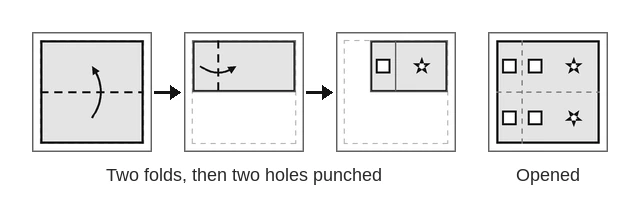
In the picture the bottom half is folded up, then a strip on the left is folded in. The square is punched through 4 layers and the star through 2, so the opened sheet has 4 squares and 2 stars.
Then go through the options in this order
- Count the holes in each option, and throw out every option with the wrong number.
- Open the last fold first. Each hole gets a twin across that crease, as far from the crease as the hole is.
- Open the earlier folds one at a time, in reverse order.
- Check the shapes that point. A twin across an upright crease is flipped left to right, and across a level crease it is flipped top to bottom. Across a slanting crease the shape ends up facing a side next to its old one: a round side facing right comes out facing up or down, depending on which way the crease slants.
| Hole | Twin across an upright crease | Twin across a level crease |
|---|---|---|
| square | looks the same | looks the same |
| semicircle, round side right | round side left | round side still right |
| semicircle, round side up | round side still up | round side down |
| star with one point up | still points up | points down |
Transparent sheets
A transparent sheet folded at a middle line works like one fold with nothing punched. The marks on the half that stays do not move. The marks on the other half land at their mirror places and are flipped. Check two things: that every mark is there, and that every mark from the moving half faces its new way.
[SSC Tip] Write the hole count beside the question before you look at the options, for example "4 + 2 = 6". It takes five seconds and you will not be pulled in by a pretty option with the wrong number of holes.
Embedded Figures and Figure Completion: Look for One Feature
Embedded figures: start with the odd corner
The figure X is usually three to six lines. Most options hold something close to X: X turned, X as seen in a mirror, X with one line missing, or X at a different size. Do not trace all of X in every option. Pick the one feature of X that is hardest to fake and look for that first.
- The odd corner: a sharp corner where a slanting line meets a level or upright one, or a point where three lines meet.
- The slanting line: note which way it slants (down to the right, or up to the right) and how long it is compared with the other lines.
Look for that feature in each option. Where it is missing, the option is out. Where it is there, trace the rest of X from it, line by line, at the same size. Lines of the option may cross X or run on past the ends of X's lines. That is allowed. X itself may not be turned or flipped.
For example: X is a level line with a slanting line going down to the right from its left end. In an option where every slanting line goes down to the left, X cannot be there, however busy the figure looks.
The reverse question
Sometimes the big figure is given and the options are small: which option is hidden in the big figure? Turn the method round. Take each option's odd corner and look for it in the big figure, the same way up.
Figure completion: let the full row and column tell you the symmetry
Three quarters of a square pattern are shown, and the fourth is a box with a question mark. Do not judge by the look of the shapes. Find the symmetry first. Say the gap is at the bottom-right.
- The top row is complete. Are its two quarters mirror images across the upright centre line?
- The left column is complete. Are its two quarters mirror images across the level centre line?
- If both answers are yes, the pattern has both mirrors. The missing quarter is the mirror image of the quarter beside it, and also of the quarter above it.
- If only one answer is yes, use that mirror alone: the missing quarter is the mirror image of the quarter across that centre line.
- If neither is, check for a half turn: the bottom-right quarter is then the top-left quarter turned halfway round.
So the full row and column tell you which symmetry to use, and that symmetry builds the missing quarter from a quarter you can see. The wrong options are nearly always the right quarter flipped the wrong way, a neighbour copied without flipping, or the right quarter with one mark missing. A single mark near a corner of the quarter usually tells them apart.
Counting Triangles: Ready Counts and the Group Method
Ready counts
A few figures come up again and again. Learn their counts as facts.
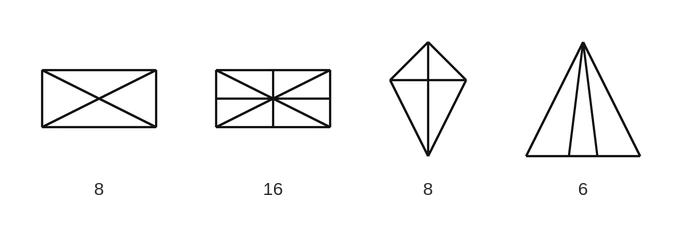
| Figure | Triangles |
|---|---|
| A rectangle (or a square) with both diagonals | 8 |
| The same with both middle lines as well | 16 |
| A kite with both diagonals | 8 |
| A triangle with k lines from its top corner to the base | (k + 1) × (k + 2) ÷ 2, so 3, 6, 10 for k = 1, 2, 3 |
| The same with one line across, parallel to the base | twice that, so 12 for two lines from the top |
When a question figure is one of these with an extra line or two, start from the ready count. A new line never spoils an old triangle, because the old one still has its three sides. So add only the triangles that use the new line.
The group method
For any other figure, count in groups and write each subtotal down:
- Single pieces: the smallest triangles, with no line inside them.
- Triangles made of two pieces.
- Triangles made of three or four pieces.
- The biggest ones: often half of the figure, or the whole of it.
Add the subtotals at the end. Most mistakes come from rushing groups 2 and 3, so look carefully for triangles that have a line running through them.
Lines from one point
When several lines start from one point, such as the top of a roof or a corner of a rectangle, there is a faster way. Take a line that crosses k of those lines. Any two of them, with that line, make a triangle, so it gives k × (k − 1) ÷ 2 triangles. Do this for every such line, then add the few triangles that do not touch the point.
For example: five lines spread down from one point and a level line crosses all five. That level line alone gives 5 × 4 ÷ 2 = 10 triangles.
Squares, Rectangles and Painted Cubes: Use the Formulas
Squares in a grid
In a grid of n × n small squares, there are 1² + 2² + … + n² squares of all sizes. In a grid of m rows and n columns of squares, with m the smaller, count each size: m × n small ones, (m − 1) × (n − 1) of the next size, and so on until a side runs out.
| Grid of squares | Squares |
|---|---|
| 2 × 2 | 4 + 1 = 5 |
| 3 × 3 | 9 + 4 + 1 = 14 |
| 4 × 4 | 16 + 9 + 4 + 1 = 30 |
| 2 × 3 | 6 + 2 = 8 |
| 3 × 5 | 15 + 8 + 3 = 26 |
Rectangles in a grid
A rectangle is fixed by choosing two level lines for its top and bottom and two upright lines for its sides. A grid of m rows and n columns has m + 1 level lines and n + 1 upright lines. Two lines out of L can be chosen in L × (L − 1) ÷ 2 ways. So the number of rectangles, squares included, is [m × (m + 1) ÷ 2] × [n × (n + 1) ÷ 2].
| Grid | Rectangles |
|---|---|
| one row of 4 | 1 × 10 = 10 |
| 2 × 2 | 3 × 3 = 9 |
| 3 × 3 | 6 × 6 = 36 |
| 2 × 4 | 3 × 10 = 30 |
When a grid has a piece of line missing or an extra line, start from the full grid and then take away the rectangles the missing piece spoils, or add the ones the extra line makes.
Painted cubes
A cube made of n × n × n small cubes and painted on all six faces:
| Faces painted | Where the small cubes sit | How many |
|---|---|---|
| 3 | at the corners | 8 |
| 2 | along the 12 edges, not at the corners | 12 × (n − 2) |
| 1 | inside the 6 faces, away from the edges | 6 × (n − 2)² |
| 0 | hidden inside | (n − 2)³ |
The four numbers add up to n³, which is a quick check. For n = 4 they are 8, 24, 24 and 8, and 64 in all.
For a cuboid of a × b × c small cubes painted all over, think edge by edge and face by face: 8 corners, 4 × [(a − 2) + (b − 2) + (c − 2)] with two faces painted, 2 × [(a − 2)(b − 2) + (b − 2)(c − 2) + (a − 2)(c − 2)] with one face, and (a − 2)(b − 2)(c − 2) inside. If a face is left unpainted, or the faces have different colours, do not force a formula. Picture the layer next to each face and count it.
Dice and Cube Nets: Time-Saving Rules
Dice from two or three positions
Faces seen together in one position are next to each other, so they are never opposite. Start every dice question by writing down the faces seen next to the asked face. Then use one of these rules.
- Four neighbours: if the asked face is seen next to four different faces across the positions, the sixth face is opposite it.
- One common face: if two positions share exactly one face, read each position clockwise starting from that face. On a dice drawn like these, clockwise round the corner goes top, right, left. The faces in matching places are opposite.
- Two common faces: if two positions share two faces, their third faces are opposite.
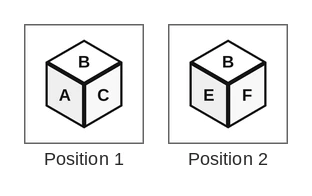
In the picture the two positions share only B. Read clockwise from B: B, C, A in the first and B, F, E in the second. So C is opposite F and A is opposite E, and the faces left over, B and D, are opposite too.
Do not use the idea that opposite faces add up to 7. That is true of an ordinary playing dice, not of the dice in these questions.
Cube nets
In a row of three or more squares, skip one: the first and third squares are opposite, and so are the second and fourth. Squares that touch side by side are never opposite. In a zigzag of four squares, shaped like a Z or an S, the two end squares are opposite.
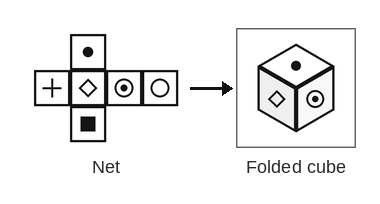
For "which cube can be made" questions, work in two steps.
- Write the three opposite pairs. Any option that shows two faces of one pair is out.
- For the options left, find the three faces in the net. If they meet at one point, read them clockwise round that point. On the cube, read the three faces clockwise round the corner: top, right, left. The order must match. An option with the right three faces in the other order is a mirror image and cannot be made.
In the picture the black dot, the ring with a dot and the diamond meet at one point of the net. Clockwise they go black dot, ring with a dot, diamond, and the cube shows the black dot on top, the ring with a dot on the right and the diamond on the left.
[SSC Tip] With a net, write the three opposite pairs in the margin first, such as "A–C, B–E, D–F". Every question on that net, opposite face or which cube, then takes a few seconds.
A Time Plan for These Questions
The Reasoning section has 25 questions and its own locked 15-minute clock, which is 36 seconds a question on average. A right answer earns 2 marks and a wrong one costs 0.5.
Targets for this chapter
| Question type | Target time |
|---|---|
| Paper folding | 30–45 seconds |
| Transparent sheet | 25–35 seconds |
| Embedded figure | 30–40 seconds |
| Figure completion | 20–30 seconds |
| Counting triangles | 45–60 seconds |
| Counting squares or rectangles | 40–60 seconds |
| Dice from positions | 30–45 seconds |
| Cube net, opposite face | 20–30 seconds |
| Which cube from a net | 45–60 seconds |
| Painted cube | 20–30 seconds |
Completion, net opposites and painted cubes come in under the average, so do them as soon as you meet them. Folding, transparent sheets, embedded figures and dice sit close to the average. Counting figures and "which cube" questions run over it, so the seconds saved on the quick ones pay for them.
Move on when
- you have counted a figure twice and got two different totals (mark it and come back with fresh eyes)
- two options are still left in an embedded figure question after 40 seconds
- you cannot find a rule that fixes the dice after listing the neighbours of the asked face
Before you move on, jot down what you already have, such as a hole count or two opposite pairs, so coming back costs only the last step.
Guessing
With two options left, a guess wins 2 marks or loses half a mark at even odds, so on average it gains three quarters of a mark. A blind guess among four gains only about an eighth of a mark. So cut the options down first, with a hole count, an odd corner or one opposite pair, and then decide.
Solved Questions
Question 1
A square sheet of paper is folded along the dotted lines in the order shown, and then holes are punched in it as shown. How will the paper look when it is unfolded?
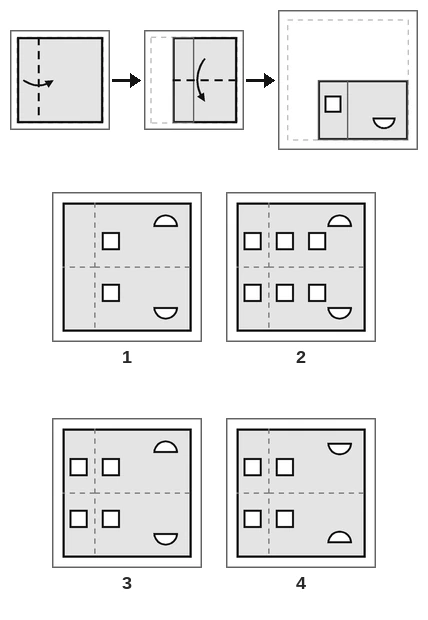
(a) Figure 1 (b) Figure 2 (c) Figure 3 (d) Figure 4
Answer. Count the holes before you look at any shapes. The strip on the left is folded in first, so the left quarter of the folded paper has two layers. Then the top half comes down over the bottom half, which doubles everything. Under the square there are now 4 layers, so it makes 4 squares. Under the semicircle there are only 2 layers, so it makes 2. The opened sheet must have 6 holes. Figure 1 has 4 holes and Figure 2 has 8, so both go at once. Two figures are left, so open the last fold. The top half comes back up, and every hole gets a twin straight above it, flipped top to bottom. The semicircle's round side points down, so its twin's round side points up: the two round sides point away from the middle crease. Figure 4 also has six holes, but its two semicircles point towards each other. Figure 3 has four squares in two rows near the left edge and the two semicircles pointing away from each other. Time check: the hole count took about ten seconds and removed half the options. So the answer is (c) Figure 3.
Question 2
A square sheet of paper is folded along the dotted lines in the order shown, and then holes are punched in it as shown. How will the paper look when it is unfolded?
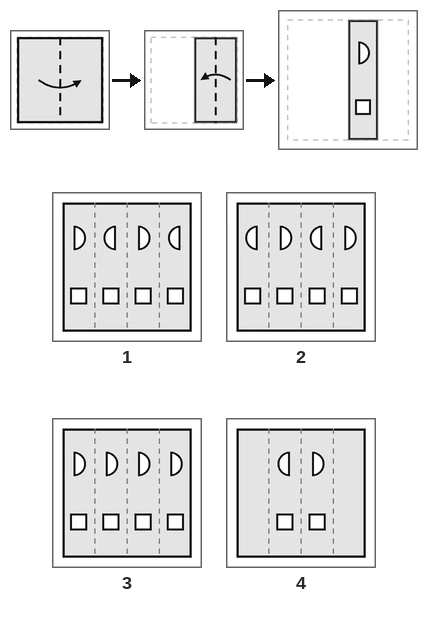
(a) Figure 1 (b) Figure 2 (c) Figure 3 (d) Figure 4
Answer. Both holes are punched through four layers, so each makes four and the opened sheet needs 8 holes. Figure 4 has only 4, so it goes. Now open the folds one at a time, the last fold first. The last fold laid the right-hand strip over to the left. Opening it gives each hole a twin across that crease, as far from the crease as the hole is, and flipped left to right. The semicircle has its round side to the right, towards the crease, so its twin near the right edge has its round side to the left. Next open the first fold. The right half is copied onto the left half, flipped again. Reading the top row from left to right, the semicircles face right, left, right, left. The two near each outer crease face each other, and the two at the middle crease are back to back. Figure 3 has all four semicircles facing right, and Figure 2 has every one the wrong way round. Figure 1 matches. So the answer is (a) Figure 1.
Question 3
A paper is folded and cut as shown below. How will it appear when unfolded?
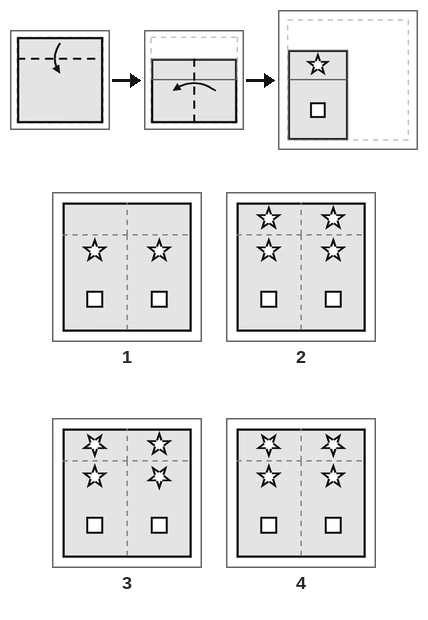
(a) Figure 1 (b) Figure 2 (c) Figure 3 (d) Figure 4
Answer. The star is punched where the top strip lies, and that part is then doubled again by the second fold, so it goes through four layers: four stars. The square has two layers under it: two squares. Six holes in all, so Figure 1, with four, is out. Open the last fold first. The right half comes back across the upright crease. A star with one point straight up still points up in an upright mirror, so these twins look just like the holes. Then open the strip at the top. Each star near that level crease gets a twin above it, flipped top to bottom, so the new stars point down. Figure 2 has all four stars pointing up, which forgets this flip. Figure 3 has the right-hand pair the wrong way round. Figure 4 has the top two stars pointing down and the two below them pointing up. So the answer is (d) Figure 4.
Question 4
A transparent sheet with a pattern is given below. Select the option that depicts the pattern that would appear when the given transparent sheet is folded at the dotted line as shown.
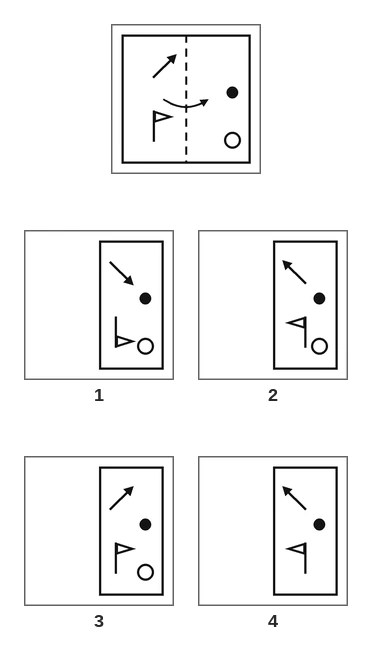
(a) Figure 1 (b) Figure 2 (c) Figure 3 (d) Figure 4
Answer. A transparent sheet folded in half lets you see the marks of both halves at once. The right half stays where it is, so the black dot and the ring do not move. The left half turns over onto the right, so each of its marks lands at its mirror place across the dotted line and is flipped left to right. The arrow points up and to the right, so after the fold it points up and to the left. The flag's cloth points right, so it now points left, still at the top of its pole. Figure 3 moves the marks across but keeps their old directions. Figure 1 flips them top to bottom instead: the arrow points down and the flag hangs upside down. Figure 4 has lost the ring. Figure 2 has all four marks, with the arrow and the flag facing left. So the answer is (b) Figure 2.
Question 5
Select the option figure in which the given figure (X) is embedded as its part (rotation is NOT allowed).
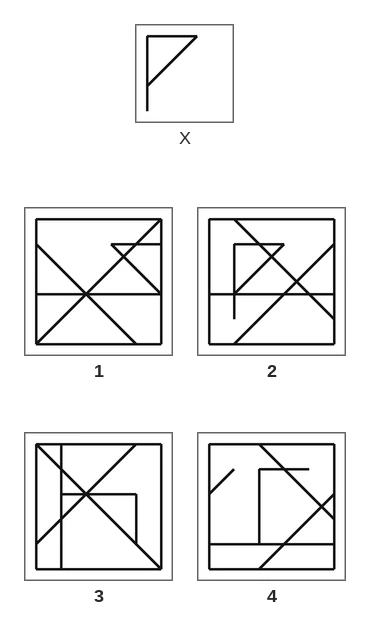
(a) Figure 1 (b) Figure 2 (c) Figure 3 (d) Figure 4
Answer. Start with X's odd corner. At its top right a slanting line meets the short level line in a sharp corner, and the slanting line runs down to the left from there. The other thing to remember is that X's upright line carries on below the triangle. Now look for that sharp corner in each option. In Figure 3 X has been turned: its long line lies level along the top and the sharp corners point the wrong ways. In Figure 1 the sharp corner is on the left, because there X is a mirror image with its upright line on the right. Figure 4 has an upright line and a short level line at the top, but no slanting line joins them. In Figure 2 the triangle sits near the top left: the short level line at the top, the slanting line running down to the left, and the upright line carrying on below the long level line, exactly as in X. So the answer is (b) Figure 2.
Question 6
Select the option figure in which the given figure (X) is embedded as its part (rotation is NOT allowed).
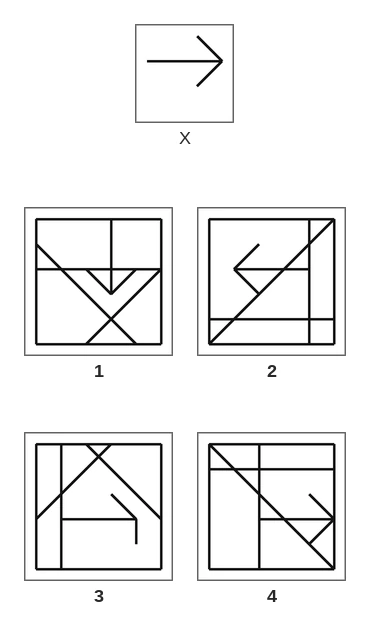
(a) Figure 1 (b) Figure 2 (c) Figure 3 (d) Figure 4
Answer. X is an arrow pointing right: a level stem with two short slanting strokes meeting at its right end. The quickest thing to look for is the arrow's tip, the point where the two slanting strokes meet. In Figure 2 the tip points left, so X is mirrored there. In Figure 1 the arrow points down, so it has been turned. Figure 3 has a tip on the right, but its lower stroke goes straight down instead of slanting back, so the angle is wrong. In Figure 4 the tip touches the right side of the frame, a little below the middle: the stem runs left from it and the two strokes slant back from it, one up and one down. Lines of the option may cross X or run on past it. That does not matter, as long as all of X is there at the same size and the same way round. So the answer is (d) Figure 4.
Question 7
Select the figure from the options that can replace the question mark (?) and complete the given pattern.
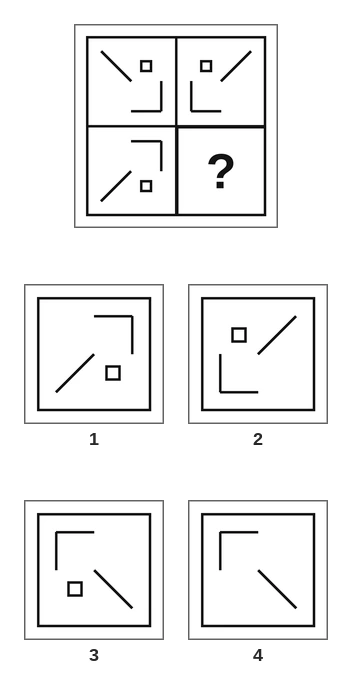
(a) Figure 1 (b) Figure 2 (c) Figure 3 (d) Figure 4
Answer. Decide the symmetry before you look at the options. The top row is complete, and the top-right quarter is the top-left quarter seen in an upright mirror. The left column is complete too, and the bottom-left quarter is the top-left quarter flipped top to bottom. So the pattern has both mirrors, and the missing bottom-right quarter is the mirror image of its neighbour on the left. In every quarter the slanting line runs from the outer corner in towards the centre, so here it sits in the bottom-right corner of the quarter. The bent line hugs the centre of the pattern, so here it is at the top-left of the quarter, with its level part along the top. The small square sits lower down, on the left. Figure 1 is the bottom-left quarter copied without flipping. Figure 2 is the top-right quarter copied. Figure 4 has lost the small square. So the answer is (c) Figure 3.
Question 8
How many triangles are there in the given figure?
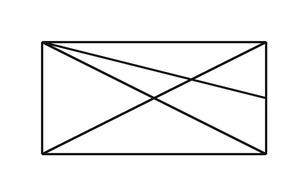
(a) 8 (b) 14 (c) 12 (d) 16
Answer. Start from a ready count. A rectangle with both diagonals has 8 triangles: 4 small ones meeting at the centre and 4 big ones, one on each side of each diagonal. The extra line runs from the top-left corner A to the middle of the right side, R. It does not spoil any of the 8, because each of them still has all three sides, so count only the triangles that use the new line. Call the other corners B (top-right), C (bottom-right) and D (bottom-left), the centre O, and call Q the point where the new line crosses the diagonal from B. With a corner at A the new line makes ABR, ABQ, ARC, AOQ and ADQ, which is 5. Away from A it makes one more, QBR, the thin triangle at the top right. So the count is 8 + 6 = 14. Option (a) is the ready count alone. So the answer is (b) 14.
Question 9
How many triangles are there in the given figure?
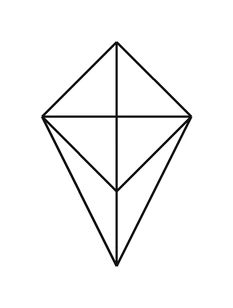
(a) 12 (b) 16 (c) 13 (d) 15
Answer. This kite has its two diagonals and two more lines, from the side corners down to a point on the upright diagonal. Count in groups and write each subtotal. Single pieces: 2 at the top above the level diagonal, 2 in the middle between the level diagonal and the two new lines, and 2 at the bottom, which makes 6. Made of two pieces: the top triangle above the level diagonal, the middle triangle between the level diagonal and the new lines, a top piece with the middle piece below it on each side, and a middle piece with the bottom piece below it on each side, which makes 6. Made of three pieces: the left half and the right half of the kite, cut by the upright diagonal, which makes 2. Made of four pieces: the whole part below the level diagonal, which makes 1. Total 6 + 6 + 2 + 1 = 15. Option (c) misses the two halves of the kite, and option (a) misses the big lower triangle as well. So the answer is (d) 15.
Question 10
How many rectangles are there in the given figure? (Squares also count as rectangles.)
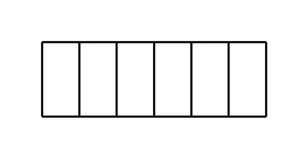
(a) 21 (b) 16 (c) 15 (d) 20
Answer. Use the rectangle formula, not the group method. Every rectangle is fixed by two level lines for its top and bottom and two upright lines for its sides. This strip has only 2 level lines, which give 1 pair, and 7 upright lines. Two of 7 lines can be chosen in 7 × 6 ÷ 2 = 21 ways, so there are 1 × 21 = 21 rectangles. Each piece is twice as tall as it is wide, so two pieces side by side make a square, and 5 of the 21 are such squares. The stem says squares count. Option (b) is what you get if you leave those 5 squares out. So the answer is (a) 21.
Question 11
Three different positions of the same dice are shown. Find the letter on the face opposite the face showing 'A'.
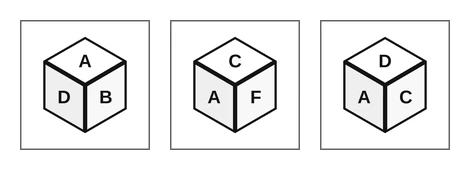
(a) B (b) F (c) E (d) D
Answer. First list the faces seen next to A. In the first position A is on top with D and B. In the second, A is on the left with C and F. In the third, A is on the left again, with D and C. So A touches D, B, C and F: four different faces. A dice has six faces. A and its four neighbours make five, so the sixth face, E, must be the one opposite A. B, D and F were all seen next to A, and a face seen next to A can never be opposite it. So the answer is (c) E.
Question 12
Two different positions of the same dice are shown. Which letter is on the face opposite the face showing 'E'?
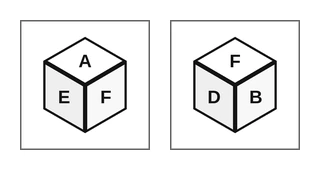
(a) B (b) C (c) A (d) D
Answer. The two positions share one face, F, and nothing else, so use the common-face rule. Read each position clockwise round the corner, starting from F. On a dice drawn like this, clockwise goes top, then right, then left. In the first position F is on the right, so from F: F, then E (left), then A (top). In the second position F is on top, so from F: F, then B (right), then D (left). Now match the places: E with B, and A with D. Faces in matching places are opposite, so B is opposite E. The pair left over, C and F, must be opposite too. A was seen next to E in the first position, so it cannot be the answer. So the answer is (a) B.
Question 13
A cube is made by folding the given sheet. In the cube so formed, which letter will be on the face opposite to the face showing 'C'?
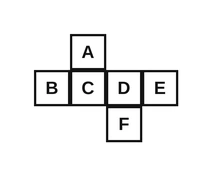
(a) A (b) B (c) D (d) E
Answer. Use the skip-one rule along the row of four: B, C, D, E. Skipping one square each time, B is opposite D and C is opposite E. The two squares off the row, A above C and F below D, become the top and bottom when the row wraps round into a ring, so A and F are opposite. Squares that touch side by side in the net are never opposite, and A, B and D all touch C. That leaves E. So the answer is (d) E.
Question 14
A cuboid measuring 4 cm × 3 cm × 3 cm is painted red on all its faces and is then cut into 36 equal cubes of side 1 cm. How many of the small cubes have exactly two faces painted?
(a) 12 (b) 16 (c) 20 (d) 24
Answer. A small cube with exactly two painted faces sits on an edge of the cuboid, but not at a corner, because a corner cube has three painted faces. A cuboid has 12 edges: 4 of each length. An edge 4 cm long has 4 small cubes on it, and taking away the 2 corner cubes leaves 2. An edge 3 cm long has 3 cubes, which leaves 1. So the total is 4 × 2 + 4 × 1 + 4 × 1 = 16. As one formula: 4 × [(4 − 2) + (3 − 2) + (3 − 2)] = 4 × 4 = 16. So the answer is (b) 16.