
Dice: What the Positions Tell You
A dice question shows two or three drawings of the same dice in different positions. Each drawing shows three faces: the top, the left and the right. You are asked which face is opposite a given face.
Faces seen together are never opposite
Opposite faces can never be seen at the same time. So any face that appears in the same drawing as the asked face cannot be its opposite. Use this every time, before anything else.
The habit: list the neighbours
Write the asked face and, next to it, every face you see beside it across all the positions. For example, if the ring is seen with the dot and the plus in one drawing and with the diamond in another, write "ring: dot, plus, diamond". This short list does most of the work.
Next to four faces
A face has four neighbours and one opposite face. So if the asked face is seen next to four different faces, the sixth face, the one never seen with it, must be its opposite.
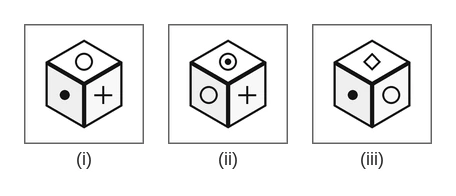
The dice in the picture carries six symbols: a dot, a ring, a plus, a target (a ring with a dot in the middle), a black square and a diamond. The ring appears in all three positions: with the dot and the plus in (i), with the target and the plus in (ii), and with the diamond and the dot in (iii). Its neighbours are the dot, the plus, the target and the diamond. The only face never seen with the ring is the black square, so the black square is opposite the ring.
Do not guess from the numbers
When the faces carry numbers, they can be numbered in any order. Never decide a pair from the numbers themselves. Only the positions shown can tell you which faces are opposite.
Time check: a dice question should take 30–45 seconds.
Solved Questions
Question 1
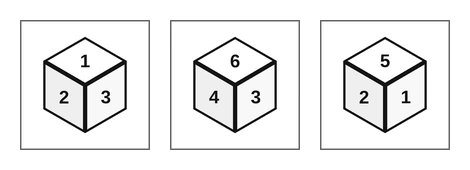
Three different positions of the same dice are shown. Find the number on the face opposite the face showing '3'.
(a) 1 (b) 4 (c) 5 (d) 6
Answer. List the faces seen next to 3. The first position shows 3 with 1 and 2. The second shows 3 with 6 and 4. The third position has no 3 in it, so it does not matter here. That makes four different neighbours: 1, 2, 4 and 6. A face has only four neighbours, so the face never seen with 3, which is 5, is opposite it. So the answer is (c) 5.
Question 2
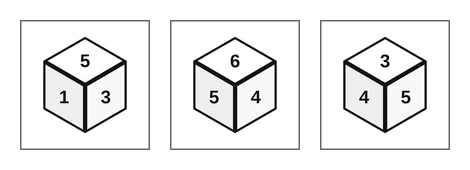
Three positions of the same dice are shown below. Which number will be on the face opposite to the face showing '5'?
(a) 2 (b) 3 (c) 4 (d) 6
Answer. The 5 shows up in all three positions: on top next to 1 and 3, on the left next to 6 and 4, and on the right next to 3 and 4. Put the neighbours together without repeats: 1, 3, 4 and 6. That is four different faces, so the one face never seen with 5 is its opposite. That face is 2. Time check: a question like this should take 30–45 seconds. So the answer is (a) 2.
Question 3
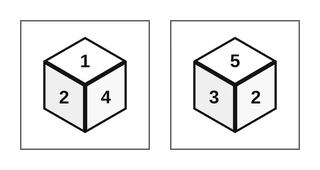
Two different positions of the same dice are shown. Which number is on the face opposite the face showing '6'?
(a) 1 (b) 3 (c) 4 (d) 2
Answer. The 6 is not in either position, so come at it from the other side. The 2 appears in both positions: next to 1 and 4 in the first, and next to 3 and 5 in the second. So 2 has four different neighbours, 1, 3, 4 and 5, and its opposite must be the sixth face, which is 6. Opposite pairs work both ways, so the face opposite 6 is 2. So the answer is (d) 2.
Two Positions That Share One Face
Often the asked face is seen with only two or three faces, so the four-neighbours rule cannot finish the job. Then look for two positions that have exactly one face in common.
Read round the common face
In each of the two positions, start at the common face and read the other two faces going clockwise. On these drawings, clockwise round the near corner means top, then right, then left. Write the two readings one under the other. Faces in the same place in the two readings are opposite.
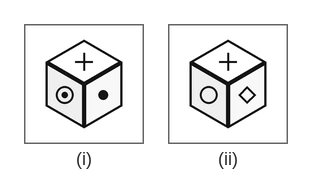
For example: both positions in the picture show the plus on top. Reading clockwise from the plus, (i) gives plus, dot, target and (ii) gives plus, diamond, ring. So the dot is opposite the diamond, and the target is opposite the ring. The plus and the black square, the two faces left, make the third pair.
Why it works
The four faces round the common face form a loop of neighbours. One position shows two of them side by side, and the other position shows the other two. Read in the same direction, each face lines up with the face across the loop from it.
The common face in different places
The common face need not be on top in both drawings. If it is on the left, read left, top, right. If it is on the right, read right, left, top. Both are clockwise. Start at the common face, go clockwise, and compare.
The pair left over, and faces that can be next to each other
Once two pairs are known, the last two faces make the third pair. This helps when the asked face appears only once: find the other pairs first, and its partner is whatever is left.
A question may also ask what can come on the faces next to a given face. Find its opposite first. Every other face is a neighbour, so the right option is the pair that contains neither the face itself nor its opposite.
[SSC Tip] Check that the two positions share exactly one face. If they share two faces, this rule does not apply, so pick a different pair of positions.
Solved Questions: One Common Face
Question 4
Two different positions of the same dice are shown. Which number is on the face opposite the face showing '2'?
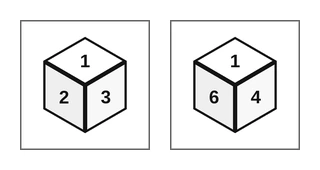
(a) 1 (b) 6 (c) 4 (d) 5
Answer. The 2 is seen only next to 1 and 3, so the four-neighbours rule cannot finish it. The two positions share only the 1, which is on top in both. Read clockwise from 1 (top, then right, then left). First position: 1, 3, 2. Second position: 1, 4, 6. Faces in the same place are opposite, so 3 is opposite 4 and 2 is opposite 6. Reading the second position the wrong way round would pair 2 with 4, so always go clockwise in both. So the answer is (b) 6.
Question 5
Two positions of a dice are shown below. Which number is opposite the face showing '1'?
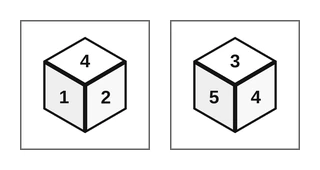
(a) 3 (b) 2 (c) 5 (d) 6
Answer. The only face the two positions share is 4. In the first it is on top, and in the second it is on the right. Start at 4 each time and go clockwise. First position, top then right then left: 4, 2, 1. Second position, right then left then top: 4, 5, 3. Line them up: 2 is opposite 5, and 1 is opposite 3. So the answer is (a) 3.
Question 6
Three different positions of the same dice are shown. Find the number on the face opposite the face showing '2'.
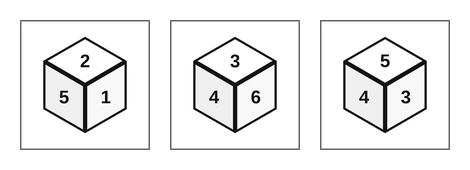
(a) 4 (b) 5 (c) 3 (d) 6
Answer. The 2 is seen only next to 5 and 1, so look for two positions with exactly one face in common. The first and second share nothing. The second and third share 3 and 4, two faces, so they are no help. The first and third share only the 5. Read clockwise from 5. In the first position 5 is on the left, so left, top, right: 5, 2, 1. In the third, 5 is on top: 5, 3, 4. 2 is opposite 3, and 1 is opposite 4. So the answer is (c) 3.
Solved Questions: The Left-over Pair and Neighbours
Question 7
Three positions of the same dice are shown below. Which number will be on the face opposite to the face showing '6'?
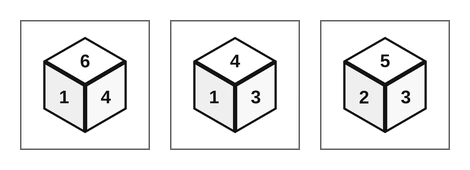
(a) 1 (b) 2 (c) 5 (d) 3
Answer. The 6 is seen only once, next to 1 and 4, so it cannot be settled directly. Find the other pairs first. The first and second positions share two faces, so skip that pair. The second and third share only the 3, which is on the right in both. Read clockwise from 3 (right, left, top): the second gives 3, 1, 4 and the third gives 3, 2, 5. So 1 is opposite 2 and 4 is opposite 5. The only faces left are 3 and 6, so they make the third pair. So the answer is (d) 3.
Question 8
Two positions of a dice are given below. What can come on the adjacent faces of the face containing '4'?
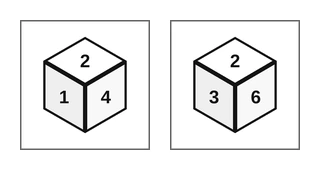
(a) 1 and 6 (b) 3 and 5 (c) 2 and 6 (d) 5 and 6
Answer. First find the face opposite 4. The two positions share only the 2, on top in both. Read clockwise from 2: the first gives 2, 4, 1 and the second gives 2, 6, 3. So 4 is opposite 6 (and 1 is opposite 3). Every face except 4 itself and 6 sits next to 4, so the faces next to 4 are 1, 2, 3 and 5. Three options have a 6 in them, and 6 can never touch 4. Only one pair is left, 3 and 5, and both of them are next to 4 even though neither is drawn beside it. So the answer is (b) 3 and 5.
Cube Nets: Opposite Faces
A net is the flat sheet that folds into a cube: six squares joined edge to edge. The question asks which face will be opposite a given face after folding.
Skip one square
In a straight row or column of three or more squares, the first and third squares are opposite, and so are the second and fourth. A row of four wraps round the cube like a belt, so squares one apart end up facing each other. The two ends of a row of four are not opposite: they meet side by side when the belt closes.
Squares that touch are never opposite
Two squares joined along an edge in the net become neighbours on the cube, so they can never be opposite.
The pair left over
Once two pairs are found by skipping, the two squares left are opposite. In a net with a row of four, the row gives two pairs, and the square above the row and the square below it are the third pair, wherever along the row they are joined.
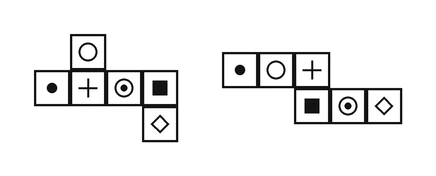
In the first net, skip one along the row dot, plus, target, black square: the dot is opposite the target, and the plus is opposite the black square. The ring above the row and the diamond below it are the last pair, even though they hang from different squares of the row. In the second net each row of three gives one pair: the dot with the plus, and the black square with the diamond. The two left over, the ring and the target, are the third pair.
You do not need to learn the shapes
There are eleven different nets of a cube. You do not have to memorise them. Find two pairs by skipping, take the left-over pair, and if a net still puzzles you, fold it in your head one square at a time, keeping one square flat as the bottom.
Time check: an opposite-face net question should take 20–30 seconds.
Solved Questions: Opposite Faces in a Net
Question 9
A cube is made by folding the given sheet. In the cube so formed, which number will be on the face opposite to the face showing '4'?
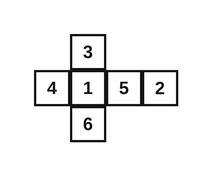
(a) 1 (b) 5 (c) 2 (d) 3
Answer. Use the row of four: 4, 1, 5, 2. Skip one square along it: 4 and 5 are opposite, and 1 and 2 are opposite. The 3 above the row and the 6 below it are the last pair. Note that 4 and 2, the two ends of the row, are not opposite: when the row wraps round the cube they meet side by side. So the answer is (b) 5.
Question 10
The given sheet is folded to form a cube. Which number will be on the face opposite the face showing '5'?
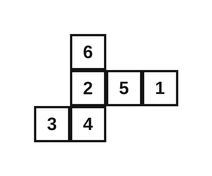
(a) 1 (b) 4 (c) 6 (d) 3
Answer. Look for straight lines of three squares. The column 6, 2, 4 gives 6 opposite 4 (skip the 2). The row 2, 5, 1 gives 2 opposite 1 (skip the 5). The two squares left are 5 and 3, so they are opposite. They do not touch along an edge in the net, which fits. So the answer is (d) 3.
Question 11
A cube is made by folding the given sheet. In the cube so formed, which number will be on the face opposite to the face showing '6'?
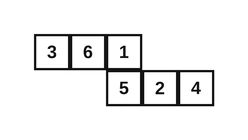
(a) 2 (b) 1 (c) 4 (d) 5
Answer. This net is two rows of three. Each row gives one pair by skipping its middle square: 3 is opposite 1, and 5 is opposite 4. The middle squares, 6 and 2, are the two left over, so they are opposite. So the answer is (a) 2.
Which Cube Can Be Made from the Net
Here the options are four drawings of a cube, and only one of them can be folded from the net. Work in two steps.
Step 1: rule out opposite faces
Find the three pairs of opposite faces in the net. Any option that shows both faces of a pair is impossible, because opposite faces are never seen together. This usually removes one option straight away.
Step 2: check the order round the corner
The options left show three faces that can meet at a corner. Now check their order. In the net, find the point where these three squares meet (three squares round one point, in an L shape). Go round that point clockwise and note the order. When the net is folded, the three faces meet at a corner of the cube in the same clockwise order.
On a drawn cube, going clockwise round the near corner means top, then right, then left.
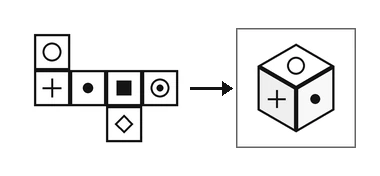
In the picture, the ring, the dot and the plus meet at the bottom-right corner of the square with the ring. Going clockwise round that point: ring, dot, plus. The cube shows the ring on top, the dot on the right and the plus on the left, and top, right, left is clockwise, so the order matches. A cube with the dot on the left and the plus on the right would be the mirror image, and no folding can make it.
Turning the cube
The same corner can be drawn with any of its three faces on top. Ring on top with the dot on the right, dot on top with the plus on the right, and plus on top with the ring on the right are all the same corner. What matters is the clockwise order, not which face is on top.
Time check: a which-cube question should take 45–60 seconds.
Solved Questions: Which Cube
Question 12
Select the cube that can be formed by folding the given sheet along the lines.
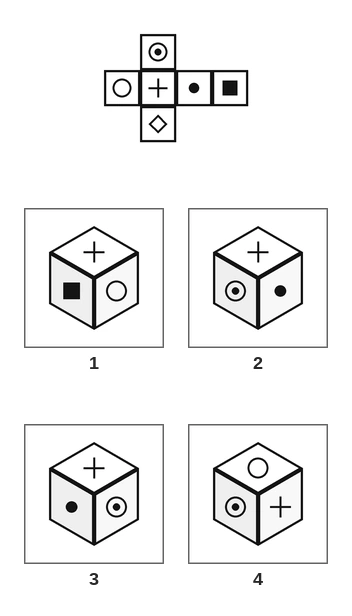
(a) Figure 1 (b) Figure 2 (c) Figure 3 (d) Figure 4
Answer. First the opposite pairs. Along the row ring, plus, dot, black square, skip one: the ring is opposite the dot, and the plus is opposite the black square. The target above the row and the diamond below it are the third pair. Figure 1 shows the plus and the black square together, so it is out. Now the order. In the net the plus, the dot and the target meet at one point, the top-right corner of the square with the plus. Going clockwise round that point from the plus: plus, target, dot. On a drawn cube clockwise is top, right, left, so with the plus on top the target must be on the right and the dot on the left. Figure 3 is exactly that. Figure 2 has the dot and the target swapped, which is the mirror image. In Figure 4 the ring is on top, but round the top-left corner of the square with the plus the order from the ring is ring, target, plus, so the target belongs on the right, not the left. So the answer is (c) Figure 3.
Question 13
Select the cube that can be formed by folding the given sheet along the lines.
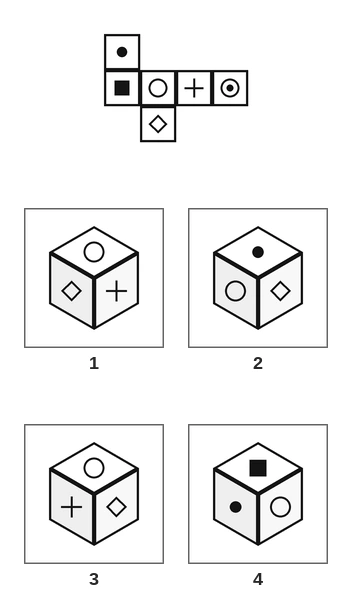
(a) Figure 1 (b) Figure 2 (c) Figure 3 (d) Figure 4
Answer. Opposite pairs first. Along the row black square, ring, plus, target, the black square is opposite the plus and the ring is opposite the target. The dot above the row and the diamond below it are the third pair, so Figure 2, with the dot and the diamond together, is out. The ring, the plus and the diamond meet at the bottom-right corner of the square with the ring. Clockwise round that point from the ring: ring, plus, diamond. So with the ring on top, the plus is on the right and the diamond on the left, which is Figure 1. Figure 3 swaps the plus and the diamond. Figure 4 has the black square on top, the ring on the right and the dot on the left. But the dot, ring and black square meet at the top-left corner of the square with the ring, where the clockwise order from the black square is black square, dot, ring, so the dot belongs on the right. So the answer is (a) Figure 1.
Question 14
Select the cube that can be formed by folding the given sheet along the lines.
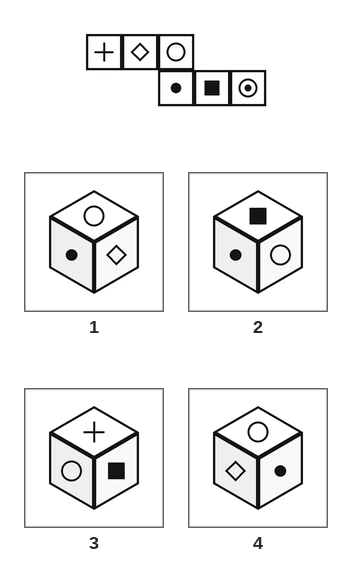
(a) Figure 1 (b) Figure 2 (c) Figure 3 (d) Figure 4
Answer. Each row of three gives a pair by skipping its middle square: the plus is opposite the ring, and the dot is opposite the target. The two middle ones, the diamond and the black square, are the third pair. Figure 3 shows the plus and the ring together, so it is out. The diamond, the ring and the dot meet at the bottom-left corner of the square with the ring. Clockwise round that point from the ring: ring, dot, diamond. So with the ring on top, the dot is on the right and the diamond on the left, which is Figure 4. Figure 1 swaps them. Figure 2 has the black square on top with the ring on the right, but the ring, black square and dot meet at the bottom-right corner of the square with the ring, where the clockwise order from the black square is black square, dot, ring. The dot belongs on the right, and Figure 2 is a mirror image. So the answer is (d) Figure 4.
Painted Cubes
A cube is painted on all its faces and then cut into equal small cubes. The question asks how many small cubes have three, two, one or no faces painted. There is no picture, so build one in your head.
Where each kind of small cube sits
Let each edge be cut into n equal parts, so there are n × n × n small cubes.
| Faces painted | Where these cubes sit | How many |
|---|---|---|
| three | at the 8 corners | 8 |
| two | along the 12 edges, leaving out the corners | 12 × (n − 2) |
| one | in the middle part of each of the 6 faces | 6 × (n − 2) × (n − 2) |
| none | hidden inside | (n − 2) × (n − 2) × (n − 2) |
The n − 2 appears because each edge loses its two corner cubes, and each face loses a strip along every edge.
Ready numbers
| n | small cubes | three | two | one | none |
|---|---|---|---|---|---|
| 3 | 27 | 8 | 12 | 6 | 1 |
| 4 | 64 | 8 | 24 | 24 | 8 |
| 5 | 125 | 8 | 36 | 54 | 27 |
As a check, the four numbers always add up to the total. For n = 4: 8 + 24 + 24 + 8 = 64.
Reading the stem
The stem may give the number of small cubes instead of n: 27 means n = 3, 64 means n = 4 and 125 means n = 5. Or it may give the edge of the big cube and the edge of the small ones: a 4 cm cube cut into 1 cm cubes means n = 4.
Time check: a painted cube question should take 20–30 seconds.
[SSC Tip] Read the last line of the stem twice. "Exactly two faces" leaves out the corner cubes, while "at least two faces" takes them in.
Solved Questions: Painted Cubes
Question 15
A cube is painted red on all its faces and is then cut into 27 equal small cubes. How many of the small cubes have exactly two faces painted?
(a) 4 (b) 6 (c) 8 (d) 12
Answer. Cut into 27 cubes means 3 along each edge, so n = 3. Cubes with exactly two painted faces sit along the edges, but not at the corners, because corner cubes have three. Each edge has 3 small cubes, and taking away the 2 corner ones leaves 1. A cube has 12 edges, so 12 × 1 = 12. So the answer is (d) 12.
Question 16
A wooden cube of edge 4 cm is painted blue on all six faces. It is then cut into small cubes of edge 1 cm. How many small cubes have exactly one face painted?
(a) 8 (b) 16 (c) 24 (d) 32
Answer. A 4 cm edge cut into 1 cm pieces gives 4 small cubes along each edge, so n = 4. Cubes with exactly one painted face sit in the middle part of a face, away from all its edges. On one face that is a 2 × 2 square of cubes, which is 4. There are 6 faces, so 6 × 4 = 24. Time check: with the formula 6 × (n − 2) × (n − 2) this fits easily in 20–30 seconds. So the answer is (c) 24.
Cuboids, Unpainted Faces and Two Colours
Not every question paints a whole cube in one colour. The method stays the same: decide where each small cube sits, then count.
A cuboid
Say a cuboid is cut into a small cubes along its length, b along its width and c along its height, each at least 2. It still has 8 corner cubes with three faces painted. Each of its edges loses its two corner cubes, so the cubes with two faces are 4 × (a − 2) + 4 × (b − 2) + 4 × (c − 2). Each face loses its border, so the cubes with one face are 2 × (a − 2) × (b − 2) + 2 × (b − 2) × (c − 2) + 2 × (c − 2) × (a − 2). The hidden ones are (a − 2) × (b − 2) × (c − 2). For a 3 × 5 × 6 cuboid that gives 8, 32, 38 and 12, which add up to 90.
Some faces left unpainted
When a face is not painted, the small cubes against it lose that painted face. A corner cube against the unpainted face has only two painted faces, and so on. Picture the cube standing on a table with its bottom face unpainted, and count layer by layer: the top layer, the middle layers and the bottom layer each have their own pattern.
Two colours
When faces have different colours, sort the small cubes by where they sit and name the colours on each one. A cube on the edge where a red face meets a blue face has one red and one blue face. A corner cube touches three faces, so it carries all three of their colours.
Still aim for 20–30 seconds: once you can picture where each cube sits, the counting is quick.
Solved Questions: Colours and Unpainted Faces
Question 17
A cube is painted red on its top and bottom faces and blue on its four side faces. It is then cut into 64 equal small cubes. How many small cubes have exactly one face painted, and that face blue?
(a) 4 (b) 16 (c) 20 (d) 24
Answer. 64 small cubes means 4 along each edge. A cube with only one face painted lies in the middle part of a face: 2 × 2 = 4 on each face. The top and bottom faces are red, so their middle cubes have a red face and do not count. The four side faces are blue, so 4 × 4 = 16 cubes have exactly one face painted, and it is blue. So the answer is (b) 16.
Question 18
A cube stands on a table. Its top face and its four side faces are painted green, and the face resting on the table is left unpainted. The cube is then cut into 27 equal small cubes. How many small cubes have exactly one face painted?
(a) 5 (b) 6 (c) 9 (d) 12
Answer. 27 small cubes means 3 along each edge, so picture the cube in three layers. In the top layer only the centre cube has one painted face, the top: 1. In the middle layer the cube in the middle of each side has one painted face: 4. In the bottom layer nothing is painted underneath, so the middle cube of each side again has only its side face painted: 4. If all six faces were painted the answer would be 6, but here 1 + 4 + 4 = 9. So the answer is (c) 9.