
The Four Statement Forms and the Picture Method
Every syllogism starts with three rules. Take each statement as true, however odd it sounds ("All chairs are rivers"), and use nothing from outside it. Every class that is named has at least one member. A conclusion follows only if it is true in every picture that fits the statements.
What each form gives
| Statement | It also gives | It does not give |
|---|---|---|
| All A are B | Some A are B, Some B are A | All B are A, Some B are not A |
| No A is B | No B is A, Some A are not B, Some B are not A | anything that puts an A inside B |
| Some A are B | Some B are A | All A are B, Some A are not B |
| Some A are not B | nothing new | anything about B, not even "Some B are not A" |
Two of these trip students up again and again. "All A are B" turned round becomes "All B are A", which does not follow, because the B circle can be bigger. And "Some A are not B" says nothing about the B side at all: the B circle may sit wholly inside A, or far away from it.
The picture method
- Draw the smallest picture the statements allow. "All" puts one circle inside another, "No" keeps two circles apart, and "Some" makes two circles overlap.
- Take each conclusion in turn and try to break it. Draw another picture that still fits every statement but makes the conclusion false. If you can, the conclusion does not follow. If every picture keeps it true, it follows.
Four moves break most conclusions. Slide a class into the empty part of the middle class, away from the other class. Make two classes one circle ("All A are B" lets A and B be the same). Let one class swallow another ("Some A are B" lets all of A sit inside B). Move a class that nothing holds in place right outside.
For example: "All A are B. Some B are C." The smallest picture has A inside B and C overlapping B. Slide C so it touches B only outside A, and "Some A are C" breaks. Slide it over A instead, and "No A is C" breaks. So neither follows on its own, and those two make an either pair.
Two and Three Statements, Either-Or and Possibility
Two statements joined by the middle class
| The two statements | What follows about A and C |
|---|---|
| All A are B, All B are C | All A are C, and Some C are A |
| All A are B, No B is C | No A is C, and Some C are not A |
| Some A are B, All B are C | Some A are C, and Some C are A |
| Some A are B, No B is C | Some A are not C (not "Some C are not A") |
| No A is B, All B are C | only Some C are not A |
| No A is B, Some B are C | only Some C are not A |
| All A are B, Some B are C | nothing definite |
| Some A are B, Some B are C | nothing definite |
| No A is B, No B is C | nothing definite |
| All A are B, All C are B | nothing definite |
| No A is B, All C are B | No A is C, and No C is A |
Read the direction of the "not" carefully. In "Some A are B, No B is C", the A's that are B are cut off from C, so some A are not C. The C side is free: every C could still be an A.
Three statements
Find two statements that share a class and join them, then join that result to the third statement. A conclusion about two classes at the ends of the chain needs every link on the way to give something definite. One weak link (a "Some" meeting a "Some", or two "All" pointing into the same circle) and the end-to-end conclusion breaks. Conclusions that only turn a statement round, or follow from one statement alone, are quick wins, so mark them first.
Either-or
"Either I or II follows" is right only when all three of these hold:
- neither I nor II follows on its own,
- both are about the same two classes, and
- exactly one of the two is true in every picture: "Some A are B" with "No A is B", or "All A are B" with "Some A are not B".
"All A are B" with "No A is B" is not an either pair, because both can be false at once (the circles just overlap). When an either pair is there, the right option names it, as in "Only I and either II or III follow".
Possibility
- "Some A being B is a possibility", "All A can be B" and the like follow when at least one picture that fits the statements makes them true.
- If the statements already force "No A is B", then "Some A being B is a possibility" fails, and so does "All A being B is a possibility".
- "All A can never be B" means it is impossible for every A to be a B. It follows only when "Some A are not B" must be true.
Venn Diagrams: Classes, Counting and Set Problems
Classes, pair by pair
Take the three classes two at a time and settle each pair by plain everyday meaning:
- Inside: every X is a Y (every cricketer is a sportsperson). The X circle goes inside the Y circle.
- Overlap: some X are Y, some X are not, and some Y are not X (cricketers and left-handers).
- Separate: no X is a Y (cricketers and bridges).
Then pick the diagram that shows exactly those three relations, no more and no fewer.
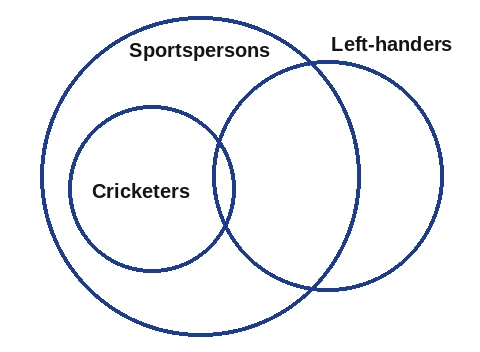
Here every cricketer is a sportsperson, so that circle sits inside. Left-handers overlap both: there are left-handed cricketers, left-handed sportspersons who play other games, and many left-handers who play no sport at all.
In a reverse question the diagram comes first. Read off its shape (which circle is inside which, which circles touch), then test each set of classes against it. One pair that does not fit knocks a set out, so you seldom need to check all three pairs.
Counting phrases
- only X: the part of the X circle that touches no other circle
- X and Y but not Z: the part where just X and Y meet
- X and Y (both): that part plus the centre
- exactly two: the three parts where just two circles meet
- at least two: those three parts plus the centre
- only one: the three "only" parts
- at least one: every number inside the circles
- none: the number outside all the circles
- neither X nor Y: everything outside those two circles. With three circles, that takes in the part of the third circle that touches neither
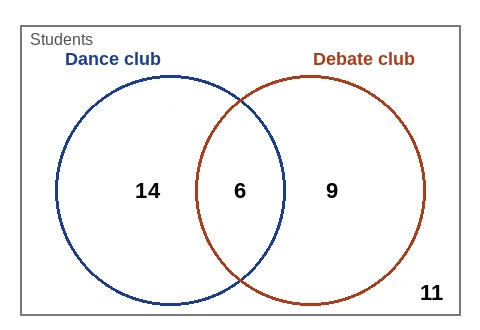
Two sets with no figure
The two-set rule in words: the number in at least one set is the first set plus the second set, minus the number in both. The people in both were counted once in each set, so you take them away once. After that:
- neither = total minus those in at least one
- only the first = the first set minus both
- exactly one = the two sets added, minus two times both
The figure above shows a class of 40. The dance club has 14 + 6 = 20 members and the debate club has 9 + 6 = 15. So 20 + 15 − 6 = 29 are in at least one club, 40 − 29 = 11 are in neither, 20 − 6 = 14 are in dance only, and 20 + 15 − 12 = 23 are in exactly one. Read the question for "only": a word problem that says "40 like tea" counts the ones who like coffee too, unless it says "only tea".
Timing and Last-Week Checks
Time targets
- a one- or two-statement syllogism: about 25–35 seconds
- a three-statement syllogism, or any with either-or or possibility conclusions: about 40–50 seconds
- a pick-the-diagram or reverse Venn question: about 20–30 seconds
- a counting question on a figure: about 25–35 seconds
- a set word problem: about 40–60 seconds
The Tier 1 Reasoning section has 25 questions and its own locked 15-minute clock, an average of 36 seconds a question. The Venn questions are the quick ones, and the time you save there can go to a three-statement syllogism with a possibility conclusion.
Skip rule. If a syllogism is still open after 50 seconds, or a set word problem has not come out in a minute, mark it and move on. When you come back, start from what you already wrote: the tick or cross beside each conclusion, or the numbers you had already added.
Checks for the last week
- "All" turned round. "All A are B" never gives "All B are A".
- "Some … not" read backwards. "Some A are not B" tells you nothing about B.
- A false either pair. "All A are B" with "No A is B" can both be false, and a pair is never an either if one of the two already follows.
- A possibility the statements forbid. If "No A is B" is forced, then "Some A being B" and "All A being B" are not possible.
- Outside facts in a syllogism. "All cups are rivers" is true for the question.
- A shaky fact in a Venn question. Go with plain meaning: every sparrow is a bird, some teachers are swimmers, no fish is a chair.
- "And" versus "but not". "Tea and coffee" takes in the centre, "tea and coffee but not juice" leaves it out.
- The "both" group in a word problem. Take it away once when you add the two sets, not twice and not zero times.
[SSC Tip] Write your verdict beside each conclusion (tick, cross, or E for an either pair) before you read the options. Options in this chapter are built to catch a verdict you half-remember.