
Three Statements: One Picture for All
Three statements usually bring in four classes. Often they run in a line: the first statement links A with B, the second links B with C, and the third links C with D. That is a chain.
For example: Some A are B. All B are C. No C is D.
Draw it one statement at a time, all on the same picture. B goes inside C. A overlaps B. D stays clear of C.
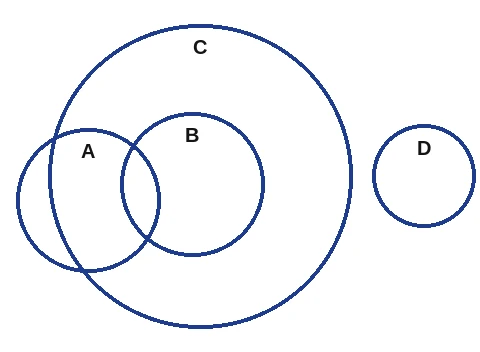
Now read the picture one pair of classes at a time.
- A and C: the A members inside B are inside C as well, so "Some A are C" follows.
- B and D: B is inside C, and C never meets D, so "No B is D" follows.
- A and D: the A members inside B are C, so they cannot be D. "Some A are not D" follows. The A members outside C are free, though, so "No A is D" does not follow.
Two links instead of one long chain
You can also treat three statements as two separate links. The first link is statements 1 and 2, joined through the class they share. The second link is statements 2 and 3, joined through theirs. Use the two-statement results from the previous section on each link, then put the links together.
In the example, the first link (Some A are B, All B are C) gives "Some A are C". The second link (All B are C, No C is D) gives "No B is D". To reach from A to D, join "Some A are C" with "No C is D", which gives "Some A are not D". If any step on the way gives nothing definite, such as two "some" statements in a row, nothing definite reaches the far end.
Not every question is a straight line. Sometimes one class appears in all three statements, like a hub with the other three classes hanging off it. Treat each statement as a link to the hub and draw them all on one picture in the same way.
Four conclusions
Some questions add a fourth conclusion. Take them one at a time, in this order:
- Conclusions about the two classes of a single statement. Check them by turning the statement round.
- Conclusions about the two outer classes of one link. Use the two-statement results.
- Conclusions about the far ends. Use the whole picture, and try hard to break them.
After the first two or three conclusions, several options usually drop out, so keep an eye on the options as you go.
Time check: aim for about 40–50 seconds on a three-statement question.
Solved Questions
Question 1
Three statements are given, followed by three conclusions numbered I, II and III. Assuming the statements to be true, even if they seem to be at variance with commonly known facts, decide which of the conclusions logically follow(s) from the statements.
Statements:
All staplers are punches.
Some punches are trimmers.
No trimmer is a stencil.
Conclusions:
I. Some punches are not stencils.
II. Some trimmers are staplers.
III. No stapler is a stencil.
(a) Only conclusion I follows (b) Only conclusions I and III follow (c) Only conclusions II and III follow (d) All conclusions follow
Answer. This is a chain: staplers to punches, punches to trimmers, trimmers to stencils. Draw staplers inside punches, let trimmers overlap punches, and keep stencils clear of trimmers. The punches that are trimmers can never be stencils, so some punches are not stencils. I follows. Trimmers can meet punches in the part with no staplers, which breaks II. For III, nothing keeps staplers away from stencils. Stencils only have to stay clear of trimmers, so let them overlap staplers, and III fails. So the answer is (a) Only conclusion I follows.
Question 2
Three statements are given, followed by three conclusions numbered I, II and III. Assuming the statements to be true, even if they seem to be at variance with commonly known facts, decide which of the conclusions logically follow(s) from the statements.
Statements:
Some ledgers are journals.
All ledgers are dockets.
No ledger is a memo.
Conclusions:
I. Some dockets are journals.
II. Some dockets are not memos.
III. No journal is a memo.
(a) Only conclusions II and III follow (b) Only conclusion I follows (c) Only conclusions I and II follow (d) All conclusions follow
Answer. Ledgers appear in all three statements, so take ledgers as the hub and hang the other classes off it. Ledgers sit inside dockets, journals overlap ledgers, and memos stay clear of ledgers. The journals that are ledgers are dockets too, so some dockets are journals. I follows. Every ledger is a docket and no ledger is a memo, so the ledger part of dockets has no memos in it. II follows. III fails, because the journals outside ledgers are free, and memos can overlap them. So the answer is (c) Only conclusions I and II follow.
Question 3
Three statements are given, followed by four conclusions numbered I, II, III and IV. Assuming the statements to be true, even if they seem to be at variance with commonly known facts, decide which of the conclusions logically follow(s) from the statements.
Statements:
All K are E.
All E are G.
All G are M.
Conclusions:
I. All K are G.
II. Some M are E.
III. All M are K.
IV. Some G are K.
(a) Only conclusions I and II follow (b) Only conclusions I, II and IV follow (c) Only conclusions II and IV follow (d) All conclusions follow
Answer. All three statements are "All", so the four circles nest: K inside E, E inside G, G inside M. Anything in an inner circle is inside every circle around it. K is inside G, so I follows. E has a member, and it sits inside M, so II follows. K has a member, and it sits inside G, so IV follows. III turns the chain round. M can be much bigger than K, so III fails. So the answer is (b) Only conclusions I, II and IV follow.
Time check: a pure "All" chain is the quickest kind of three-statement question, so aim for the low end of 40–50 seconds.
Solved Questions: Longer Chains
Question 4
Three statements are given, followed by four conclusions numbered I, II, III and IV. Assuming the statements to be true, even if they seem to be at variance with commonly known facts, decide which of the conclusions logically follow(s) from the statements.
Statements:
Some lecterns are podiums.
All podiums are stands.
Some stands are racks.
Conclusions:
I. Some stands are lecterns.
II. Some racks are podiums.
III. Some lecterns are racks.
IV. Some racks are stands.
(a) Only conclusions I and IV follow (b) Only conclusions I, III and IV follow (c) Only conclusion IV follows (d) Only conclusions II and IV follow
Answer. Take the first link. Some lecterns are podiums, and every podium is a stand, so those lecterns are stands. That gives some stands are lecterns, and I follows. IV is the third statement turned round, so it follows too. Now the second link. Podiums sit inside stands, and racks meet stands somewhere. Racks can meet stands away from podiums and away from lecterns, which breaks both II and III. So the answer is (a) Only conclusions I and IV follow.
Question 5
Three statements are given, followed by three conclusions numbered I, II and III. Assuming the statements to be true, even if they seem to be at variance with commonly known facts, decide which of the conclusions logically follow(s) from the statements.
Statements:
All jotters are notepads.
No notepad is a sketchbook.
Some sketchbooks are albums.
Conclusions:
I. No jotter is a sketchbook.
II. Some albums are not notepads.
III. Some albums are jotters.
(a) Only conclusion I follows (b) All conclusions follow (c) Only conclusions I and III follow (d) Only conclusions I and II follow
Answer. Jotters sit inside notepads, and sketchbooks stay clear of notepads, so no jotter is a sketchbook. I follows. The albums that are sketchbooks cannot be notepads, so some albums are not notepads. II follows. III needs albums to reach jotters. The albums outside sketchbooks could touch jotters, but they need not. Keep albums away from notepads altogether and III fails. So the answer is (d) Only conclusions I and II follow.
Question 6
Three statements are given, followed by three conclusions numbered I, II and III. Assuming the statements to be true, even if they seem to be at variance with commonly known facts, decide which of the conclusions logically follow(s) from the statements.
Statements:
All B are H.
Some H are C.
No C is L.
Conclusions:
I. All B are C.
II. Some H are not L.
III. No B is L.
(a) Only conclusions II and III follow (b) Only conclusion II follows (c) Only conclusions I and II follow (d) None of the conclusions follow
Answer. Draw B inside H. C meets H somewhere, and L stays clear of C. The H members that are C cannot be L, so some H are not L. II follows. C can meet H in the part with no B, so B need not sit inside C, which breaks I. For III, nothing keeps L away from B. L only has to avoid C, so let L overlap B, and III fails. So the answer is (b) Only conclusion II follows.
Either-Or Pairs
Sometimes two conclusions both fail on their own, and yet one of the two must be true. Then the answer reads "Either I or II follows".
When two conclusions make an either pair
All three of these must hold:
- Neither conclusion follows on its own.
- Both talk about the same two classes.
- In every picture that fits the statements, exactly one of the two is true.
Only two kinds of pair can do this:
| Pair | Why exactly one is always true |
|---|---|
| Some A are B / No A is B | A and B either share a member or they do not |
| All A are B / Some A are not B | either every A is a B, or at least one A is not |
The first pair works with the classes in either order. "Some B are A" with "No A is B" is also a pair, since both ask whether A and B share a member. The second pair needs the same order. "All A are B" pairs with "Some A are not B", not with "Some B are not A".
For example: Some A are B. All B are C. Conclusions: I. All A are C. II. Some A are not C. The A members inside B are inside C, but the rest of A may stay inside C or stick out. So neither conclusion is forced. Both are about A and C in the same order, and one of them is always true. That is an either pair.
Why "All A are B" and "No A is B" are not a pair
These two can both be false at the same time. Draw A overlapping B with some A outside. Then not every A is a B, and some A are B, so both conclusions are false in one picture. "Either" needs one of the two to be true in every picture, so this is not an either pair. When both fail, the answer is that neither follows.
Reading the options
When the conclusions hold an either pair, the right option must name it. If another conclusion follows as well, look for an option like "Only conclusion III and either I or II follow". "Neither I nor II follows" is wrong for a real pair, even though each conclusion fails on its own.
Check the first condition before anything else. If one of the two conclusions already follows, there is no either case. For example, if the statements make "Some A are B" certain, then "Some A are B" simply follows, and "No A is B" simply fails.
[SSC Tip] When two conclusions about the same two classes both fail, stop and check whether they form an either pair before you mark "Neither".
Solved Questions: Either-Or
Question 7
Two statements are given, followed by three conclusions numbered I, II and III. Assuming the statements to be true, even if they seem to be at variance with commonly known facts, decide which of the conclusions logically follow(s) from the statements.
Statements:
Some vouchers are coupons.
All coupons are tokens.
Conclusions:
I. Some vouchers are tokens.
II. Some tokens are not vouchers.
III. All tokens are vouchers.
(a) Only conclusion I follows (b) Only conclusions I and II follow (c) Only conclusion I and either II or III follow (d) Either conclusion II or III follows
Answer. Coupons sit inside tokens, and some vouchers are coupons. Those vouchers are tokens, so I follows. II and III are both about tokens and vouchers, in the same order. Neither one is forced. Tokens can stick out of vouchers, or the whole tokens circle can sit inside vouchers. But one of them is always true, because either every token is a voucher or at least one is not. That makes an either pair. So the answer is (c) Only conclusion I and either II or III follow.
Question 8
Three statements are given, followed by three conclusions numbered I, II and III. Assuming the statements to be true, even if they seem to be at variance with commonly known facts, decide which of the conclusions logically follow(s) from the statements.
Statements:
All inkpads are stamps.
Some stamps are seals.
No seal is a sticker.
Conclusions:
I. Some inkpads are seals.
II. No inkpad is a seal.
III. Some stamps are not stickers.
(a) Only conclusion III follows (b) Only conclusion III and either I or II follow (c) Either conclusion I or II follows (d) Only conclusions I and III follow
Answer. The stamps that are seals cannot be stickers, so some stamps are not stickers. III follows. Now I and II. Inkpads sit inside stamps, and seals meet stamps somewhere. Seals may touch the inkpads or meet stamps somewhere else, so neither I nor II is forced. But both are about inkpads and seals, and one of them must be true: either some inkpad is a seal or none is. I and II make an either pair. So the answer is (b) Only conclusion III and either I or II follow.
Question 9
Read the given statements and conclusions carefully. Assuming that the information given in the statements is true, even if it appears to be at variance with commonly known facts, decide which of the given conclusions logically follow(s) from the statements.
Statements:
Some M are B.
Some B are J.
Conclusions:
I. All M are J.
II. No M is J.
(a) Either conclusion I or II follows (b) Only conclusion I follows (c) Only conclusion II follows (d) Neither conclusion I nor II follows
Answer. Both conclusions are about M and J, and neither follows on its own, since two "some" statements say nothing about M and J. It is tempting to call them an either pair. But "All" and "No" can both be false together. Draw M overlapping J with part of M outside J. Then not all M are J, and some M are J, so I and II are both false in the same picture. "Either" needs one of the two to be true in every picture, so this is not an either pair. So the answer is (d) Neither conclusion I nor II follows.
Question 10
Read the given statements and conclusions carefully. Assuming that the information given in the statements is true, even if it appears to be at variance with commonly known facts, decide which of the given conclusions logically follow(s) from the statements.
Statements:
Some highlighters are not markers.
No marker is a whitener.
Conclusions:
I. Some whiteners are highlighters.
II. No highlighter is a whitener.
(a) Only conclusion I follows (b) Neither conclusion I nor II follows (c) Both conclusions I and II follow (d) Either conclusion I or II follows
Answer. Whiteners stay clear of markers. The highlighters outside markers are free, so whiteners may touch them or may not. Neither conclusion is forced. Now look at the classes. I talks about whiteners and highlighters, and II about highlighters and whiteners. The order is turned, but both ask the same thing, which is whether highlighters and whiteners share a member. Either they do or they do not, so exactly one of the two is always true. So the answer is (d) Either conclusion I or II follows.
Possibility Conclusions
Some conclusions are written as possibilities: "Some A being B is a possibility", "All A being B is a possibility", or the shorter "All A can be B" and "Some A can be B". These ask whether a conclusion can be true, not whether it must be true.
So the test flips. A possibility follows if you can draw at least one picture that fits every statement and makes it true. You are no longer trying to break the conclusion. You are trying to build it.
For example: Some A are B. No B is C. Conclusion: "Some A being C is a possibility."
Draw A overlapping B, and let the part of A outside B reach across to C. B and C still stay apart.
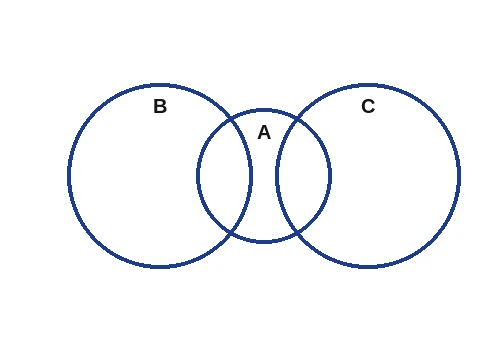
Both statements hold, and some A are C. So the possibility follows.
When a possibility fails
A possibility fails only when the statements forbid it in every picture. Look for a "No" in the way, or a definite result that goes against it.
- In the example, "Some B being C is a possibility" fails, because no B is a C in any picture.
- If all A are B and no B is C, then "Some A being C is a possibility" fails, because A sits inside B, and B never meets C.
- "All A being B is a possibility" fails whenever some A must be outside B, for example when some A are C and no C is B.
Never already certain
A possibility conclusion is meant for something the statements leave open. If the statements already make it certain, for example "Some A being B is a possibility" when "Some A are B" is given, readers split on whether to mark it. The questions in this course never use such a conclusion. Every possibility here is about something that may or may not be true.
"Can be" says the same thing
"All A can be B" is read just like "All A being B is a possibility", and "Some A can be B" just like "Some A being B is a possibility". Test them in the same way: find one picture that makes them true.
You may also meet "No A being B is a possibility". It asks whether A and B could be kept completely apart. One picture with A and B apart that still fits every statement is enough to make it follow.
Solved Questions: Possibility
Question 11
Three statements are given, followed by three conclusions numbered I, II and III. Assuming the statements to be true, even if they seem to be at variance with commonly known facts, decide which of the conclusions logically follow(s) from the statements.
Statements:
Some easels are canvases.
No canvas is a palette.
Some palettes are brushes.
Conclusions:
I. Some easels being palettes is a possibility.
II. All canvases being easels is a possibility.
III. Some palettes being canvases is a possibility.
(a) Only conclusions I and II follow (b) Only conclusion I follows (c) All conclusions follow (d) Only conclusions II and III follow
Answer. For a possibility, look for one picture that makes it true. For I, let the easels outside canvases overlap palettes. Canvases and palettes still stay apart, so every statement holds. I follows. For II, put the whole canvases circle inside easels. Some easels are still canvases, so II follows too. III asks for a palette that is a canvas, but no canvas is a palette in any picture, so III fails. So the answer is (a) Only conclusions I and II follow.
Question 12
Two statements are given, followed by three conclusions numbered I, II and III. Assuming the statements to be true, even if they seem to be at variance with commonly known facts, decide which of the conclusions logically follow(s) from the statements.
Statements:
All atlases are workbooks.
No workbook is a magazine.
Conclusions:
I. Some atlases being magazines is a possibility.
II. All magazines being workbooks is a possibility.
III. All workbooks being atlases is a possibility.
(a) Only conclusions I and III follow (b) None of the conclusions follow (c) Only conclusions II and III follow (d) Only conclusion III follows
Answer. Atlases sit inside workbooks, and magazines stay clear of workbooks. I asks for an atlas that is a magazine. Every atlas is a workbook and no workbook is a magazine, so that can never happen, and I fails. II fails in the same way: magazines have members, and none of them can be workbooks. III asks whether every workbook could be an atlas. Make the two circles the same, and both statements still hold. III follows. So the answer is (d) Only conclusion III follows.
Question 13
Three statements are given, followed by four conclusions numbered I, II, III and IV. Assuming the statements to be true, even if they seem to be at variance with commonly known facts, decide which of the conclusions logically follow(s) from the statements.
Statements:
Some E are F.
All F are K.
No K is L.
Conclusions:
I. Some E are K.
II. Some E being L is a possibility.
III. All F being E is a possibility.
IV. Some L being F is a possibility.
(a) Only conclusions I and II follow (b) All conclusions follow (c) Only conclusions I, II and III follow (d) Only conclusions I and III follow
Answer. Start with the definite one. The E members that are F sit inside K, so some E are K. I follows. For II, let the part of E outside K stretch across to L.
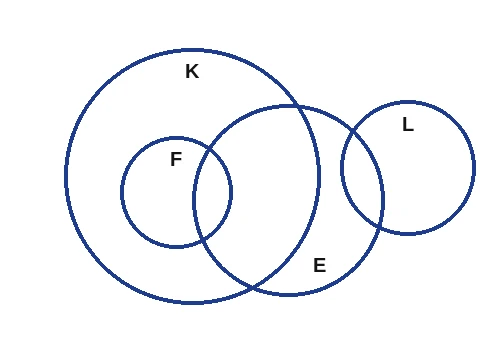
K and L still stay apart, so every statement holds, and some E are L. II follows. For III, put the whole F circle inside E. Some E are still F, so III follows. IV asks for an F that is an L. Every F is a K and no K is an L, so that can never happen. So the answer is (c) Only conclusions I, II and III follow.
Solved Questions: More Possibility
Question 14
Read the given statements and conclusions carefully. Assuming that the information given in the statements is true, even if it appears to be at variance with commonly known facts, decide which of the given conclusions logically follow(s) from the statements.
Statements:
Some K are M.
Some M are H.
Conclusions:
I. All K being H is a possibility.
II. No K being H is a possibility.
(a) Only conclusion I follows (b) Only conclusion II follows (c) Both conclusions I and II follow (d) Either conclusion I or II follows
Answer. Two "some" statements leave K and H completely open. For I, put the whole K circle inside H, with M overlapping both. Every statement holds, and all K are H. For II, draw K and H apart, each meeting M in a different place. Every statement holds again, and no K is an H. Each conclusion has its own picture, so both follow. This is not an either case, because either-or is only for definite conclusions. So the answer is (c) Both conclusions I and II follow.
Question 15
Three statements are given, followed by three conclusions numbered I, II and III. Assuming the statements to be true, even if they seem to be at variance with commonly known facts, decide which of the conclusions logically follow(s) from the statements.
Statements:
All dividers are squares.
No square is a protractor.
Some protractors are compasses.
Conclusions:
I. All dividers can be compasses.
II. Some protractors can be dividers.
III. Some compasses are not squares.
(a) Only conclusion III follows (b) Only conclusions I and III follow (c) Only conclusions II and III follow (d) All conclusions follow
Answer. "Can be" is read just like "being … is a possibility". For I, let compasses spread over the whole dividers circle while still touching protractors outside squares. Squares and protractors stay apart, so every statement holds, and all dividers are compasses. I follows. II fails, because every divider is a square and no square is a protractor. III is definite. The compasses that are protractors cannot be squares, so some compasses are not squares. So the answer is (b) Only conclusions I and III follow.
"All X Can Never Be Y"
This form sounds very strong, but SSC reads it in a narrow way. "All X can never be Y" means "it is impossible for all X to be Y". In other words, at least one X is forced to stay outside Y. That is the same as saying "Some X are not Y" must be true.
So it follows exactly when "Some X are not Y" follows. It does not mean "No X is Y".
How to check it
- Ask whether, in some picture that fits the statements, every X could be a Y.
- If you can draw such a picture, "All X can never be Y" does not follow.
- If you cannot, because some X is forced outside Y, it follows.
For example: Some A are B. No B is C.
"All A can never be C": the A members inside B can never be C, because no B is a C. So not all A can be C, and the conclusion follows.
For "All C can never be A", test whether every C could be an A. Put the whole C circle in the part of A that is outside B. Some A are still B, and B and C stay apart. Every statement holds, and all C are A. So it is possible, and the conclusion does not follow.
A quick link with "No"
When "No X is Y" follows, "All X can never be Y" follows too, since every X is then outside Y. The other way round does not work. "All X can never be Y" can follow even when some X may still be Y, as with A and C in the example above.
Solved Questions: "Can Never"
Question 16
Read the given statements and conclusions carefully. Assuming that the information given in the statements is true, even if it appears to be at variance with commonly known facts, decide which of the given conclusions logically follow(s) from the statements.
Statements:
Some memos are circulars.
No circular is a notice.
Conclusions:
I. All memos can never be notices.
II. All circulars can never be memos.
(a) Only conclusion I follows (b) Only conclusion II follows (c) Both conclusions I and II follow (d) Neither conclusion I nor II follows
Answer. Read "All memos can never be notices" as "it is impossible for every memo to be a notice". The memos that are circulars can never be notices, because no circular is a notice. So some memos always stay outside notices, and I follows. For II, ask whether every circular could be a memo. Put the whole circulars circle inside memos. Both statements still hold, so it is possible, and II fails. So the answer is (a) Only conclusion I follows.
Question 17
Three statements are given, followed by three conclusions numbered I, II and III. Assuming the statements to be true, even if they seem to be at variance with commonly known facts, decide which of the conclusions logically follow(s) from the statements.
Statements:
All bills are invoices.
Some invoices are receipts.
No receipt is a challan.
Conclusions:
I. All receipts can never be bills.
II. All invoices can be bills.
III. All challans can never be receipts.
(a) Only conclusion II follows (b) Only conclusions I and II follow (c) All conclusions follow (d) Only conclusions II and III follow
Answer. Take I first, and test whether every receipt could be a bill. Put the receipts circle inside bills. Bills are still inside invoices, some invoices are receipts, and challans can stay away. Every statement holds, so all receipts can be bills, and I fails. II asks whether all invoices could be bills. Make bills and invoices the same circle, and nothing breaks, so II follows. For III, no receipt is a challan, so no challan is a receipt either. Not a single challan can be a receipt, so certainly not all of them. III follows. So the answer is (d) Only conclusions II and III follow.
Question 18
Three statements are given, followed by three conclusions numbered I, II and III. Assuming the statements to be true, even if they seem to be at variance with commonly known facts, decide which of the conclusions logically follow(s) from the statements.
Statements:
All C are G.
No G is M.
Some M are D.
Conclusions:
I. All C can never be M.
II. Some D being G is a possibility.
III. All D being C is a possibility.
(a) Only conclusions I and II follow (b) Only conclusion I follows (c) Only conclusions II and III follow (d) All conclusions follow
Answer. C sits inside G, and M stays clear of G, so no C is an M. Then it is certainly impossible for all C to be M, and I follows. For II, let the part of D outside M overlap G. G and M stay apart, so every statement holds, and II follows. III fails. Some D are M, and no C can be an M, so those D members can never be C. So the answer is (a) Only conclusions I and II follow.
A Short Checklist
Questions in this section mix definite conclusions, possibilities, either pairs and "can never" in one set. Run the same steps every time.
- Draw one picture for all the statements, the smallest one they allow.
- Sort the conclusions: definite ("All", "Some", "No", "Some … not"), possibility ("being … is a possibility", "can be"), or "can never".
- Definite: try to break it. Possibility: try to build it. "Can never": check whether some X is forced outside Y.
- Take the definite conclusions that failed and look for an either pair: same two classes, and the right kind of pair.
- Read every option. The right one names exactly the conclusions that follow, plus the either pair if there is one.
| Kind of conclusion | It follows when |
|---|---|
| All, Some, No, Some … not | it is true in every picture that fits |
| … being … is a possibility, … can be … | it is true in at least one picture that fits |
| All X can never be Y | some X is outside Y in every picture that fits |
| Either I or II | neither follows alone, both are about the same two classes, and exactly one is always true |
Time check: a question with either-or or possibility conclusions should take about 40–50 seconds. The Tier 1 average is 36 seconds a question, so these take a little longer than average. If one will not settle, remember that a wrong answer costs half a mark, and come back to it later.
Solved Questions: Everything Together
Question 19
Three statements are given, followed by four conclusions numbered I, II, III and IV. Assuming the statements to be true, even if they seem to be at variance with commonly known facts, decide which of the conclusions logically follow(s) from the statements.
Statements:
Some pointers are dusters.
All dusters are slates.
No slate is a crate.
Conclusions:
I. Some pointers are slates.
II. Some slates being crates is a possibility.
III. Some pointers are crates.
IV. No pointer is a crate.
(a) Only conclusion I follows (b) Only conclusions I and II follow (c) Only conclusion I and either III or IV follow (d) Either conclusion III or IV follows
Answer. Run the checklist. The picture: dusters inside slates, pointers overlapping dusters, crates clear of slates. I is definite. The pointers that are dusters are slates, so I follows. II is a possibility, but no slate can ever be a crate, so II fails. III and IV are definite, and both are about pointers and crates. The pointers outside slates may reach crates or may not, so neither is forced. One of them is always true, so they form an either pair. So the answer is (c) Only conclusion I and either III or IV follow.
Question 20
Three statements are given, followed by four conclusions numbered I, II, III and IV. Assuming the statements to be true, even if they seem to be at variance with commonly known facts, decide which of the conclusions logically follow(s) from the statements.
Statements:
All wrappers are covers.
All covers are parcels.
Some parcels are packets.
Conclusions:
I. Some parcels are wrappers.
II. All parcels are covers.
III. Some parcels are not covers.
IV. All packets being covers is a possibility.
(a) Only conclusions I and IV follow (b) Only conclusions I and IV and either II or III follow (c) Only conclusion I and either II or III follow (d) All conclusions follow
Answer. Wrappers sit inside covers, and covers inside parcels. There is at least one wrapper, and it is a parcel, so I follows. II and III are both about parcels and covers, in the same order. Parcels may be bigger than covers or exactly the same circle, so neither is forced, but one of them is always true. That is an either pair. IV is a possibility. Put packets inside covers. Some parcels are still packets, so every statement holds, and all packets are covers. IV follows. So the answer is (b) Only conclusions I and IV and either II or III follow.