
Two Statements: Read the Result off a Table
Most two-statement syllogisms join two classes through a third class that turns up in both statements. Call it the middle class. Once you know what each pair of statements gives about the two outer classes, you can read the result off a small table and draw only to check it.
Write the pair so that the middle class is B: the first statement joins A and B, the second joins B and C. If a statement has its classes the wrong way round, turn it round first, but only in the safe ways. "No A is B" and "Some A are B" turn round freely. "All A are B" does not.
| First statement | Second statement | What is certain about A and C |
|---|---|---|
| All A are B | All B are C | All A are C (so also Some C are A) |
| All A are B | No B is C | No A is C (so also No C is A) |
| Some A are B | All B are C | Some A are C (so also Some C are A) |
| Some A are B | No B is C | Some A are not C |
| No A is B | All B are C | Some C are not A |
| No A is B | Some B are C | Some C are not A |
| All B are A | All B are C | Some A are C |
Read the fifth and sixth rows slowly. The "not" result there is about C, not about A. The A's are kept out of B, but they may still sit in the part of C that has no B in it. So "Some A are not C" does not have to be true, while "Some C are not A" does, because the B's inside C can never be A.
Signs that nothing definite links A and C
- Both statements begin with "Some". The two "some" groups of B may be different things.
- Both statements are negative ("No" or "Some … not"). Two pushes apart never fix where A and C stand.
- B is the big circle both times: All A are B and All C are B. A and C sit in the same circle and may or may not meet.
- All A are B with Some B are C. The C's touch B somewhere, but nothing says they touch the part where the A's are.
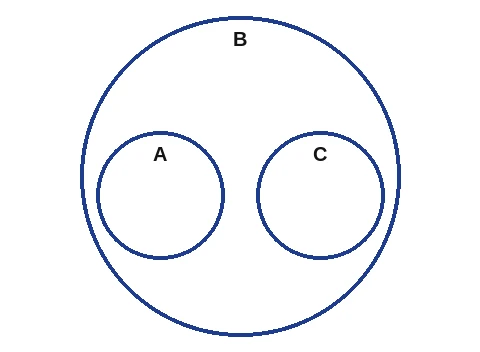
The picture fits All A are B and All C are B with A and C kept apart, so "Some A are C" fails. Slide C across A and both statements still hold, so "No A is C" fails too. When you see one of these signs, stop hunting for a definite link between A and C and go straight to the either and possibility checks.
Fast Checks on a Conclusion
Before you draw anything, run each conclusion through the checks below. Each takes a second, and together they settle a good share of conclusions without any picture.
Turning a statement round
| Statement | Turned round, it gives |
|---|---|
| All A are B | Some B are A (never All B are A) |
| No A is B | No B is A |
| Some A are B | Some B are A |
| Some A are not B | nothing at all |
Remember too that every class named in the statements has members. So "All A are B" also gives "Some A are B", and "No A is B" also gives "Some A are not B" and "Some B are not A". A conclusion that only repeats a statement, or turns it round in one of these safe ways, follows. These are free marks, so settle them first.
Conclusions that never follow as definite
- A conclusion about two classes with no link. If you cannot walk from one class to the other through the statements, no "All", "No" or "Some" conclusion about them can be certain. For example, from "All P are Q" and "No R is S", nothing definite can be said about P and R.
- "All B are A" when the statements give "All A are B". An "All" never turns round into an "All".
- "Some B are not A" when the only link between A and B is "Some A are not B".
What each kind of conclusion needs
- An "All" conclusion needs every link on the path to be an "All", all pointing the same way. One "Some" anywhere on the path sinks it.
- A "No" conclusion needs one "No" on the path, with "All" links carrying each end class into the two classes that the "No" keeps apart. "All A are B, No B is C, All D are C" gives "No A is D". One "Some" on the path sinks it.
- A "Some" or "Some … not" conclusion can survive a "Some" link. These are the ones worth a quick picture.
For example: "Some V are X. All X are Z." The conclusion "All V are Z" fails at once, because the path starts with "Some". "Some Z are V" follows from the third row of the first table, turned round. That is two conclusions settled with no drawing at all.
[SSC Tip] Settle the free marks and the never-follows first, then strike every option that disagrees with them. Often only one option is left before you have drawn a single circle.
Either Pairs and Possibilities in Seconds
Spotting an either pair
When two conclusions both fail, give them one more look before you mark "Neither". They make an either pair when all three of these hold:
- Neither of them follows on its own.
- Both are about the same two classes.
- They are one of these two pairs: "Some A are B" with "No A is B" (A and B may swap places), or "All A are B" with "Some A are not B" (same order).
The pair works because one of the two must be true in every picture. Either some A are B or none are. Either all A are B or some are not. "All A are B" with "No A is B" is not a pair: when A and B partly overlap, both are false.
The "nothing definite" signs from the first table are where either pairs live. If the statements give nothing about A and C, and two conclusions say "Some A are C" and "No A is C", the answer is the either option.
When a question has three or four conclusions, the right option names the definite ones and the pair together, as in "Only I and either II or III follow". Look for that wording before you settle on "Only I follows".
Possibility in one line
A possibility conclusion follows unless its opposite is certain.
| Possibility conclusion | It fails only when this is certain |
|---|---|
| Some A being B is a possibility (or Some A can be B) | No A is B |
| All A being B is a possibility (or All A can be B) | Some A are not B |
| No A being B is a possibility | Some A are B |
So you never need a fresh picture for a possibility. Run the definite checks on its opposite. If the opposite is certain, the possibility fails. If it is not, some picture makes the possibility come true, and it follows.
"All A can never be B" is the odd one out. It is not a possibility at all. It says that "All A are B" cannot happen, which is the same as saying "Some A are not B" is certain. Test it as that definite conclusion.
For example: "All Q are V. No V is Y."
- "Some Q being Y is a possibility" fails, because its opposite, "No Q is Y", is certain from the second row of the first table.
- "All V being Q is a possibility" follows. Its opposite, "Some V are not Q", is not forced by anything, so Q can fill the whole of V.
- "All Q can never be Y" follows. It means "Some Q are not Y", and since no Q is Y at all, that is certain.
Venn Diagrams of Classes, Pair by Pair
Three classes make three pairs. Decide each pair with one word, then pick the diagram that shows the same three words. You never need to look at the whole picture at once.
The three words
- Inside: every X is a Y. Every capital city is a city. Draw X fully inside Y.
- Overlap: some X are Y, some X are not Y, and some Y are not X. Some cars are red, some are not, and plenty of red things are not cars. Draw two circles that cross.
- Apart: no X is a Y. No village is a city. Draw two circles that do not touch.
Overlap needs all three parts. If every X turned out to be a Y, the pair would be "inside" instead.
Which picture goes with which three words
There are eleven different shapes. Note that the same shape can be drawn in two ways, so look at what touches what, not at the size or place of the circles.
| The three pairs | Picture |
|---|---|
| all three apart | three separate circles |
| X inside Y, Y inside Z | three circles one inside the next |
| X and Y inside Z, X and Y apart | two separate circles inside a big one |
| X and Y inside Z, X and Y overlap | two crossing circles inside a big one |
| X inside Y, Z apart from both | one circle inside another, the third alone |
| X inside Y, Z overlaps Y but misses X | the third circle cuts the big one only (also drawn as two crossing circles with a small circle in one outer part) |
| X inside Y, Z overlaps both | the third circle cuts across both |
| X and Y overlap, Z apart from both | two crossing circles, the third alone |
| X overlaps Y, Y overlaps Z, X and Z apart | a chain of three |
| all three overlap, with something in all three | three circles meeting in the middle |
| X and Y overlap, Z inside both | a small circle in the shared part |
The order of work
- Find the inside pairs first. They fix the most.
- Then mark the apart pairs.
- Last, the overlaps. When all three pairs overlap, check whether a single thing can belong to all three classes. If one can, you need three circles meeting in the middle.
For example: Cities, Capital cities, Villages. Every capital city is a city: inside. No village is a city: apart. No village is a capital city: apart. One inside another, the third alone.
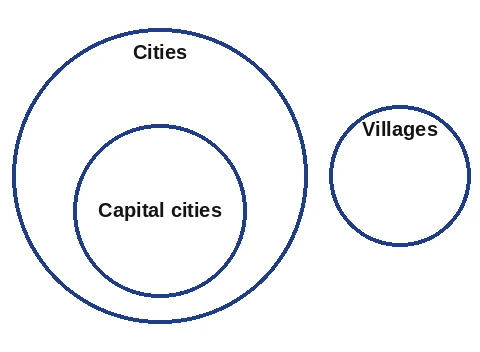
The reverse question
When the diagram is given and the options are sets of classes, read the diagram as three words first. Then test each option on its easiest pair. Usually the first pair you check knocks out two options, and the second pair settles the rest.
Counting Figures and the Two-Set Rule
In a counting figure every part already carries its number. The whole skill is choosing the right parts, so put a finger on each part the question wants before you add anything. The figure below shows the subjects a group of students like.
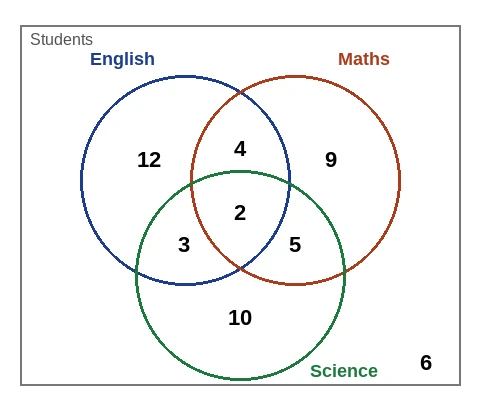
| The question says | Add these parts | In this figure |
|---|---|---|
| only Maths | the Maths part outside both other circles | 9 |
| Maths and Science (or both Maths and Science) | the Maths–Science part and the centre | 5 + 2 = 7 |
| Maths and Science but not English | the Maths–Science part only | 5 |
| all three | the centre | 2 |
| exactly one | the three "only" parts | 12 + 9 + 10 = 31 |
| exactly two | the three two-circle parts, without the centre | 4 + 3 + 5 = 12 |
| at least two | the three two-circle parts and the centre | 12 + 2 = 14 |
| at least one | every number inside the circles | 45 |
| at most one | the three "only" parts and the number outside | 31 + 6 = 37 |
| none | the number outside the circles | 6 |
| not English | every number outside the English circle | 9 + 10 + 5 + 6 = 30 |
Two words cause most slips. "And" means both, so the centre comes in. "But not" throws the centre back out.
The two-set rule in words
With no figure, the numbers come as a total for each set and a number for "both". The rule is: those in at least one set = first set + second set − both. The people in "both" are counted once in each set total, so you take them away once.
From that one rule:
- neither = total − (first + second − both)
- only the first = first − both
- both, when everyone is in at least one set = first + second − total
For three sets, skip the long formula. Draw three circles and fill them from the centre outward: the "all three" number first, then each "two sets" number minus the centre, then each "only" part. The parts of each circle must add back up to that set's total, which is a free check on your work.
A Time Plan, and When to Skip
The Reasoning section has 25 questions and its own locked 15-minute clock. That is 36 seconds a question on average. A right answer earns 2 marks and a wrong one costs 0.5.
Targets for this chapter
| Question type | Target time |
|---|---|
| One- or two-statement syllogism | about 25–35 seconds |
| Three-statement syllogism, or any with either-or or possibility conclusions | about 40–50 seconds |
| Pick the diagram, or the reverse Venn question | about 20–30 seconds |
| Counting on a figure | about 25–35 seconds |
| Set word problem | about 40–60 seconds |
Venn questions and short syllogisms run under the average. Use the seconds you save there on a three-statement item or a word problem.
Time for each type
- Drawing every conclusion from scratch. Read the pair off the table, then draw only to break a conclusion.
- Marking "Neither" and then spotting the either pair on a second look. Do the either check before you mark.
- Adding the centre of a counting figure twice, or forgetting it for "and".
- Drawing three circles for a two-set word problem. The rule in words is faster.
When to skip
- a three-statement item has used its 50 seconds and two conclusions are still open
- two diagrams still look right after the pair-by-pair check, which usually means one of your three words is wrong
- a word problem gives a part that is negative, which means a number was misread
- you have read the same statements twice and cannot say which class is the middle one
Note the question number and what you have already settled, so that coming back costs only the open part.
Guessing
Striking options changes the sum. With two options left, a guess wins 2 marks half the time and loses 0.5 half the time, which is worth it on average. With all four still open, a guess is close to worthless, and the seconds are better spent on a question you can finish.
[SSC Tip] Do the Venn questions in the section as soon as you reach them. They are the quickest marks in this chapter, and a clear head helps most with the three-statement syllogisms that come after.
Solved Questions
Question 1
Read the given statement and conclusions carefully. Assuming that the information given in the statement is true, even if it appears to be at variance with commonly known facts, decide which of the given conclusions logically follow(s) from the statement.
Statement:
Some jugs are not kettles.
Conclusions:
I. All kettles are jugs.
II. Some jugs are kettles.
(a) Only conclusion I follows (b) Only conclusion II follows (c) Both conclusions I and II follow (d) Neither conclusion I nor II follows
Answer. Shortcut: "Some … not" is the one form that gives nothing when you turn it round. It only says that part of the jugs is outside kettles. It says nothing about where the kettles are, and nothing about any jug that is a kettle. So both conclusions are out before you draw.
Check: draw the two circles apart. Some jugs are outside the kettles, so the statement holds. But no kettle is a jug, so I is false, and no jug is a kettle, so II is false too. One picture breaks both. So the answer is (d) Neither conclusion I nor II follows.
Question 2
Read the given statements and conclusions carefully. Assuming that the information given in the statements is true, even if it appears to be at variance with commonly known facts, decide which of the given conclusions logically follow(s) from the statements.
Statements:
Some loaves are buns.
No bun is a biscuit.
Conclusions:
I. Some loaves are not biscuits.
II. Some biscuits are not loaves.
(a) Only conclusion II follows (b) Only conclusion I follows (c) Neither conclusion I nor II follows (d) Both conclusions I and II follow
Answer. Shortcut: this is the "Some + No" row of the table. Some A are B and No B is C give Some A are not C, with loaves as A, buns as B and biscuits as C. That is conclusion I word for word. II needs some biscuit to be pushed outside loaves, but the biscuits only have to keep out of buns.
Check: draw loaves crossing buns, and biscuits away from buns. The loaves inside buns can never be biscuits, so I holds in every picture. Now put the whole biscuits circle inside the part of loaves that has no buns. Both statements still hold, and every biscuit is a loaf, so II breaks. So the answer is (b) Only conclusion I follows.
Question 3
Read the given statements and conclusions carefully. Assuming that the information given in the statements is true, even if it appears to be at variance with commonly known facts, decide which of the given conclusions logically follow(s) from the statements.
Statements:
All mugs are cups.
All cups are glasses.
Conclusions:
I. All glasses are mugs.
II. All mugs are glasses.
(a) Only conclusion I follows (b) Both conclusions I and II follow (c) Only conclusion II follows (d) Neither conclusion I nor II follows
Answer. Shortcut: two "All" statements in a chain give an "All" in the same direction. Mugs go into cups and cups go into glasses, so all mugs are glasses, which is II. I runs the chain backwards, and an "All" never turns round into an "All".
Check: three circles one inside the next, mugs inside cups inside glasses. II is true in this picture and in every other one. Now make the glasses circle much bigger than cups. The glasses outside the cups are not mugs, so I breaks. So the answer is (c) Only conclusion II follows.
Question 4
Read the given statements and conclusions carefully. Assuming that the information given in the statements is true, even if it appears to be at variance with commonly known facts, decide which of the given conclusions logically follow(s) from the statements.
Statements:
All jars are tins.
All bottles are tins.
Conclusions:
I. Some jars are bottles.
II. Some tins are bottles.
(a) Only conclusion II follows (b) Only conclusion I follows (c) Both conclusions I and II follow (d) Neither conclusion I nor II follows
Answer. Shortcut: tins is the big circle in both statements. Two classes sitting inside the same big circle need not meet, so nothing definite links jars and bottles, and I fails at once. II only turns "All bottles are tins" round, and "All A are B" gives "Some B are A". So II follows.
Check: draw tins with jars and bottles inside it, kept apart. Both statements hold and no jar is a bottle, so I breaks. In every picture the bottles sit inside tins, and there is at least one bottle, so some tins are always bottles. So the answer is (a) Only conclusion II follows.
Question 5
Three statements are given, followed by three conclusions numbered I, II and III. Assuming the statements to be true, even if they seem to be at variance with commonly known facts, decide which of the conclusions logically follow(s) from the statements.
Statements:
All rotis are parathas.
Some parathas are puris.
No puri is a dosa.
Conclusions:
I. Some puris are not dosas.
II. Some rotis are puris.
III. No roti is a dosa.
(a) Only conclusions I and III follow (b) Only conclusion I follows (c) All conclusions follow (d) Only conclusions II and III follow
Answer. Shortcut: for each conclusion, find the path between its two classes and read the pairs off the table.
I: puris and dosas meet in one statement. No puri is a dosa, and there is at least one puri, so some puris are not dosas. I follows.
II: rotis, parathas, puris. That is "All + Some" with parathas as the big circle, one of the nothing signs. II fails.
III: the path from rotis to dosas runs through that same broken link, and a "No" conclusion dies at a "Some". III fails.
Check: one picture breaks both II and III.
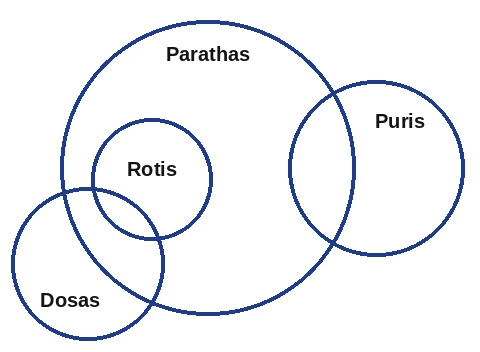
The rotis sit inside parathas but away from puris, so no roti is a puri. The dosas cut into the rotis but stay clear of the puris, so some rotis are dosas. All three statements still hold. Time check: three statements, about 45 seconds. So the answer is (b) Only conclusion I follows.
Question 6
Three statements are given, followed by three conclusions numbered I, II and III. Assuming the statements to be true, even if they seem to be at variance with commonly known facts, decide which of the conclusions logically follow(s) from the statements.
Statements:
Some N are O.
All O are P.
No P is Q.
Conclusions:
I. Some N are P.
II. No O is Q.
III. Some N are not Q.
(a) Only conclusions I and II follow (b) Only conclusions II and III follow (c) Only conclusion I follows (d) All conclusions follow
Answer. Shortcut: I is "Some + All", which gives Some N are P. II is "All + No", which gives No O is Q. For III, walk from N to Q in two steps. The first two links already gave "Some N are P", and "Some N are P" with "No P is Q" is "Some + No", so Some N are not Q.
Check: the N's that are O sit inside P, and P is cut off from Q. Those N's can never be Q, whatever you do with the rest of N. Every conclusion holds in every picture. So the answer is (d) All conclusions follow.
Question 7
Read the given statements and conclusions carefully. Assuming that the information given in the statements is true, even if it appears to be at variance with commonly known facts, decide which of the given conclusions logically follow(s) from the statements.
Statements:
All spoons are ladles.
Some ladles are whisks.
Conclusions:
I. Some spoons are whisks.
II. No spoon is a whisk.
(a) Only conclusion I follows (b) Neither conclusion I nor II follows (c) Either conclusion I or II follows (d) Both conclusions I and II follow
Answer. Shortcut: "All + Some" with ladles as the big circle is a nothing sign, so neither conclusion follows on its own. Now the three either checks. Both conclusions are about spoons and whisks. Neither follows. And the pair is "Some" with "No". That is an either pair.
Check: the whisks can cut into the spoons, and then I is true. Or they can stay in the part of ladles with no spoons, and then II is true. No picture makes both false, because either some spoon is a whisk or none is. Marking "Neither" here is the usual slip. So the answer is (c) Either conclusion I or II follows.
Question 8
Read the given statements and conclusions carefully. Assuming that the information given in the statements is true, even if it appears to be at variance with commonly known facts, decide which of the given conclusions logically follow(s) from the statements.
Statements:
All kettles are flasks.
No flask is a tumbler.
Conclusions:
I. Some tumblers are not kettles.
II. Some kettles being tumblers is a possibility.
(a) Only conclusion I follows (b) Both conclusions I and II follow (c) Only conclusion II follows (d) Neither conclusion I nor II follows
Answer. Shortcut: "All + No" gives No kettle is a tumbler. Turn it round: no tumbler is a kettle, and since there are tumblers, some tumblers are not kettles. I follows. For II, ask whether the opposite is certain. The opposite of "some kettles are tumblers" is "No kettle is a tumbler", and we have just found that certain. So II fails.
Check: the kettles sit inside flasks, and the tumblers sit outside flasks altogether. No picture lets a kettle touch a tumbler. So the answer is (a) Only conclusion I follows.
Question 9
Read the given statements and conclusions carefully. Assuming that the information given in the statements is true, even if it appears to be at variance with commonly known facts, decide which of the given conclusions logically follow(s) from the statements.
Statements:
Some V are W.
No W is X.
Conclusions:
I. All V can never be X.
II. All X being V is a possibility.
(a) Only conclusion II follows (b) Both conclusions I and II follow (c) Only conclusion I follows (d) Neither conclusion I nor II follows
Answer. Shortcut: "All V can never be X" is only "Some V are not X" said another way. "Some + No" gives exactly that, so I follows. For II, look at its opposite, "Some X are not V". Nothing in the statements pushes any X outside V, so the opposite is not certain and II follows.
Check: draw V crossing W, and put X inside V in the part with no W. Both statements hold, and here all X are V. Time check: the low end of 40–50 seconds once you know the two one-line tests. So the answer is (b) Both conclusions I and II follow.
Question 10
Select the Venn diagram that best illustrates the relationship between the following classes.
Vehicles, Buses, Electric vehicles
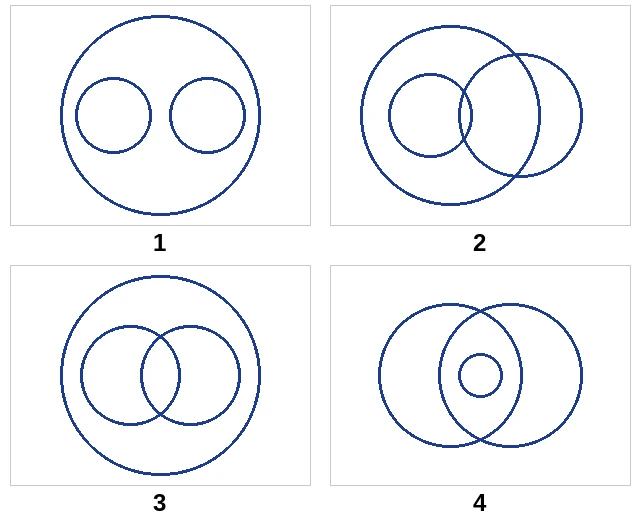
(a) Diagram 1 (b) Diagram 2 (c) Diagram 3 (d) Diagram 4
Answer. Shortcut: pair by pair. Every bus is a vehicle: inside. Every electric vehicle is a vehicle: inside. Buses and electric vehicles: some buses run on electricity, many do not, and most electric vehicles are not buses: overlap. So two crossing circles sit inside one big circle.
Check the near misses. Diagram 1 keeps the two small circles apart, which would mean no bus is electric. Diagram 2 lets one circle poke out of the big one, which would mean an electric vehicle that is not a vehicle. Diagram 4 has no circle holding the other two. Only Diagram 3 shows the right three words. So the answer is (c) Diagram 3.
Question 11
Select the set of classes, the relationship among which is best illustrated by the following Venn diagram.
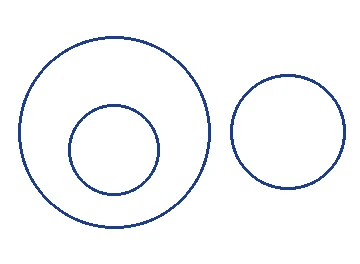
(a) Units of length, Kilometre, Litre (b) Hour, Minute, Units of time (c) Buses, Electric vehicles, Rivers (d) Airports, Bus stands, Railway stations
Answer. Shortcut: read the diagram as three words first. One circle sits inside another, and the third stands apart from both. So look for one "inside" pair and two "apart" pairs.
Check each set on its easiest pair. A kilometre is a unit of length: inside. A litre is not a unit of length, and it is not a kilometre: apart, apart. That fits. An hour and a minute are both units of time but apart from each other, which is two circles inside a third. Some buses are electric vehicles, so that pair crosses instead of sitting inside. The three places are all apart from one another. So the answer is (a) Units of length, Kilometre, Litre.
Question 12
Study the given Venn diagram and answer the question that follows.
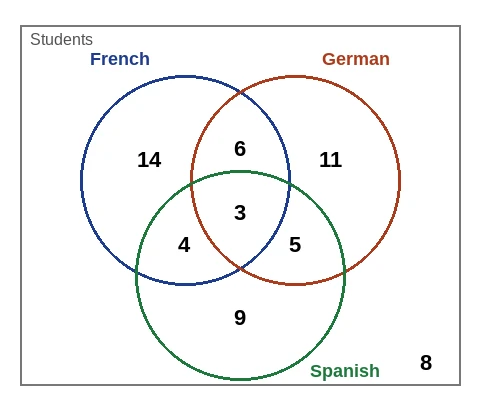
How many students learn exactly two of the three languages?
(a) 18 (b) 15 (c) 12 (d) 26
Answer. Shortcut: "exactly two" means the three parts where two circles meet, without the centre. The centre belongs to three circles, not two.
Check: French and German only is 6, French and Spanish only is 4, German and Spanish only is 5. 6 + 4 + 5 = 15. If you add the centre 3 as well, you get 18, which is the count for "at least two". So the answer is (b) 15.
Question 13
Study the given Venn diagram and answer the question that follows.
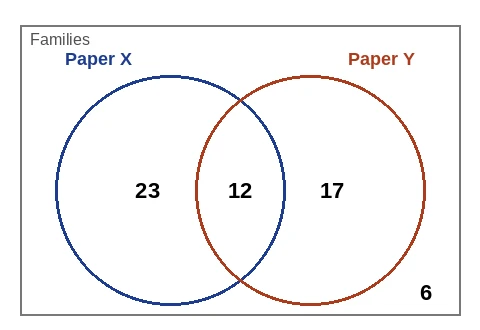
How many families read only one of the two papers?
(a) 52 (b) 46 (c) 35 (d) 40
Answer. Shortcut: "only one" is the two outer parts of the circles. Leave out the shared part and the number outside.
Check: Paper X only is 23 and Paper Y only is 17, so 23 + 17 = 40. Adding the shared 12 would give 52, the families who read at least one paper. The 6 outside read neither. So the answer is (d) 40.
Question 14
In a housing society of 90 families, 52 families read an English newspaper, 41 read a Hindi newspaper and 17 read both. How many families read neither?
(a) 14 (b) 31 (c) 7 (d) 21
Answer. Shortcut: the two-set rule in words. Families reading at least one paper = English + Hindi − both = 52 + 41 − 17 = 76. Neither = 90 − 76 = 14.
Check with the parts. Both: 17. English only: 52 − 17 = 35. Hindi only: 41 − 17 = 24. Then 35 + 24 + 17 = 76, and 76 + 14 = 90, the whole society. If you forget to take away the 17, you get 93 readers out of 90 families, which cannot be right. So the answer is (a) 14.