
How to Use This Section
This is a longer mixed set of 32 questions from the whole chapter, and most of them are a step up from the concept sections. The syllogisms bring in three conclusions on two statements, four conclusions on three statements, an either pair sitting next to a definite conclusion, and possibility conclusions mixed with "can never". The Venn questions use classes where at least one pair needs real thought, and the counting questions ask for parts such as "at most one" or "not English".
Every key rests on the same rules as before. Take every statement as true, however odd it sounds. Every class named has members. A definite conclusion must hold in every picture that fits the statements, and a possibility needs only one such picture. For the Venn questions, use plain everyday meaning and nothing else.
Cover the answer, decide every conclusion or every pair, choose an option, and only then read on. Check your reason as well as your option. A right option reached by a wrong reason counts as a miss, because the same reason will let you down on the next question.
Keep the targets in view: about 25–35 seconds for a one- or two-statement syllogism, 40–50 seconds for a three-statement one or any with either-or or possibility conclusions, 20–30 seconds for a Venn diagram of classes, 25–35 seconds for a counting figure and 40–60 seconds for a set word problem. The four-conclusion items will run over the first time. Mark them, and try them again from a blank page a few days later.
Three habits help throughout. Settle the conclusions you can read off the two-statement table from the shortcuts section first, and strike the options they rule out. Before you mark "Neither" or "None", look for an either pair. For a Venn question, decide the three pairs before you look at the diagrams.
Solved Questions
Question 1
Two statements are given, followed by three conclusions numbered I, II and III. Assuming the statements to be true, even if they seem to be at variance with commonly known facts, decide which of the conclusions logically follow(s) from the statements.
Statements:
No ladle is a sieve.
Some sieves are graters.
Conclusions:
I. Some graters are not ladles.
II. Some ladles are not graters.
III. No grater is a ladle.
(a) Only conclusion I follows (b) Only conclusions I and II follow (c) Only conclusion III follows (d) None of the conclusions follow
Answer. Start with the table. "No A is B" with "Some B are C" gives "Some C are not A". With ladles as A, sieves as B and graters as C, that is "Some graters are not ladles", which is I. The graters that are sieves can never be ladles, so I holds in every picture.
II is the trap. It looks like I turned round, but a "Some … not" never turns round. Put the ladles inside graters, in the part with no sieves. No ladle is a sieve and some sieves are graters, so both statements hold. In this picture every ladle is a grater, so II breaks. The same picture has graters that are ladles, so III breaks too. So the answer is (a) Only conclusion I follows.
Question 2
Three statements are given, followed by four conclusions numbered I, II, III and IV. Assuming the statements to be true, even if they seem to be at variance with commonly known facts, decide which of the conclusions logically follow(s) from the statements.
Statements:
All cups are bowls.
Some bowls are jugs.
No jug is a kettle.
Conclusions:
I. Some bowls are not kettles.
II. Some cups are jugs.
III. No cup is a kettle.
IV. Some jugs are bowls.
(a) Only conclusions I, II and IV follow (b) All conclusions follow (c) Only conclusions I and IV follow (d) Only conclusions II and III follow
Answer. Read what you can off the table. Bowls, jugs, kettles is "Some + No", so some bowls are not kettles: I follows. IV only turns "Some bowls are jugs" round, so it follows too.
II needs a link from cups to jugs, but both hang off bowls, and bowls is the big circle in "All cups are bowls". That is one of the nothing signs. III needs a "No" to reach the cups, and the path from cups to kettles runs through that same weak link. One picture breaks both:
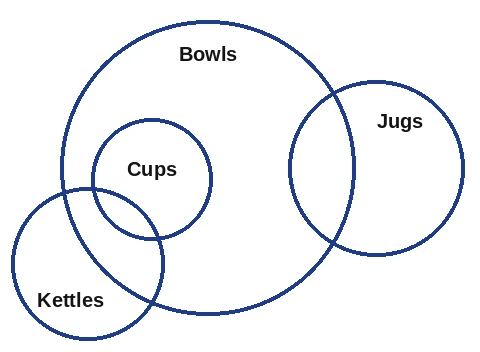
The cups sit inside bowls, away from the jugs, so no cup is a jug. The kettles stay clear of the jugs but cut into the cups, so some cups are kettles. Every statement still holds. Time check: four conclusions, about 50 seconds. So the answer is (c) Only conclusions I and IV follow.
Question 3
Select the Venn diagram that best illustrates the relationship between the following classes.
Cars, Electric vehicles, Red things
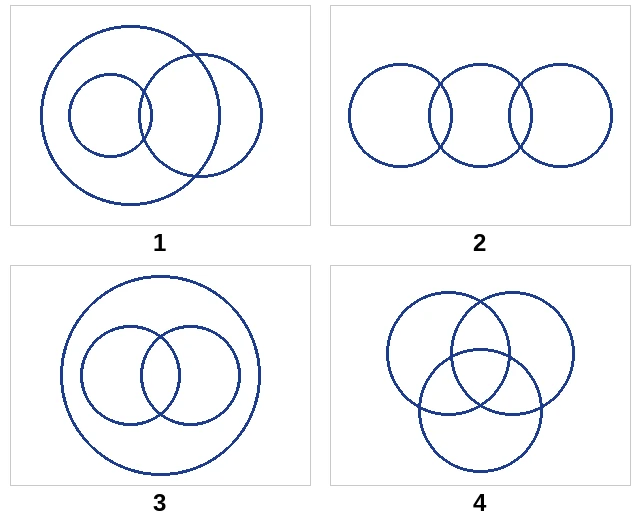
(a) Diagram 1 (b) Diagram 2 (c) Diagram 3 (d) Diagram 4
Answer. Take the pairs one by one. Some cars are electric and most are not, and many electric vehicles are scooters or buses: overlap. Some cars are red, some are not, and plenty of red things are not cars: overlap. Some electric vehicles are red, some are not, and most red things are not vehicles at all: overlap.
Three overlaps, so check one more thing: whether a single thing can be in all three classes. A red electric car is all three, so the three circles must meet in the middle. Diagram 1 puts one circle wholly inside another, but none of these three classes sits wholly inside another. Diagram 2 keeps two of the classes apart. Diagram 3 holds two classes inside the third. Only Diagram 4 has all three meeting. So the answer is (d) Diagram 4.
Question 4
Two statements are given, followed by three conclusions numbered I, II and III. Assuming the statements to be true, even if they seem to be at variance with commonly known facts, decide which of the conclusions logically follow(s) from the statements.
Statements:
Some forks are knives.
No knife is a peeler.
Conclusions:
I. Some forks are not peelers.
II. Some forks are peelers.
III. No fork is a peeler.
(a) Only conclusion I follows (b) Either conclusion II or III follows (c) Only conclusion I and either II or III follow (d) None of the conclusions follow
Answer. I comes straight from the table: "Some + No" gives "Some forks are not peelers". The forks that are knives can never be peelers.
II and III are both about forks and peelers. The forks outside knives are free. Let the peelers cut into that part of forks and II is true. Keep the peelers away and III is true. So neither follows alone. But they are "Some" and "No" about the same two classes, and one of them must be true in every picture, so they make an either pair. The option has to carry both parts of the result: I for certain, and either II or III. "Only conclusion I follows" is the trap for anyone who stops after the first look. So the answer is (c) Only conclusion I and either II or III follow.
Question 5
Two statements are given, followed by three conclusions numbered I, II and III. Assuming the statements to be true, even if they seem to be at variance with commonly known facts, decide which of the conclusions logically follow(s) from the statements.
Statements:
Some X are not Y.
All Y are Z.
Conclusions:
I. Some X are not Z.
II. Some Z are Y.
III. Some Z are not X.
(a) Only conclusion I follows (b) Only conclusion II follows (c) Only conclusions II and III follow (d) All conclusions follow
Answer. "Some X are not Y" sits at the front of the path, and it only tells you where some X are not. Test I with a picture: put all of X inside Z, partly in Y and partly outside it. Both statements hold, and no X is outside Z, so I breaks.
II turns "All Y are Z" round into a "Some", which always follows.
For III, let X swallow the whole of Z. The part of X outside Z is outside Y as well, so "Some X are not Y" still holds, and every Y is still a Z. Now every Z is an X, and III breaks. So the answer is (b) Only conclusion II follows.
Question 6
Study the given Venn diagram and answer the question that follows.
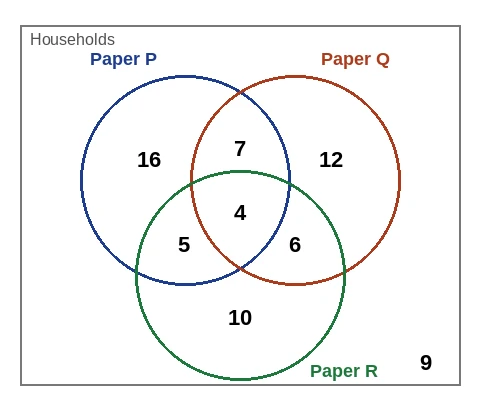
How many households read Paper P or Paper Q but not Paper R?
(a) 39 (b) 28 (c) 35 (d) 50
Answer. "Paper P or Paper Q" takes every part inside either of those two circles. "But not Paper R" then throws out everything inside the R circle. What is left is P only, Q only and the P–Q part outside R: 16 + 12 + 7 = 35.
The 4 in the centre reads all three papers, so it is inside R and stays out. Adding it is the usual slip, and it gives 39. Forgetting the shared 7 gives 28. So the answer is (c) 35.
Question 7
Three statements are given, followed by three conclusions numbered I, II and III. Assuming the statements to be true, even if they seem to be at variance with commonly known facts, decide which of the conclusions logically follow(s) from the statements.
Statements:
All tumblers are mugs.
Some mugs are flasks.
No flask is a jar.
Conclusions:
I. Some flasks being jars is a possibility.
II. All jars being mugs is a possibility.
III. Some mugs are not jars.
(a) Only conclusion III follows (b) Only conclusions II and III follow (c) Only conclusions I and III follow (d) All conclusions follow
Answer. Do III first, because it is definite. The mugs that are flasks can never be jars, so some mugs are not jars. III follows.
I asks whether some flasks can be jars. Its opposite, "No flask is a jar", is one of the statements, so it is certain. I fails.
II asks whether all jars can be mugs. Its opposite is "Some jars are not mugs". The jars must stay out of flasks, but the part of mugs with no flasks is free. Put every jar there, and every statement still holds. The opposite is not forced, and II follows. So the answer is (b) Only conclusions II and III follow.
Question 8
Select the Venn diagram that best illustrates the relationship between the following classes.
Kilogram, Units of mass, Metric units
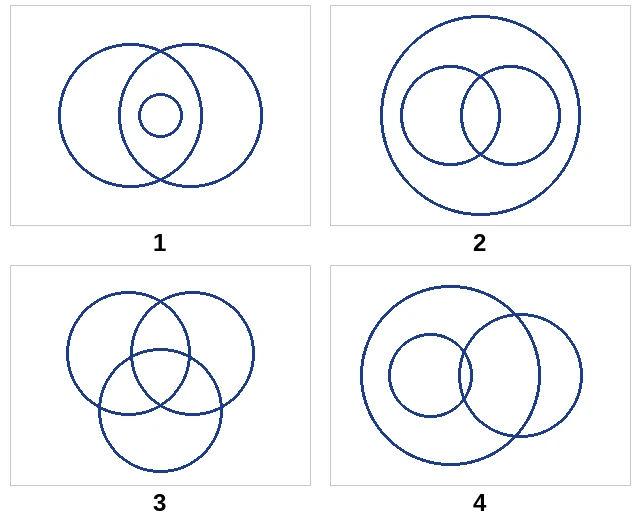
(a) Diagram 1 (b) Diagram 2 (c) Diagram 3 (d) Diagram 4
Answer. Pair by pair. A kilogram is a unit of mass: inside. A kilogram is a metric unit: inside. Units of mass and metric units: the gram is both, the pound is a unit of mass that is not metric, and the metre is metric but not a unit of mass: overlap.
So the two big classes cross, and the kilogram sits inside the part they share. That is Diagram 1. Diagram 2 is the near miss: it puts two crossing circles inside one big circle, which would need one class to hold both the others. Neither units of mass nor metric units can do that, since each has members outside the other. So the answer is (a) Diagram 1.
Question 9
Three statements are given, followed by four conclusions numbered I, II, III and IV. Assuming the statements to be true, even if they seem to be at variance with commonly known facts, decide which of the conclusions logically follow(s) from the statements.
Statements:
All N are P.
All P are R.
No R is T.
Conclusions:
I. No N is T.
II. Some R are N.
III. Some T are not P.
IV. All R are N.
(a) Only conclusions I and II follow (b) All conclusions follow (c) Only conclusions II and IV follow (d) Only conclusions I, II and III follow
Answer. I: N goes into P, P into R, and R is cut off from T. Two "All" links carrying N into R, then a "No", so no N is T.
II: every N is an R, and there are N's, so some R are N.
III: P sits inside R, so no P is T. Turn that round: no T is P, and as there are T's, some T are not P.
IV turns an "All" chain round into an "All", which never follows. R can be far bigger than N. Time check: about 45 seconds, since three of the four come straight off the table. So the answer is (d) Only conclusions I, II and III follow.
Question 10
Two statements are given, followed by three conclusions numbered I, II and III. Assuming the statements to be true, even if they seem to be at variance with commonly known facts, decide which of the conclusions logically follow(s) from the statements.
Statements:
All muffins are cakes.
All muffins are snacks.
Conclusions:
I. All cakes are snacks.
II. Some snacks are cakes.
III. Some cakes are muffins.
(a) Only conclusion II follows (b) Only conclusions II and III follow (c) Only conclusions I and III follow (d) All conclusions follow
Answer. Muffins is the middle class, and it is the front class in both statements. That is the last row of the table. Every muffin is a cake and a snack at once, and there is at least one muffin, so some cakes are snacks. Turned round, some snacks are cakes: II follows.
III is the first statement turned round into a "Some", so it follows as well.
I wants every cake to be a snack. Draw cakes as a big circle crossing snacks, with the muffins inside the shared part. Both statements hold, and the cakes outside snacks break I. So the answer is (b) Only conclusions II and III follow.
Question 11
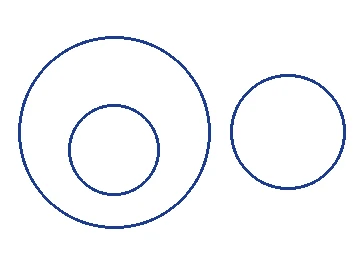
Select the set of classes, the relationship among which is best illustrated by the following Venn diagram.
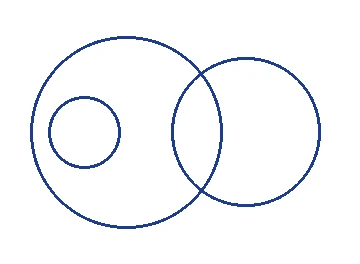
(a) Coins, Notes, Ten-rupee notes (b) Dollar notes, Rupee notes, Coins (c) Indian money, Coins, Ten-rupee notes (d) Currency, Paper money, Ten-rupee notes
Answer. Read the diagram first. Two circles cross, and a small third circle sits inside one of them, away from the shared part. As pairs that is one overlap, one inside and one apart.
Indian money and coins overlap: there are Indian coins, Indian notes, and coins of other countries. Every ten-rupee note is Indian money: inside. No ten-rupee note is a coin: apart. That fits.
The other sets fail on their first pair. Coins and notes are apart, so the first set has no overlap at all. Dollar notes, rupee notes and coins are three separate classes. Currency, paper money and ten-rupee notes sit one inside the next. So the answer is (c) Indian money, Coins, Ten-rupee notes.
Question 12
Two statements are given, followed by three conclusions numbered I, II and III. Assuming the statements to be true, even if they seem to be at variance with commonly known facts, decide which of the conclusions logically follow(s) from the statements.
Statements:
All lids are covers.
No cover is a pan.
Conclusions:
I. All lids can never be pans.
II. All pans can never be lids.
III. Some pans being lids is a possibility.
(a) Only conclusions I and II follow (b) Only conclusion I follows (c) Only conclusions II and III follow (d) All conclusions follow
Answer. I and II are "can never" conclusions, so test them as "Some … not". "All + No" gives no lid is a pan. So some lids are not pans, and I follows. Turn it round: no pan is a lid, and as there are pans, some pans are not lids. II follows.
III asks whether some pans can be lids. Its opposite, "No pan is a lid", is certain, as you have just seen. III fails. So the answer is (a) Only conclusions I and II follow.
Question 13
Three statements are given, followed by three conclusions numbered I, II and III. Assuming the statements to be true, even if they seem to be at variance with commonly known facts, decide which of the conclusions logically follow(s) from the statements.
Statements:
Some samosas are rolls.
All rolls are wraps.
No wrap is a sweet.
Conclusions:
I. Some samosas are not sweets.
II. No roll is a sweet.
III. Some sweets are not rolls.
(a) Only conclusions I and II follow (b) Only conclusions II and III follow (c) Only conclusion I follows (d) All conclusions follow
Answer. All three come off the table. I: "Some samosas are rolls" with "All rolls are wraps" gives some samosas are wraps. Carry that one step on, and "Some + No" with sweets gives some samosas are not sweets. II: "All + No" gives no roll is a sweet. III: turn II round, so no sweet is a roll, and as there are sweets, some sweets are not rolls.
Check with one picture in your head. The samosas that are rolls sit inside wraps, and wraps are cut off from sweets. No picture can move those samosas, so nothing breaks. Time check: about 40 seconds if you walk each path two links at a time. So the answer is (d) All conclusions follow.
Question 14
In a survey of 200 people, 60% said they read Paper X, 45% said they read Paper Y and 20% said they read neither paper. How many of the people surveyed read both papers?
(a) 70 (b) 50 (c) 40 (d) 30
Answer. Turn the percentages into people first. Paper X: 60% of 200 is 120. Paper Y: 45% of 200 is 90. Neither: 20% of 200 is 40, so 200 − 40 = 160 read at least one paper.
Now the two-set rule: at least one = X + Y − both. So 160 = 120 + 90 − both, and both = 210 − 160 = 50.
Check with the parts: X only is 70, Y only is 40, both is 50 and neither is 40. 70 + 40 + 50 + 40 = 200. So the answer is (b) 50.
Question 15
Three statements are given, followed by four conclusions numbered I, II, III and IV. Assuming the statements to be true, even if they seem to be at variance with commonly known facts, decide which of the conclusions logically follow(s) from the statements.
Statements:
No V is W.
All W are X.
Some X are Y.
Conclusions:
I. Some X are not V.
II. Some Y are W.
III. Some V are Y.
IV. No V is Y.
(a) Only conclusion I follows (b) Only conclusions I and II follow (c) Only conclusion I and either III or IV follow (d) Either conclusion III or IV follows
Answer. I: this is the "No + All" row. The W's are X's that are never V, so some X are not V.
II: the Y's touch X somewhere, but they can sit in the part of X with no W. II fails.
III and IV are about V and Y. V only has to keep out of W, and Y only has to touch X, so V can cut into Y (III true) or stay away from it (IV true). Neither follows alone. They are about the same two classes, and they are "Some" with "No", so one of them must hold in every picture. That is an either pair, and the right option names I together with the pair. So the answer is (c) Only conclusion I and either III or IV follow.
Question 16
Select the Venn diagram that best illustrates the relationship between the following classes.
Vehicles, Trucks, Red things
(a) Diagram 1 (b) Diagram 2 (c) Diagram 3 (d) Diagram 4
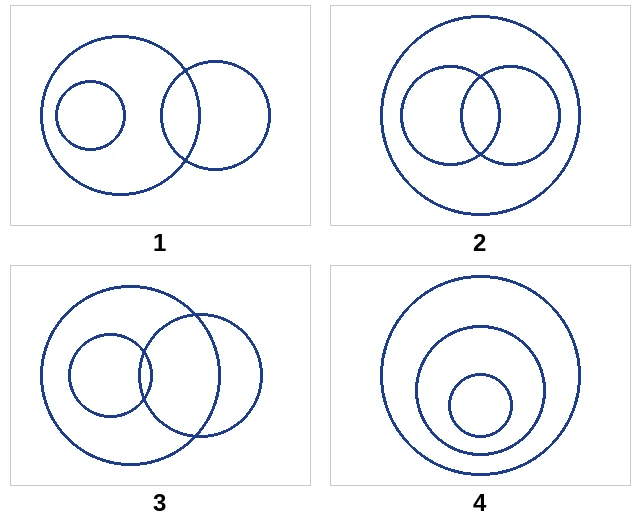
Answer. Every truck is a vehicle: inside. Some vehicles are red, some are not, and most red things, such as apples and roses, are not vehicles: overlap. Some trucks are red and some are not: overlap.
So the red things circle crosses the vehicles circle and also cuts into the trucks circle inside it. That is Diagram 3. Diagram 1 is the trap: there the third circle cuts the big circle but misses the small one, which would mean that no truck is red. So the answer is (c) Diagram 3.
Question 17
Three statements are given, followed by three conclusions numbered I, II and III. Assuming the statements to be true, even if they seem to be at variance with commonly known facts, decide which of the conclusions logically follow(s) from the statements.
Statements:
No apron is a napkin.
All napkins are towels.
Some towels are mats.
Conclusions:
I. Some mats are napkins.
II. Some towels are not aprons.
III. Some aprons are not napkins.
(a) Only conclusion II follows (b) Only conclusions II and III follow (c) Only conclusions I and II follow (d) All conclusions follow
Answer. I is about mats and napkins. The mats only touch towels somewhere, and the napkins fill just one part of towels, so the mats can sit in the part with no napkins. I fails.
II is the "No + All" row: the napkins are towels that are never aprons, so some towels are not aprons.
III needs no path at all. No apron is a napkin, and there are aprons, so some aprons are not napkins. This is the rule that every class named has members, and it is easy to miss on a three-statement item. So the answer is (b) Only conclusions II and III follow.
Question 18
Study the given Venn diagram and answer the question that follows.
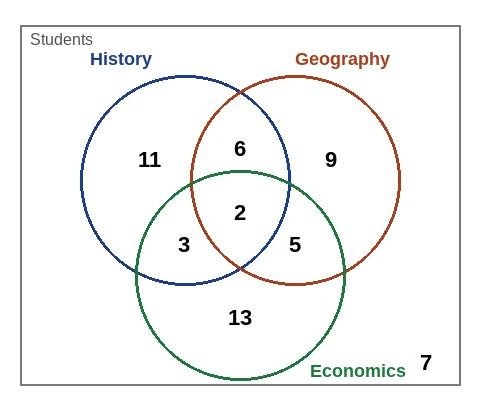
How many students study at most one of the three subjects?
(a) 33 (b) 47 (c) 40 (d) 38
Answer. "At most one" means one subject or none at all. That is the three "only" parts and the number outside the circles: 11 + 9 + 13 + 7 = 40.
Leaving out the 7 outside gives 33, which is the count for "exactly one". The word "most" is what brings the 7 in. So the answer is (c) 40.
Question 19
Two statements are given, followed by three conclusions numbered I, II and III. Assuming the statements to be true, even if they seem to be at variance with commonly known facts, decide which of the conclusions logically follow(s) from the statements.
Statements:
No O is P.
No P is Q.
Conclusions:
I. Some O are not Q.
II. Some P are not O.
III. No Q is P.
(a) Only conclusion III follows (b) Only conclusions II and III follow (c) Only conclusions I and II follow (d) None of the conclusions follow
Answer. Two "No" statements push O and Q away from P, but they say nothing about O and Q themselves. O and Q may sit together, even as one circle, so I fails.
II: no O is P turns round to no P is O, and as there are P's, some P are not O.
III turns "No P is Q" round, which is always safe. II and III follow. So the answer is (b) Only conclusions II and III follow.
Question 20
Three statements are given, followed by three conclusions numbered I, II and III. Assuming the statements to be true, even if they seem to be at variance with commonly known facts, decide which of the conclusions logically follow(s) from the statements.
Statements:
Some breads are buns.
All buns are rusks.
Some rusks are not loaves.
Conclusions:
I. Some breads being loaves is a possibility.
II. All buns being loaves is a possibility.
III. All rusks being loaves is a possibility.
(a) Only conclusion I follows (b) Only conclusions II and III follow (c) All conclusions follow (d) Only conclusions I and II follow
Answer. All three are possibilities, so test each one's opposite.
I: the opposite is "No bread is a loaf". The breads only have to touch buns, and the loaves only have to miss some rusks, so nothing keeps breads and loaves apart. I follows.
II: the opposite is "Some buns are not loaves". Put every bun inside loaves, and keep some rusks outside loaves. Every statement holds, so the opposite is not forced, and II follows.
III: the opposite is "Some rusks are not loaves", which is the third statement itself. III fails. So the answer is (d) Only conclusions I and II follow.
Question 21
Select the Venn diagram that best illustrates the relationship between the following classes.
Scooters, Electric vehicles, Lakes
(a) Diagram 1 (b) Diagram 2 (c) Diagram 3 (d) Diagram 4
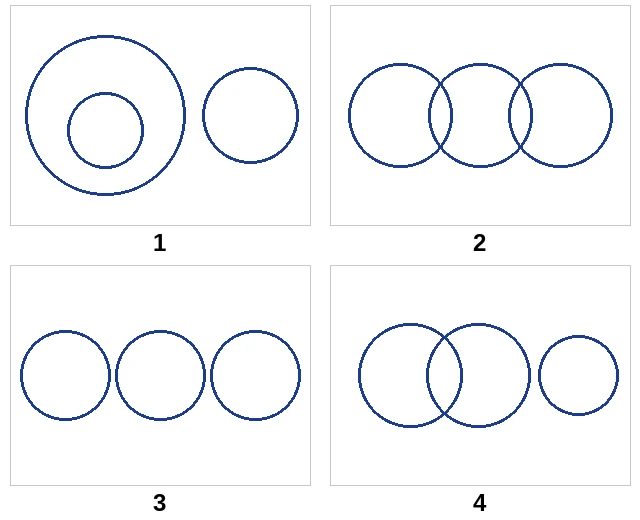
Answer. Some scooters are electric and some run on petrol, and many electric vehicles are cars or buses: scooters and electric vehicles overlap. A lake is neither a scooter nor any kind of vehicle: apart from both.
Two crossing circles with the third one alone is Diagram 4. Diagram 1 is close but wrong: it puts one circle wholly inside another, as if every scooter were electric. So the answer is (d) Diagram 4.
Question 22
Three statements are given, followed by three conclusions numbered I, II and III. Assuming the statements to be true, even if they seem to be at variance with commonly known facts, decide which of the conclusions logically follow(s) from the statements.
Statements:
Some S are T.
Some T are U.
Some U are V.
Conclusions:
I. Some S are U.
II. Some V are U.
III. No S is V.
(a) Only conclusion II follows (b) Only conclusions I and II follow (c) Either conclusion I or III follows (d) None of the conclusions follow
Answer. Three "Some" statements in a row. Every link is a "Some", so nothing definite reaches from S to U, or from S to V. I and III both fail.
II only turns "Some U are V" round, so it follows.
Before marking, check the two failures for an either pair. I is about S and U, while III is about S and V. Different classes, so they are not a pair, and the either option is a trap. So the answer is (a) Only conclusion II follows.
Question 23
Three statements are given, followed by three conclusions numbered I, II and III. Assuming the statements to be true, even if they seem to be at variance with commonly known facts, decide which of the conclusions logically follow(s) from the statements.
Statements:
Some Q are R.
All R are S.
No S is T.
Conclusions:
I. All Q are S.
II. Some Q are not S.
III. Some Q are not T.
(a) Only conclusion III follows (b) Only conclusion III and either I or II follow (c) Either conclusion I or II follows (d) Only conclusions II and III follow
Answer. III first. The Q's that are R sit inside S, and S is cut off from T, so those Q's are never T. III follows.
I and II are about Q and S. The path starts with "Some Q are R", so "All Q are S" is not certain. The Q's outside R are free to sit inside S or outside it, so "Some Q are not S" is not certain either. Together they are "All" with "Some … not", in the same order, and one of them must hold in every picture. That is an either pair, so III goes with either I or II. So the answer is (b) Only conclusion III and either I or II follow.
Question 24
Select the set of classes, the relationship among which is best illustrated by the following Venn diagram.
(a) Second, Metre, Litre (b) Trucks, Cars, Vehicles (c) Coins, Indian currency, Rivers (d) Ambulances, Vehicles, Hospitals
Answer. The diagram shows one circle inside another, and the third circle apart from both. So you need one "inside" pair and two "apart" pairs.
Every ambulance is a vehicle: inside. A hospital is a place, not a vehicle, so it is apart from both. That fits.
In the other sets, the three units are all apart from one another. Trucks and cars both sit inside vehicles, which needs two small circles in a big one. Coins and Indian currency cross rather than one sitting inside the other, since there are foreign coins and Indian notes. So the answer is (d) Ambulances, Vehicles, Hospitals.
Question 25
Two statements are given, followed by three conclusions numbered I, II and III. Assuming the statements to be true, even if they seem to be at variance with commonly known facts, decide which of the conclusions logically follow(s) from the statements.
Statements:
No saucer is a platter.
All saucers are dishes.
Conclusions:
I. Some dishes are not platters.
II. No dish is a platter.
III. Some platters are not saucers.
(a) Only conclusion I follows (b) Only conclusions I and III follow (c) Only conclusions II and III follow (d) All conclusions follow
Answer. Saucers is the middle class, and it is the front class in both statements. Every saucer is a dish and no saucer is a platter, so the saucers are dishes that are not platters. I follows.
III turns "No saucer is a platter" round to no platter is a saucer, and as there are platters, some platters are not saucers.
II wants every dish kept away from platters, but only the saucer part of dishes is kept away. Let the platters cut into the dishes outside saucers, and II breaks. So the answer is (b) Only conclusions I and III follow.
Question 26
The given Venn diagram shows how many people in a group speak Hindi and how many speak English.
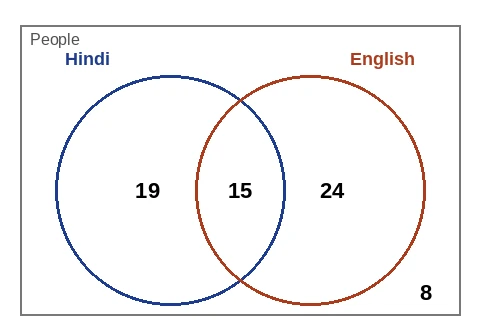
How many people in the group do not speak English?
(a) 27 (b) 19 (c) 35 (d) 8
Answer. "Do not speak English" means everyone outside the English circle. That is the Hindi only part, 19, and the people outside both circles, 8. So 19 + 8 = 27.
The 15 in the shared part speak English, so they stay out, even though they speak Hindi as well. Students who read "not English" as "Hindi only" stop at 19. So the answer is (a) 27.
Question 27
Three statements are given, followed by three conclusions numbered I, II and III. Assuming the statements to be true, even if they seem to be at variance with commonly known facts, decide which of the conclusions logically follow(s) from the statements.
Statements:
All jams are spreads.
No spread is a pickle.
All pickles are side dishes.
Conclusions:
I. No jam is a pickle.
II. Some side dishes are not spreads.
III. All side dishes are pickles.
(a) Only conclusions I and II follow (b) Only conclusion I follows (c) Only conclusions II and III follow (d) All conclusions follow
Answer. I: jams sit inside spreads, and spreads are cut off from pickles. "All + No" gives no jam is a pickle.
II: the pickles are side dishes that are never spreads, so some side dishes are not spreads. This is the "No + All" row, where the "not" result lands on the third class.
III turns "All pickles are side dishes" round into an "All", which never follows. The side dishes circle can be much bigger than the pickles. So the answer is (a) Only conclusions I and II follow.
Question 28
Three statements are given, followed by four conclusions numbered I, II, III and IV. Assuming the statements to be true, even if they seem to be at variance with commonly known facts, decide which of the conclusions logically follow(s) from the statements.
Statements:
Some cutlets are patties.
All patties are fritters.
No fritter is a chutney.
Conclusions:
I. All cutlets can be fritters.
II. Some chutneys can be cutlets.
III. All patties can be cutlets.
IV. Some fritters can be chutneys.
(a) Only conclusions I and II follow (b) Only conclusions II and IV follow (c) All conclusions follow (d) Only conclusions I, II and III follow
Answer. All four are possibilities, so test each opposite instead of drawing four pictures.
I, all cutlets can be fritters. The opposite is "Some cutlets are not fritters". The cutlets that are patties are already fritters, and the rest of the cutlets may sit inside fritters too. Nothing forces the opposite, so I follows.
II, some chutneys can be cutlets. The opposite is "No chutney is a cutlet". Chutneys only have to keep out of fritters, and the cutlets outside fritters are free, so II follows.
III, all patties can be cutlets. The opposite is "Some patties are not cutlets". The cutlets circle can grow to cover the whole of patties, so III follows.
IV, some fritters can be chutneys. The opposite is "No fritter is a chutney", which is a statement. IV fails. Time check: testing opposites keeps this to about 50 seconds. So the answer is (d) Only conclusions I, II and III follow.
Question 29
Select the Venn diagram that best illustrates the relationship between the following classes.
Coins, Notes, Cheques
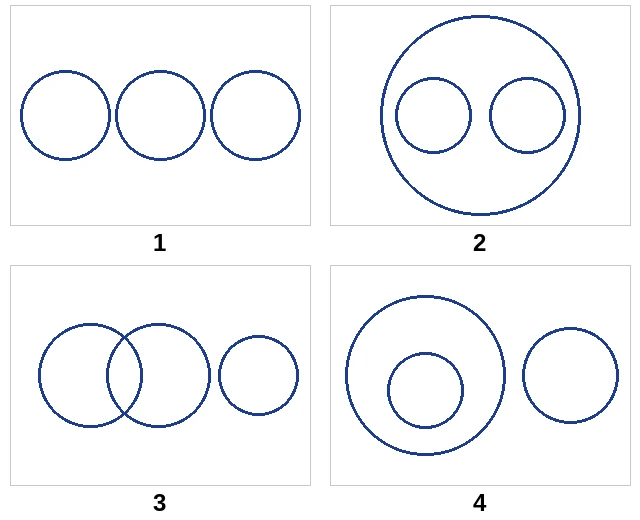
(a) Diagram 1 (b) Diagram 2 (c) Diagram 3 (d) Diagram 4
Answer. Coins and notes are both money, but no coin is a note: apart. A cheque is a written order asking a bank to pay money. It is not itself a coin or a note: apart, and apart again.
With all three pairs apart, every circle stands alone, which is Diagram 1. Diagram 2 would need one class holding the other two, the way money holds coins and notes, but money is not one of the three classes here. So the answer is (a) Diagram 1.
Question 30
Select the set of classes, the relationship among which is best illustrated by the following Venn diagram.
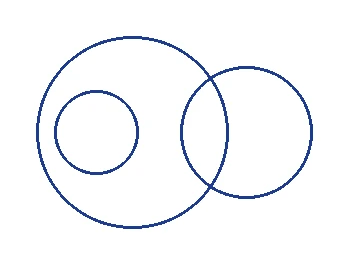
(a) Vehicles, Buses, Red things (b) Units of length, Metre, Metric units (c) Units of length, Inch, Metric units (d) Water bodies, Rivers, Mountains
Answer. Read the diagram as pairs. A big circle holds a small one, and the third circle cuts the big one but misses the small one. So: inside, overlap, apart. It is the same arrangement as the diagram in Question 11.
Take the units with the inch. An inch is a unit of length: inside. The metre is a metric unit of length, the foot is a unit of length that is not metric, and the gram is metric but not a unit of length, so units of length and metric units overlap. An inch is not a metric unit: apart. That fits all three pairs.
The set with the metre is the near miss. The metre is metric, so its small circle would sit in the shared part instead. Red things cut into the buses as well as the vehicles. Rivers and mountains have nothing crossing at all. So the answer is (c) Units of length, Inch, Metric units.
Question 31
In the given Venn diagram, which number represents the students who take Accounts and Maths but not Economics?
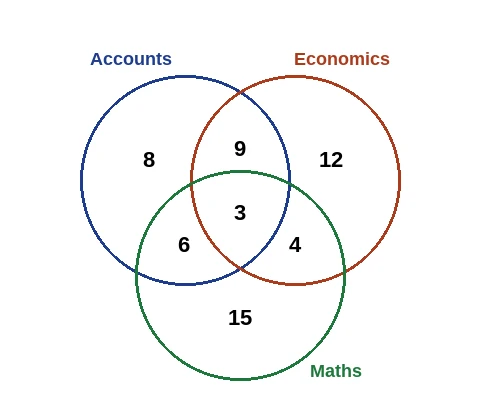
(a) 6 (b) 9 (c) 3 (d) 4
Answer. "Accounts and Maths but not Economics" is the part shared by the Accounts and Maths circles that lies outside the Economics circle. That part shows 6.
The 3 in the centre takes all three subjects, so "but not Economics" rules it out. The 9 is Accounts and Economics, and the 4 is Economics and Maths. So the answer is (a) 6.
Question 32
In a school, each of 100 students was asked which of three languages, French, German and Spanish, they learn. 50 learn French, 40 learn German and 35 learn Spanish. 15 learn both French and German, 12 learn both German and Spanish, 10 learn both French and Spanish, and 5 learn all three. Each "both" number includes the students who learn all three. How many of the 100 students learn none of the three languages?
(a) 12 (b) 93 (c) 5 (d) 7
Answer. Fill the three circles from the centre outward. It takes a few more lines than the formula, but every step checks the one before it.
All three: 5.
French and German only: 15 − 5 = 10. German and Spanish only: 12 − 5 = 7. French and Spanish only: 10 − 5 = 5.
French only: 50 − 10 − 5 − 5 = 30. German only: 40 − 10 − 7 − 5 = 18. Spanish only: 35 − 7 − 5 − 5 = 18.
At least one language: 30 + 18 + 18 + 10 + 7 + 5 + 5 = 93. None: 100 − 93 = 7.
The formula agrees: 50 + 40 + 35 − 15 − 12 − 10 + 5 = 93. Marking 93 means answering a different question, the students who learn at least one language. So the answer is (d) 7.